Transport in Plants
(a) the need for transport systems in multicellular plants
Size: Although some plants can be small, all are multicellular organisms and are therefore too large to rely on diffusion to transport materials, such as the assimilates of photosynthesis, from the leaves to the roots. Therefore, specialised transport systems are needed.
Metabolic rate: need to actively transport materials throughout the plant, so therefore have
SA:V ration: Their surface area to volume ratio is very small, and therefore diffusion would not be rapid enough to meet the demands of the plant.
(b) (i) the structure and function of the vascular system in the roots, stems and leaves of herbaceous dicotyledonous plants
Root structure:
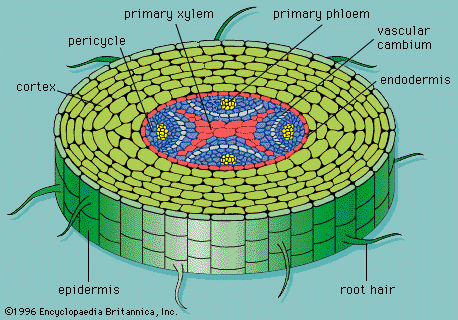
root hair cells - microscopic specialised cells with a large SA:V ratio (due to thousands of root hairs growing on a root tip), and a 1 cell thick surface layer in order to allow rapid diffusion of water and dissolved mineral ion into the plant from the soil.
epidermis - protection of the stem and roots
endodermis -
phloem - transports products of photosynthesis (glucose and oxygen) to the roots from the leaves
xylem - transports water and dissolved mineral ions from roots to stem and leaves
pericycle - Site of lateral root growth
cortex parenchyma - can act as a storage space in the stem
sclerenchyma - lignified cells that provide strength and support to the cells.
cambium - a meristematic tissue that can undergo mitosis to produce more xylem and phloem.
Stem structure:
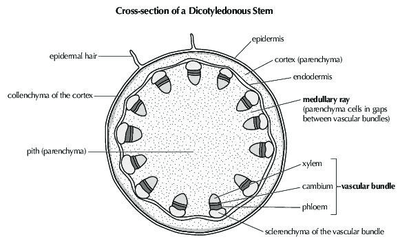
Vascular tissues:
Xylem → can be xylem vessels and tracheids, which transport water and dissolved mineral ions from the roots to the stem and leaves.
Mineral that are dissolved in the water carried by the xylem:
Magnesium - chlorophyll synthesis
Phosphate - DNA/RNA, ATP, membrane phospholipids
Nitrate - DNA /RNA, amino acids/proteins
Potassium - Turgor in stomata guard cells
- enzyme cofactor in starch synthesis
- enzyme cofactor for pyruvate kinase in glycolysis (respiration)
Calcium - Makes cross links within cellulose cell wall matrix, strengthening it
- Adhesion i.e. helps hold adjacent cells together
How do xylem vessels form:
Cells die and lose all cytoplasm, organelles and end cell walls
This forms a long, hollow, tube like structure. The gaps between the dead cells become the bordered pits
walls become lignified by lignin rings and spirals and strengthened
Tracheids v.s. Xylem vessels:
Both strong, narrow, hollow, elongated tubes
Tracheids are less specialised than xylem vessels
Tracheids are the only type of water conducting tissues in gymnosperms (conifers, pines).
Xylems are the main type of water conducting tissues in flowering plants.
Adaptations of xylem vessels:
Walls impregnated with lignin → to provide support under negative pressure so the vessel does not collapse when no water is flowing through it. Also to minimise water loss
Vessels are hollow, with no organelles or cytoplasm → to minimise resistance to flow of water up the vessel.
Lignin is laid down in rings or spirals → to provide flexibility in the vessel
The vessels have bordered pits → to allow lateral movement of water between xylem vessels.
Phloem → Made from sieve tube elements and companion cells, transport the organic products of photosynthesis and their derivatives in solution i.e. sucrose, amino acids, plant hormones, some mineral ions etc. (Remember: 6H2O + 6CO2 → C6H12O6 + 6O2)
However, after glucose is released during photosynthesis, it is converted into sucrose. This is because sucrose is:
Less reactive than glucose, because it is a non reducing sugar. Reducing sugars, like glucose and fructose have an expose alderhyde /ketone group that make them much more reactive.
Still soluble in water, which is import for transporting it within the plant.
Companion cells have a few important adaptations:
Many inerfoldings to allow a greater surface area for for the active transport/diffusion of solutes.
Many mitochondria to provide ATP for their H+ protein pumps to perform active transport.
Many proteins in their cell surface membrane to carry out active transport and facilitated diffusion during the active loading of sucrose.
(c) (i) the process of transpiration and the environmental factors that affect transpiration rate
Transpiration is the evaporation of water within the plant via the open stomata in its leaves, it is a consequence of the gaseous exchange that takes place at the stomata. Around 99% of the water absorbed by a plant is lost by transpiration, and transpiration only occurs when there is a diffusion gradient between inside the plant and its surroundings.
There are benefits to transpiration for the plant:
It cools the plant down due to the evaporative cooling effect, just like how losing water via sweat in humans cools us down.
The transpiration stream pull enables the movement of water and mineral ions up the xylem.
Water moving through the plant give the cells turgor pressure that helps maintain the shape of the plant.
Factors that affect the rate of transpiration:
Air movement: When there is little air movement, a layer of humid air can accumulate around the stoma, lowing the diffusion gradient between inside and outside of the plant, and therefore decreases the rate of transpiration and diffusion becomes less rapid. Thus, the opposite is true when there is lots of air movement.
Temperature: Higher temperatures mean the water molecules have more kinetic energy, and this therefore increases the rate of diffusion and in turn transpiration. The opposite is true when temperatures are low. However, if the temperature gets too high, stomata will close to prevent too much water loss, and transpiration will decrease.
Light intensity: In the dark, the stomata in a plant close due to the fact that photosynthesis cannot take place, therefore gas exchange is pointless. Therefore, more intense light will mean more stomata are open, and will therefore increase rate of transpiration.
Humidity: When humidity is high, there is a smaller diffusion gradient between the inside of the stomata and the outside of the stomata, and therefore diffusion occurs less rapidly, and so does transpiration.
(ii) practical investigations to estimate transpiration rates - Potometer practical

1. Construct the potometer underwater. This stops the entry of air bubbles.
2. Immerse the end of the cut shoot underwater and using a pair of scissors, cut the last centimeter off at an oblique angle. Cut underwater to prevent the entry of air bubbles into the xylem. Cut at an oblique angle to increase the surface area for water absorption. Ensure that the leaves of the shoot remain dry to prevent the obstruction of stomata by water droplets.
3. Whilst still underwater, insert the shoot tip into the rubber tubing of the potometer. The shoot tip must perfectly fit the rubber tubing to prevent the entry of air and formation of air bubbles.
4. Remove the apparatus from the water and grease all joints with Vaseline to give a tight seal. This prevents air entering.
5. Leave the cut shoot in the potometer for 10 minutes to allow it to equilibrate.
6. Clamp the potometer so that the end of the capillary tube is immersed under water. Remove the end from the water to allow an air bubble to form. Re Immerse and seal the capillary tube.
7. Note the starting position of the bubble on the volume scale. Start the stopwatch and record the distance travelled by the bubble in a set period of time (e.g. 10 minutes).
8. Repeat steps 6 to 7 a further two times to obtain three repeats.
9. Rate of transpiration can be calculated: let y = distance moved by bubble and t = time taken, and r = radius of capillary tube: πr2y / t
To investigate the different factors that could affect the rate of transpiration:
Airflow: Set up a fan or hairdryer
Humidity: Spray water in a plastic bag and wrap around the plant
Light intensity: Change the distance of a light source from the plant
Temperature: Temperature of room (cold room or warm room)
(d) the transport of water into the plant, through the plant and to the air surrounding the leaves
Osmosis is the net movement of water molecules down a water potential gradient across a selectively/ partially permeable membrane. It is a passive process. Because the concentration of mineral ions in the root hair cell is greater than that of the soil, water moves down a water potential gradient via osmosis from the soil into the root hair cell.
Once in the root, water moves from cell to cell through the epidermis by osmosis until it reaches the endodermis…
There are three ways the water moves (via osmosis) through the epidermis:
Apoplast pathway - water moves along the spaces in the cell walls external to the cell membrane and contents of the cell (protoplast). Water does not cross any cytoplasmic membrane or cytoplasm at any time.
Symplast pathway - water moves continuously across the cytoplasm and through the plasma desmata that bridge each cell together
Vacuolar pathway - water moves across the cytoplasm and through the sap vacuoles.
The main way water moves through the epidermis is via the apoplast pathway because it is the pathway with the least resistance. However, once the water reaches the edge of the endodermis, the Casparian strip, a band of Suberin (a naturally occurring water resistant material present) blocks water through the apoplast pathway. So water must flow through symplast pathway instead, forcing water to cross the cytoplasm for the first time.
Root Pressure:
The stele has a high mineral concentration than the soil or the cortex because the endodermis cells actively transport mineral ions to the xylem vessels, lowering the water potential. This has the affect of drawing water across the root from the epidermis to the stele, down a water potential gradient. It enter the xylem via the bordered pits.
This flow of water across the root into the stele and xylem vessels creates a NEGATIVE PRESSURE celled root pressure, which helps push water up the stem.
Transpiration stream pull:
Polar water molecules are attracted to each other by cohesion forces. Cohesion forces enable the water molecules up be pulled up the xylem vessels as a chain, forming continuous columns of water. As the molecules of water at the top of the chain are lost due to transpiration (via the stoma), the whole chain is pulled up as one lot, creating the transpiration stream. This is a POSITIVE PULLING PRESSURE that helps water move up xylem vessels.
Capillary action:
Polar water molecules are attracted to the lignified walls of the xylem vessels by adhesion forces (lignin is partially polar). As water evaporates from leaves, tension (a NEGATIVE PRESSURE) increases. Because the xylem are very narrow, these forces pull the water up the sides of the xylem vessels.
(e) adaptations of plants to the availability of water in their environment
Xerophytes: are plants that are adapted to dry and arid conditions
Adaptations of xerophytes:
Fleshy succulent leaves to store water for times of dehydration
Hinge cells which shrink when flaccid, and therefore cause the leaf to roll further, creating a humid microenvironment in the middle of the rolled leaf.
Leaves reduced to needles of spikes to reduce surface area available for transpiration.
CAM: stomata close during the day and open at night, then store the carbon dioxide exchanged as an organic acid, which is then converted into carbon dioxide in the day for photosynthesis.
Sunken stomata to minimise water loss as moist air is trapped which reduces diffusion gradient.
Thick waxy cuticle to reduce water loss as it is waterproof, so inhibits evaporation.
Hydrophytes: Plants that are adapted to living in freshwater
Adaptations of hydrophytes:
air spaces in the leaves to provide buoyancy
thin waxy cuticle as no need to waterproof.
Stomata on the upper side of the leaf (outside of the water) due to oxygen and carbon dioxides poor solubility in oxygen, so more efficient gas exchange occurs in the air.
reduced root system as mineral and water can be extracted from their surroundings.
reduced xylem as no need to transport water all around.
(f) the mechanism of translocation.
Translocation is the movement of the assimilates of photosynthesis (mainly sucrose, converted from glucose) throughout the plant from source to sink. Because sources and sinks cane be at the bottom and the top of the plant, translocation is two ways.
Sources - where the assimilates are made eg. leaf, bulbs
Sinks - where the assimilates are stored eg. bulbs, starch storing tubers in the ground, buds
At sources, solute assimilates accumulates inside the phloem sieve
At a source cell, (like in a photosynthesising leaf)

Companion cells actively transport protons/H+ ions out of themselves into the extracellular spaces next to sucrose sources (ie. photosynthesising cells). The H+ ions are pumped out by a protein pump. This is a form of active transport because the ions are being moved against an ion concentration gradient.
The H+ ions accumulate outside the companion cells. They move down a concentration gradient back into the companion cells through a symporter cotransporter protein, which facilitates the diffusion of a H+ ion along with a sucrose molecule, in the ratio 1:1.
The sucrose molecules accumulate in the companion cell against a concentration gradient. They then diffuse passively down a concentration gradient from the companion cells into the phloem sieve tube elements via the plasmodesmata.
Mass flow hypothesis: