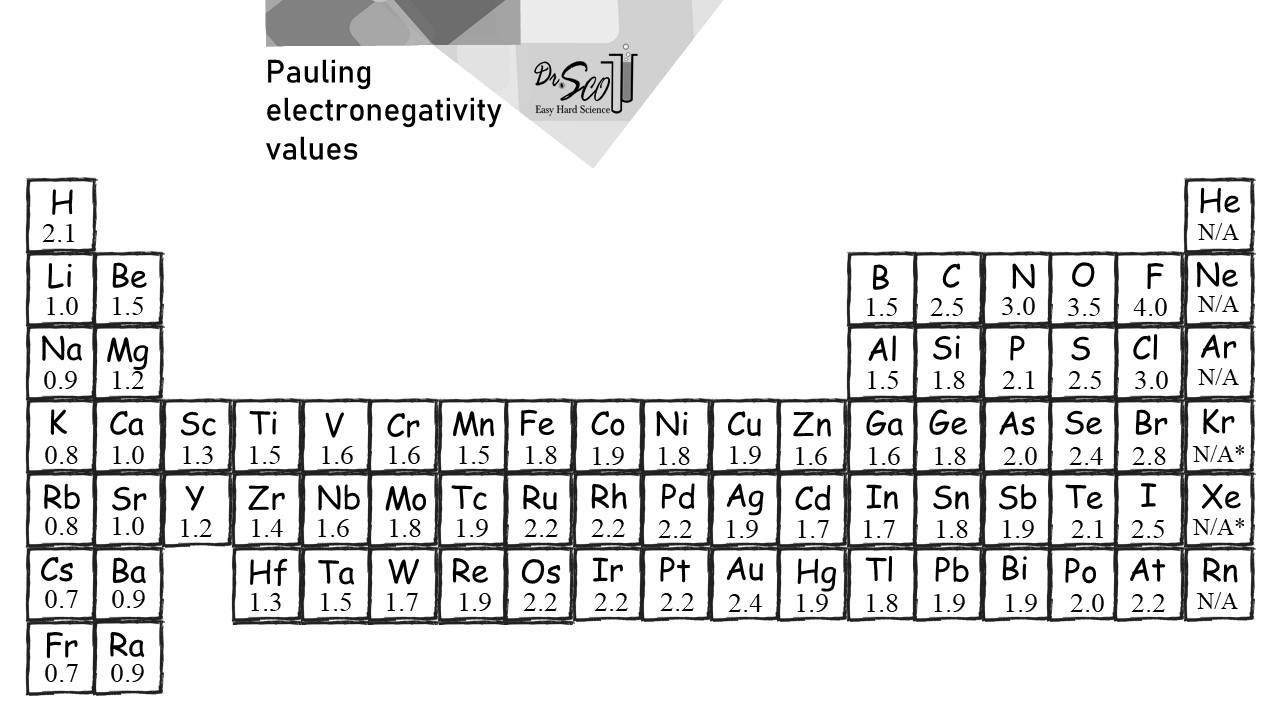
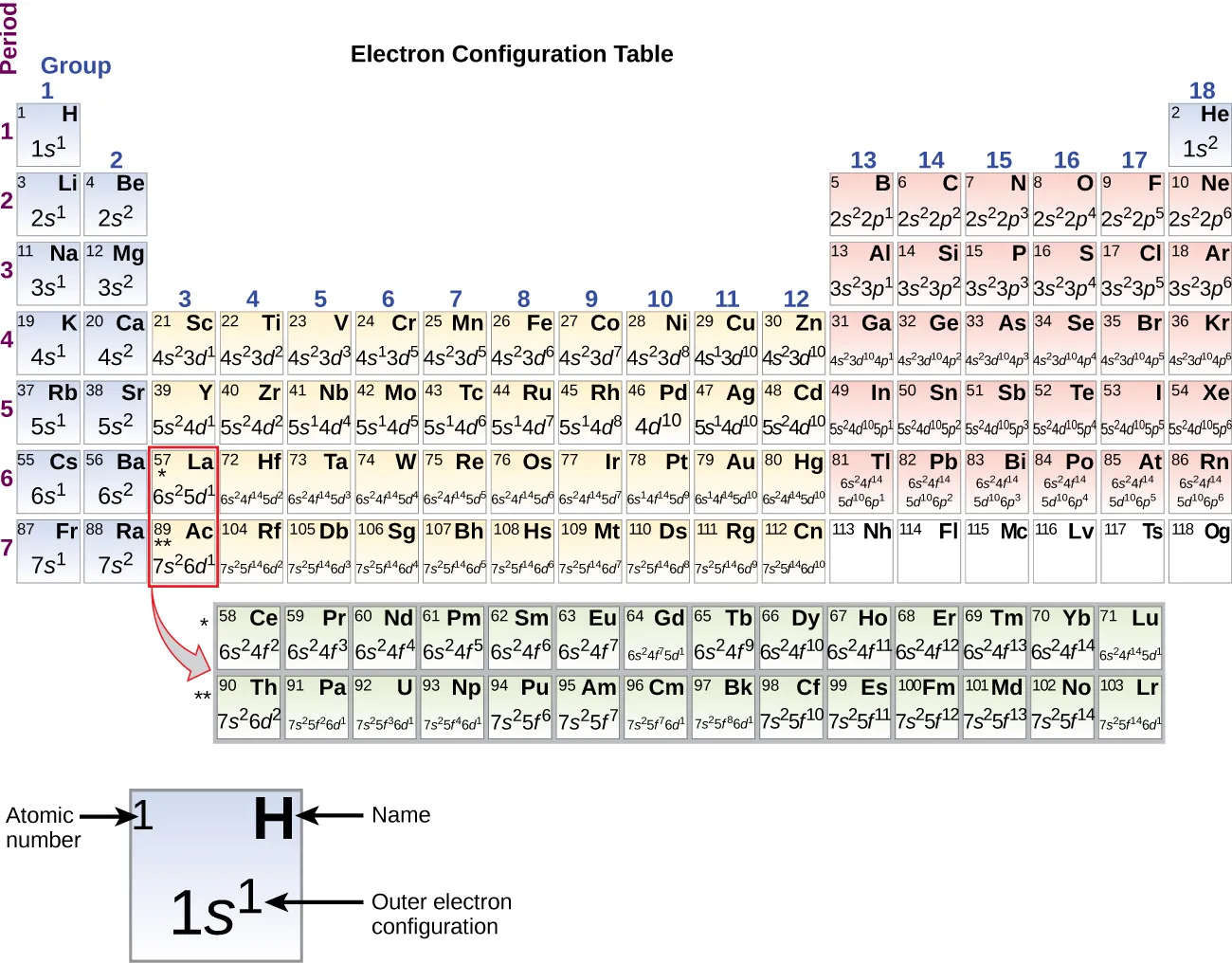
test 2
Boyles's Law:
know what happens to volume and pressure at constant T
If the temperature of a gas is constant, as the pressure on the gas increases the volume will decrease. vice versa; if pressure decreases, volume increases
Charles' Law:
know what happens to volume and temp at constant P
the volume occupied by a fixed amount of gas is directly proportional to its absolute temperature, if the pressure remains constant
what 3 laws make the ideal gas law
boyle’s law, charles law, and avogadro’s law
Know what happens to atomic light when passed thru prism
it splits into different frequencies and its spectrum of colors, increasing wavelengths as well
Hf (heat of formation) reaction with lowest energy elements
The ΔHf values indicate the energy changes associated with these formation reactions. Lower ΔHf values indicate more stable compounds in their standard states.
Pv=NRT
the electromagnetic spectrum order of wavelengths & energies
Key: Rw: Radiowave, Mw: Microwave, IR: Infrared, {Red, Orange, Yellow, Green, Blue, Violet/Indigo}, Uv:Ultra Violet, X: X ray, Gamma Ray, Cosmic Radiation
Rw Mw IR {R,O,Y,G,B,V} Uv, X, Gamma Ray, cosmic radiation
Energy and Frequency increases as you go right —>
<—Wavelength increases as you go to left (radio waves are longer than micro, etc)
Example Question:
Q? WHich photon has more energy blue or red? The one on the right side, blue has more energy
Q? Which has a higher frequency R or Gamma Ray? Gamma Ray, increases toward right
Q? WHich has a longer wavelength, Rw, or X ray? Radio waves, wavelength increases toward the right.
Relationship between Energy, Frequency and Wavelength= λ
λ increases, F decreases, E decreases
λ decreases, F increases, E increases
Speed of light Equation= C= λ (F)
Speed of light= C = 3x10⁸m/s in a vacuum (air)
The speed of light changes based on its index of refraction: v=, n=index of refraction (should be given), plug c constant in the equation
Planck's Constant:E=H(F)
H=6.626x10⁻³⁴J(S)
E(energy of photon):H(planck's constant) F(frequency)
Example Question:
Q?700 nm
Red→ What's the Frequency? F=(3x10⁸M(s))/(700x10-9)m, F=4.286x10¹⁴hz, s-1)
Nanometer= one billionth so we need to convert from nm to m
-Speed of light equation needed a meter conversion for mathematics to be correct
Q? Now from the frequency you just found, find the Energy? E= H(F), Now use planck's constant H=6.626x10⁻³⁴J(S)
(6.626x10⁻³⁴J(S) )(4.286x10¹⁴)=E seconds cancel out, E=2.84x10⁻¹⁹J, now convert to electron volts (conversion factor=1ev / (1.602x10⁻¹⁹J)), so now we multiply 2.84x10⁻¹⁹J by our conversion factor, finally E= 1.773ev
How can you use this wavelength (480 nm) to calculate the energy of a photon directly?
E=H(F) C= λ (F) So we can state E=hc/
F= (6.626x10⁻³⁴J(S))(3x10⁸m/s))/(480x10-9m)=4.14x10-19J
Q? electron volts (conversion factor=1ev / (1.602x10⁻¹⁹J))
7ev→ J,F,λnm J=1.12x10⁻¹⁸, F=1.692x10¹⁵hz, λ=177.3nm
Work for wavelength:
((3x10⁸m/s))/(1.692x1015)=1.773x10-7m→convert back to nm cuz that is what the question is asking. 1.773x10-7x109, always 109 or -9 when talking about nm, so 1.773x102=177.3nm
expanded and condensed version of ground state electron configurations
Expanded configurations are written using n (principal quantum number), followed by orbital (s, p, d, f) with the total number of electrons written as a superscript.
Condensed configurations are done by using the symbol of the noble gas in the period above the element.
difference between an equivalence and an endpoint
Equivalence= a point where the chemical reaction comes to an end
endpoint= point where the color change occurs in a system
ID element in an excited state
an atom with an electron higher than the ground state (i.e., further from the nucleus)
ground state= an atom with all its electrons in their lowest possible energy levels.
EXAMPLE: 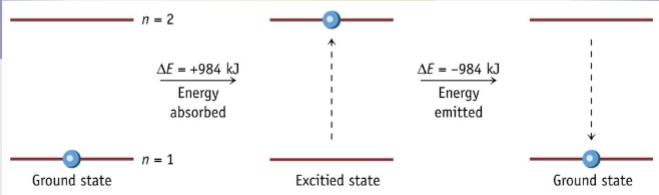
oxidation numbers of elements vs ions and of central atoms of polyatomic ions and carbon
Oxidation number of simple ions = the charge on the ion.
Polyatomic ions: consists of more than one atom.
Unique properties of carbon make it a central part of biological molecules. Carbon binds to oxygen, hydrogen, and nitrogen covalently.
redox (oxidation/reduction reactions)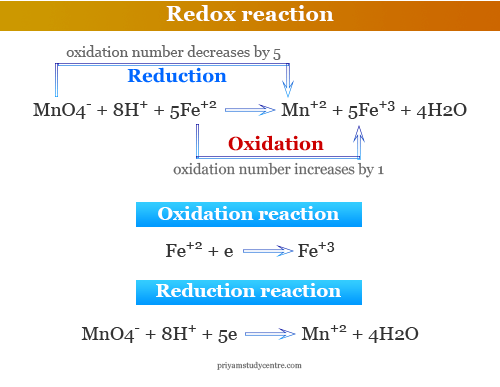
Oxidation= total number of electrons increase in a reaction
reduction= total number of electrons decrease in a reaction
calculating molarity
moles of solute/ liters of solution
calculating mol of total ions in a 100% solution
????
calculate vol if given molarity and grams of solute
Convert grams of solute to moles, divide moles by molarity
heat and work sign changes
q= heat lost or gained
w= work done involving systems and surrounding
+q= endothermic
-q= exothermic
+w= work from SURROUNDING to SYSTEM
-w= work from SYSTEM to SURROUNDINGS
quantum numbers and their meaning
4 quantum numbers: n, ℓ, mℓ , ms
n= principal or shell quantum number (1, 2, 3, 4,...) size of orbital
ℓ= angular momentum quantum number (0, 1, 2, … n-1) orbital shape
mℓ= magnetic quantum number (-ℓ… 0 … +ℓ) orbital orientation/ direction in space
ms= spin quantum number (+½ or -½ ) represents the electron spinning clockwise or counterclockwise
Formula sheet
(William Thompson) Kelvins conversion= C + 273.15
Robert Boyle’s law: P1V1=P2V2
Joseph Gay-Lussac: P1T2 = P2T1
Jacques Charles: V1T2 = V2T1
Constant (slope) = V/T
Ideal gas equation: PV= nRT
Relationship between Energy, Frequency and Wavelength= C= λ (F)
Speed of light= C = 3x10⁸m/s in a vacuum (air)
The speed of light changes based on its index of refraction: v=, n=index of refraction (should be given), plug c constant in the equation
Planck's Constant:E=H(F)
H=6.626x10⁻³⁴J(S)
E(energy of photon):H(planck's constant) F(frequency)
Calculating energy of a photon directly- E=