Chapter2&3 Biology
Conditions needed for life to exist:
-Source of energy
-Availability of liquid water
-Life can be found even in hostile environments
Characteristics of a living thing:
-Movement: self-generated, not just because of other forces
-Respiration: extracting energy from organic molecules
-Sensitivity
-Growth
-Reproduction
-Equilibrium: homeostasis
-Excretion: removing waste
-Nutrition: obtaining nutrients
Cell theory:
-Cells are the basic structural and functional units of all life
–All living things are made of one or more cells and the products of cells
–All cells come from pre-existing cells
Prokaryotes vs Eukaryotes:
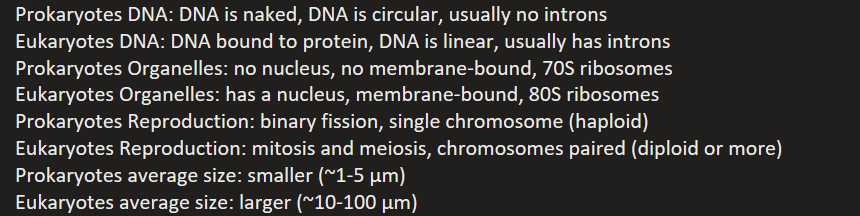
Prokaryotes DNA: DNA is naked, DNA is circular, usually no introns
Eukaryotes DNA: DNA bound to protein, DNA is linear, usually has introns
Prokaryotes Organelles: no nucleus, no membrane-bound, 70S ribosomes
Eukaryotes Organelles: has a nucleus, membrane-bound, 80S ribosomes
Prokaryotes Reproduction: binary fission, single chromosome (haploid)
Eukaryotes Reproduction: mitosis and meiosis, chromosomes paired (diploid or more)
Prokaryotes average size: smaller (~1-5 µm)
Eukaryotes average size: larger (~10-100 µm)
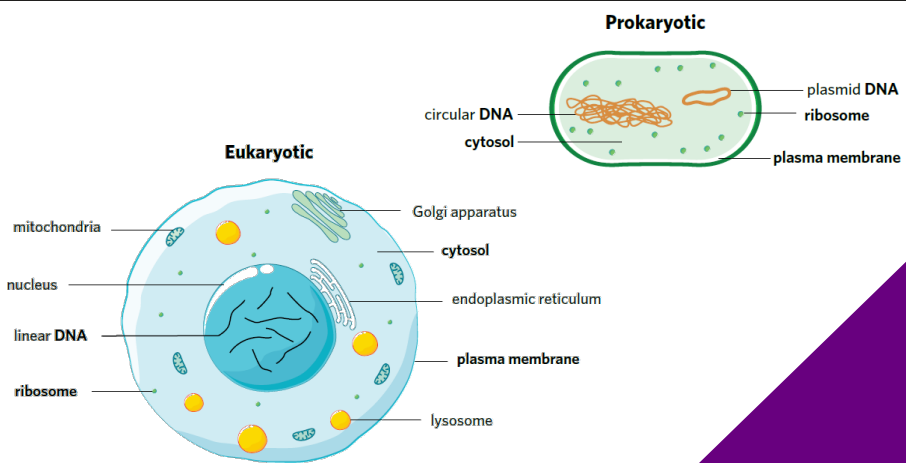
Comparison:
Further classification:
Prokaryotes:
Archaebacteria: unicellular
Eubacteria: unicellular
Eukaryotes:
Protista: unicellular or multicellular
Fungi: unicellular or multicellular
Plantae: multicellular
Animalia: multicellular
2B:
Definition of Organelles
No universal definition
Some definitions include only membrane-bound organelles
Others include all cellular structures but differentiate membrane-bound and non-membrane-bound
Plant vs. Animal Cells
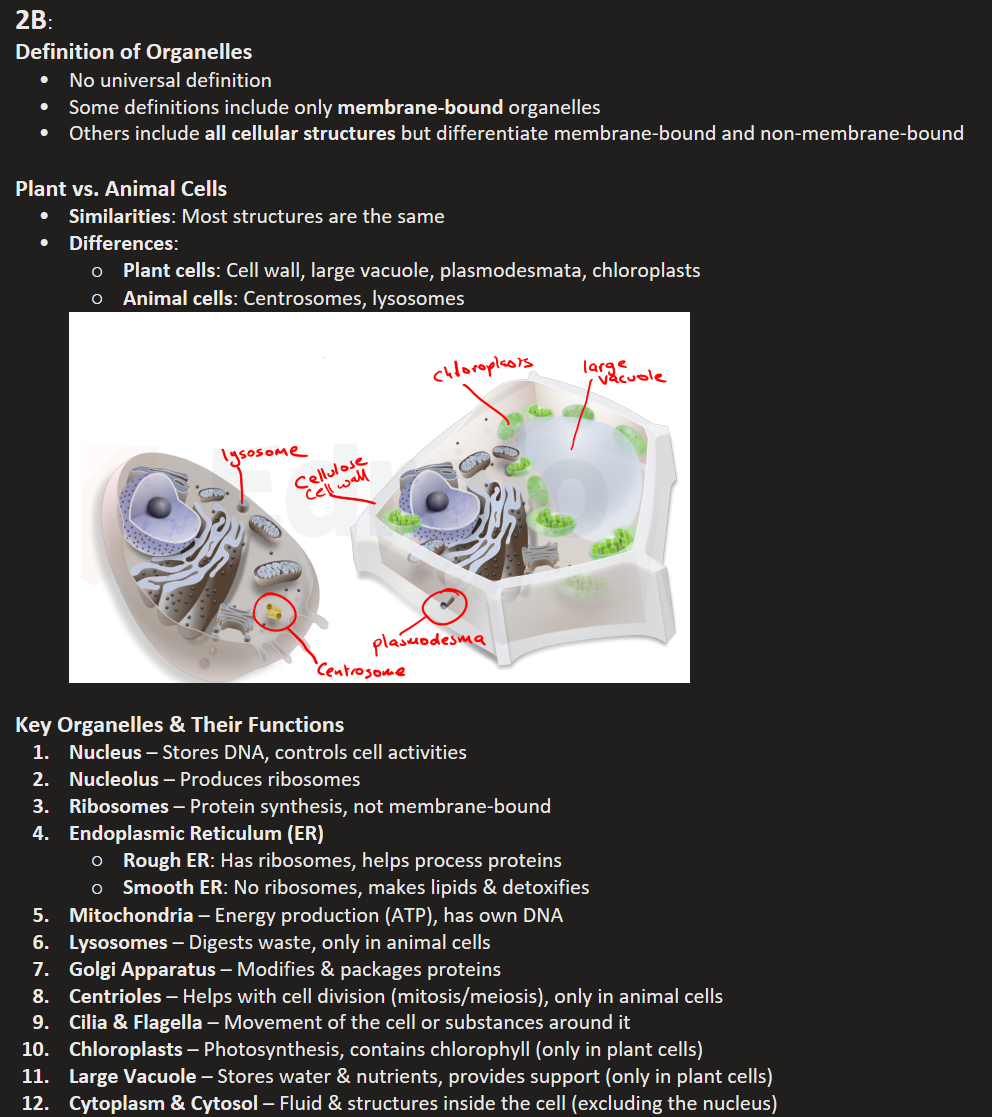
Similarities: Most structures are the same
Differences:
Plant cells: Cell wall, large vacuole, plasmodesmata, chloroplasts
Animal cells: Centrosomes, lysosomes
Key Organelles & Their Functions
Nucleus – Stores DNA, controls cell activities
Nucleolus – Produces ribosomes
Ribosomes – Protein synthesis, not membrane-bound
Endoplasmic Reticulum (ER)
Rough ER: Has ribosomes, helps process proteins
Smooth ER: No ribosomes, makes lipids & detoxifies
Mitochondria – Energy production (ATP), has own DNA
Lysosomes – Digests waste, only in animal cells
Golgi Apparatus – Modifies & packages proteins
Centrioles – Helps with cell division (mitosis/meiosis), only in animal cells
Cilia & Flagella – Movement of the cell or substances around it
Chloroplasts – Photosynthesis, contains chlorophyll (only in plant cells)
Large Vacuole – Stores water & nutrients, provides support (only in plant cells)
Cytoplasm & Cytosol – Fluid & structures inside the cell (excluding the nucleus)
2C:
Cell Size
Smaller cells have a higher SA:V, making diffusion of nutrients and waste removal more efficient.
Example: Pancreatic cells are small to quickly secrete insulin.
Adaptations in Different Environments
Cold climates: Larger animals (e.g., Arctic mammals) have a lower SA:V, helping retain heat.
Hot climates: Smaller animals (e.g., Papua New Guinea mammals) have a higher SA:V, helping lose heat.
Effect of Shape
Flattened or elongated shapes increase SA:V, improving diffusion and absorption.
Example: Villi in the intestine increase SA:V for better nutrient absorption.
Why Are Cells Small?
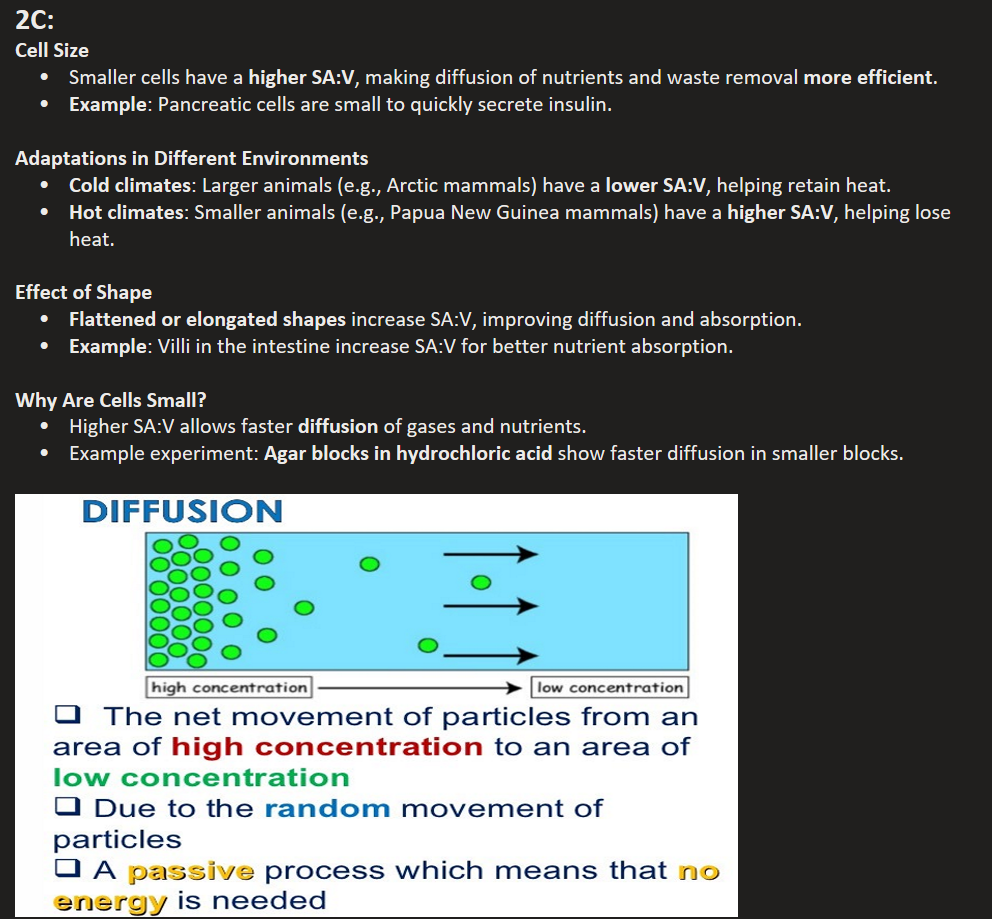
Higher SA:V allows faster diffusion of gases and nutrients.
Example experiment: Agar blocks in hydrochloric acid show faster diffusion in smaller blocks.
3A:
Structure of the Plasma Membrane:
Composed of a phospholipid bilayer with embedded proteins.
Functions as a selective barrier, allowing controlled exchange of substances.
Also involved in cell communication and cytoskeleton anchoring.
Fluid Mosaic Model:
Phospholipids:
Hydrophilic heads are polar and water-loving.
Hydrophobic tails are non-polar and water-repelling.
Provides flexibility to the membrane.
Proteins in the Membrane:
Integral proteins: Span the whole membrane, involved in transport and signalling.
Peripheral proteins: Temporarily attached, assisting in various functions.
Roles of Membrane Proteins (Mnemonic: JET RAT):
Junctions – Connects cells together.
Enzymes – Helps metabolic reactions.
Transport – Facilitates movement of substances.
Recognition – Identifies the cell.
Anchorage – Attaches to the cytoskeleton.
Transduction – Receives external signals (e.g., hormones).
Other Membrane Components:
Cholesterol:
Regulates fluidity based on temperature by decreasing the fluidity in high temp and increasing fluidity in cold temp.
Carbohydrates:
Act as cell labels for recognition.
Transport Mechanisms:
Passive Transport: Diffusion, osmosis, facilitated diffusion.
Active Transport: Requires energy (ATP) to move substances against the concentration gradient.
Tonicity & Water Movement:
Predicts how water moves across membranes via osmosis.
]
3B:
Plasma Membrane & Transport
Controls passage of substances via diffusion, osmosis, and facilitated diffusion.
Hydrophilic, hydrophobic, and ionic substances move differently across the membrane.
Diffusion
Passive movement of molecules from high to low concentration.
Simple diffusion occurs for small, nonpolar molecules (e.g., O₂, CO₂).
Rate of diffusion depends on concentration gradients.
Osmosis
Passive movement of water across a semipermeable membrane.
Moves from low solute concentration to high solute concentration.
Osmolarity describes solute concentration:
Hypertonic: Higher solute concentration outside the cell → Water exits → Cell shrinks.
Hypotonic: Lower solute concentration outside → Water enters → Cell swells.
Isotonic: Equal solute concentration → No net movement.
Facilitated Diffusion
Passive movement of large, polar, or charged molecules via transmembrane proteins.
Channel proteins: Allow small ions/polar molecules to pass.
Carrier proteins: Change shape to transport large molecules (e.g., glucose, amino acids).
Some channel proteins are gated, opening in response to stimuli.
3C:
Active Transport & ATP
Active transport requires energy (ATP) to move molecules against their concentration gradient.
ATP is produced in the mitochondria and is broken down into ADP + Pi to release energy.
Carrier proteins move molecules across the membrane using ATP.
Bu

lk Transport
Movement of large molecules that cannot pass through proteins.
Exocytosis: Bulk transport out of the cell via vesicles fusing with the membrane.
Endocytosis: Bulk transport into the cell by membrane invagination:
Phagocytosis: Engulfing solid material (e.g., bacteria).
Pinocytosis: Engulfing liquid material.