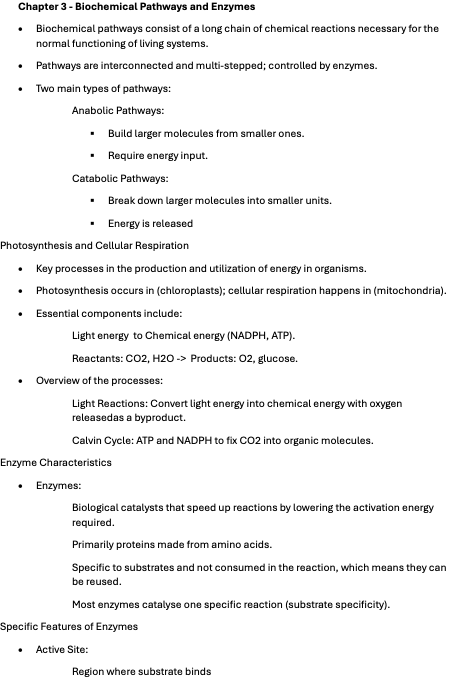
Chapter 3 - Biochemical Pathways and Enzymes
Chapter 3 - Biochemical Pathways and Enzymes
Biochemical pathways consist of a long chain of chemical reactions necessary for the normal functioning of living systems.
Pathways are interconnected and multi-stepped; controlled by enzymes.
Two main types of pathways:
Anabolic Pathways:
Build larger molecules from smaller ones.
Require energy input.
Catabolic Pathways:
Break down larger molecules into smaller units.
Energy is released
Photosynthesis and Cellular Respiration
Key processes in the production and utilization of energy in organisms.
Photosynthesis occurs in (chloroplasts); cellular respiration happens in (mitochondria).
Essential components include:
Light energy to Chemical energy (NADPH, ATP).
Reactants: CO2, H2O -> Products: O2, glucose.
Overview of the processes:
Light Reactions: Convert light energy into chemical energy with oxygen releasedas a byproduct.
Calvin Cycle: ATP and NADPH to fix CO2 into organic molecules.
Enzyme Characteristics
Enzymes:
Biological catalysts that speed up reactions by lowering the activation energy required.
Primarily proteins made from amino acids.
Specific to substrates and not consumed in the reaction, which means they can be reused.
Most enzymes catalyse one specific reaction (substrate specificity).
Specific Features of Enzymes
Active Site:
Region where substrate binds
Complementary in shape to the substrate.
Types of specificity:
Absolute specificity: One specific substrate.
Bond specificity: Specific types of bonds.
Group specificity: Groups of related substrates.
Enzymatic Reactions
Reactions catalyzed by enzymes can be reversible, participating in both anabolism (building) and catabolism (breaking down).
Enzymes end with the suffix '-ase' (e.g., lactase, protease).
Displayed above the reaction arrow in chemical equations.
Cofactors and Coenzymes
Coenzymes: Organic molecules aiding enzyme function by participating in the reaction.
Examples: NAD+, FAD, and coenzymes change structure during catalysis.
Cofactors: Both organic or inorganic molecules assisting biochemical transformations, such as metal ions.
Coenzymes exist in two forms:
High energy (loaded) and Low energy (unloaded).
Coenzyme Function
Coenzymes facilitate:
transfer of atoms/groups of atoms (e.g., hydrogens, phosphate).
Energy transfers during enzymatic reactions.
Recycling of coenzymes is necessary as they cannot be immediately reused.
Summary
Enzymes lower activation energy, facilitating both photosynthesis and respiration reactions.
Specific enzymes are essential for specific reactions in metabolic pathways.
Examples: Rubisco, ATP synthase, involved in photosynthesis.
Glossary Terms
Activation Energy: Energy required to start a reaction.
Active Site: The region of the enzyme where substrates bind.
Anabolic Reaction: A reaction that builds larger molecules.
Biochemical Pathway: Series of reactions catalyzed by enzymes in living organisms.
Catabolic Reaction: A reaction that breaks down substances.
Catalyst: Substance that accelerates a reaction without being consumed.
Coenzyme: Organic non-protein substances that help enzymes.
Cofactor: General term for a non-protein that assists enzyme activity.
Key Terms/Concepts
Enzyme: A biological catalyst that speeds up biochemical reactions by lowering the activation energy required.
Coenzyme: A non-protein molecule that assists enzymes in catalyzing reactions.
Denaturation: The process by which an enzyme loses its functional shape due to extreme conditions, rendering it inactive.
Competitive Inhibition: A type of enzyme inhibition where an inhibitor competes with the substrate for the active site.
Non-Competitive Inhibition: An inhibitor binds to an allosteric site, changing the enzyme's shape and affecting substrate binding.
Key Processes
Photosynthesis: The process by which plants convert solar energy into chemical energy, occurring in chloroplasts, involving light-dependent and light-independent reactions.
Cellular Respiration: The biochemical pathways that release energy from glucose, converting it into ATP for cellular use.
Key Factors Affecting Enzyme Function
Factor | Description |
Temperature | Affects the rate of reaction; too high can denature enzymes, while optimal temperatures enhance activity. |
pH | Each enzyme has an optimal pH; deviations can lead to decreased activity or denaturation. |
Concentration of Substrate | Increasing substrate concentration increases reaction rate until saturation (Vmax) is reached. |
Inhibitors | Molecules that decrease enzyme function; can be competitive or non-competitive. |
Phosphorylation | The addition of a phosphate group to an enzyme, which can activate or deactivate its function. |
Key Concepts in Enzyme Regulation
· Feedback Inhibition: A regulatory mechanism where the end product of a pathway inhibits an enzyme involved earlier in the pathway.
· Reversible Inhibition: Inhibitors that bind weakly and temporarily impair enzyme function.
· Irreversible Inhibition: Inhibitors that bind strongly and permanently impair enzyme function.
Key Terms in Glossary
Adenosine Triphosphate (ATP): The primary energy carrier in cells.
Adenosine Diphosphate (ADP): The product formed when ATP loses a phosphate group.
Chlorophyll: The green pigment in plants that absorbs light energy for photosynthesis.
Glycolysis: The metabolic pathway that converts glucose into pyruvate, producing ATP.
Facts to Memorize
Photosynthesis occurs in chloroplasts.
Aerobic respiration produces 30 or 32 ATP molecules.
Anaerobic respiration produces 2 ATP molecules.
Enzymes can be denatured by extreme temperatures and pH levels.
Reference Information
Light-dependent reactions and light-independent reactions (Calvin cycle) are the two main stages of photosynthesis.
Competitive inhibitors compete with substrates for the active site, while non-competitive inhibitors bind to an allosteric site.
Nucleic Acids as Information Molecules
What are Nucleic Acids?
Biomacromolecules that store and pass on genetic material
Act as a chemical code for making proteins
Two types:
DNA
RNA
(Made of monomers called nucleotides
Structure of Nucleic Acids
Each nucleotide has three parts:
Phosphate group
5-carbon sugar (deoxyribose in DNA, ribose in RNA)
Nitrogenous base
DNA Structure
Double helix (twisted ladder shape)
Sugar-phosphate backbone
Nitrogenous bases make the "rungs"
DNA Nitrogenous Bases
Adenine (A)
Thymine (T)
Cytosine (C)
Guanine (G)
Base Pairing Rule
A pairs with T
C pairs with G
Purines (A, G) pair with Pyrimidines (C, T)
Antiparallel Nature of DNA
DNA strands run in opposite directions (5’ → 3’ and 3’ → 5’)
Strands are held together by hydrogen bonds
mRNA (Messenger RNA) Carries genetic code from DNA to ribosomes
tRNA (Transfer RNA) Brings amino acids for protein synthesis
rRNA (Ribosomal RNA) Forms part of ribosomes