Chem ch8A
 The molecular formula represents a list of elements and the number of atoms of each element in a molecule.
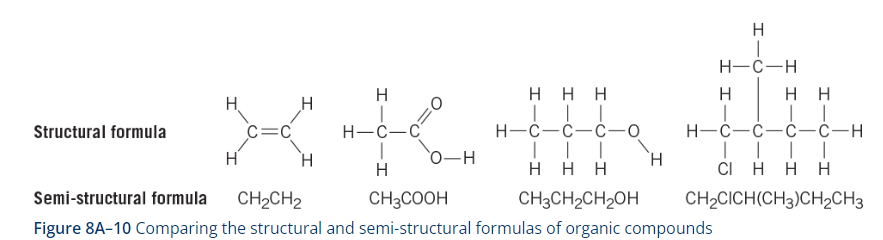
structural formula explicitly shows how all atoms in a molecule are connected.
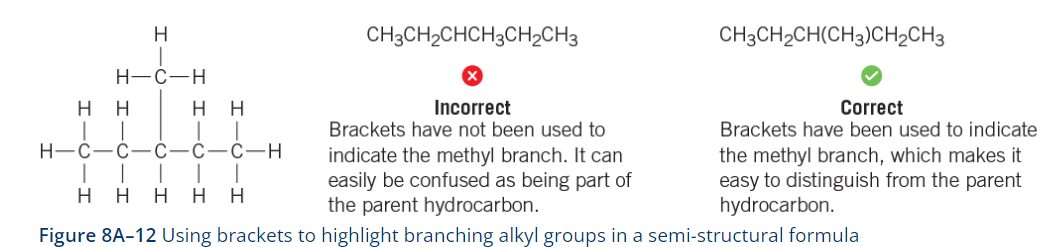
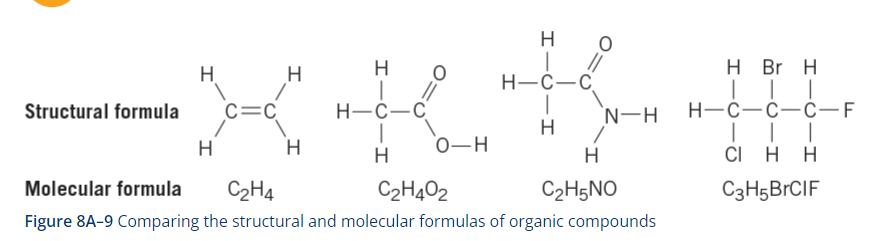 semi-structural (or condensed) formula usually omits the bonds within a molecule. (more difficult to interpret)
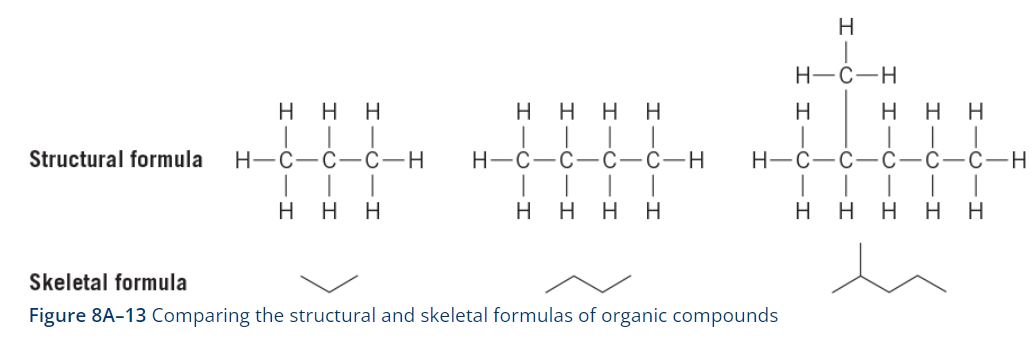
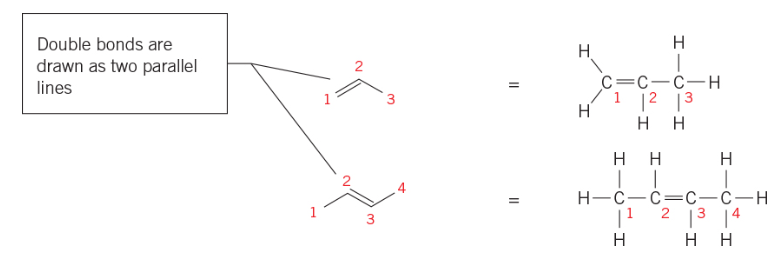
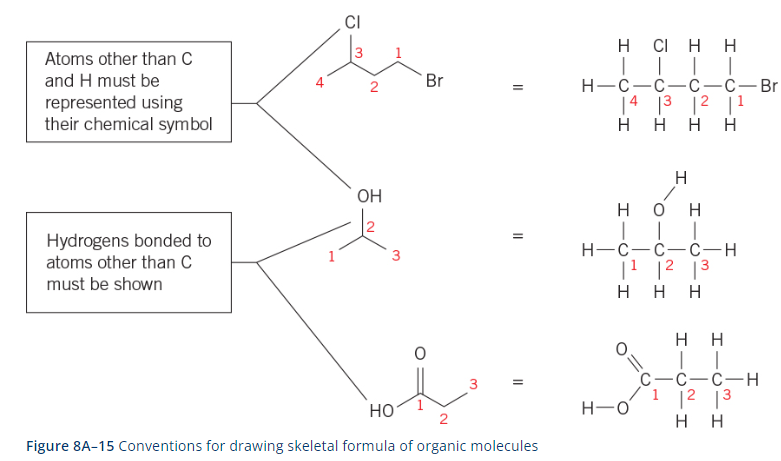
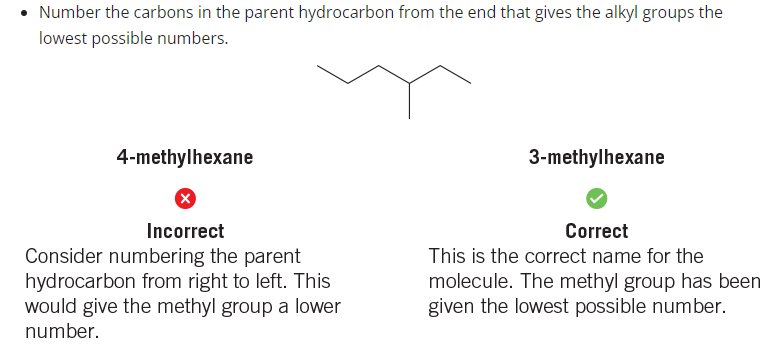
 The skeletal formula or skeletal representation is a commonly used method to represent large or complex organic compounds.
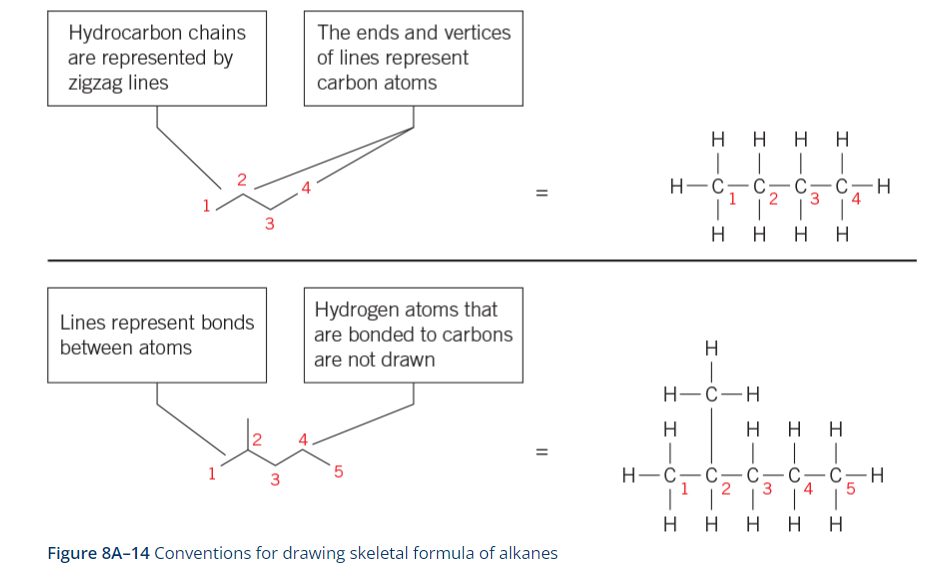 In addition, the following conventions apply when there is a functional group present in the molecule:
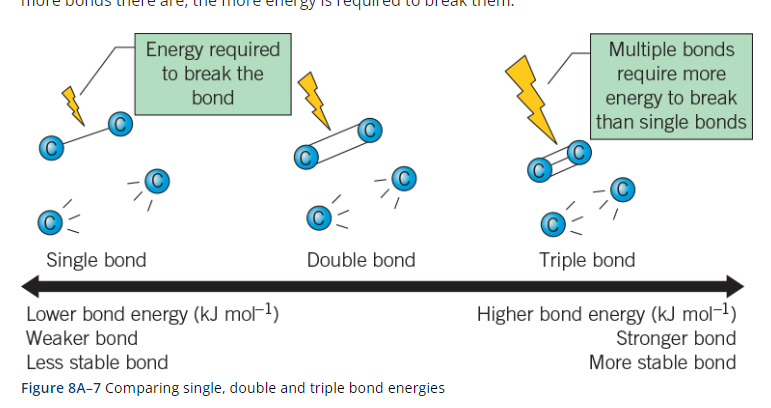
Double bonds are shown as two parallel lines.
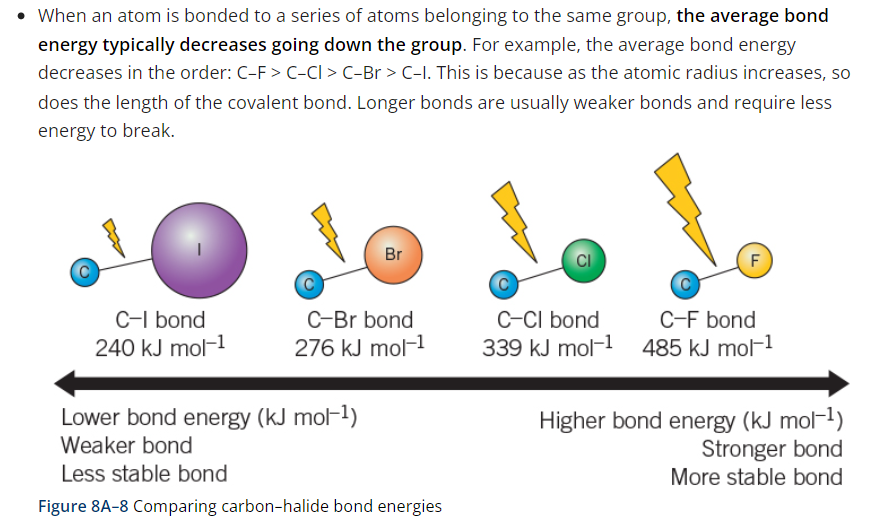
All other atoms (O, N, S, F, Cl, Br, I etc.) are represented by their chemical symbols.
Hydrogen atoms (H) bonded to atoms other than carbon are always shown.
 CHapter 8B
Family | Functional group | General formula | Homologous series |
|---|---|---|---|
Alkane | – | CnH2n+2 |
Alkene | C═C double bond | CnH2n |
Chloroalkane | Chloro | CnH2n+1Cl |
Chloroalkane | Chloro | CnH2n+1Cl |
Carboxylic acid | Carboxyl | CnH2n+1COOH |
Alkanes are saturated hydrocarbons, meaning that only single bonds exist between their carbon atoms.
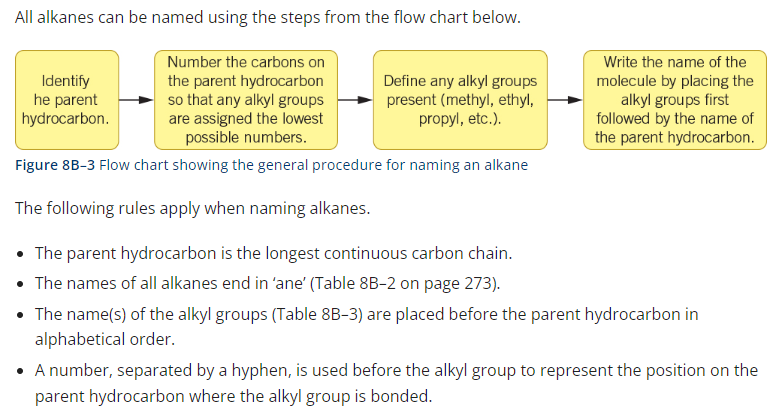
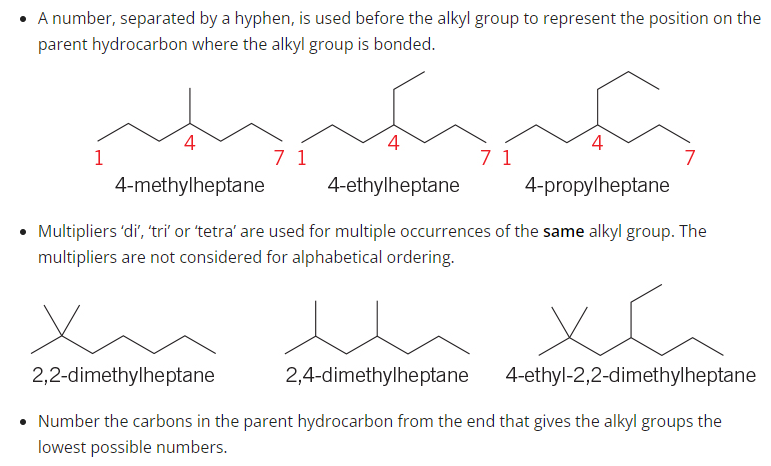
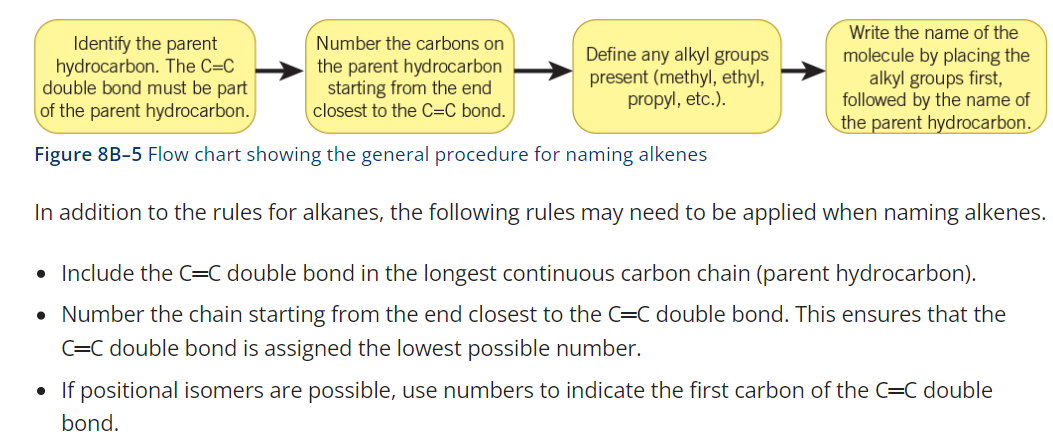
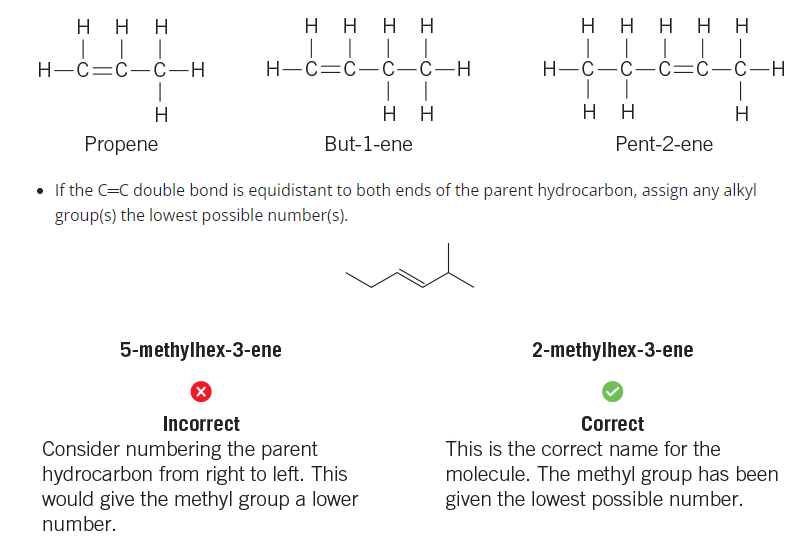
 Alkenes are unsaturated hydrocarbons characterised by the presence of one or more C═C double bond(s). CnH2n.
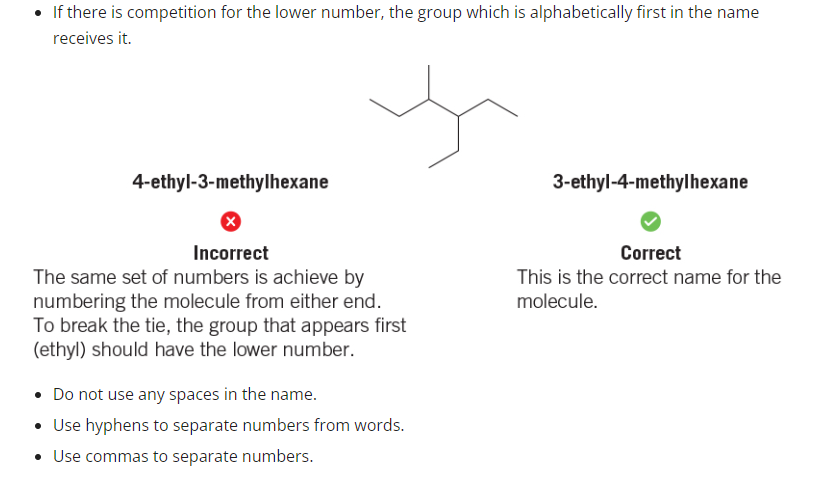
Naming alkenes
 At least one double bond The word ‘unsaturated’ is associated with the idea that the molecule is ‘not full’. This is because one of the bonds from the double bond can break allowing the molecule to form new bonds to more atoms.
Degree of unsaturation (DoU) = number of double bonds + number of cyclic structures
OR 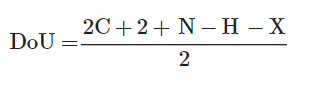
C = The number of carbon atoms
N = The number of nitrogen atoms
H = The number of hydrogen atoms
X = The number of halogen atoms (F, Cl, Br, I).
Ch8C
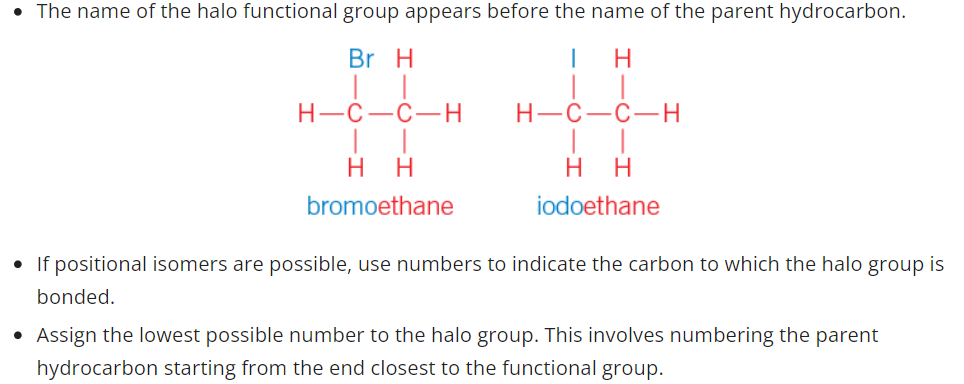
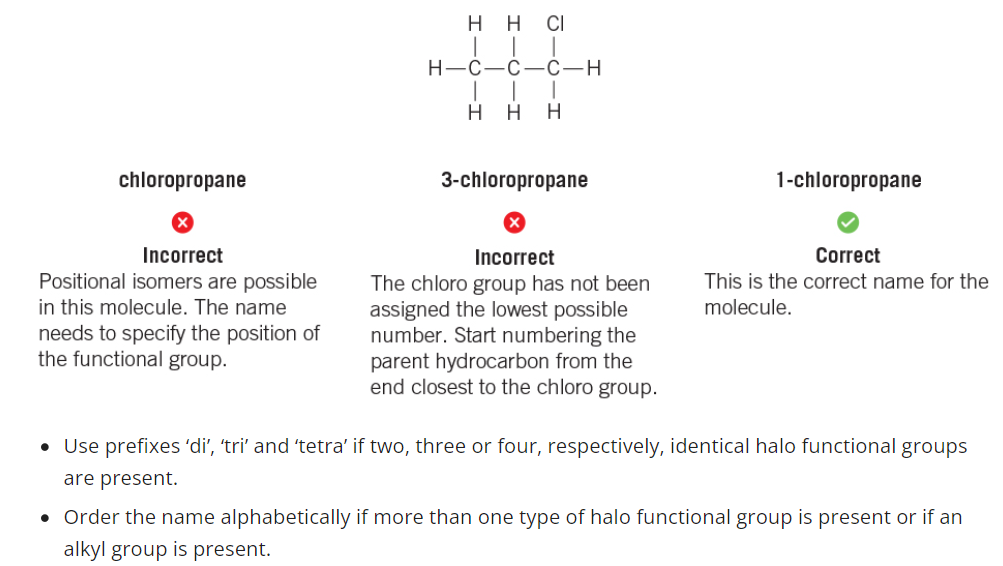
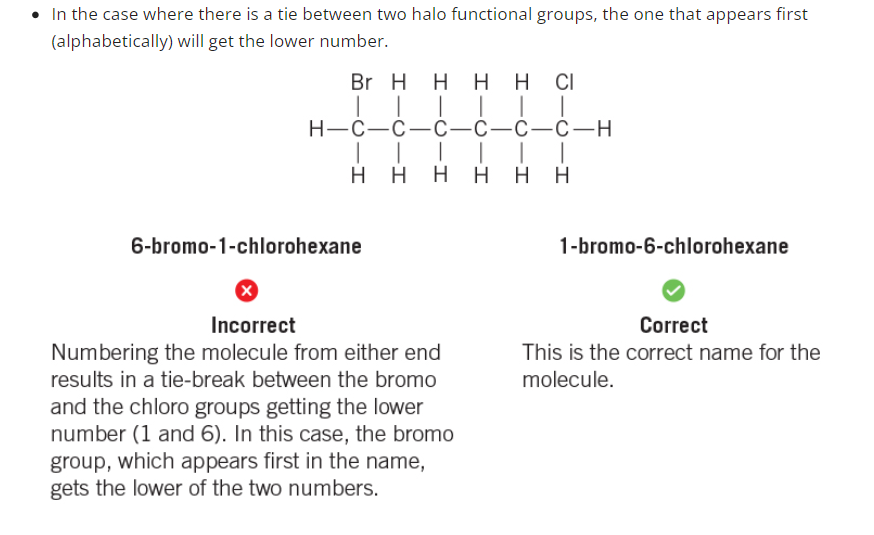
Haloalkanes are a family of molecules in which one or more of the hydrogens in an alkane is substituted for a halogen atom (F, Cl, Br or I).
 Alcohols
Substituting a hydrogen of an alkane for a hydroxyl group (–OH) gives an alkanol or alcohol
Hydroxyl groups are polar functional groups due to oxygen having a higher electronegativity than its neighbouring atoms
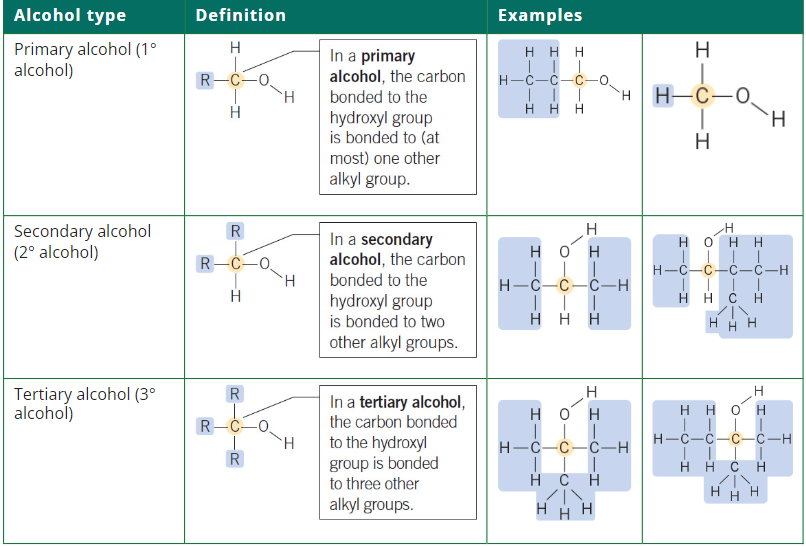
An alkyl group (denoted by the symbol R) refers to any hydrocarbon chain
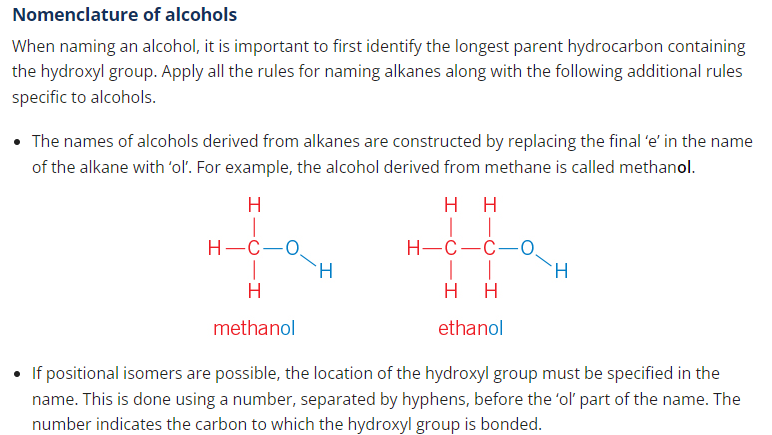
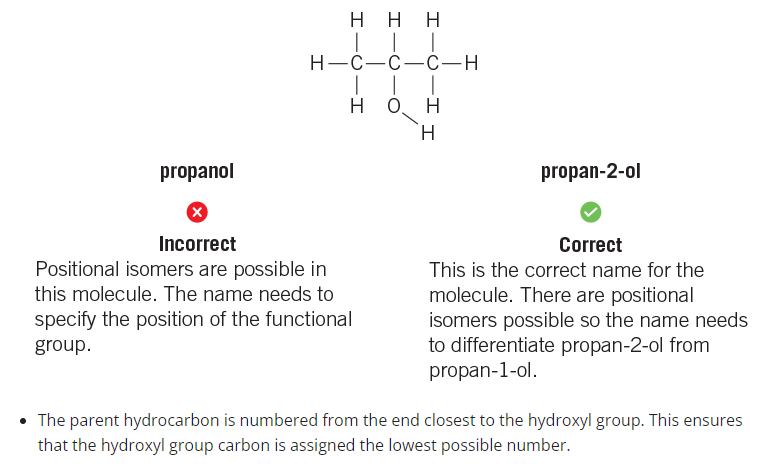
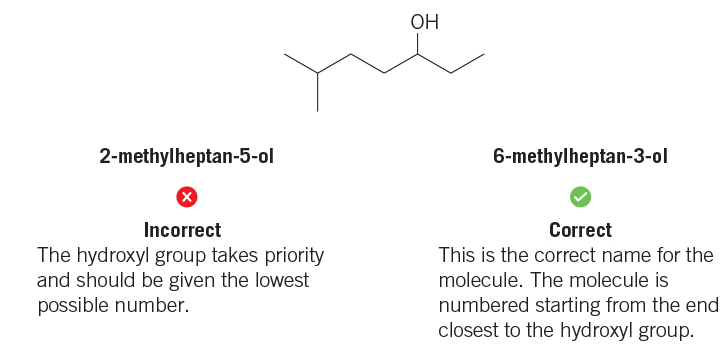

Primary amines
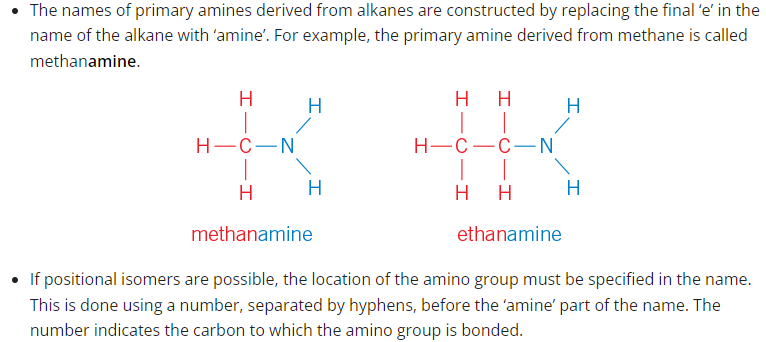
Substituting a hydrogen of an alkane for an amino functional group (–NH2) gives an amine.
Amines are commonly found in household cleaning products, paints, dyes and various pharmaceutical products.
The amino group adopts a trigonal pyramidal shape due to the lone pair of electrons on the nitrogen atom. This makes the amino group a polar functional group.
The amino group is an alkaline or basic functional group. This means that an aqueous solution of an amine has a pH greater than 7 at 25oC
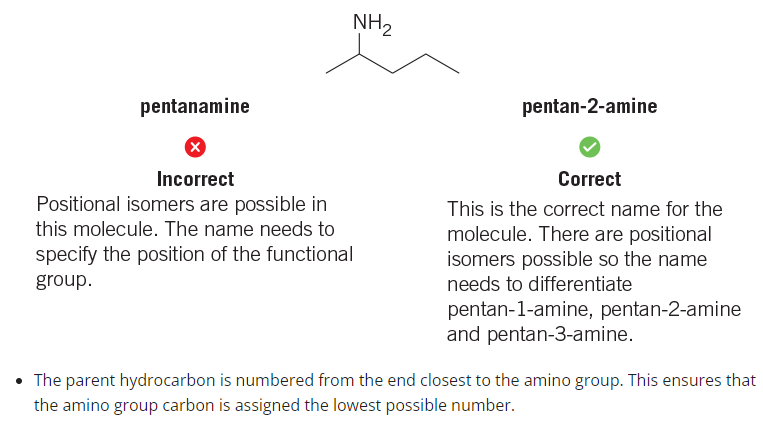
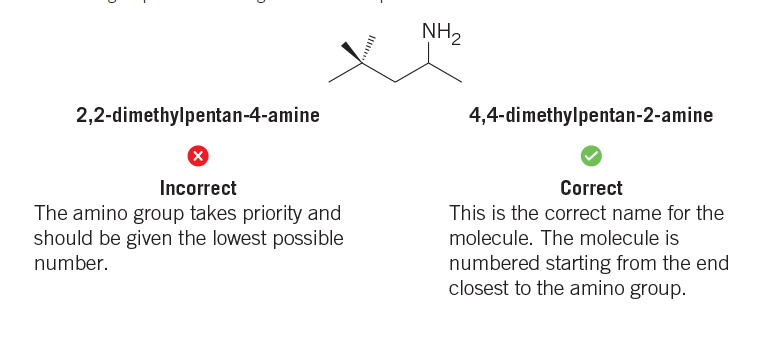
Naming Amines
 Ch 8D
Ch 8D
The carbonyl group consists of a carbon atom double bonded to an oxygen atom: C═O.
Aldehydes and ketones are two families of organic compounds characterised by the presence of a carbonyl functional group. Both aldehydes and ketones have the general chemical formula CnH2nO.
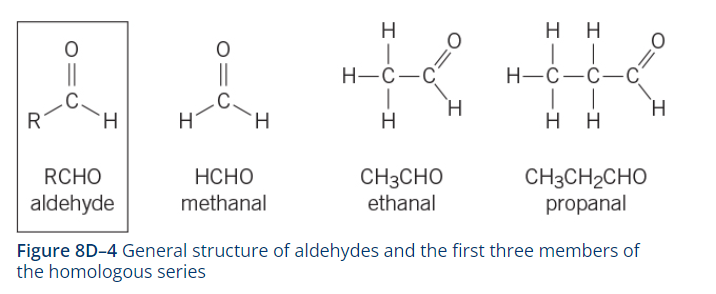
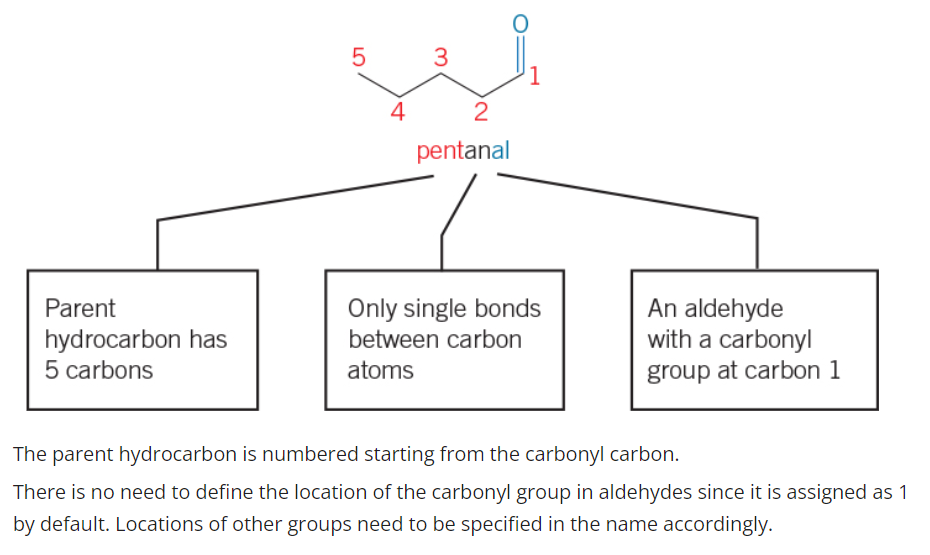
Aldehydes have a carbonyl group on the first carbon of the parent hydrocarbon. This means that the carbonyl carbon of an aldehyde is always bonded to a H, making the general structure of aldehydes RCHO, where R is either a hydrogen or an alkyl group.
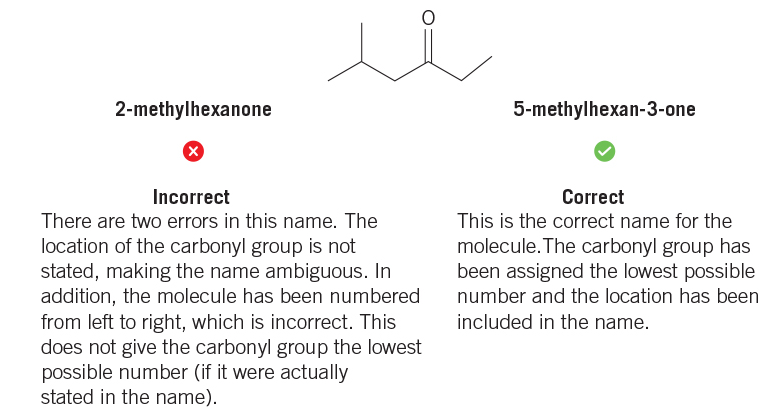
 In contrast, the carbonyl group in ketones must be located somewhere in the middle of the carbon chain.
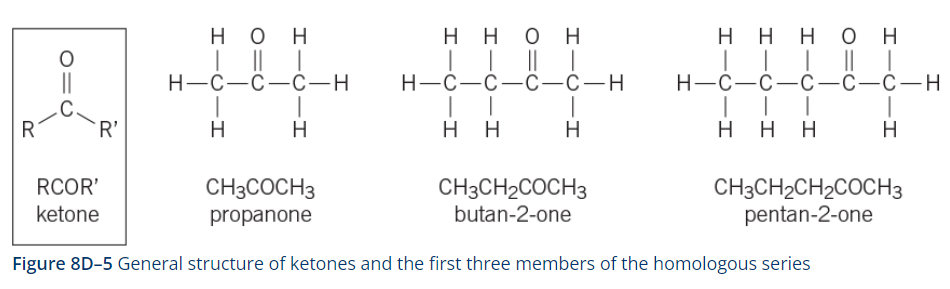 The carbonyl functional group is polar due to oxygen being more electronegative than carbon
Nomenclature of aldehydes:
 Carboxylic acids
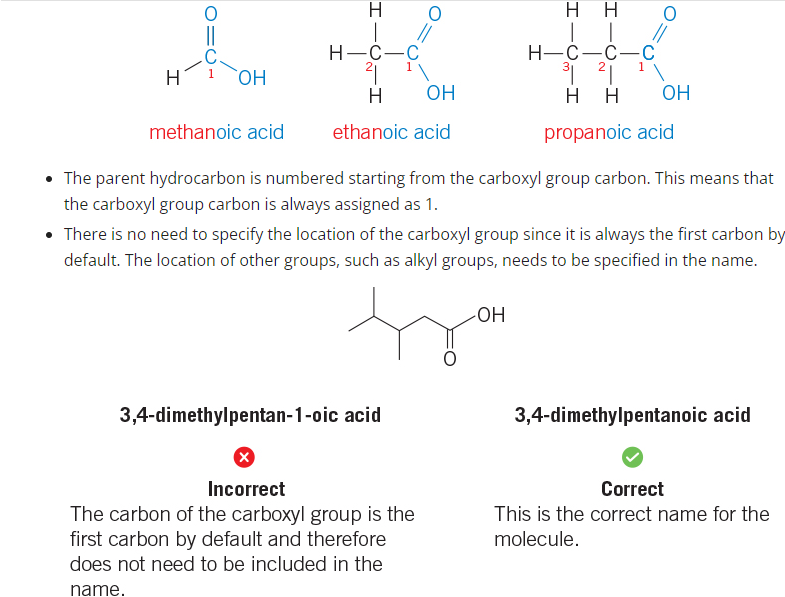
Carboxylic acids are a family of molecules characterised by the presence of a carboxyl group (–COOH).
Carboxylic acids derived from alkanes have the general formula CnH2n+1COOH. This can be further simplified to RCOOH, where R represents either a hydrogen or an alkyl group.
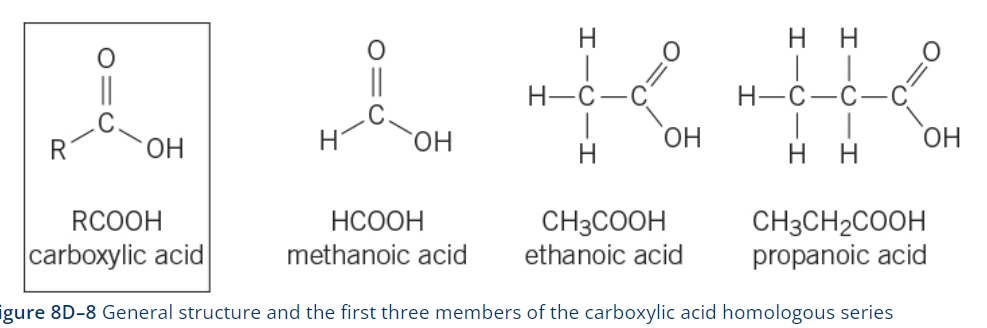 Carboxylic acids are weak organic acids that can donate the H from the carboxyl group.
Carboxyl functional groups are polar.
Nomenclature of carboxylic acids- oic acid.
 Esters
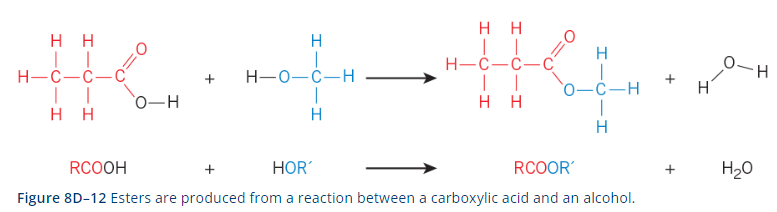
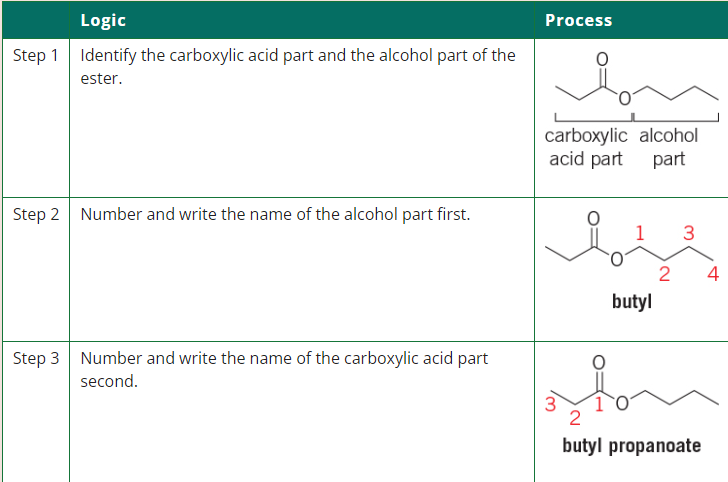
Esters are a family of organic molecules characterised by the ester functional group. An ester is a derivative of a carboxylic acid in which the –OH portion of the carboxyl group is substituted for an OR’ group, where R’ is an alkyl group.
The general structure of an ester is RCOOR’
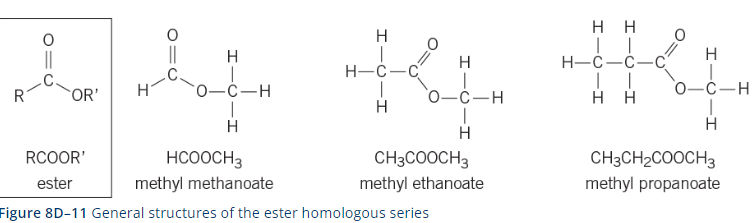
 Esters are polar due to the electronegativity difference between the carbonyl carbon and the oxygen atoms.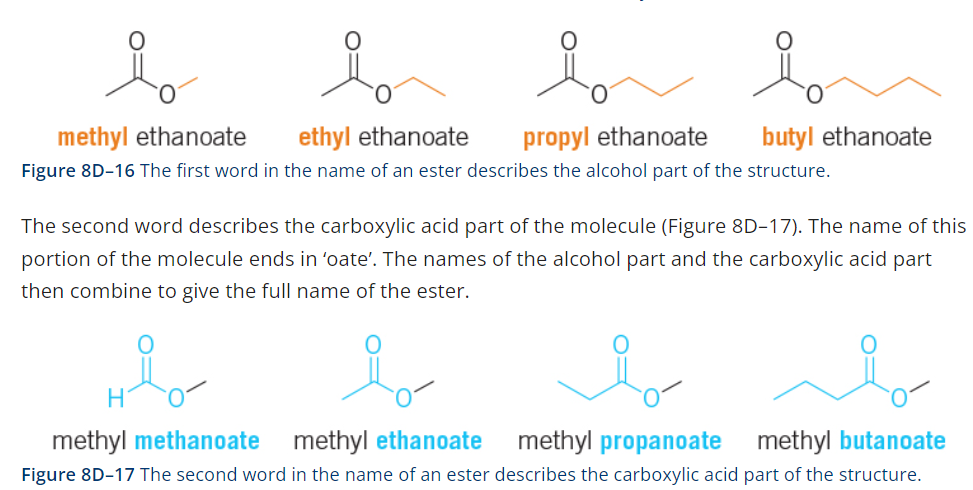
 Primary amides
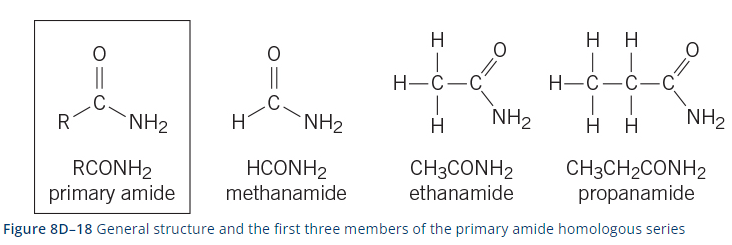
Primary amides are a family of organic molecules characterised by the amide functional group.
Primary amides are derivatives of carboxylic acids where the hydroxyl (–OH) portion of the carboxyl group is substituted for an amino (–NH2) group.
Just like in carboxylic acids, the carbon of the amide functional group is always the first carbon of the chain.
The general structure of primary amides is RCONH2 where R is either H or an alkyl group
 Naming molecules with two identical functional groups
The following rules need to be applied when naming a molecule with two identical functional groups.
Add a ‘di’ before the part of the name relevant to the functional group; for example, CH2Br2 is called dibromomethane.
The ‘e’ is returned if ‘di’ is used after the name of the hydrocarbon; for example, CHOCH2CHO is called propanedial.
If positional isomers are possible, then the location of both functional groups needs to be specified; for example, CH2OHCH2CH2OH is called propane-1,3-diol.
An ‘a’ is added after the first part of the name for molecules with two C═C double bonds; for example, buta-1,3-diene instead of but-1,3-diene.
Naming molecules with two different functional groups
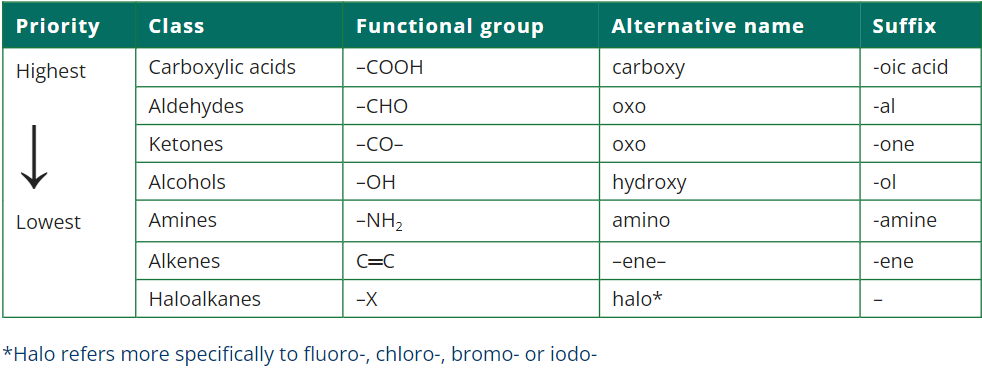
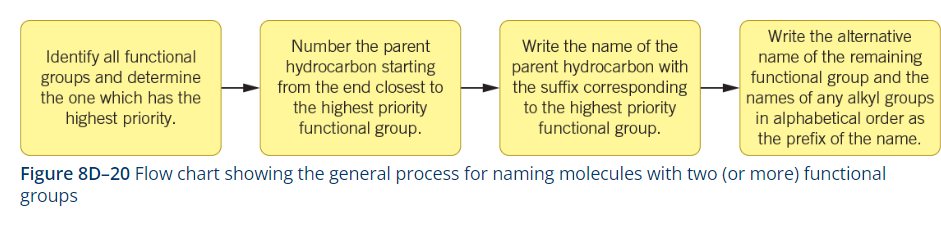
When naming molecules with two different functional groups, we must assess and rank the functional groups in terms of their priority.
 8E Physics properties of organic compounds
Physical Properties-
Melting POint- the temp at which the particles of a s ubstance achieve enough kinetic energy to break free of solid lattice and move freely as a liquid.
Boiling pt- the temp at which the particles of a substance achieve enough kinetic energy to break attractions holding them as a liquid and move freely as a gas.
The temp of a substances remains constant during a change of state.
The forces of attraction that need to be overcome so particles can move freely are:
Dispersion forces- as the chain length of the homologous series increases, the dispersion forces strengthen therefore, more energy needed.
as the degree of alkyl branching increases, the dispersion forces weaken therefore, less energy needed.
H-bonding- strong dipole-dipole attraction between H+ δ
atom of are molecule and δ- F, O or N atom of another molecule. very strong intramolecular force of attraction therefore, more energy needed.
9A Organic reactions: substitution, addition and oxidation
Addition reactions of alkenes: break a double C═C bond to open up 2 band sites where atom/ functional group can be added.
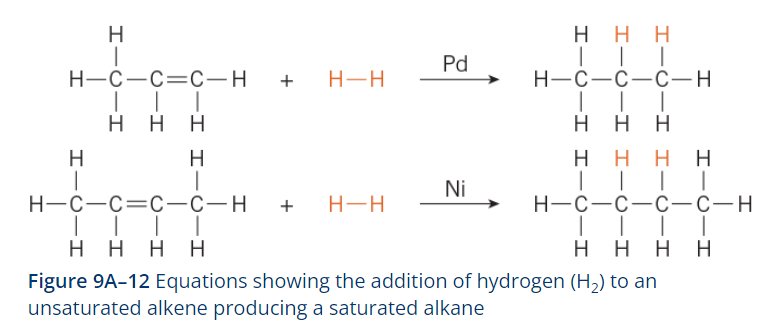
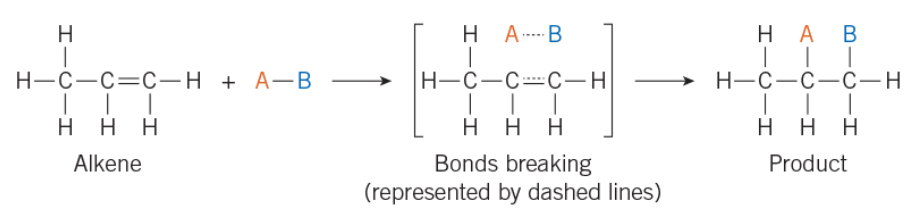 Hydrogenation reactions- add H via H2 (g)
Hydrogenation is carried out in the presence of a transition metal catalyst such as nickel (Ni), palladium (Pd) or platinum (Pt)
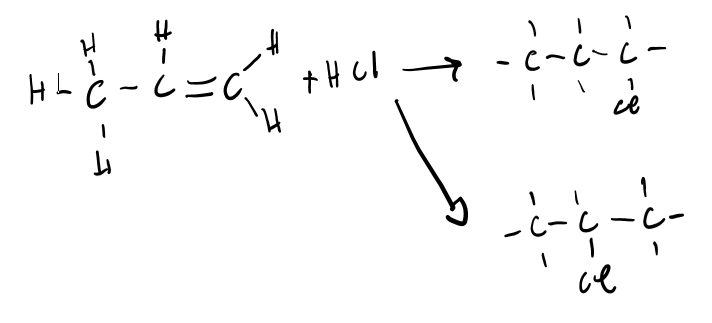
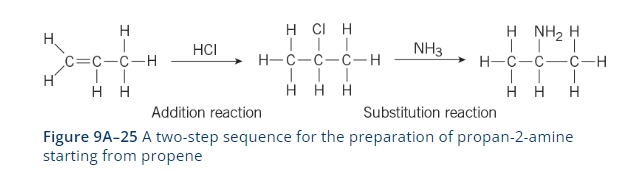
 Hydrohalogenation – add hydrogen (x) and H via a halogen hydride (HX)
 be careful with positional isomers
Propene + hydrogen chloride are both non-symmetrical
 Hydration – addition reactions involving water (H2O)
performed at high temperature (150–200°C) and uses phosphoric acid (H3PO4) or sulfuric acid (H2SO4) as a catalyst.
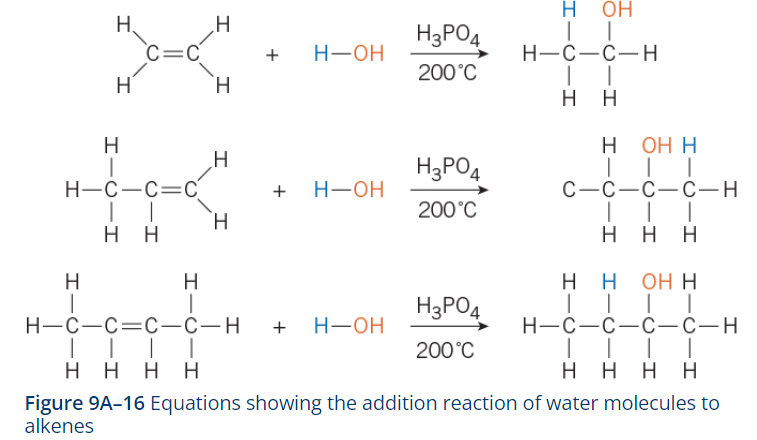 Summary of addition reactions to alkenes
Addition reactions involving alkenes are useful for a variety of applications, including the production of plastics, fuels, pharmaceuticals and other chemicals vital for everyday goods.
Some common examples include:
the addition of hydrogen gas to an alkene to form an alkane, which is commonly used in the production of fuels and margarine
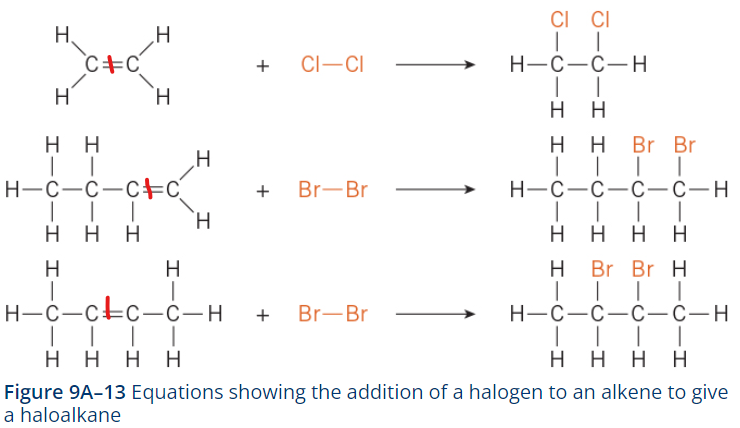
the addition of halogens (such as Cl2 or Br2) to an alkene to form a dihaloalkane, which is used as a solvent, a refrigerant or a starting material for the synthesis of other chemicals
the addition of water to an alkene to form an alcohol, which is used as a solvent, a fuel or a starting material for the synthesis of other chemicals.
Substitution reactions
involve exchanging an atom (or a group of atoms) in a molecule for another atom (or group of atoms).
Substitution reactions involving alkanes- halogenation reaction
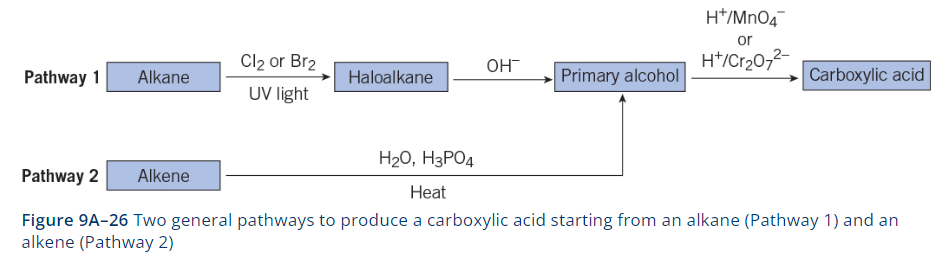
Alkanes can react with halogens (Cl2 or Br2) in the presence of ultraviolet light (UV light) to produce haloalkanes in a substitution reaction
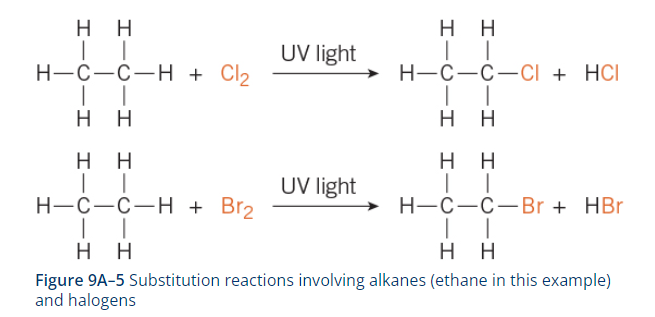 Substitution reactions involving haloalkanes
Haloalkanes can react with aqueous metal hydroxides (LiOH(aq), NaOH(aq), KOH(aq) etc.) to produce alkanols in a substitution reaction
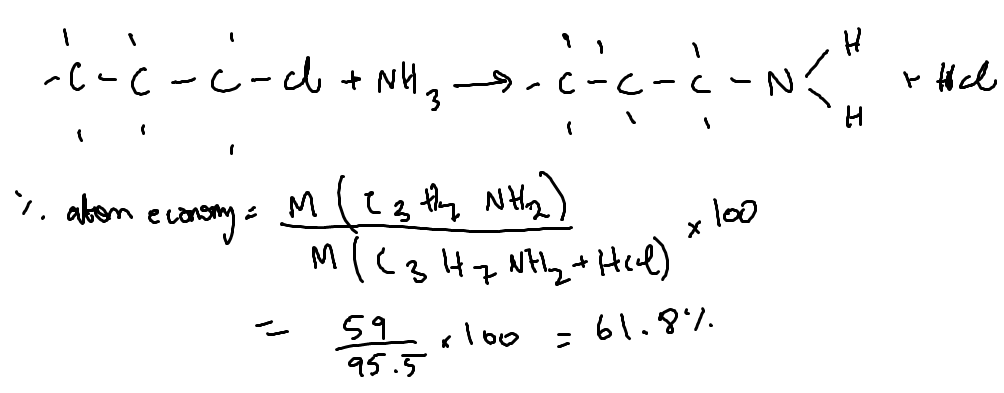
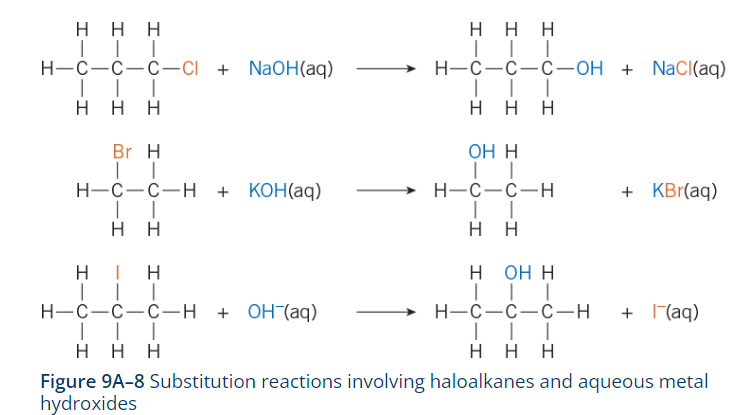 Haloalkanes can also react with ammonia (NH3) to form primary amines in a substitution reaction. The by-product of this reaction is a hydrogen halide (HCl, HBr or HI).

Addition reactions of alkenes- a molecule is added across the double bond of an alkene.
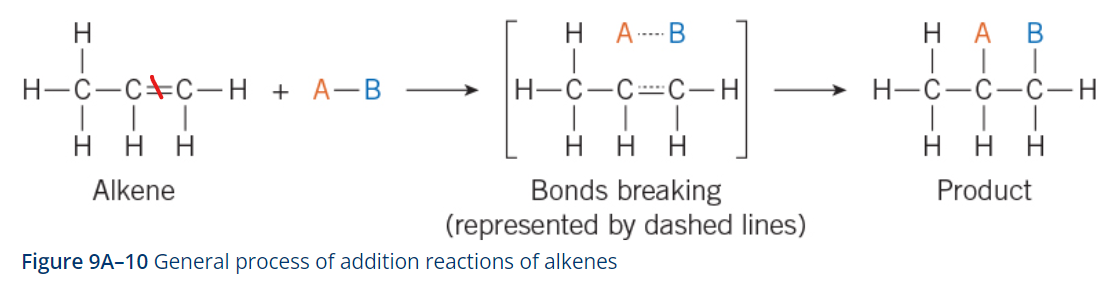 Oxidation reactions of primary alcohols
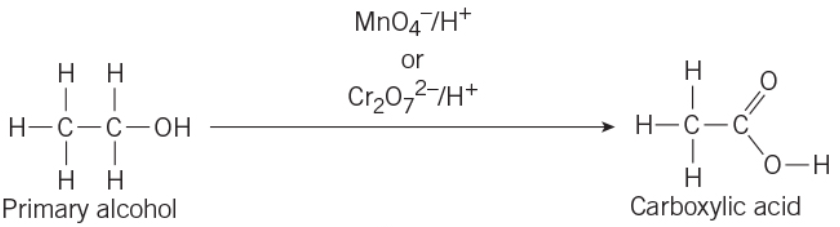
Oxidation of primary alcohols is a process that converts a primary alcohol into a carboxylic acid or an aldehyde, depending on the specific reaction conditions and the type of oxidising agent used.
Reacting a primary alcohol with an oxidising agent in the presence of acid (H+) would give a carboxylic acid.
high temp and a catalyst potassium dichromate dichromate (Cr2O72–)
permanganate (MnO4–).
 Reaction pathways show reactants, products, catalysts +reaction conditions, but don’t need to be balanced. State symbols are only shown on catalysts if diff options are possible e.g. NaOH (s) NaOH (aq).
Pathways to synthesise primary amines
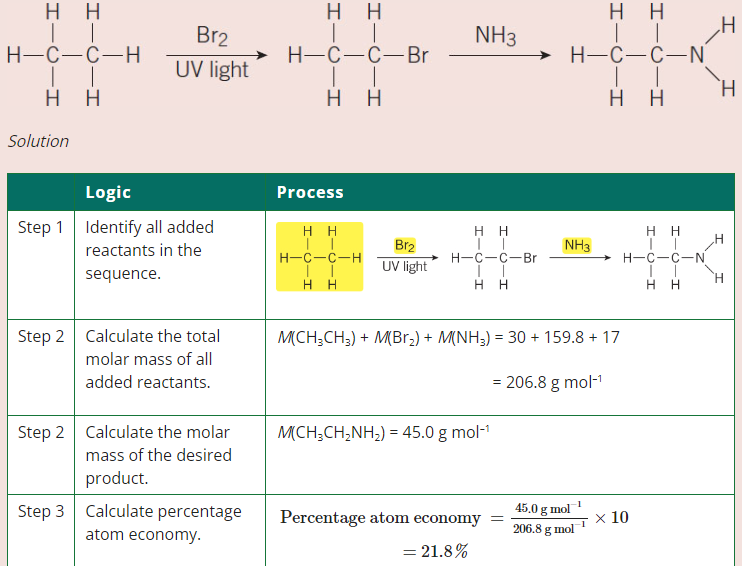
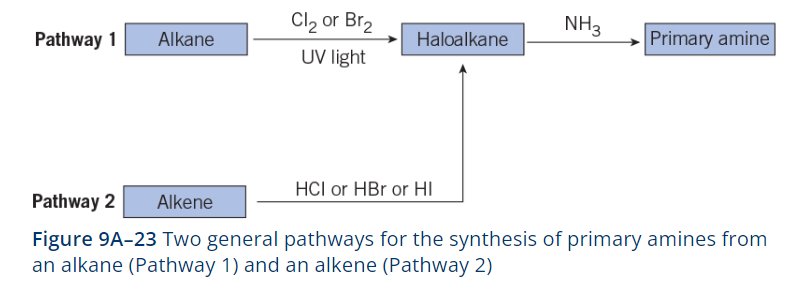 Pathway 1 begins with an alkane starting material. A substitution reaction involving the alkane and a halogen under UV light yields a haloalkane intermediate. A second substitution reaction between the haloalkane and ammonia, NH3, gives the desired primary amine.
Pathway 2 begins with an alkene undergoing an addition reaction with a hydrogen halide to give a haloalkane intermediate. Subsequent reaction with ammonia, NH3, gives the desired amine product.
Pathways to synthesise carboxylic acids
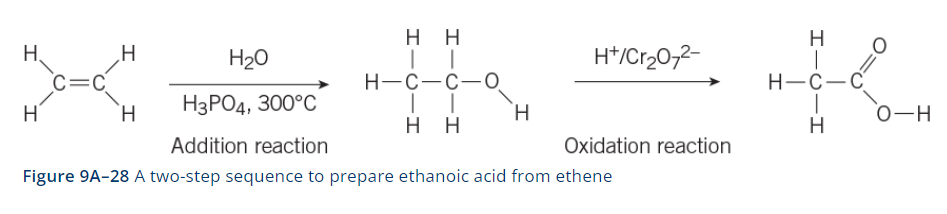 Designing a reaction pathway
Factor | Attributes |
|---|---|
Reagent/starting material |
|
Intermediate compounds |
|
Product |
|
Waste/by-products |
|
Number of steps in the sequence |
|
Overall yield of product |
|
Reaction conditions |
|
Rates of reactions |
|
9B Organic reactions: condensation and hydrolysis
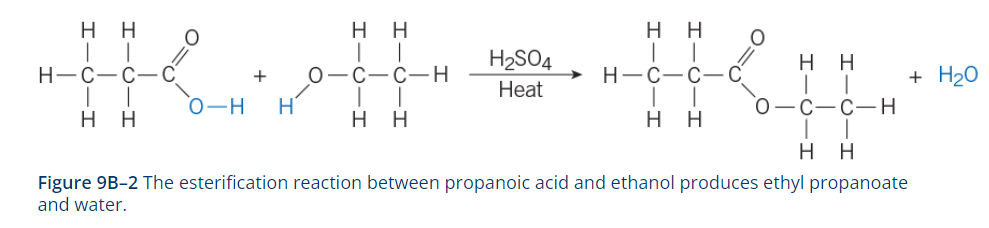
Condensation reactions: are a type of chemical reaction in which two molecules combine to form a larger molecule with the release of a small molecule usually water.

Esterification reactions: A carboxylic acid and an alcohol can undergo a condensation reaction to form an ester and a molecule of water. Heat and an acid catalyst such as H2SO4 are commonly used to increase the rate of the reaction.
 Hydrolysis Reactions-
water is added and sometimes heat and catalyst is needed, to break apart a large molecule into 2 smaller molecules. ⬛+H2O —> ⬛-OH + H-⬛
Esters: ester + water—-NaOH—> alcohol+ carboxylic acid
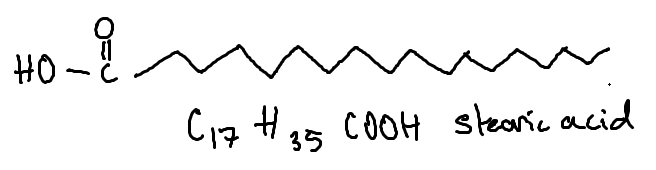
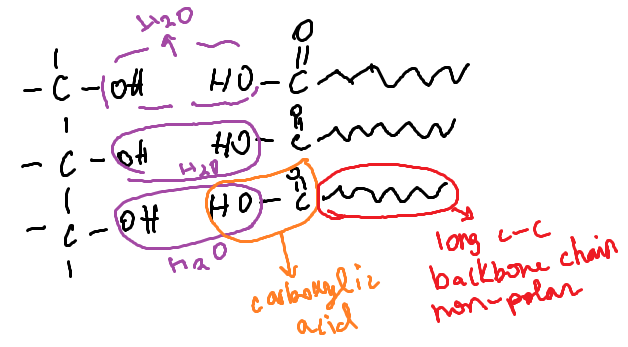
Lipids: fat molecules made up of triglycerides
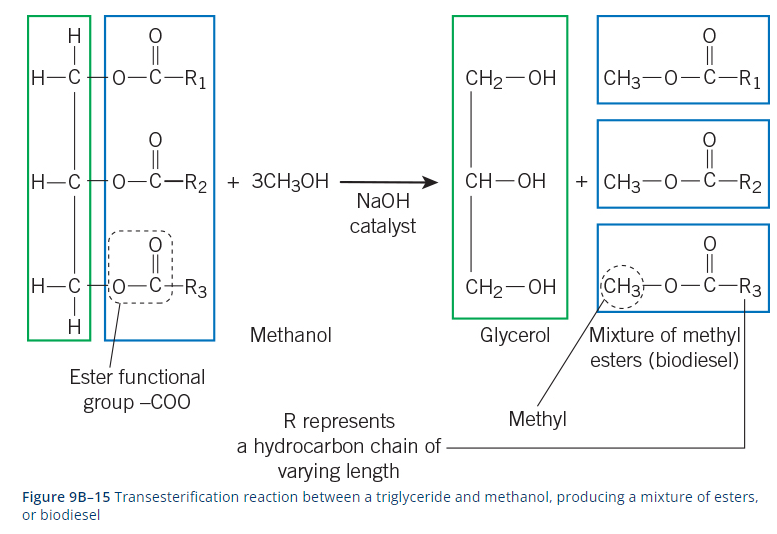
triglyceride+ water —-NaOH or enzyme—> glycerol + 3 fatty acids
Protein: made up of ‘basic building blocks’ molecules called 2-amino acids.
peptide +water —HCl or enzyme, heat—> amino acids
Carbohydrates:
disaccharide +water —enzyme—> α-glucose
polysaccharide +water—enzyme—> shorter polysaccharide and α-glucose
polysaccharides are hydrolysed at the terminal (ends) saccharide monomers. This means glycogen will break down faster than amylose because glycogen is branched and has more termini.
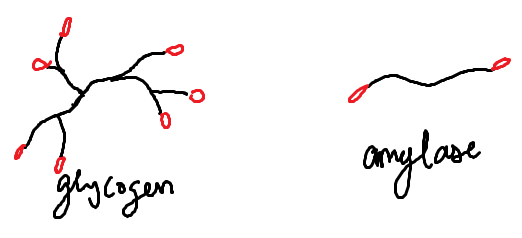
Therefore, more energy released from digesting glycogen
Transesterification reactions- process of connecting a triglyceride into a biofuel
9C Designing sustainable organic reactions
looks at how many atoms (using molar mass) of the reactants end up in the products. This is a way of evaluating the efficiency of a reaction as you want the atoms to be in the product and not in the waste products.
%atom economy: M(desired)/ M(of product) *100
 Green Chemistry:
we need to evaluate our reaction pathways to find the best way to make our desired products.
there are 12 factors to consider:
waste prevention
atom economy
less hazardous synthesis
design safer chemicals
use safer solvents
design for energy effeciency
use renewable feedstock
reduce derivatives
use catalysts
design for degredation
Real-time pollution control
safer process for accident prevention
9C Designing sustainable organic reactions navigate_next. Percentage yield;
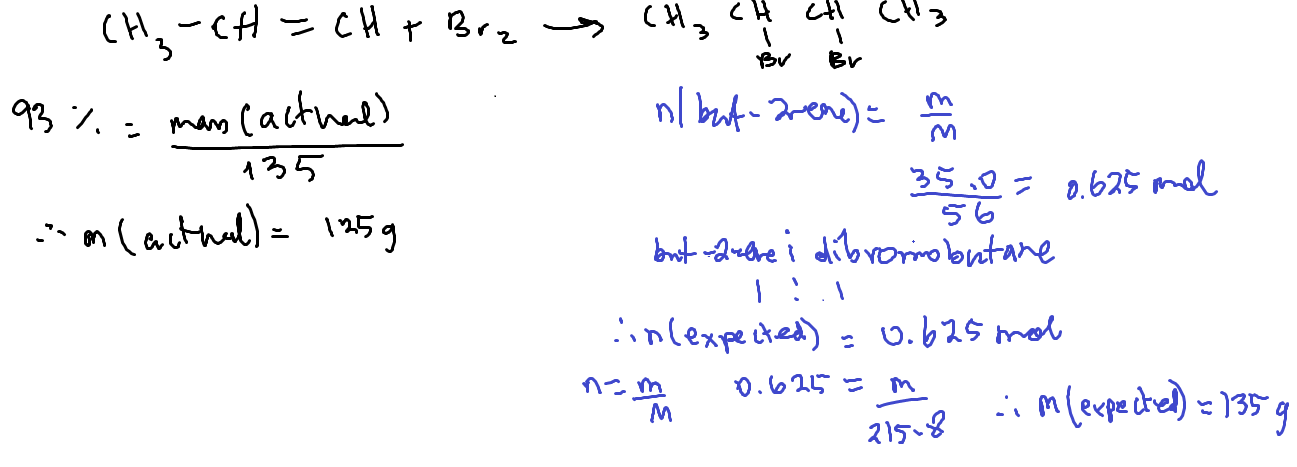
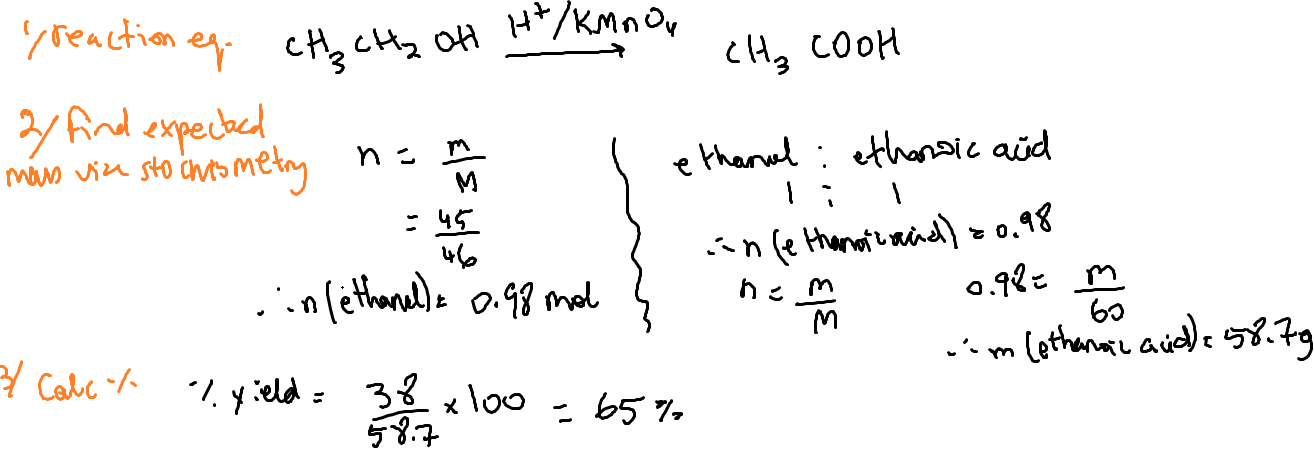
%yield= m(actual)/m(expected)*100
we can change the reaction conditions to improve the production of a chemical and improve %yield.
e.g. A 45g sample of ethanol was oxidised to form ethanoic acid using acidified KMnO4. The product was purified by distillation and had a mass of 38g . Find %yield.
 e.g.2 The addition reaction between but-2-ene and Br2 has a 93.0% yield. If 35.0g of but-2-ene was added to excess Br2 find the mass of product obtained.