Waves 🌊
The Electromagnetic Spectrum (EMS)
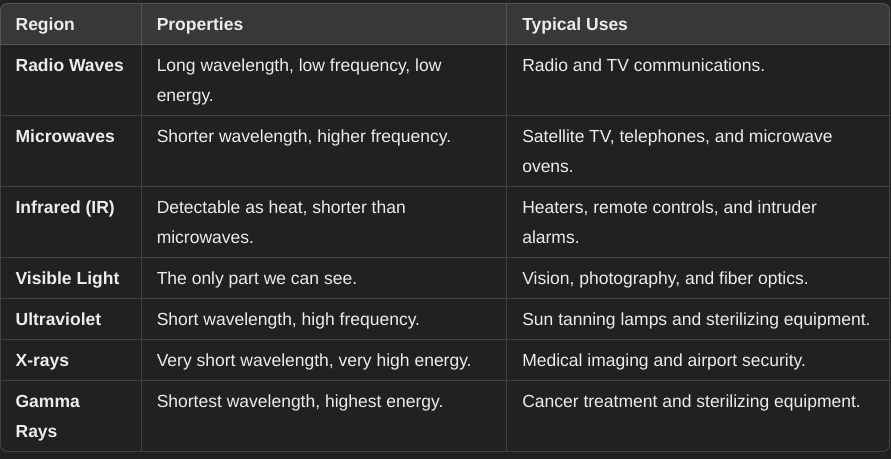
The electromagnetic spectrum consists of waves arranged in order of increasing frequency (and decreasing wavelengths) as follows:
Radiowaves
Microwaves
Infrared Radiation
Visible Light
Ultraviolet Radiation
X-Rays
Gamma Rays (Y-rays)
Speed of electromagnetic waves:
All electromagnetic waves travel at the same speed in a vacuum at the speed of 3.0 × 10⁸ m/s. In air, they travel approximately the same speed as in a vacuum.
Properties of each wave in the EMS:
Radiowaves
Properties- Long wavelength, low frequency, low energy
Uses- Transmitting information over long distances (eg- communication in broadcasting)
Microwaves
Properties- Shorter wavelength and higher frequency than radiowaves, low energy (but still slightly more than radiowaves)
Uses- Satallite communication, microwave ovens for heating food
Infrared Radiation (IV)
Properties- Wavelength is shorter than microwaves, but longer than visible light.
Uses- Used in vision and photography, fiber optic communication
Visible Light
Properties- The only part of the EMS that is visible to the human eye.
Uses- Fiber optic communication
Ultraviolet radiation (UV)
Properties- Higher frequency and shorter wavelength than visible light, high energy
Uses- Sun tanning lamps, sterilizing equipment
Danger- Exessive exposure to UV (eg- from the sun) can cause sun burns, skin cancer, and eye damage.
X-rays
Properties- Very short wavelength and high energy
Uses- Medical imaging (X-ray imaging), scanning luggage at an airport
Dangers- Overexposure to x-rays can cause DNA damage, which can lead to cancers, so protective measures (eg- lead shielding) are necessary.
Gamma rays (y- rays)
Properties- Highest frequency, wavelength, and highest energy
Uses- Medical treatment (eg- radiotherapy to kill cancer cells) and sterilize medical equipment
Dangers- Highly penetrable and causes DNA damage, which can lead to cancers.
Dangers and safety issues:
Microwaves
Danger- Can cause body tissues to become hotter and cause damage with prolonged exposure.
Safety- Use proper shielding (eg- microwave oven protection)
X-rays
Danger- Are ionizing radiation and can cause DNA damage and increase skin cancer risk.
Safety- Use lead shielding and minimize exposure
Ultraviolet Radiation (UV)
Origin- Comes from the sun and tanning lamps (can also be produced artificially)
Danger- Excessive exposure can cause eye damage, sunburns, sun poisening, skin cancer.
Safety- Use sunscreen, sun glasses, and minimize exposure
Gamma rays
Same as X-rays, but more severe
Key Facts
Electromagnetic waves are transverse waves.
They travel at 3.0 × 10⁸ m/s in a vacuum.
Frequency increases with decreasing wavelength (inverse relationship)
General Wave Properties
Key Concepts:
Waves transfer energy, without transferring matter
This is because the particles oscillate (move back and forth) but do not move with the wave, so only energy is transferred through the medium.
Wave Motion:
Can be demonstrated through these 2 experiments:
Vibrations in ropes and strings.
When a pulse or disturbance travels along the rope/string the rope itself stays in place.
Water Waves
Dropping a stone into water, creates ripples (waves) that spread out, and spread energy across the water surface.
Wave Terminology:
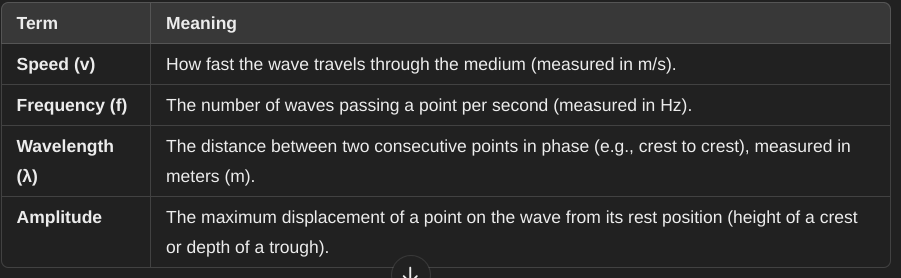
Speed (v)- How fast the wave travels through the medium (measured in m/s)
Frequency (f)- The number of waves passing a point per second (measured in Hz)
Wavelength (Lambda)- The distance between two consectutive points in a wave (crest to crest, trough to trough) (measured in m)
Amplitude (A)- Height of crest or trough at their deepest/highest point.
Transverse vs Longitudinal Waves:
Transverse Waves
Behaviour- Oscillations (vibrations) are perpendicular to the direction of energy transfer.
Examples- Water waves, light waves, waves on a rope
Longitudinal Waves
Behaviour- Oscillations are parallel to the direction of energy transfer.
Examples- Sound waves, compressions in springs.
Wave Behaviors:
NB- Reflection and Refraction or not limited to light waves, but can also happen with other wave like sound waves.
Reflection
Definition- When waves bounce back when they hit a plane surface.
Example- Light reflecting a mirror, sound waves echoing
Law of reflection- Angle of incidence equals angle of reflection
Refraction
Definition- When a wave changes direction when it passes from one medium to another due to the change in speed.
Key points:
When a wave slows done (eg- air to glass) they bend towards the normal line.
When a wave speeds up (eg- glass to air) they bend away from the normal line.
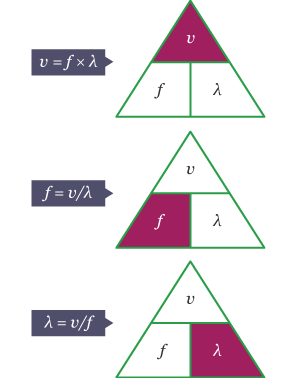
Wave Equuation:
v= flambda
speed= frequency x wavelength
Light Waves
Formation of an optical image by a plane mirror:
When a light wave is reflected off a plane mirror, they form an image that has these characteristics:
Virtual- Cannot be projected onto a screen, because it is formed by the apparent intersection of reflected rays.
Upright- The image is always the right the way up.
Same Size- The image is always the same size as the object.
Same distance behind mirror- The image appears to be as far behind the mirror, as it is in front of the mirror.
Law of Reflection:
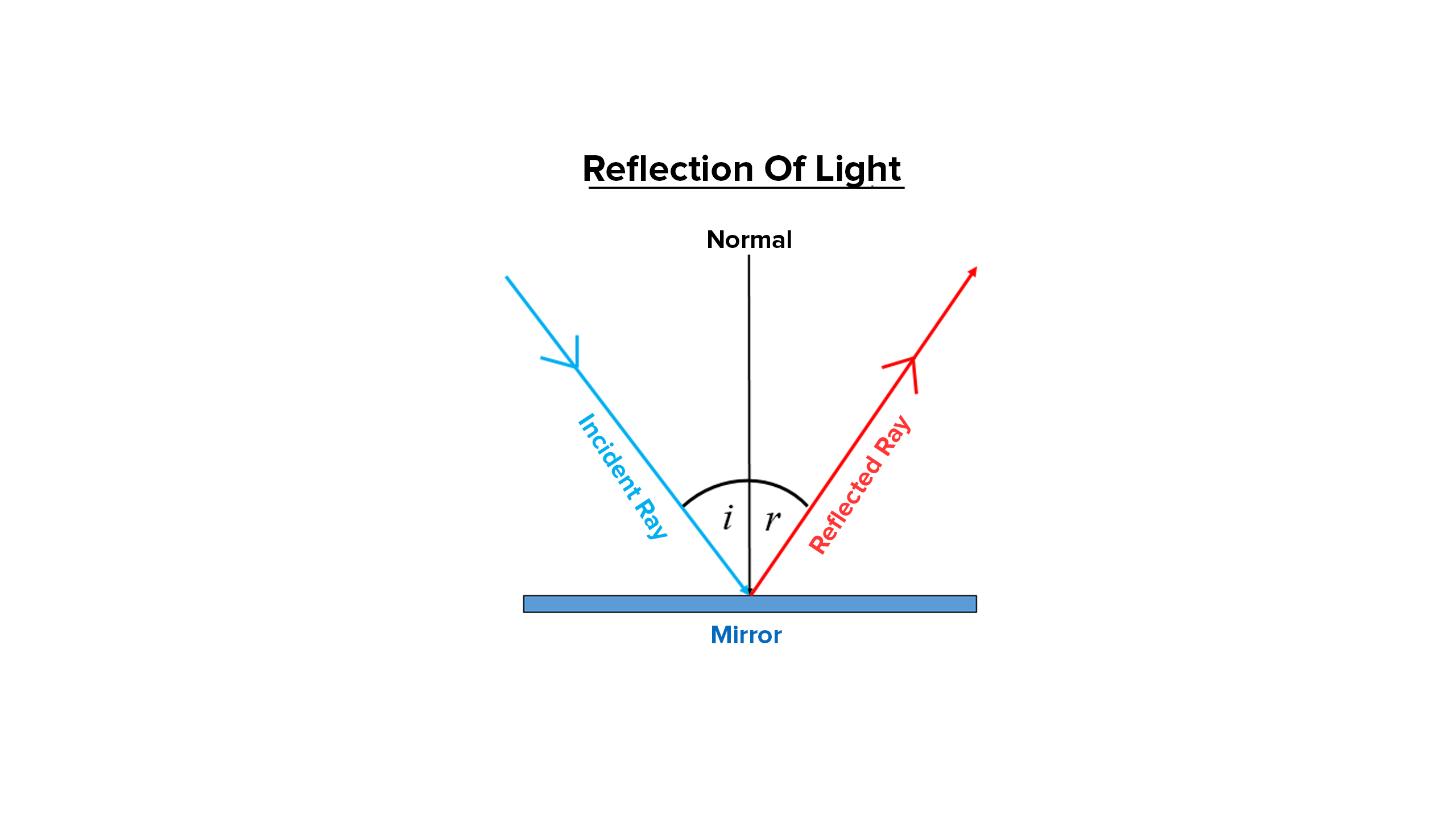
Law= Angle of reflection= angle of incidence
Definition of angles:
Both angles are measured relative to the normal line, which is an imaginary line perpendicular to the surface of the mirror that is being hit by the ray of light.
Ray of reflection= The ray of light that is reflected off the mirror.
Ray of incidence= The ray of light that is pointed towards the mirror.
Simple constructions, measurements, and calculations for reflection by plane mirrors:
Ray Diagram Construction
Draw the ray of incidence hitting the mirror at a specific point.
Draw the normal line, which is perpendicular to the mirror.
Reflect the ray, so that the angle of incidence equals the angle of reflection (law of reflection).
Extend the reflected ray behind the mirror, to show the virtual image.
Calculations
Use a protractor to measure i (angle of incidence) and r (angle of reflection).
Confirm i=r for accurate reflection.
Experiment for Refraction of Light:
Materials you need:
Glass or perspex block
Ray box (and material to set it up)
Protractor
Pencil
Ruler
Procedure
Shine a ray of light into the block
Observe how the ray of light bends as it enters the block (refraction occurs because the speed of light is decreased)
Mark the path of the incident and refracted ray (inside the block), and emergent ray (when it leaves the block)
Measure the angles of incidence and refraction
Observations
When light enters a denser medium (air to glass) it bends towards the normal line
When light exits to a less dense medium (glass to air) it bends away from the normal line
Key Summary Points
A plane mirror produced a virtual, upright, laterally inverted image the same size as the object.
The law of reflection states that i=r, measured relative to the normal line.
Reflection can be demonstrated using ray diagrams, protractors, and mirrors
Refraction occurs because light changes speed as it travels between materials of different densities
Sound Waves
Production of Sound:
Description- Sound is produced when objects vibrate, these vibrations disturb the sorrounding medium creating regions of compression (high pressure) and rarefaction (low pressure).
Examples- When a guitar string is plucked, it produces sound. A tuning fork produces sound, as it vibrates, which disturbs the air molecules.
Longitudinal Nature of Sound Waves:
Definition- Sound waves are longitudinal waves, this means that the particles in the medium vibrate parallel to the direction of energy transfer
Key Feature- The wave will consist of alternating compressions (particles close together) and rarefactions (particles spread out).
Range of Audible Frequencies for humans:
A healthy human ear can hear sound waves within 20Hz (low pitch sounds) to 20kHz (high pitch sounds).
Sound below 20Hz are called infrasounds, and sounds above 20kHz are called ultrasounds.
Understanding the Need for a Medium:
Key Point- Sound waves require a medium (solid, liquid, or gas) to travel, because they depend on particle vibrations to propagate.
Vacuum Experiment- If a bell jar is placed in a vacuum and the air is removed, no sound can be heard because there are no particles to transmit the sound waves.
Speed of Sound in Air:
Experiment:
Materials
A pistol (or a loud clap)
Two people
Stopwatch
A large open space
Procedure
One person fires a pistol or a loud clap
The other person (who has a distance between the other person) starts the stopwatch when they see the pistol fire or clap clap, and stop the stopwatch when they hear the sound (Best works when they have a large distance between them, and they use a light flash to start the stopwatch)
Measure the distance between the two people.
Calculation:
Formula- Speed of Sound= distance/time
Distance= speed x time
Time= Distance/speed
Common result- the speed of sound in air= 340 m/s (usually)
Sound of speed in different media:
Gases (slowest)
Sound travels slowest in gas, because the particles are farther apart (in air 340 m/s)
Liquids (faster)
Sound travels faster in liquids than gases, because the particles are closer together (in water 1500 m/s)
Solids (fastest)
Sound travels the fastest in solids, because the particles are close together (in steel 5000 m/s)
Loudness and pitch of Sounds:
Loudness= Determined by the amplitude of the wave. Large amplitude= louder sound.
Pitch= Determined by the frequency of the wave. Higher frequency= Higher pitch
Reflection of Sound Waves:
Reflection= When sound waves hit a hard smooth surface, they reflect back, creating an echo.
Conditions for an echo;
The reflected sound must take 0.1 seconds to reach the ear for it to be heard as an echo.
This requires the reflecting surface to be at least 17 meters away.
Example- Echoes heard in large empty halls, caves and mountains.
Key Points:
Sound waves are produced by vibrating sources and require a medium to travel.
Sound waves are longitudinal, consisting of compressions and rarefactions.
Humans can hear sounds between 20Hz to 20kHz.
Sounds travel fastest in solids, slower in liquids, and slowest in gases .
Loudness related to amplitude, and pitch related to frequency.
Sound reflection causes echoes, which require sufficient distance.