PSY230_Study Guide_Exam 1 (Modules 1-4) 6e

PSY230 Study Guide
Exam 1 (Modules 1 – 4)
Chapter 1: The People and the Field
- Explain the contexts of development and provide examples from the 20th century that have impacted lifespan development.
- How did conceptions of childhood, adolescence, and late adulthood change over the 20th century?
Conceptions regarding Childhood adolescence and late adulthood have changed drastically as different societal factors have changed, such as working age, marriage age, and general lifespan. Following baby boomers there became a bigger emphasis on the joy of childhood and adolescence.
- Discuss major changes in the 20th century that has contributed to a longer lifespan.
Medical advances such as vaccines and antibiotics helped others to survive longer. In addition to this, the use of pasteurized milk lessened the number of infant mortality rates.
- Compare and contrast individualistic and collectivistic cultures.
Individualistic cultures focus on independence and personal success. While collectivistic cultures focus on dependency on family with great emphasis on respecting your elders. Both of these cultures can show the importance of being a part of a group is it deciding whether or not to stay in this group based on social pressures is where these two cultures take different directions
- Explain the major theoretical perspectives of developmental psychology including nature vs. nurture, behaviorism, cognitive psychology, and psychoanalysis.
nature vs nurture is the argument on whether children are shaped by their environment (nurture) or based on their biology (nature). Behaviorism is the belief that our development falls under the nurture category in that it believes that behavioral development is based on what we reinforce and what we discourage with children. Cognitive psychology focuses on how people think, Jean Piaget is a cognitive psychologist. Lastly, psychoanalysis is an analysis of the human psyche in discovering conscious and unconscious fears and desires to discover why a person might think a certain way.
- What is the purpose of twin and adoption studies and twin/adoption studies?
to observe the nature vs nurture theory in analyzing how those with the same genetic code end up developing in comparison to one another.
- Briefly describe the contributions made by Bowlby and Piaget.
Bowlby created the attachment theory that states that whatever we attach to for safety as children translates into our adult lives based on how our caregivers treat us. Piaget took a different look into development which contradicted Freud’s theory of development in that Piaget broke down the different stages of childhood in a non-sexual way.
- Compare and contrast the following types of research: correlational, true experiment, case study.
A correlational study is a study that compares two different variables in relation to each other. A true experiment occurs when the independent variable is manipulated in order to deny or prove a hypothesis. A case study is a study that is conducted on a specific person, group or community in order to better understand the subject.
- Describe data collection strategies used by researchers.
Naturalistic observation occurs when someone is being recorded as they are in their natural environment, these are naturally occurring events being recorded. Self-reports are created when individuals reflect and report their feelings, ideas, and thoughts regarding a certain subject. Observer reports are reports made when a person is observed and ranked by a knowledgeable individual based on the behavior shown.
- Compare and contrast cross-sectional and longitudinal studies. Discuss the pros and cons of each.
Cross-sectional studies compare different age groups at the same point in time while longitudinal studies compare a certain age group over a very long period. These two studies both rely on similar variables with people and time. On the downside to cross-sectional studies, it is hard to determine people individually as data is recorded in a group setting. Longitudinal studies can often prove to be hard work, the doctors and the patients involved have to be devoted to the experiment for years on end. But it does give proper insight into what the researchers are attempting to discover due to this devotion over a long period of time.
Chapter 2: Prenatal Development, Pregnancy and Birth
- Explain the reproductive systems of males and females and discuss how the process of fertilization unfolds including the development of body parts, internal organs, the CNS, neural connections, and brain development.
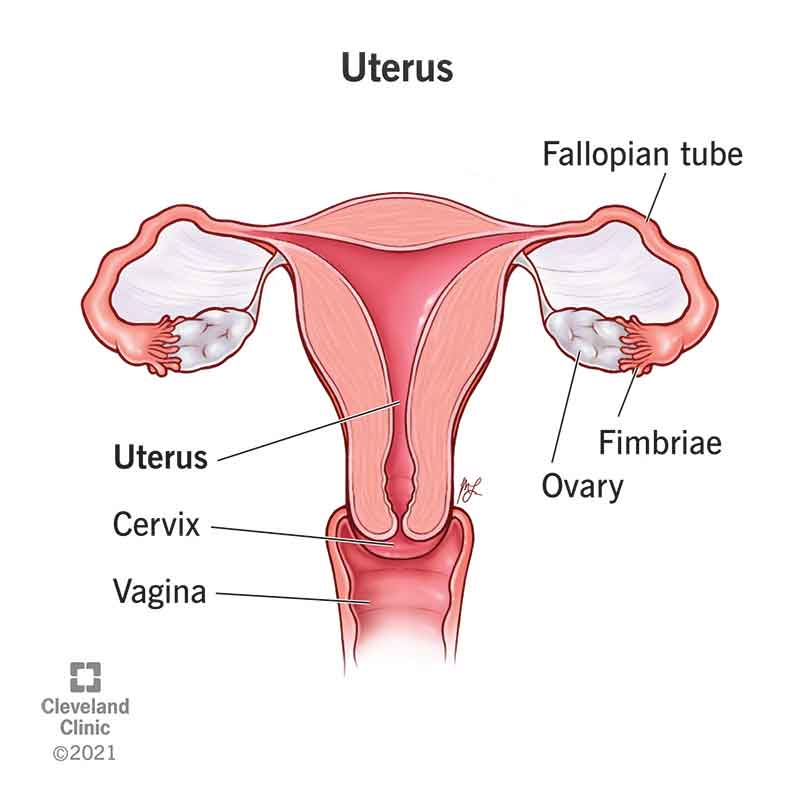
The uterus is the organ of the female body that holds a baby during pregnancy, the baby comes out through the cervix upon birth. Fertilization occurs during ovulation which is the period that is on day fourteen of the woman's menstrual cycle. The testes are the male equivalent of the ovaries. Ovaries are created at birth while men continually produce in the testes.
- Describe the three stages of prenatal development by explaining developmental milestones within the womb.
- Germinal stage- (1-2) the zygote begins to divide and grow in complexity, shortest stage the fertilized egg (blastocyst) travels toward the uterus
- Embryonic stage (week 3-8) all major organs are created, most faced pace thing of development, day 26 arm buds; day 28; legs swell; day 41 hands and at week 8 all internal organs are in place
- Fetal stage (week 9 to 12) longest stage; additional growth in the babies body such as hair and brain
- Describe the structures of the womb and their functions
Fallopian tubes: upper end of the uterus that serve as conduits to the uterus.
Ovary: keeps mothers eggs inside
.
- Describe the typical experience of each trimester of pregnancy.
first trimester; feeling tired and ill; fainting, throwing up, urinating a lot
second trimester; feeling much better and connecting emotionally
third trimester; backaches, getting very large, cramps
- Discuss the various types of teratogens and their effects during prenatal development including substances such as alcohol and nicotine, infectious diseases, medications, recreational drugs, environmental toxins, and stress.
Alcohol; fetal alcohol syndrome, impaired mental health, and face abnormalities (flat face) smaller birth weight etc
Nicotine: children can’t receive the nutrients they need inhibits brain development
Infectious diseases:
Medications: antidepressants; premature birth.
Radiation and Lead: impairments to brain and cognitive functioning
- Explain the four teratogenic principles.
- Teratogenic factors create major structural damage in the first stage (embryonic)
- Teratogens can affect the developing brain through pregnancy during the second and third trimester the exposure to teratogens increases the risk of developmental disorders
- Teratogens have a threshold level above which damage occurs; ex women who have coffee 4 times a day are worse off than a woman who might have an occasional soda
- Teratogens exert their damage unpredictably; depending on fetal and maternal vulnerabilities
- Discuss chromosomal threats and down syndrome.
Sometimes children are born with a missing chromosome or an extra chromosome this can happen due to genetic birth defects. When someone is born with an extra chromosome they will have Down syndrome this occurs due to an error in cell division this error is called a nondisjunction.
- Explain the three types of genetic disorders (dominant, recessive, and sex-linked) and provide examples of each with their effects.
Dominant | Recessive | Sex Linked |
|---|---|---|
Tay-Sachs: fatal infant nervous system disorder; fatty material in neurons; common in Jewish and European ancestory | Hemophilia: blood clotting disorder in males; uncontrolled bleeding and pain | |
Huntington's disease: nervous disease; jerky movements; dementia | Cystic Fibrosis: single gene disorder; muscus clogs lungs and pancreas | |
Sickle Cell Amenia: blood cells collapse and clump 2gether; organ damage; o2 deprivation |
- Describe the three stages of birth and any threats to delivering a baby.
- Dilation and Effacement: The cervix must thin out (efface) and dilate 30 pounds of pressure to the cervix; contractions
- Birth: Baby's scalp appears in what is known as crowning; baby slithers out
- Expulsion of the Placenta: The placenta and other supporting structures are pushed out
Threats: Baby isn’t head down; mainly positional problems
- Explain the APGAR test given to infants upon birth.
The APGAR test is given upon minutes of birth and rates an infants heart rate, muscular tone, respiration, reflex response, and color. This test is given within the first 2 minutes of birth and then five minutes after birth. This determines how healthy the baby is and whether or not they will need to further their stay to ensure their health at the hospital.
Chapter 3: Physical and Cognitive Development in Infants and Toddlers
- Brain Development
- Connections in the Brain: axons are fibers that conduct impulses they sprout dendrites which are long and branch-like. The connection between these two is what is defined as synapses
- Pruning and plasticity: pruning is the process where the brain eliminates extra synapses; plasticity is the ability of the brain to change because of experience
- Reflexes – be able to define, give examples, and connect to survival.
Reflexes are automatic responses to a stimulus, reflexes such as the rooting reflex (turns head when touched) and sucking reflex (they suck all the time) in babies are based on their survival instinct to be fed,
- What are the benefits and barriers of breast feeding?
Breastfeeding is free, meaning those in poor countries or households get to limit just one more expense that comes with having a child. It also has been proven to be good for the baby long term to help with memory and behaviors. Barriers include work (most women can’t call off for maternity leaves that long), social stigma (people are weird and suck balls; women can’t do anything without people complaining) and lastly it hurts for a lot of mothers.
- What is the purpose of crying? What is kangaroo care?
To communicate how we are feelings especially for babies who can’t communicate through words yet. Kangaroo care is when a baby snuggles with their parent with skin-to-skin contact with some sort of cloth or sling to wrap the two together like in a kangaroo pouch.
- Malnutrition & food insecurity
Malnutrition is the lack or excess of nutrients; typical in second-world countries and common after wars. Food insecurity refers to where there is limited adequate food for others.
- Sleep: stages, self-soothing, SIDS
When we fall asleep we fall into three stages involving rapid eye movements and slower brain waves and eventually, we fall into REM sleep our brain waves are at their lowest. Self-soothing is when we can soothe ourselves by falling back asleep after waking up after 6 months of age. Sudden Infant Death Syndrome (SIDS) explains the death of a healthy baby while sleeping under one.
- Senses and Motor Skills
- Habituation: the fact that we lose interest in an object after a while.
- Sensation and Perception: face perception (making sense of the human face), depth perception (ability to judge distance), and visual cliff (an “end” of a table based on perception)
- Motor Skills: Babies have control over shoulders before arms and fingers. first step near age one
- Sensorimotor Intelligence
- Stages One and Two: Primary Circular Reactions (mouthing schema, by age two babies, stop relying on reflexes and start to rely on symbolic thoughts; thumb makes contact with the mouth; waving legs)
- Stages Three and Four: Secondary Circular Reactions (reaching; action-oriented schemas; can do two circular reactions at once)
- Object permanence: believing an object is there even when it is out of view sight
- Stages Five and Six: Tertiary Circular Reactions 18 to 24 months
- “little scientist” and imitation - explores the reactions to the objects of the world through things such as throwing; and trying different things.
- Piaget and modern research: What are some contemporary critiques of Piaget’s work? We now know that infants grasp the basics of physical reality before age one and that this grasp on reality happens gradually. Piaget believed that infants understand this later.
- Language Development in the First Two Years
- The Universal Sequence of Language Development (language milestones table 3.9 on p. 99)
2-4 Months | cooing: growing out reflexes |
|---|---|
5-11 Months | babbling:vowel-constant sounds |
12 Months | holophrases: 1-word sentences |
18 Months -2 years | telepathic speech: 2-word sentences |
- Theories of Learning Language
- LAD: hypothetical brain structure that allows our species 2 use communication and produce it
- Behavioral reinforcement: what we encourage in behavior is what ur child will do
- Social-interactional model: learning through social settings and example
- Theories of Learning Language
Chapter 4: Emotional and Social Development in Infants and Toddlers
- Attachment
- Milestones
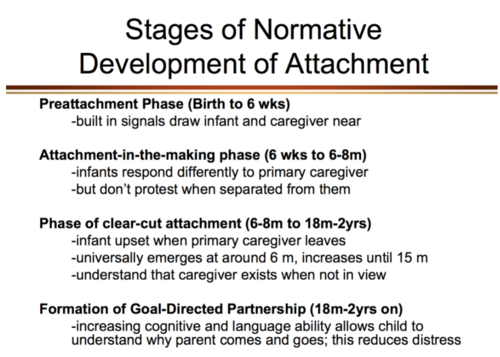
- Separation and stranger anxiety- nervous and agitated about being in the hands of strangers
- Social referencing- when children look to their caregivers for their reactions
- Styles (secure, avoidant- doesn't show a lot of emotion, anxious- shows a lot of emotion, disorganized- runs around freezes, frightened)
- Strange situation- baby is left in a room full of toys, the mother leaves and a stranger comes in to replace the mother
- Synchrony- the sense of being emotionally in tune
- The universality of attachment- when given an opportunity all infants without severe neurological impairments will become attached to their parents
- Adult relationships and attachment- Women who have happy childhoods have securely attached children (typically)
- Temperament and socialization fit- trying to find a solution to a child’s temperament such as a shy child etc
Shy/Timid Child | don’t be overprotective; introduce them to new people and places |
|---|---|
Exuberant Child | use time outs; respond empathetically to child's problems |
- Effects of poverty
Low-income toddlers have high cortisol levels. Will have problems academically.
- Head Start program – What is it? Why is it used? Is it effective?
government-sponsored program for early childhood, helps those in poverty to be prepared academically. Not super effective due to underfunding.
- What is the impact of childcare on infants? What types of things should a parent consider in choosing a childcare center?
show elevated cortisol levels, making it harder for them to handle stress later on in life. Parents should look for a childcare center that has a low teacher-to-child ratio and a well-designed facility that is interactive.