AP Psyc Unit 2: Cognition (copy)
1. Perception
Perception is influenced by whether one primarily relies on external sensory information (bottom-up processing) or internal prior expectations (top-down processing).
An example of this is:
If I am driving, bottom-up processing includes processing information about the road, other cars, and traffic signals.
Top-down processing involves using prior knowledge and experience to make decisions, such as knowing to brake when approaching a red light.
Factors Influencing Perception
Biological: Sensory processing, innate visual abilities, critical periods for development.
Psychological: Attention, learned schemas, emotions, expectations.
Social-Cultural: Cultural norms and beliefs, physical context.
Schemas and perceptual sets are internal factors that filter perceptions of the world.
Schemas are cognitive frameworks or concepts that help organize and interpret information.
A perceptual set refers to a predisposition to perceive things in a certain way.
Contexts, experiences, and cultural experiences and expectations are external factors that filter perceptions of the world.
A doctor examining a patient might have a perceptual set to look for signs of illness.
Perceptual principles proposed by Gestalt psychology (closure, figure and ground, proximity, and similarity) help explain how humans organize their perceptual world.
Proximity: We group nearby figures together.
Similarity: We group figures that are similar to each other.
Continuity: We perceive smooth, continuous patterns rather than discontinuous ones.
Connectedness: We see uniform and linked objects as a single unit.
Closure: We fill in gaps to create complete, whole objects.
Attention is an interaction of sensation and perception that is affected by internal and external processes.
Some experiences of attention can be selective, such as with the cocktail party effect, where people attend to mentions of their names or specific topics in loud or distracting environments.
Inattention can lead to a type of “blindness” to aspects of the environment.
Change blindness occurs when changes to the environment are not perceived due to inattention.
Binocular depth cues of retinal disparity (the difference between the images projecting onto the retina) and convergence (the merging of the retinal images by the brain) utilize images from each eye to provide the perception of depth.
In convergence, the brain merges the images from both retinas. This provides the perception of depth. Both of your eyes need to look inward together.
Monocular depth cues (relative clarity, relative size, texture gradient, linear perspective, and interposition) give the illusion of depth on flat or two-dimensional surfaces.
With relative clarity, hazy objects are further away than sharp, clear objects because the light from distant objects has to pass through more atmosphere.
In relative size, objects that appear larger are closer to your retina. Those that are smaller are farther away.
Smaller objects that are more thickly clustered appear farther away than objects that are spread out in space due to texture gradient.
Linear perspective consists of parallel lines that seem to converge in the background.
Interposition is when one object overlaps another, the partially covered object is further away.
Perception: Movement, Constancy, and Interpretation
Visual perceptual constancies maintain the perception of an object even when the images of the object in the visual field change. There is shape constancy, size constancy, color constancy and brightness constancy.
Size Constancy: We perceive an object's size as constant even when its distance changes.
Muller-Lyer Illusion: Two lines of the same length appear different due to the direction of arrows at their ends.
Ponzo Illusion: Two horizontal lines of the same length appear different because of converging lines around them.
Ames Room: A distorted room that makes people appear to shrink or grow as they move across it.
Apparent movement can be visually perceived even when objects are not actually moving.
Stroboscopic Motion: The illusion of movement created by a series of rapidly changing still images. Example: Flipbooks or animated films.
Phi Phenomenon: The illusion of movement created by flashing lights in a sequence. Example: Marquees or holiday lights.
2. Thinking, Problem-Solving, Judgments, and Decision Making
Cognition (Thinking): Mental processes involved in knowing, understanding, remembering, and communicating.
Concepts: Mental groupings of similar objects, events, ideas, or people.
Prototypes A mental image or best example of a category, used to help us quickly identify new things.
People form and modify schemas, or frameworks for thinking, through assimilation (taking in new information but not changing the schema in light of it) and accommodation (taking in new information and changing the schema to incorporate the new information).
Algorithms address problems by attempting all possible solutions until the correct one is found. Using algorithms, a step-by-step process is completed the same way every time.
One such algorithm might be tying your shoes.
Another is solving a mathematical equation. If we can complete something using a step-by-step approach, then we can solve it using an algorithm.
Heuristics address problems by using mental shortcuts to make judgments.
Example: Looking for a lost item in the last place you remember seeing it.
Using heuristics can lead to errors in judgment when decisions are made according to prior expectations or stereotypes (representativeness heuristic) or recalling the first or most vivid example that comes to mind (availability heuristic).
We have limited cognitive resources, we categorize people based on our schemas and prototypes and we overestimate how important similarity is.
In the availability heuristic, certain events stand out in our minds more than other events. It could be because it is something you recently learned, it concerns an event that had a significant impact on you, something you think about frequently, or is easier to remember.
Representativeness Heuristic: Judging the likelihood of something based on how well it matches our prototype, often leading to stereotypes and ignoring other relevant information.
Insight: A sudden realization of a solution. Example: The "aha!" moment when you finally understand a concept.
Decision-making can be influenced by prior experiences that were successful (mental set) or circumstances surrounding a decision (priming and framing).
In priming, the introduction of a stimulus influences how people respond to a subsequent stimulus.
If I give you the word “yellow” and then a list of other words, you will be likely to remember words that you associate with yellow, such as banana or submarine.
In framing, you make a decision based on whether it has been put into positive or negative connotations.
Cognitive processes such as gambler’s fallacy and sunk-cost fallacy can hinder people from making good decisions.
In the gambler’s fallacy, we believe that the probability of a random event occurring in the future is influenced by previous instances of that type of event.
In the sunk-cost fallacy, we tend to follow through with something that we have already invested heavily in (whether it is time, money, effort, or emotional energy), even when giving up is clearly a better idea.
Executive functions are cognitive processes that allow individuals to generate, organize, plan, and carry out goal-directed behaviors and experience critical thinking.
Convergent thinking focuses on reaching one well-defined solution to a problem.
Divergent thinking is the process of creating multiple, unique ideas or solutions to a problem that you are trying to solve.
Lateral thinking is a form of ideation where designers approach problems by using reasoning that is disruptive or not immediately obvious.
Obstacles to Problem-Solving
Fixation: Getting stuck in one way of thinking about a problem.
Mental Set: The tendency to approach a problem in a way that has worked in the past, even if it's not the best approach for the current problem.
Functional Fixedness: The tendency to see an object only in terms of its typical use. Example: Not realizing you can use a dime as a screwdriver.
Confirmation Bias: The tendency to search for information that confirms our preconceptions and ignore information that contradicts them.
Biases
Overconfidence: Tending to be more confident than correct.
Exaggerated Fear: The opposite of overconfidence, having an unrealistic fear of something.
Framing: How an issue is presented can significantly affect decisions and judgments.
Belief Bias: Pre-existing beliefs distort logical reasoning, sometimes leading to faulty conclusions.
Belief Perseverance: Clinging to beliefs even when faced with evidence that contradicts them.
Hindsight Bias: The tendency to believe, after an event occurs, that we knew it would happen all along. Example: "I knew they'd win the game!" (said after the game ends)
Creativity
Definition: The ability to produce novel and valuable ideas.
Components of Creativity:
Expertise: A solid foundation of knowledge in a specific field, which provides the building blocks for creative ideas.
Imaginative thinking: The ability to see connections between seemingly unrelated ideas, think outside the box, and generate novel solutions.
Adventuresome personality: A willingness to take risks, embrace uncertainty, and try new things without fear of failure.
Intrinsic motivation: Being driven by an internal desire to create, rather than external rewards like money or praise.
A creative environment: A setting that supports and encourages creativity, providing opportunities for experimentation and feedback.
3. Memory

Memories for learned knowledge, events, and experiences are differentiated by how they are processed by, stored in, and retrieved by the brain.
Flashbulb Memory: A vivid, detailed memory of an emotionally significant event.
Explicit memory is a type of memory that is more easily described or explained to others. Types of explicit memory include episodic and semantic.
An episodic memory is a memory of a specific event. This is what most people call a memory.
In semantic memory, this is the knowledge that you have accumulated over your lifetime.
Implicit memory is more challenging to describe or explain to others.
Procedural memory is a type of implicit memory for procedures and processes.
Prospective memory is a type of memory related to future actions.
Long-term potentiation, a process by which synaptic connections between neurons become stronger with frequent activation, is a biological process for memory.
Baddeley's working memory model examines how our primary memory system—working memory—engages in a dynamic international with several components, namely the central executive, phonological loop, and visuospatial sketchpad, to process information into long-term memory.
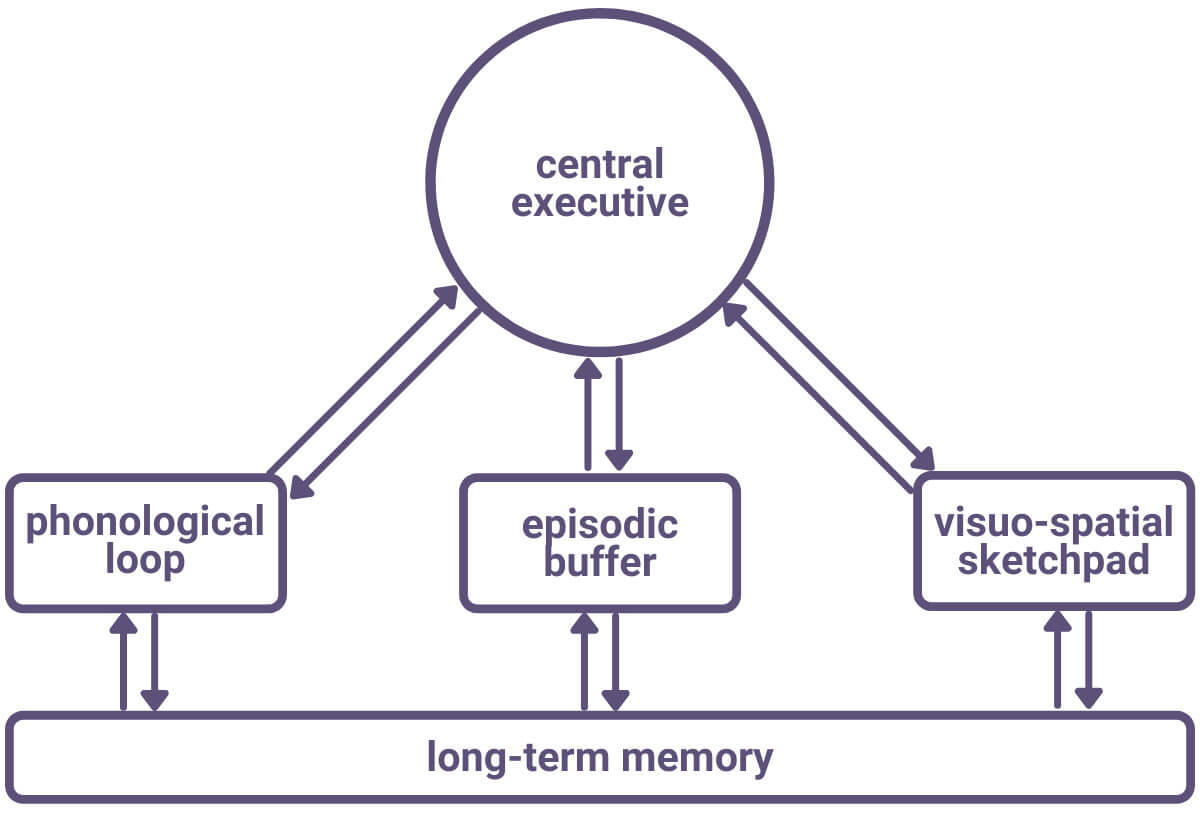
The central executive is responsible for controlled processing in working memory, including, but not limited to, directing attention, maintaining task goals, decision-making, and memory retrieval.
The phonological loop is the speech and sound-related
component of working memory and holds verbal and auditory information.
The visuospatial sketchpad refers to our ability to temporarily hold visual and spatial information, such as the location of our parked car, or the route from home to the grocery store.
Episodic Buffer: How long-term memory integrates with working memory and how different types of information, such as sounds and visuals, are combined
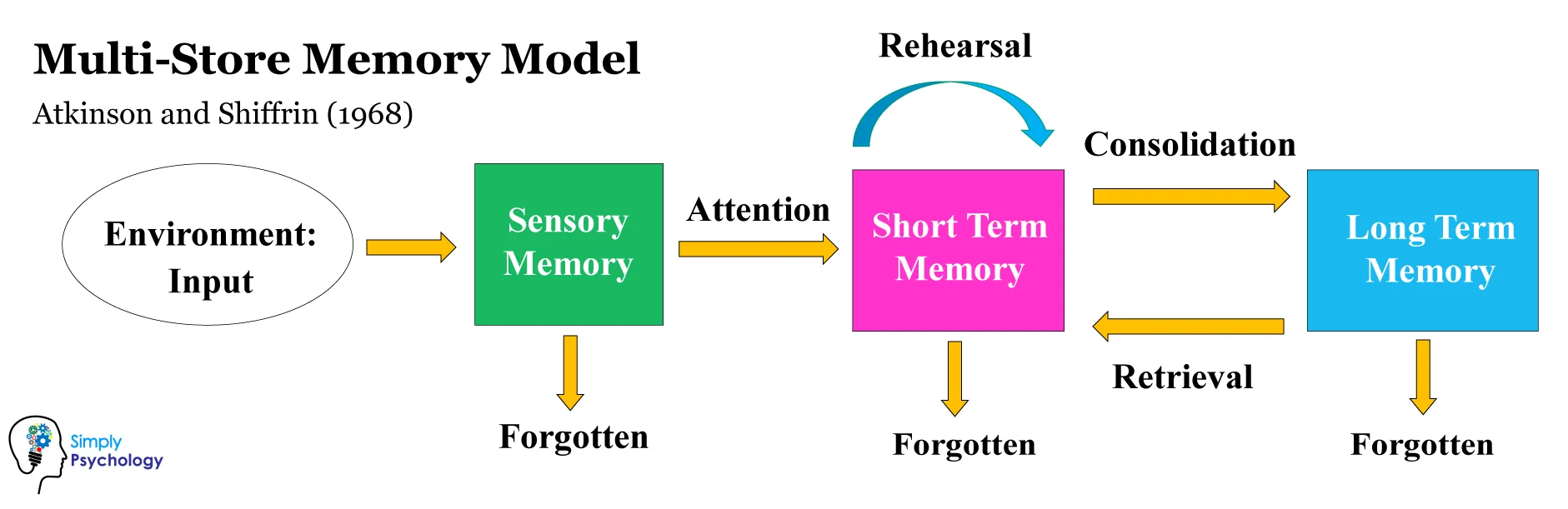
The multi-store model proposes three interacting systems (sensory memory [including iconic and echoic memory], short-term memory, and long-term memory) that information must pass through to be remembered. The model focuses on the impact of automatic and effortful processing on memory encoding, storage, and retrieval.
4. Encoding Memories
Encoding involves processes and strategies to get information into memory. How information is encoded can determine how effectively information is stored and retrieved.
Two Main Types of Encoding:
Automatic Processing: Unconscious and effortless encoding of information like space, time, and frequency. Example: Remembering where you parked your car.
Effortful Processing: Requires attention and conscious effort. Leads to more durable memories.
Mnemonic devices are processes that aid in encoding information into working and long-term memory.
Visualization
Story Telling
Acronyms
Songs and Rhymes
Acrostics
Chunking
Method of Loci
Encoding can be improved by the process of grouping information together into meaningful chunks (“chunking”), categories, or hierarchies.
The spacing effect is a process that can cause significant differences in encoding and memory consolidation depending on whether the information is encoded all at once (massed practice) or distributed over time (distributed practice).
Self-Reference Effect: We remember information better when it relates to ourselves or our personal experiences.
Next-In-Line Effect: Difficulty remembering information presented right before your turn to perform. Example: Forgetting what the person before you said in class.
Overlearning: Continuing to practice even after you think you've mastered the material. Helps solidify the information in long-term memory.
Encoding processes can be affected by the order of how the information is presented, called the serial position effect. The serial position effect predicts that information presented at the beginning of a list (primacy effect) or at the end of the list (recency effect) will be more memorable than information presented in the middle of a list.
The levels of processing model proposes that memory is encoded on three levels from shallowest to deepest: structural, phonemic, and semantic.
Structural: How is the word formed; Is it written in capital letters?
Phonemic: How does it sound; Does the word rhyme with mouse?
Semantic: What is the word describing; Is it something people can live in?
5. Storing Memories
Sensory memory, short-term memory, working memory, and long-term memory are processes that differ in storage duration, capacity, and content.
Sensory memory has five types-haptic (touch), echoic (hearing), iconic (seeing), olfactory (smell), and gustatory (taste).
There is a huge capacity for iconic memory (seeing), but it declines rapidly (about half a second).
Echoic memory (hearing) lasts several seconds.
Haptic memory (touch) last for about two seconds.
Olfactory memory (smell) is powerful due to the strong links between olfaction and emotion/memory in the brain.
As gustatory memory (taste) is linked to olfactory memory, there is also a strong emotional component here as well.
Short-term memory (STM) has a duration between 15 and 30 seconds, with a capacity of 7 ± 2 items (Miller, 1956).
With working memory, the information is either encoded into long-term memory or decays or is replaced. It has a duration of about 10-15 seconds unless it is rehearsed or we attend to it. The capacity of working memory is the amount we can attend to.
Long-term memory (LTM) may last for months, years, or decades. Its capacity is considered unlimited.
Storage may be prolonged by rehearsing information over time (maintenance rehearsal). Rehearsing information over time in ways that promote meaning (elaborative rehearsal) helps with memory retention.
Some people demonstrate highly superior autobiographical memory which may indicate that there are biological processes for superior memory storage.
Autobiographical memory may also explain why memories connected to our own lives or selves are more memorable.
Storage processes may be negatively affected by physical impairment and developmental limitations, such as amnesia (retrograde and anterograde), Alzheimer’s disease, and infantile amnesia.
Retrograde and anterograde amnesia commonly occur at the same time. This is what usually happens in dementia or Alzheimer’s disease.
Anterograde amnesia:
Inability to form new memories or retain new information after the onset of amnesia.
Can recall previously formed memories.
Caused by damage to the medial temporal lobe and medial diencephalon
Can be treated by learning through repetition, practice, and with proper cues.
Can be temporary or permanent.
Retrograde Amnesia:
Inability to recall memories and events that occurred before the onset of amnesia.
Able to encode new information.
Caused by damage to areas adjacent to the hippocampus.
This can be treated by exposing lost memories.
Usually temporary in nature.
Alzheimer’s Disease: Slowly destroys memory and thinking skills, and eventually, the ability to carry out the simplest tasks.
Infantile Amnesia: The inability to remember events from early childhood (usually before age 3).
Adults have difficulty remembering episodic experiences that occurred from (generally) ages 0-3 years and only have sparse recollection of episodic experiences that occurred before age 10. It is believed to occur because the brain of the child is still developing (the hippocampus) which would make memory consolidation difficult with deficits in memory retrieval.
6. Retrieving Memories
The process of memory retrieval occurs through recall (remembering without cues) or recognition (which relies on retrieval cues).
Retrieval Cues: Stimuli that help us remember. Example: Smelling a familiar perfume might trigger a childhood memory.
Metacognition: Thinking about your own thinking.
Consolidation: The process of stabilizing a memory trace after learning.
Web of Associations: Memories are connected to each other through a network of associations. These connections can help trigger memories.
The process of memory retrieval can be enhanced when people
are in the same environmental space (context-dependent
memory), mood (mood-congruent memory), or physical state
(state-dependent memory) as they were when they encoded the
information to be retrieved.
Déjà Vu: The feeling of having experienced something before, possibly due to cues triggering retrieval of a similar past experience.
Successful retrieval is more likely when using retrieval practice
processes, including testing effect and metacognition.
Example: Which of the following is a better strategy?
Strategy 1: You spend five minutes reading a passage and are finished.
Strategy 2: You spend five minutes reading a passage. Then you take a short break, before re-reading the passage. Then repeat this twice more, so that you have finally read the passage a total of four times.
Strategy 3: You spend five minutes reading the passage. Then you put the text away and spend ten minutes writing down everything you can remember on a blank piece of paper. Then repeat the process.
7. Memory Challenges
Forgetting: Why We Can't Remember
Encoding Failure: The information never got into memory in the first place due to lack of attention or interference.
Storage Decay: Memories fade over time if not used.
Retrieval Failure: The information is stored in memory, but you can't access it.
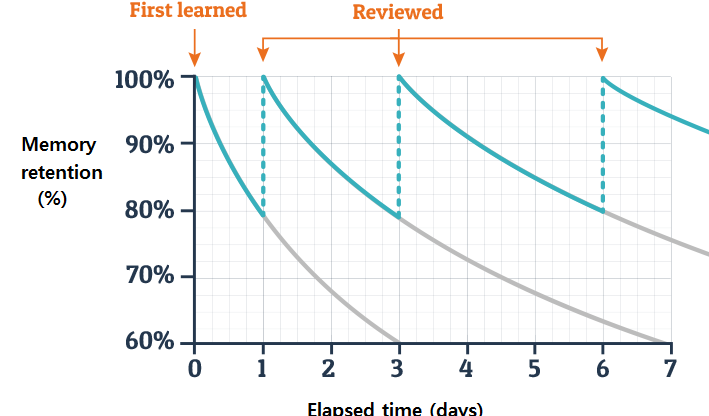
Ebbinghaus’ forgetting curve shows that time is a significant factor in
forgetting. Forgetting occurs rapidly after initial learning and
levels out over time.
Relearning: Learning something a second time is usually faster than the first time, indicating some memory remained.
Many memories are difficult to retrieve due to encoding failure. Interference (proactive or retroactive), or inadequate retrieval (i.e., tip-of-the-tongue phenomenon).
Proactive interference → Older memories interfere with remembering new information.
Retroactive interference →New information interferes with remembering old information
Forgetting and Memory Distortion
Sleep and Memory: Sleep helps prevent retroactive interference, improving memory consolidation. Tip: Study before bed!
Mass Practice (Cramming): Studying for long periods without breaks. Less effective for long-term retention than spaced practice.
Source Monitoring: Remembering where you learned information.
Psychodynamic theorists believe that information or memories can be forgotten to defend the ego from distress (repression).
Psychodynamic theories come from the work of Sigmund Freud and his psychoanalytic theories. The ego is the part of the mind that mediates between the conscious and unconscious. Keep in mind that most of Freud’s work has been disproven.
Motivated Forgetting (Freud): We may unconsciously forget things we don't want to remember
Suppression: Consciously trying to forget something.
Memory Construction and Errors
The accuracy of memories may be affected by the misinformation effect, source amnesia, or constructive memory (via memory consolidation and imagination inflation).
In source amnesia the memory of an event is retained but not the context in which we acquired it. It could be something that you experienced, heard about, read about, or imaged
Source misattribution occurs when someone does not remember where certain memories come from.
In constructive memory, we use a variety of information (perception,
beliefs, attitudes, etc.) to fill in gaps, and the accuracy of our memory
may be altered. Constructive memory includes the misinformation
effect, overconfidence effect, and hindsight bias.
The misinformation effect is explicitly listed in CED but the overconfidence
effect and hindsight bias are worth knowing. Both are cognitive biases.
In overconfidence, individuals tend to overestimate their abilities, knowledge, and skills in a particular area, leading them to make errors in judgment and decision-making.
The hindsight bias is when past events are perceived as having been more predictable than they were. “I knew it all along!”
Example: Have you ever discussed a childhood memory with a family member only to find that the memory was: from a movie you saw, or book you read? or a story someone told you about your childhood, but they were kidding? or from a dream you used to have? →If so, your memory of the event may have been accurate, but you experienced source amnesia: forgetting where the story came from, and attributing the source to your own experience.
Eyewitness Testimony: Why It's Not Always Reliable
Memory is Reconstructive: We fill in gaps with our own assumptions and biases.
Leading Questions: Can influence how witnesses remember an event.
Memory Fades Over Time: Details become less accurate.
Age: Children and older adults may be more susceptible to memory errors.
Intelligence
Definition: The ability to learn from experience, solve problems, and adapt to new situations.
Intelligence as a Concept, Not a "Thing": Intelligence is a complex mental ability, not a physical trait like height or weight.
Fluid intelligence involves comprehension, reasoning, and problem-solving,
Crystallized intelligence involves recalling stored knowledge and past experiences
Theories of Intelligence
Spearman's General Intelligence (g): A single underlying factor influences all mental abilities.
Thurstone's Primary Mental Abilities: Seven distinct mental abilities: verbal comprehension, word fluency, number facility, spatial visualization, associative memory, perceptual speed, and reasoning.
Key Points:
Both Spearman and Thurstone's theories are supported by research, suggesting that intelligence is a combination of general ability and specific skills.
While there is some debate about the exact nature of intelligence, most psychologists agree that it's a multifaceted concept.
Gardner's Multiple Intelligences
Key Idea: Intelligence is not just one general ability, but multiple independent abilities.
Evidence:
Brain damage can affect one type of intelligence without harming others.
Savant Syndrome: Individuals with exceptional skills in specific areas despite limitations in other areas.
Gardner's 8 Intelligences:
Linguistic (language skills)
Logical-Mathematical (math and reasoning)
Spatial (understanding 3D space and images)
Bodily-Kinesthetic (coordination and movement)
Musical (rhythm and melody)
Interpersonal (understanding others)
Intrapersonal (understanding oneself)
Naturalistic (recognizing patterns in nature)
Sternberg's Triarchic Theory
Key Idea: Three distinct types of intelligence.
Three Intelligences:
Analytical (academic problem-solving)
Creative (generating new ideas and solutions)
Practical (applying knowledge to everyday situations)
Emotional Intelligence (EQ)
Key Idea: The ability to perceive, understand, manage, and use emotions.
Proposed by: Daniel Goleman
Skills: Self-awareness, empathy, emotional regulation, social skills.
Debate: Some psychologists question whether EQ is a distinct form of intelligence.
Intelligence and its Measurement
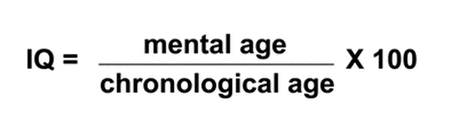
Assessing Intelligence: IQ Tests
Intelligence Tests: Tools to measure an individual's mental abilities and compare them to others using numerical scores.
Alfred Binet & Theodore Simon: Developed the first intelligence test to identify French children who might need extra educational support.
Lewis Terman & the Stanford-Binet Test: Adapted Binet's test for American children and introduced the concept of IQ.
Modern IQ Tests: The Wechsler Scales
WAIS (Wechsler Adult Intelligence Scale)
WISC (Wechsler Intelligence Scale for Children)
Most widely used IQ tests today.
Measure a combination of verbal and performance abilities.
Types of Tests
Achievement Tests: Measure what you have already learned. Example: AP exams, unit tests in school.
Aptitude Tests: Predict a person's future performance or ability to learn. Example: SAT, ACT
IQ scores are no longer calculated using the original formula (above). Modern tests use a standardized scoring system. In modern times, these tests are used to identify students for educational services.
The Wechsler scales provide separate scores for different abilities, giving a more detailed picture of a person's strengths and weaknesses.
Requirements for a Good Test (Psychometric)
Standardization:
The test is given to a large, representative sample to establish norms (average scores).
Scores are compared to these norms to see how individuals perform relative to others.
Tests are periodically re-standardized to ensure accuracy.
Reliability: The test produces consistent results.
Methods for Checking Reliability:
Split-half reliability: Comparing scores on two halves of the same test.
Test-retest reliability: Giving the same test twice and comparing scores.
Alternate forms reliability: Using different versions of the test.
Validity: The test measures what it's supposed to measure.
Content Validity: The test covers the relevant material or skills.
Predictive Validity: The test accurately predicts future performance.
Key Points About Intelligence Tests
Normal Curve (Bell Curve): Standardized tests typically result in a bell-shaped distribution of scores, with most people scoring near the average.
The Flynn Effect: IQ scores have steadily increased over the past few decades, possibly due to improved education, nutrition, and healthcare.
Fluid vs. Crystallized Intelligence:
Fluid: Ability to think abstractly and solve problems, tends to decline with age.
Crystallized: Accumulated knowledge and skills, tends to increase with age.
Researchers and Intelligence Assessments:
Researchers aim to create intelligence tests that are responsive to different cultures to reduce stereotype threat and inequality.
Systemic Issues and Intelligence Assessments:
IQ Score Variability:
IQ scores usually vary more within a group than between different groups.
Impact of Biases on IQ Scores:
Personal and sociocultural biases can affect how individual IQ scores are interpreted and how they relate to other outcomes.
Factors Influencing Intelligence Scores:
Poverty, discrimination, and educational inequities can negatively impact the intelligence scores of individuals and groups worldwide.
Intelligence test scores have been used to restrict access to jobs, military ranks, education, and immigration to the U.S.
Fixed Mindset vs. Growth Mindset
Fixed Mindset: The belief that abilities are innate and unchangeable, leading individuals to view success or failure as a reflection of inherent proficiency, often limiting personal growth.
Growth Mindset: People believe that their most basic abilities can be developed through dedication and hard work, creating a love for learning and resilience.
🎭 Stereotype Threat & Stereotype Lift
Stereotype Threat
When people feel at risk of confirming a negative stereotype about their group.
Can negatively affect performance, especially on tests.
Example: Women perform worse on math tests when reminded of gender stereotypes.
Stereotype Lift
When awareness of a positive stereotype about one’s group improves performance.
Example: Asian-American students may do better on math tests when reminded of the “good at math” stereotype. This phenomenon highlights the impact of expectations on cognitive performance.
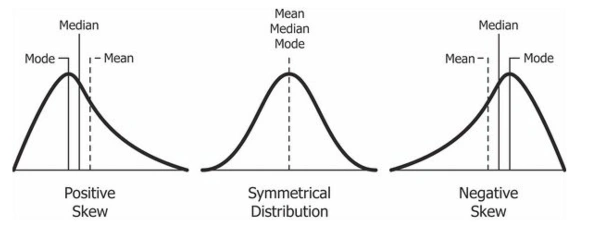
📊 Mean, Median, and Mode
Mean (Average)
Add up all the numbers, then divide by how many there are.
Example:
Numbers: 4, 6, 8
Mean = (4 + 6 + 8) ÷ 3 = 6
Median (Middle value)
The middle number when the data is ordered from least to greatest.
If there are two middle numbers, average them.
Example:
Numbers: 3, 5, 7 → Median = 5
Numbers: 2, 4, 6, 8 → Median = (4 + 6) ÷ 2 = 5
Mode (Most frequent)
The number that appears most often.
Can have no mode, one mode, or multiple modes.
Example:
Numbers: 1, 2, 2, 3, 4 → Mode = 2
Numbers: 1, 2, 2, 3, 3 → Modes = 2 and 3
🧠 Quick Tip:
Use mean when data is evenly spread.
Use median when there are outliers (extremely high or low numbers).
Use mode for categorical data or most common items.
🧬 Nature vs. Nurture
Genetics plays a strong role (twin studies show high correlation of IQ in identical twins).
Environment also matters (e.g., poverty, education, nutrition).
Heritability of intelligence = ~50–80% (how much variation in a trait is due to genes).
🌍 Group Differences in Intelligence
Gender differences: Small; vary by type of task.
Racial/ethnic differences: Exist in average scores but are influenced by socioeconomic and environmental factors, not innate ability.
Stereotype threat: Fear of confirming negative stereotypes can impair test performance.