Chapter 10 Notes - Cell Growth and Division
}}10-1 The Cell Cycle}}
Cell Cycle
→ the regular pattern of growth, DNA duplication, and cell division that occurs in eukaryotic cells
Interphase
→ G1, synthesis, and G2 together make up the interphase
%%Gap 1 (G1)%%
- The cell carries out its normal functions
- Cells increase in size, and organelles increase in number
- A cell spends most of its time in G1
- Before it can proceed to synthesis, it must have enough nutrition, adequate size, and relatively undamaged DNA (checkpoints)
%%Synthesis (S)%%
- The combining of parts to make a whole
- Cell makes a copy of its nuclear DNA
- End of S stage, cell nucleus contains two complete sets of DNA
%%Gap 2 (G2)%%
- Cells continue to carry out normal functions and additional growth occurs
- Everything must be in order before cell goes through mitosis and division (adequate cell size, undamaged DNA)
%%Rate of Cell Division%%
- Prokaryotic cells typically divide much faster than eukaryotic cells
- The rate of which cells divide is linked to the body's needs for those cells
- Rate of cell division is greater in embryos and children than adults
- Cells that only rarely divide enter a stage called G0
%%Cell Size%%
Cells have upper and lower limits
- cells that are too small cannot contain all the necessary organelles and molecules
- a cell with too few mitochondria would not have enough energy to live
- the upper limit on a cell is due to the ratio of cell surface area-to-volume ratio
- a further increase in size could result in a surface area to small for the adequate exchange of materials
- when cells grow too large, there is a higher demand on the finite amount of DNA in the cell
- cells cannot just create more DNA to meet the demands of a larger cell
}}10-2 Mitosis and Cytokinesis}}
%%Mitosis (M)%%
- %%mitosis%% - the division of the nucleus and its contents
- prophase - (longest phase) chromatin condenses into tightly coiled chromosomes, each consists of two identical sister chromatids → nuclear envelope breaks down, the nucleolus disappears → centrioles replicate and begin to migrate to opposite poles of the cell → spindle fibers (organized microtubules) grow from centrioles and radiate toward the center of the cell
- metaphase - (shortest phase) spindle fibers attach to a protein structure on the centromere of each chromosome and align the chromosomes along the cell equator, the middle of the cell
- anaphase - the centromeres divide, the spindle fibers pull the sister chromatids away from each other and to opposite sides of the cell
- telophase - a complete set of identical chromosomes is positioned at each pole of the cell; nuclear membrane and nucleolus start to form → chromosomes begin to uncoil → spindle fibers break apart
- cytokinesis - the process that divides the cell membrane and the cytoplasm and its contents; the result is two daughter cells that are genetically identical to the original cell
- animal cells: the membrane forms a furrow (trench) that is pulled inward by tiny filaments (drawstring)
- plant cells: membrane cannot pinch because of the cell wall; a cell plate forms between the two nuclei → a new wall then grows as cellulose and other materials are laid down
- Body cells have 46 chromosomes each
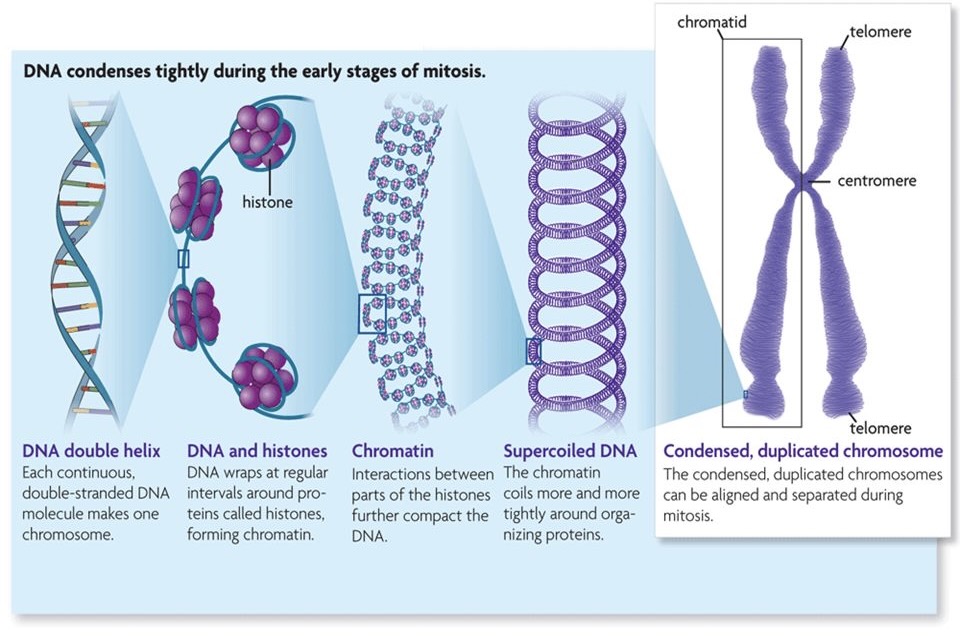
→ DNA organization
- DNA wraps around proteins that help organize and condense it
- During Interphase - DNA is loosely organized (not condensed, looks like spaghetti)
- Proteins must access specific genes for a cell to make specific proteins or to copy the entire DNA sequence
- During Mitosis - Chromosomes are tightly condensed
- Duplicated chromosomes must condense to be divided between two nuclei → so that it doesn't become entangled or get messed up (a cell might get two copies of one chromosome and none of a different one)
- These changes allow a cell to carry out necessary functions
%%Structure%%
- chromosome - one long continuous thread of DNA that consists of numerous genes along with regulatory information
- histones - a group of proteins each of your chromosomes is associated at almost all times during the cell cycle
- chromatin - the complex of protein and DNA that makes up the chromosome chromatid - one-half of a duplicated chromosome
- sister chromatids - the two identical chromatids
- centromere - a region of the condensed chromosome that looks pinched, where sister chromatids are held together
- telomeres - the ends of DNA molecules form these structures; make out of repeating nucleotides that do not form genes → prevent ends of chromosomes from accidentally attaching to each other and the loss of genes
- the structure of the short, rod-like chromosome makes it possible to separate DNA precisely during cell division
}}%%10-3 Regulation of the Cell Cycle%%}}
%%External Factors%% - come from outside the cell; include messages from nearby cells and other parts of the organism
- help regulate the cell cycle
- include physical and chemical signals
- e.g. cell to cell contact
- most mammal cells grown in the lab form a single layer on the bottom of a culture dish → once a cell touches other cells, it stops dividing
- many cells release chemical signals that tell other cells to grow
- e.g. growth factors Internal Factors kinase Apoptosis
- a broad group of proteins that stimulate cell division → bind to receptors that activate specific genes to trigger cell growth
- various hormones may also stimulate growth of certain cell types
%%Internal Factors%% - can be triggered when external factors bind to their receptors
- kinase (help do) - an enzyme that transfers a phosphate group from one molecule to another when activated
- typically increases the energy of the target molecule or changes its shape
- cells have many types of kinases (almost always present in the cell)
- help control the cell cycle are activated by cyclins
- cyclin (traffic lights) - a group of proteins that are rapidly made and destroyed at certain points in the cell cycle
- these 2 factors help a cell advance to different stages of the cell cycle
Apoptosis - programmed cell death
- occurs when internal or external signals activate genes that produce self-destructive enzymes
- the nucleus tends to shrink and break apart
- e.g. in the early stages of development, human embryos have webbing between fingers & toes → those cells go through apoptosis
Cancer - the common name for a class of diseases characterized by uncontrolled cell division
- regulation of the cell cycle is disrupted
- cancer cells grown in a culture dish continue to divide, even when surrounded by neighboring cells
- divide much more often than healthy cells
- tumors - disorganized clumps that cancer cells form
- benign tumor - the cancer cells typically remain clustered together
- may be relatively harmless and can probably be cured by removing it
- malignant tumor - some of the cancer cells can break away or metastasize from the tumor
- these breakaway cells can be carried in the bloodstream or lymphatic system to other parts of the body, where they can form more tumors called %%metastases%%
- once a tumor metastasizes, it is much more difficult to rid the body of tumors entirely
- tumors require lots of food and a hearty blood supply but contribute nothing to the body's function
- carcinogens - substances known to produce or promote development of cancer
- e.g. tobacco smoke and air pollutants → associated with lung cancer
- Cancer Treatments:
- surgery
- radiation and chemotherapy
- radiation therapy - use of radiation to kill cancer cells and shrink tumors
- damages a cell's DNA so much that it cannot divide
- usually localized - used to target a specific region (can also hurt healthy cells)
- chemotherapy - use of certain drugs to kill actively dividing cells
- kills both cancer and healthy cells
- systematic - drugs travel throughout the entire body
}}10-4 Asexual Reproduction}}
Reproduction - a process that makes new organisms from one or more parent organisms; sexual and asexual
Sexual Reproduction - the joining of two specialized cells called gametes (egg and sperm cells)
- offspring that result are genetically unique
Asexual Reproduction - the production of offspring from a single parent, does not involve the joining of gametes
- offspring are genetically identical to each other + single parent
Binary Fission - the asexual reproduction of a single-celled organism by which the cell divides into two cells of the same size
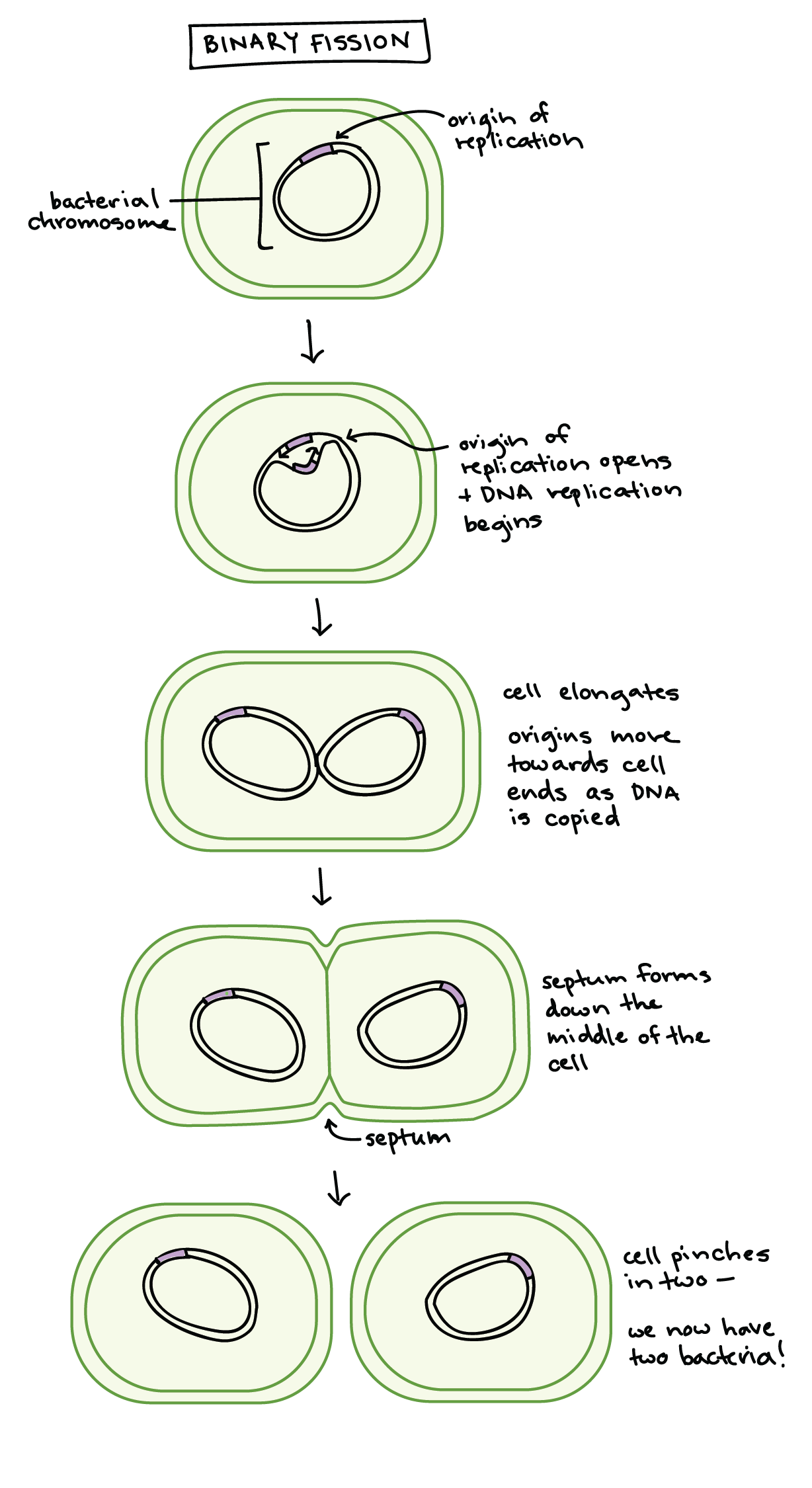
similar results to mitosis, processes are different
prokaryotes do not have nuclei or spindle fibers, less DNA than eukaryotic cells
%%plasmid%% - a single circular chromosome where most of the DNA in bacteria is
fission starts when the bacterial chromosome is copied → both chromosomes are attached to the cell membrane
as cell grows, chromosomes move away from each other
when the cell is twice its original size, it undergoes cytokinesis → membrane pinches inward, new cell wall forms, completing the separating into two daughter cells
Some eukaryotes also reproduce asexually, through mitosis
e.g. a new plant can emerge from a stem cutting; a new sea star can grow from the arm of another
- especially common in simpler plants and animals
- occurs in both multicellular and unicellular eukaryotes
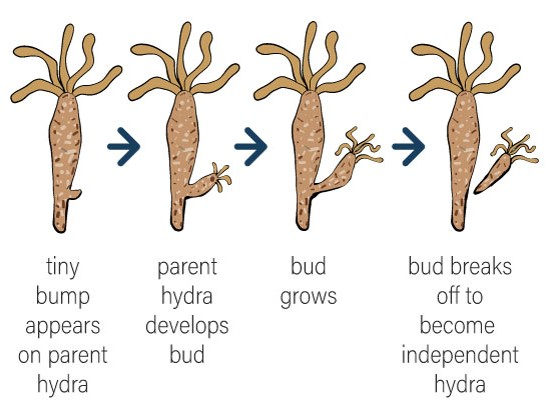
- budding - a small projection grows on the surface of the parent organism, forming a separate new individual
- e.g. hydras and some types of yeast
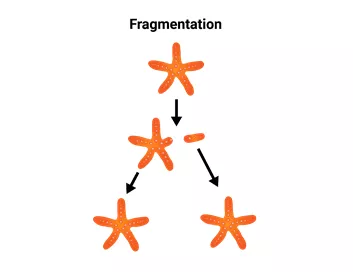
- fragmentation - a parent organism splits into two pieces, each of which can grow into a new organism
- e.g. flatworms and sea stars
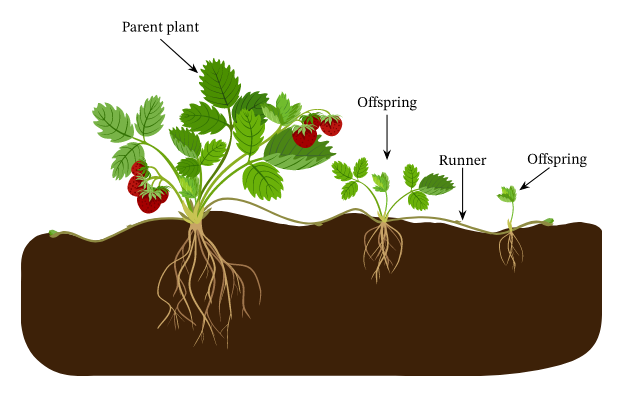
- vegetative reproduction - involves the modification of a stem or underground structure of the parent organism; offspring often stay connected to original organism
- e.g. strawberries and potatoes
}}10-5 Multicellular Life and Cell Differentiation}}
Zygote - a single fertilized egg your body begins as
- to form the different structures of your body, cells must specialize
- %%cell differentiation%% - the process by which a cell becomes specialized for a specific structure or function during multicellular development
- almost every cell has a full set of DNA, each type of cell expresses only specific genes it needs to function
- %%in plant cells, the first division of a fertilized egg is asymmetric%%
- the apical cell forms most of the embryo, including the growth point for stems and leaves
- basal cell - provides nutrients to the embryo and growth points for the roots
- plant cells continue to differentiate based on their location
- %%in animals, an egg undergoes many rapid divisions after it is fertilized%%
- resulting cells can migrate and quickly begin to differentiate
- %%blastula%% - the early animal embryo generally takes the shape of a hollow ball
- %%gastrula%% - as it develops, part of the ball folds inward, forming an inner layer and creating an opening in the outer cell layer
%%stem cells%% - a unique type of body cell that can divide and renew themselves for long periods of time, remain undifferentiated in form, and differentiate into a variety of specialized cell types
- when a stem cell divides, it forms either 2 stem cells or 1 stem and 1 specialized cell
- classified by their ability to develop into the differentiated cells types of different tissues
- the more differentiated a stem cell already is, the fewer types of cells it can form
- totipotent - "can do everything" can grow into any other cell types; these consist of only a fertilized egg and the cells produced by the first few divisions of an embryo
- pluripotent - "can do most things" can grow into any cell type except for totipotent stem cells
- multipotent - "can do many things" can grow only into cells of a closely related cell family
- embryonic stem cells have potential to form almost any cell type
%%adult stem cells%% - partially undifferentiated cells located among the specialized cells of many organs and tissues
- found all over the body: brain, liver, bone marrow, skeletal muscle, dental pulp, fat
- found in children and in umbilical cord blood
- somatic stem cell is more accurate
- advantage: adult stem cells can be taken and put back into a patient
- disadvantages: few in number, difficult to isolate, sometimes tricky to grow
- may contain more DNA abnormalities than embryonic stem cells
Embryonic Stem Cells:
- Most embryonic stem cells come from donated embryos grown in a clinic
- Inner cell mass - the stem cells are taken from a cluster of undifferentiated cells in the 3-5 day-old embryo
- Embryonic stem cells are pluripotent so they can form any of the 200 cell types of the body
- Used to treat patients w leukemia and lymphoma
Downside:
- patient's body might reject them
- cells could grow unchecked and form a tumor
- raises many ethical questions - involves destruction of embryo