Fish Adaptations
Fish Adaptations
Otolith age calculation
The otolith is the ear part of the fish, which reveals how old the fish is
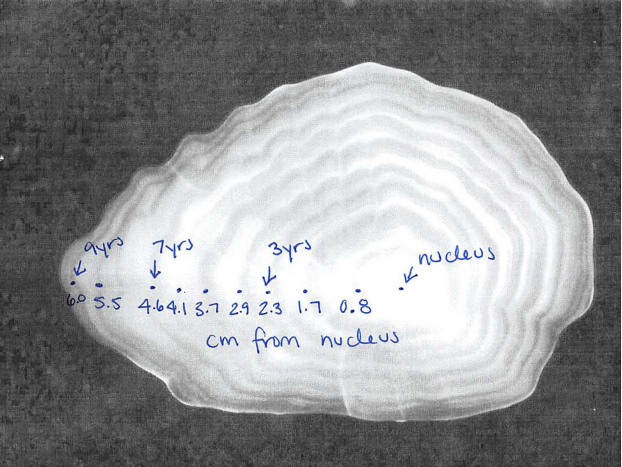
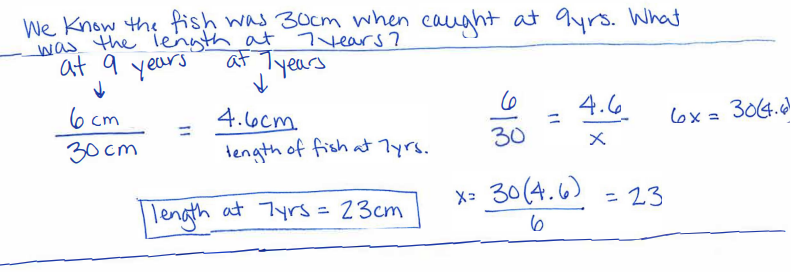
At the 9th ring, we measure the length from the ring to the nucleus as 6cm. The image is magnified. The otolith is not really 6cm, but the relative proportions are what matters. The relationship between the growth in one year on the otolith is proportional to the growth of the actual fish in one year.
What is the adaptive advantage?
How does it aid survival and/or reproduction so the genes for that trait are passed onto future generations?
Scales
Cycloid
salmon
Ctenoid
bass
Ganoid
gar
armor-like, hard to be eaten with teeth
Placoid
shark
reduces drag, helps it travel faster through water

How does each kind protect the fish?
protection from predators, being eaten
Adipose eyelid (in shad and herring, Clupeid)
Eyelid anatomy
found in layers
may cover more than the eye
There are 4 theories on the eyelid’s purpose:
Increasing focus
Increasing perception of polarized light
Decreasing effect of ultraviolet light
Physical barrier against objects

Adipose fin
Fleshy fin between dorsal and caudal fins of catfish, trout and salmon
Early hypothesis:
thought fin stored fat (adipose tissue), but studies have now shown that while fleshy, it doesn’t actually contain nutritional fat
Have evolved independently more than once, which suggests an adaptive advantage, but what is it?
Shoaling and schooling
Shoaling: when fish group together (feeding or mating)
Schooling: when fish swim together in a coordinated fashion
Adaptive advantage:
Predators cannot get all of them if they are in a group
Foraging: all benefit from what a group member finds to eat
Mating: mates are close to each other
Pharyngeal teeth
Pharyngeal teeth are opposing patches of teeth that occur in the upper and lower elements of the gill arches
Some species of fish that have pharyngeal teeth are:
Cyprinids, suckers, goldfish, loaches
Adaptive advantage
crushing things with hard shells like crustaceans
Barbels
Slender, whisker-like projections
Location on Fish
can be found on a variety of spots on the head, usually surrounding the mouth
Can be found on carp, catfish, goatfish, hagfish, sturgeon, and some sharks (saw-shark)
Usually on bottom-feeders
Adaptive advantage: Sensory, taste buds
External fertilization (Broadcast spawning)
When sperm fertilize eggs outside of an organism
examples: almost all fish
Adaptive advantage: no need to track down a mate in the wide ocean, more chances for fish to survive, promotes genetic diversity, low energy expenditure
Protandry and Protogyny
Sequential hermaphroditism
Protandry: fish change from male to female
Protogyny: fish that change from female to male during life
Adaptive advantage: fish can still reproduce if there are two of the same gender around, if females can reproduce asexually then the male can change to female and still reproduce
Nest Building
Common Nest Types:
pit diggers (sunfish)
cave spawners (cichlids)
mound-builders (chumbs)
borrowers (catfish)
Adaptive advantage: camouflage into the surrounding habitat, disguise from predators, courting to show fitness, declare territory to others, place for eggs to attach when no parental care
Countercurrent exchange
When a fish swims, water flows past its gills in the opposite direction of the blood flow
Shark Claspers
Specialized extension of the pelvic fin (only in males)
designed to deliver sperm inside of a female, inserted into the female’s cloaca to help channel the sperm delivery
Present in sharks, skates, and rays
Allows for internal fertilization
Higher chance of viability, higher chance that that individual is the parent.
Swim Bladder Respiration
Some fish can utilize atmospheric O2 when aquatic O2 levels unsuitable (gar, bowfin)
Allows for survival is areas unsuitable for other fish
Vivipary
Some sharks
Seahorses
Some perch and guppies
Greater protection for developing young