Biol 2030 lec exam two
functions of the circulatory system
- @@circularity system@@: consists of the heart, blood, and blood vessels
- @@cardiovascular system@@: refers to only the heart and blood vessels
- Functions of the circulatory system:
- TRANSPORT- ^^O2^^, CO2, Nutrients, wastes, hormones, stem cells
- PROTECTION- inflammation, limit the spread of infection, destroy cancer cells, neutralize toxins, and initiate clotting.
- REGULATION- Fluid balance, stabilizes pH or ECF, and temperature control.
Components of blood
- adults have 4-6 L of blood
- Liquid connective tissue: cells and extracellular matrix
- @@Plasma@@: Matrix of blood, clear light yellow fluid
- Formed elements: blood cells (red, white, and platelets)
- Hematocrit- centrifuge blood to separate components
\*Erythrocytes settle first and are heaviest, white blood cells and platelets are only 1% and are in the middle, Plasma is at the bottom and the largest amount at 47%-67%
7 kinds of formed elements
1. @@Erythrocytes@@: Red blood cells
- @@Platelets@@: cell fragments from special cells in bone marrow
@@Leukocytes@@: White blood cells. Divided into two categories
- GRANULOCYTES (with granules)
- \
- @@Neutrophils@@
- \
- @@Eosinophils@@
- \
- @@Basophils@@ \n
- AGRANULOCYTES ( Without granules)
- \
- @@Lymphocytes@@
- \
- @@Monocytes@@ \n
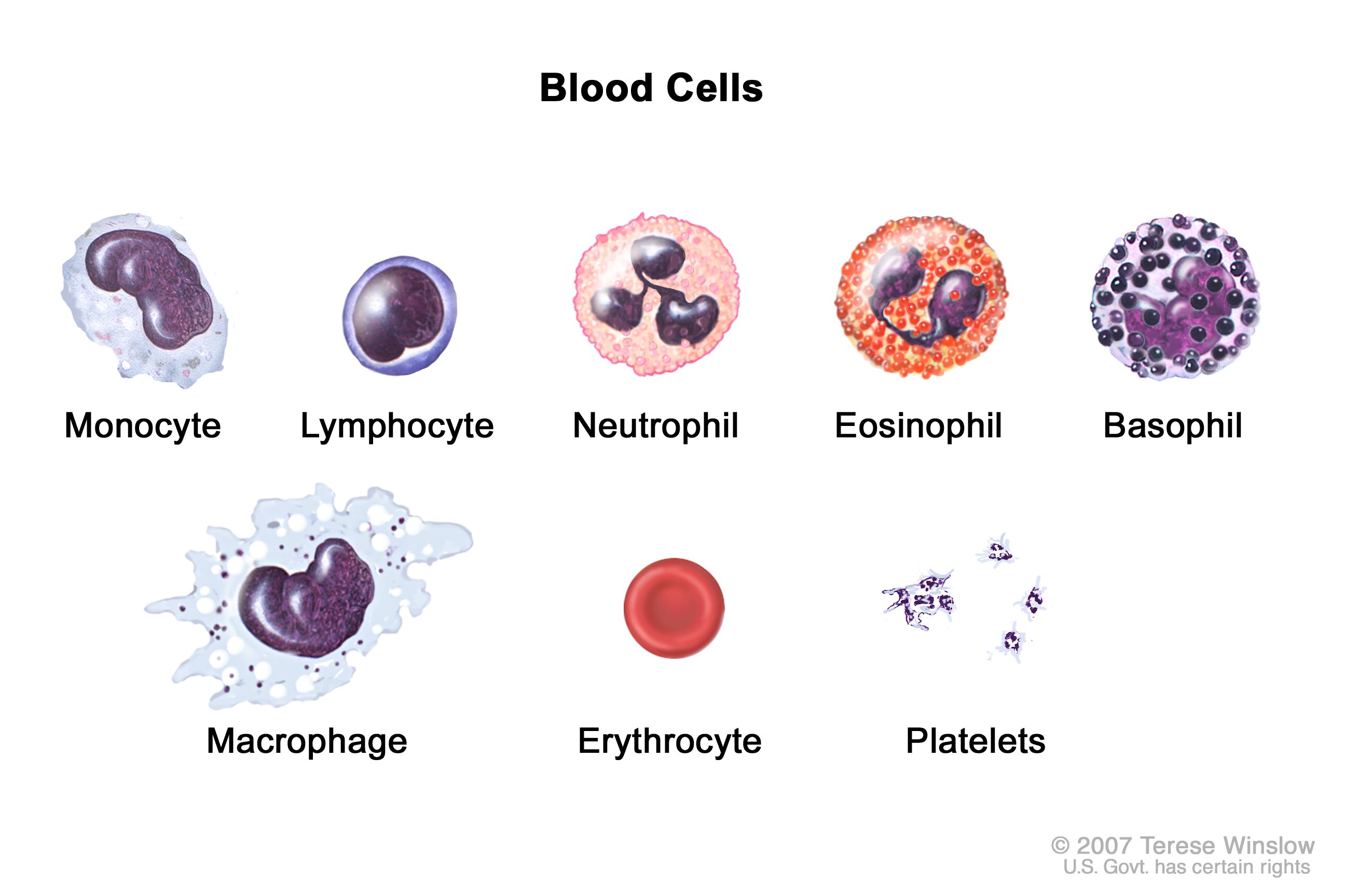
- @@Monocytes@@ \n
Blood Plasma
- @@Plasma@@- liquid portion of blood
- serum: remaining fluid when blood clots and solifs are removed identical to plasma except for absence of fibrinogen (holds blood clots together)
- Three major categories of plasma proteins
- ^^Albumins^^ : Smallest and most abundant; influences blood pressure, bloodflow, an fluid balance
- ^^Globulins^^ (antibodies): provide immune functuons
- ^^Fibrinogen^^: precursor of fibrin threads that help form blood clots
\*formed by liver (liver makes proteins)
- dissolved O2, CO2, and Nitrogen electrolytes.
Blood Viscosity and Osmolarity
- @@Viscosity@@: Resistance of a fluid to flow, resulting from the cohesion of its particles
- whole blood 4.5-5.5 times as viscous as water
- Plasma is 2.0 times as viscous as water
- @@Osmolarity@@: total molarity of those dissolved particles that cannot pass through the blood vessel wall. (measure of solute inh a solution) -Water always diffuses from low to high
- if to high, blood absorbs too much water, increasing the blood pressure
- if to low, to much water stays in the tissue, blood pressure drops, edema occurs
- optimum osmolarity is achieved by bodys regulation of sodium ions, proteins, and red blood cells
\*Albumen regulates water in blood/tissues
Starvation and plasma protein deficiency
- Hypoprotenimia: deficiency of plasma proteins
- Extreame starvation
- liver or kidney disease
- severe burns
- Kwashiorkor: children with severe protein deficiency
- Thin arms
- Distended abdomen
How blood is produced
- Adult production of 400 billion platelets, 100-200 billion RBC, and 10 billion WBCs every day
- @@Hemopoiesis@@: production of blood
- @@Hemopoietic tissues@@ produce blood cells
- Yolk sac produces stem cells for first blood cells
- liver stops producing blood cells at birth
- splen remains involved with lymphocyte production
- Red bonme marrow produces all seven formed elements
- @@colony- forming unit@@- specialized stem cells only producing one class of formed element of blood
- @@Myeloid Hemopoiesis@@- blood formation in the bone marrow
- @@Lymphoid Hemopoiesis@@- blood formation in the lymphatic organs
Erythrocytes
- Two principle functions
- carry O2 from lungs to tissues
- Pick up CO2 from tissues and bring to lungs
*inssuificient EBC can cause death in minutes due to lac of oxygen to tiussues
- disk shaped cell with thick rim
- ^^Lack of nucleus^^: no mitosis
- ^^lack of mitocondria^^: anarobic resperitaion
- ^^full of hemoglobin^^ to carry O2
- Gas transport: major function
- O2 must bind to hemogloben
- @@Carbonic anhydrase@@ (CAH) in cytoplasm
- \*found inside red blood cell
- produces carbonic acid from CO2 and water
- important role in gas transport and pH balance
Hemoglobin
- four protein chains
- four Heme groups each carrying one O2
- nonprotein moiety that binds O2 to Fe at its center
- *1 hemoghloben can bind 4 O2
- @@Men have more RBC and Hemogloblen@@
- women have a menstrual cycle and more body fat
Erythrocyte production
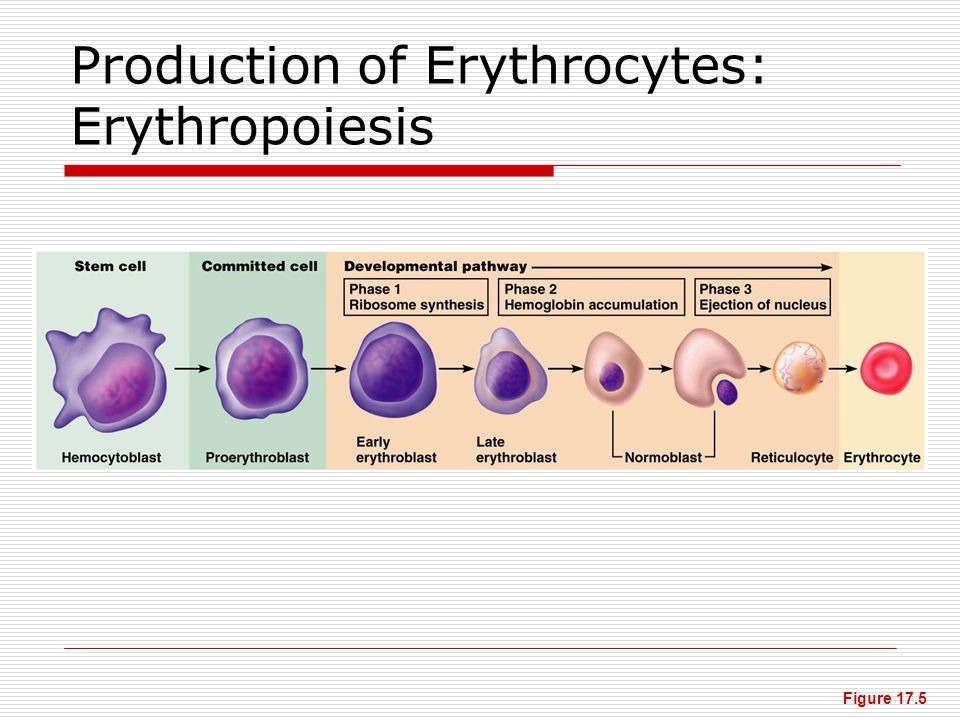
- Erythropoiesis (EPO)- RBC production
- EPO made buy kidneys
- The average lifespan of RBC is 120 days
- development takes 3-5 days
- Production
- Pluripotent stem cell
- Erythrocyte colony-forming unit (committed cell)
- has receptors for EPO from kidneys
- precursor cells
- Erythroblasts multiply and synthesize hemoglobin
- Reticulocyte discards nucleus to make room for hemoglobin
- mature cell (Erythrocyte)
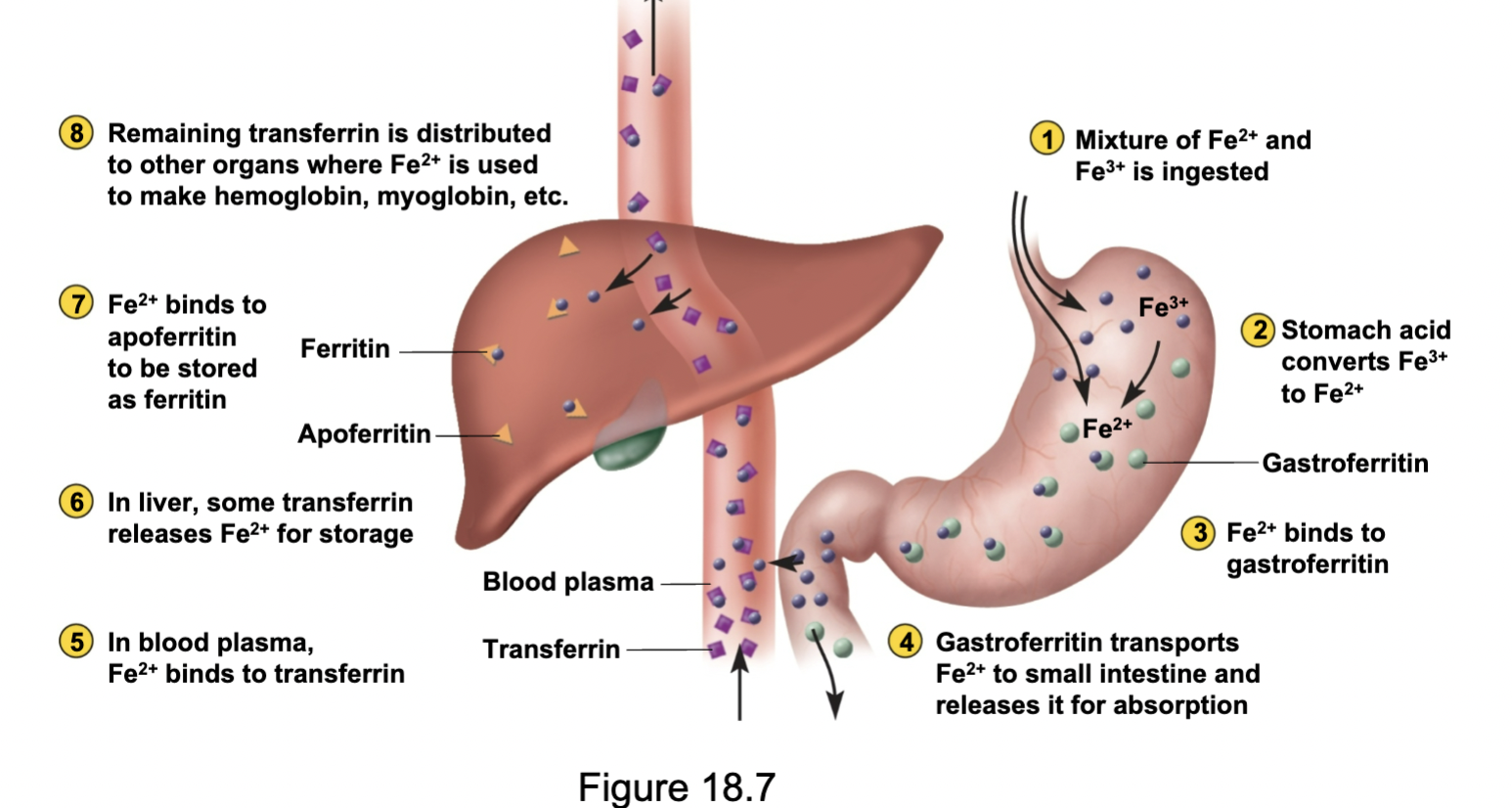
Iron Metabolism
Erythrocyte homeostasis
1. hypoxemia is sensed by the liver and kidneys
- secretion of EPO from kidneys
- stimulation of red bone marrow
- accelerated erythropoiesis (formation of red blood cells)
- increased RBC count
- increased O2 transport
- negative feedback control
- Dropped RBC causes Hypox (‘emia’ means blood)
- Kidney production of preproprotein stimulates bone marrow
*erythropoiesis (EPO) is RBC production
- RBC increases in 3-4 days
- Stimuli for increasing EPO
- Low levels of O2
- high altitude
- increase exercise
- loss of lung tissue in emphysema
Erythrocyte death and disposal
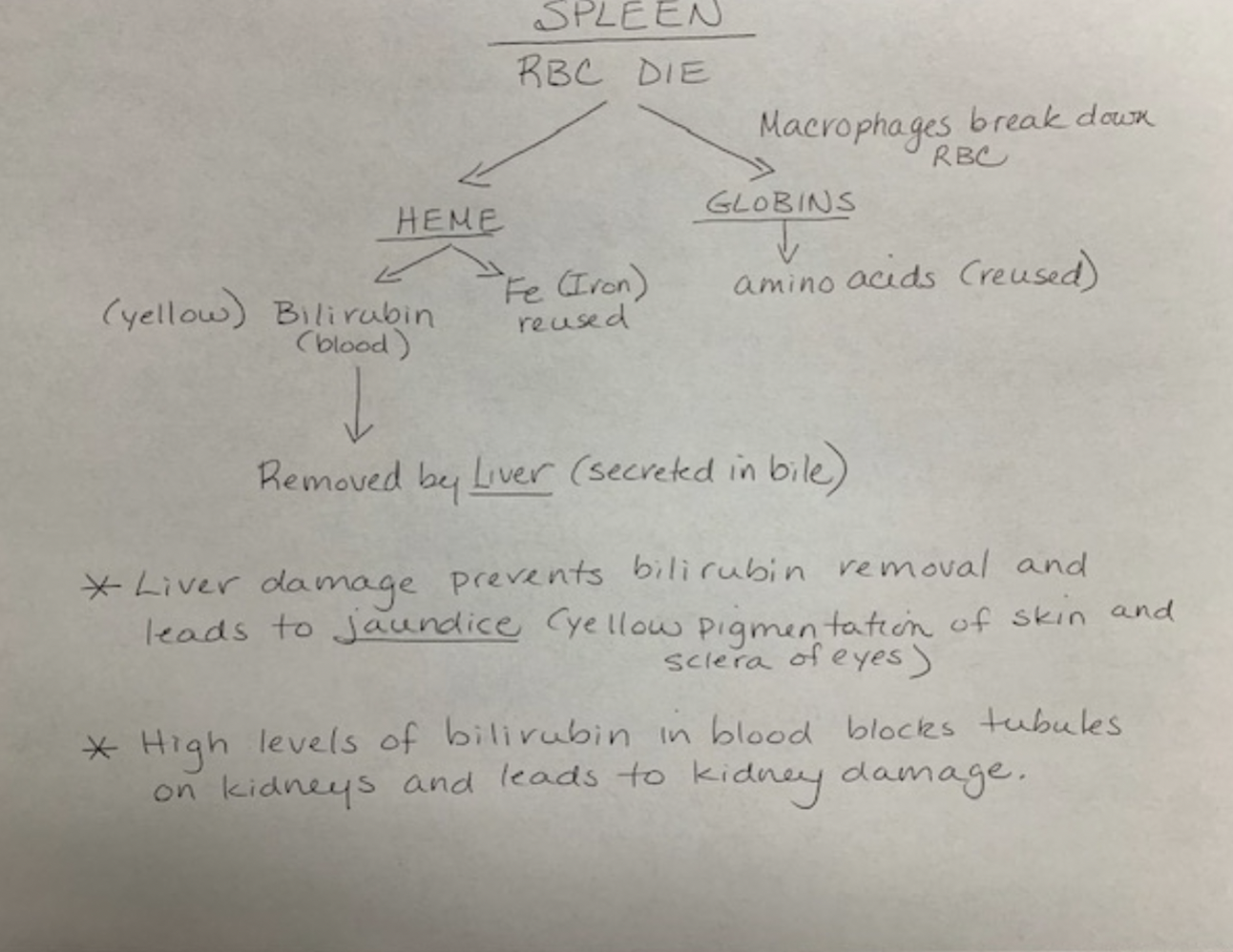
- RBC rupture (Hemolysis) in narrow channels of spleen and liver
- macrophages in the spleen (spleen considered RBC graveyard)
- Digests membrane bits
- separates heme from globin
Erythrocyte disorders
- @@polycythemia (High RBC count)@@
- primary polycythemia
- cancer of erythropoietin cell line in red bone marrow
- High RBC count high as ^^11 million^^ RBC
- Secondary polycythemia
- from dehydration, emphysema, high altitude, or physical conditioning
- RBC up to ^^8 million^^
- Dangers of polycythemia
- increased blood volume, pressure, viscosity
- can lead to embolism, stroke, or heart failure
- @@Anemia@@
- inadequate EPO or hemoglobin synthesis
- kidney failure and insufficient erythropoietin
- Hemorrhagic anemias from bleeding
- Hemolytic amenia from RBC destruction
- Dangers
- Tissue hypoxia and necrosis
- pt lethargic, shortness of breath with exertion, necrosis to the brain, heart, or kidney
- blood osmolarity is low, producing tissue edema
- blood viscosity is low, cardiac failure
- @@Sickle cell disease@@
- hereditary defect in mostly African descent (due to malaria)
- differed only on the 6th amino acid on the bata chain
- full carriers usually don’t survive without medical help
- can lead to kidney failure, heart failure, stroke, joint pain, or paralysis
Blood typing
- Agglutinogens are RBC antigens
- Called antigen A and B
- Ditermined by glycolipids on RBC surface
- antibodies are called agglutinins
I is recessive
A is dominant
B is dominant
| blood type | antigens | Antibodies |
|---|---|---|
| O | none | A and B |
| A | A | B |
| B | B | A |
| AB | A and B | none |
| blood type | donate to | receive from |
|---|---|---|
| O | O,A,B,AB | O |
| A | A and AB | O and A |
| B | B and AB | O an B |
| AB | AB | A, B, AB, O |
- RH group: Rh+ is if you have the D antigen
- Rh- people can only receive from other Rh- people but Rh+ can receive from Rh- and Rh+
Hemolytic disease of the newborn
Can occurr if Rh- mother has formed antibodies and is pregnant with a second Rh+
- prevention
- RhoGAM given to prevent Rh- women
WBC form and function
- least abundant formed element
- protects against infectious microorganisms and other pathogens
- conspicuous neculus
- retaint their organelles for protein synthesis
- granules
Types of leukocytes
- granulocytes
- Nutrophils - aggressively antibacterial
- nurtophilia- rise in number of nutrophils in response to bacterial infection
- Eosinphils- releases enzyme to destroy large parasites
- increased numbers in parasitic infections, collagen disease, allergies, and diseases of the spleen
- Basophils- secreasts histamine (speeds flow o blood to an injured area) and Heparin ( promotes mobility of other WBCs in the area.
- increased numbers in chickenpox, sinitis, diabeties.
- Agranulocytes
- Lymphocytes- Distroy cells ( cancer, foreign, and infected cells)
- coordinate actions to other immune cells
- secrete antibodies to provide immune memory
- increased number in diverse infections and immune responses
- monocytes- leaves blood stream to transform into macrophages
- increased numbers in viral infections and inflammation
Leukocyte life history
- leukopoiesis- production of white blood cells
- Hemopoiteic stem cells differeate into:
- myeoblasts- from nutrophils, eosinophils, basophils
- monoblasts- from monocytes
- lymphoblasts- gove rise to all forms of lymphocytes
- red bone marrow stores and releases monocytes and granulocytes
Leukocyte life cycle
- circulating WBC do not stay in blood stream
- granulocytes leave in 8 hours and live 5 days longer
- monocytes leave in20 hours, transform into macrophages, and live several years
- lymphocytes provide long term immunity (decades) being continuously recycled from blood to tissue fluid to luymph back to blood.
Lekocyte disorders
- lueokpenia- low WBC count, below 5,000 WBCs
- causes: radiation, poisons, infectious diseases
- effects: elevated risks of infection
- Leukpcytosis: high WBC count, above 10,000
- causes: infection, allergy, diseases
- differential WBC count: identifies what percentage of total WBC consists of each type of leukocyte.
- leukemia: cancer of hematopoietic tissue usually producing a very high number of circulating leukocytes
- myeloid leukemia: uncontrolled granulocyte production
- Lymphoid lukema: uncontrolled lymphocyte or monocyte production
## Platelets
Small fragments of megakaryocyte
- platelet function:
- secrete vasoconstriction that help reduce blood loss
- stick together to form platelet plugs ( collegon is found under skin layer and is stickey)
- secrete procoagulants to promote clotting
- chemically attract nuetrophils and monocytes to sites of inflammation
- secrete growth factors that stimulate mitosis to repair blood vessels
- Platelet production:
- Thrombopoiesis: Stem cells that becomnme megakaryoblasts
- Megakaryoblasts: repeatedly replicate DNA without dividing
- \
## Platelets and hemostasis
- Hemostasis: the cessation of bleeding
- hemorrhage: excessive bleeding
- Three homeostacic mechanisms
- vascular spams
- platelet plug formation
- coagulation ( blood clotting)
- vascular spasm- prompt constriction of a broken vessel.
- causes: pain receptors
- most immediate protection against blood loss
- platelet plug formation- plsayelet psudeopods stick to damaged vessels and other psudeoods contract
- collagen is directly under endotheial tissue and is sticky. platelets stick to collagen.
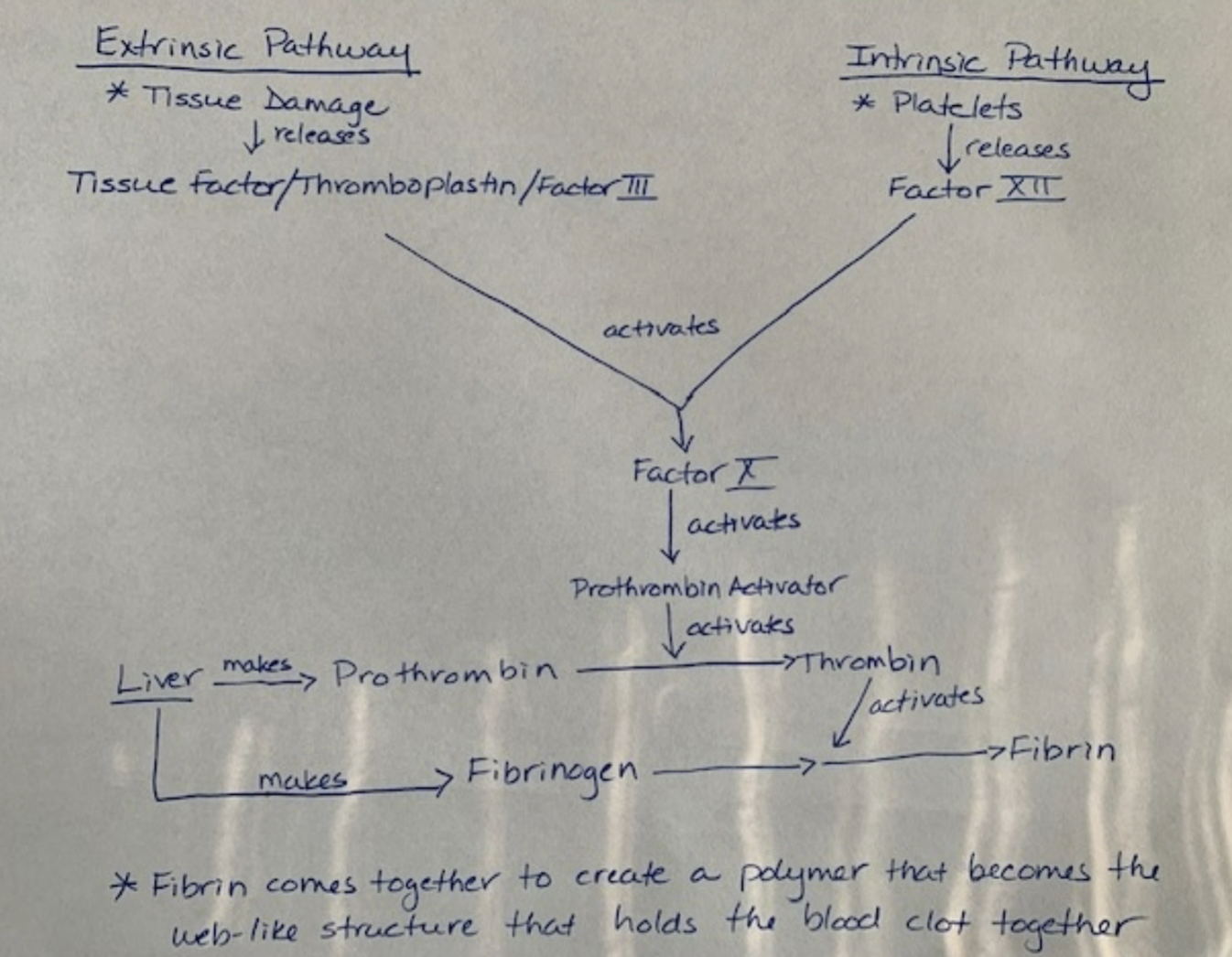
- Coagulation- clotting. conversion of fibrinogen into fibrin threads framework together
- procoagulants (clotting factors)- usually produced by the liver
- extrenisic pathway- factors released by damaged tissues begin to cascade ( activate one factor and it will activate the next)
- intrinsic pathway Factors found in blood begin to cascade
Caogulation of intrinsic and extrensic pathways
The fate of blood clots
- clot retraction occurs within 30 minutes
- fibrinolysis- dissolution of a clot
- @@plasminogen turns into plasma which dissolves fibrin that breaks up clot@@
- Thre prevention of inappropriate clotting is caused by a prostacyclin coated endothelium
Clotting disorders
- Hemophilia- deficiencies in one factor or another in coagulation
- usually missing Factor 8/VIII
- Physical exertion causes bleeding and pain
- Hematomas- blood colt in the tissues outside of the vessel
- Thrombosis- blood clotting inside a blood vessel
- embolus- anything that can travel in the blood and block blood vessels
Blood vessel anatomy
- arteries- caqrry blood away from the heart
- veins- carry blood to the heart \
- capillaries- connects smallest arteries to smallest veins
- vessel walls
- Tunica interna- inner most layer, lines blood vessels and exposed to blood
- Endthelium- simple squamous epithelium overlaying basement membrane. normally repels blood cells and platelets
- Tunica Media- middle layer that consists of smooth muscle
- regulates diameter of the blood vesssel
- Tunica Externa- outermost layer
- provides passage for small nerves, lymphatic vessels
## Arteries
- classified by size
- conducting (elastic or large) arteries
- biggest arteries ( aorta, common corotid, pulmonary trunk,..)
- Distributing (muscular or medium) arteries
- distributes blood to specific organs
- Resistance (small) arteries
- Arterioles: smallest arteries
- control amount of blood to various organs
Aneurysm
Weak point in artery or heart wall
- forms thin- walled, bulging sac and may rupture at any time
- dissecting aneruysm
- blood acculumulates between tunics of artery and separates them.
Atrial sense organ
- sensory structures in walls of major blood vessels that monitor blood pressure and chemistry
- carotid sinuses: baroreceptors monoter blood pressure and found in internal carotid
- carotid bodies: chemoreceptors, stableize pH