Learning Theories
Introduction to Learning Theories
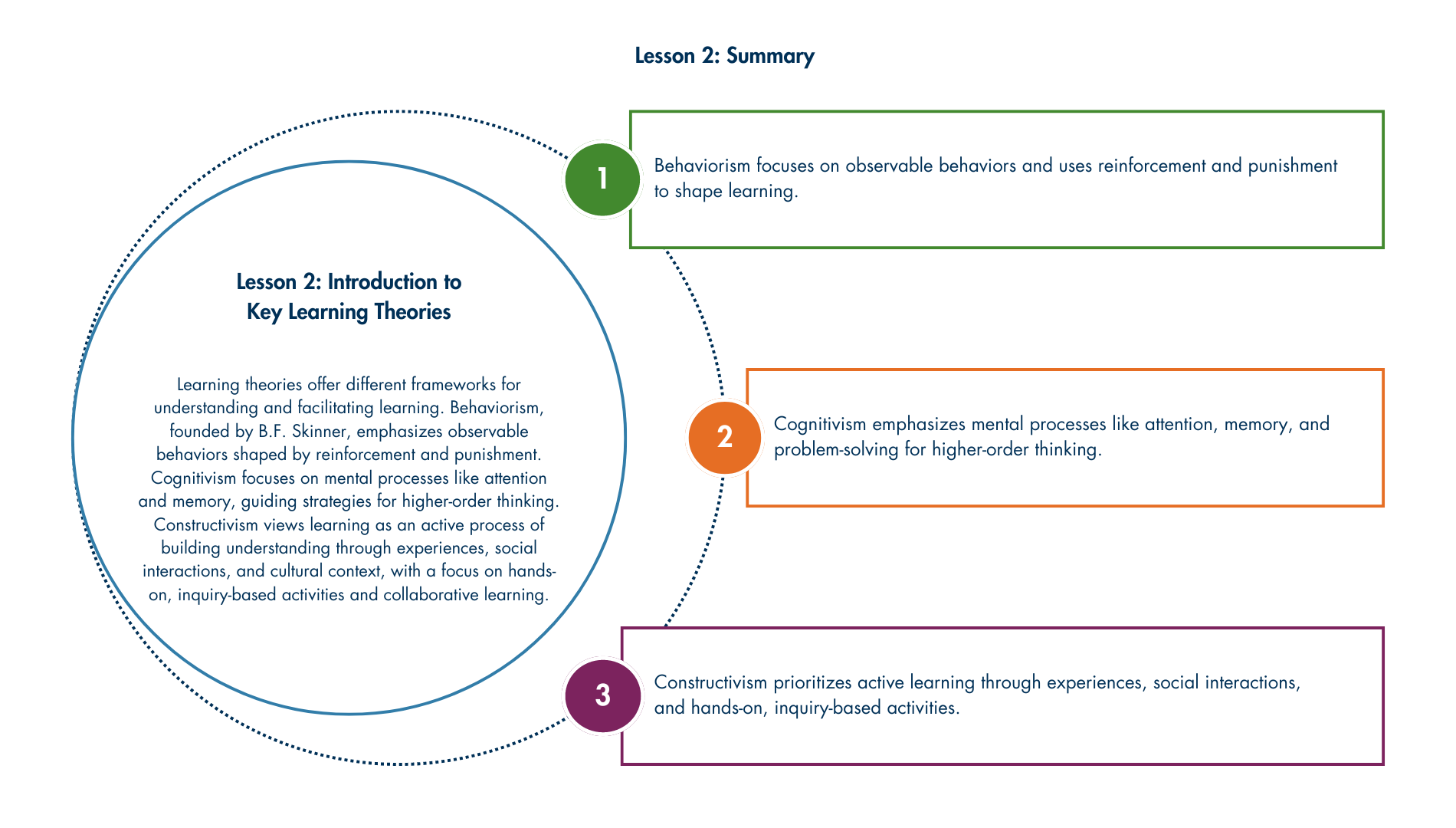
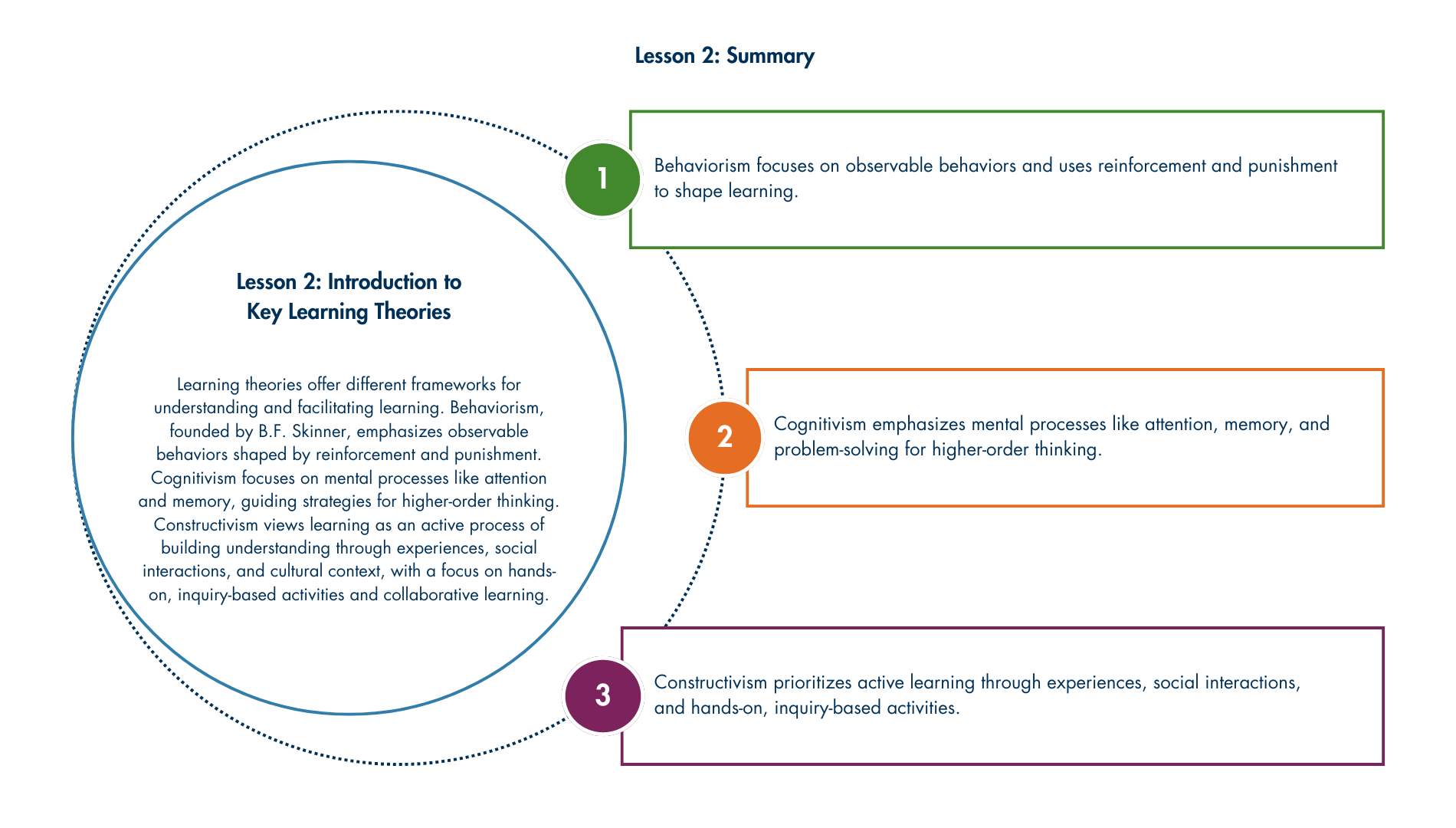
Learning theories are conceptual frameworks that help us understand how individuals gain knowledge, develop skills, and change behaviors over time. They provide insights into how thinking, feeling, and socializing influence learning, aiding us in improving our teaching methods. The history of learning theories illustrates our evolving understanding, beginning with behaviorism (which focuses on observable actions and responses), then progressing to cognitivism (which emphasizes thinking and problem-solving), and then in constructivism (which states that children learn through doing and hands-on experiences). Social constructivism adds that children learn from social interaction and observation during the learning process. Each theory offers teachers valuable ideas for making learning more engaging and meaningful, therefore promoting student understanding and mastery.
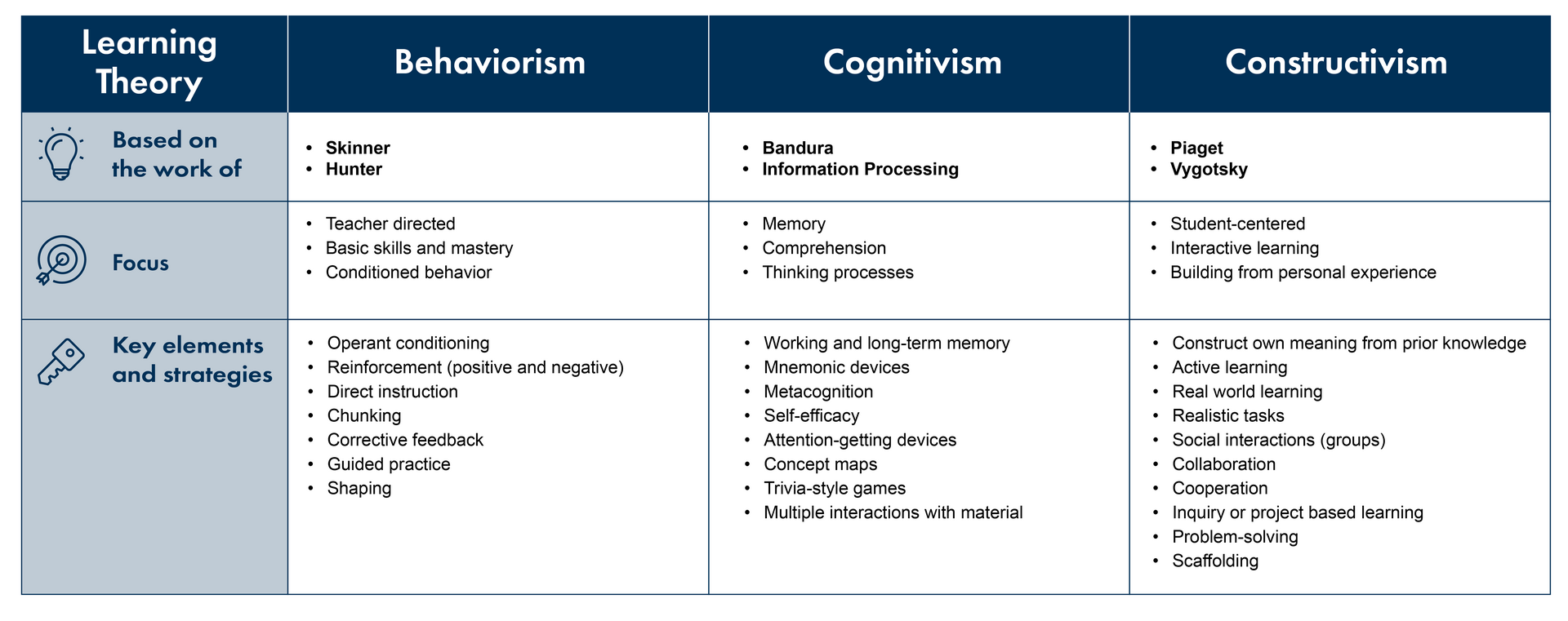
A good theory of learning provides a comprehensive framework for understanding how people learn and how to teach more effectively. It should be grounded in scientific evidence, consistent with what we know about how the mind works and applicable across multiple learning situations. Also, it should give you clear ideas on how to plan lessons, instructional strategies, materials and assessments that promote effective learning. A sound learning theory is an important tool for teachers to design engaging and meaningful learning experiences for their students. Figure 2.8 provides a summary of learning theories we will cover, the main authors of each theory, the focus of the theory, and the key elements and strategies of each theory.
Behaviorism
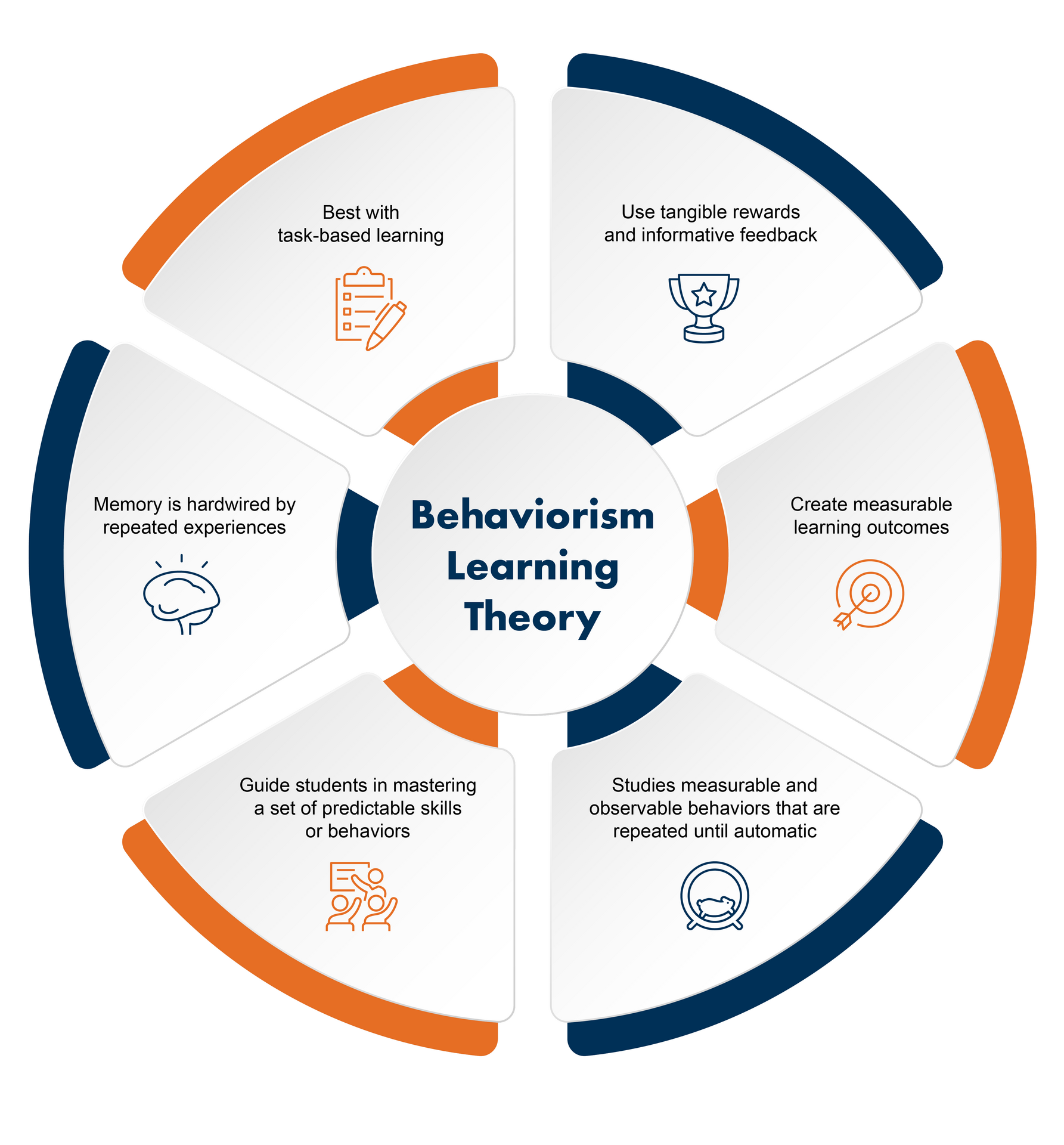
The main theory of behaviorism, which includes classical and operant conditioning, helps us understand how external influences shape behavior. In behaviorism, people often compare the mind to a black box, focusing on the behaviors of children we observe rather than what they are thinking. Classical conditioning, discovered by Ivan Pavlov, shows how children learn by making connections. For example, when a dog hears a bell and gets food, it learns to salivate at the sound of the bell. Operant conditioning, studied by BF Skinner, explains how behaviors are strengthened or weakened through reinforcement. If something good follows an action, like a reward, they are more likely to repeat the action. If something bad follows, like a punishment, they are less likely to repeat it. These theories help us understand how children learn from their surroundings and adapt to them.
In education, the ideas of behaviorism, led by Skinner, offer effective teaching and learning strategies. Behaviorism is based on the idea that behavior is shaped by reinforcement and punishment. Skinner's work shows how rewards, punishments, and attention are key in teaching. He says that having clear goals, getting feedback, practicing, and mastering skills are important for learning. In behaviorism, Skinner suggests practical ways and teaching methods to make teaching and learning better. One common behaviorism teaching strategy is teacher-led direct instruction.
Skinner stresses how important it is for you to improve your knowledge of effective teaching and learning strategies. He points out reasons why some learning experiences do not work well, like only demonstrating a concept without providing reinforcing students’ efforts. To remedy this, Skinner suggests you use a structured approach to teaching. This means clearly explaining learning objectives and breaking tasks into manageable steps. Making sure students understand each step helps them progress in difficulty of tasks in order to master them at each stage. Skinner highlights how crucial it is to reinforce correct actions, creating a positive learning atmosphere where children are actively involved in the learning process. Figure 2.9 provides a summary of the behaviorism learning theory.
Cognitivism
Cognitivism, a significant theory in psychology and education, changes the focus from observable behavior to what is happening inside the mind. Unlike behaviorism, cognitivism aims to understand how we think, remember, solve problems, and make choices. By studying how people take in, process, and remember information, cognitivism provides valuable insights into cognition and learning. While behaviorism looks at external stimuli and responses, cognitivism dives into the thoughts that come between the stimulus and the reaction, showing us the complexities of human thinking and behavior. Through cognitive theories and research, educators and psychologists try to solve the mysteries of the mind and create better teaching and learning strategies that consider cognitive needs and abilities.
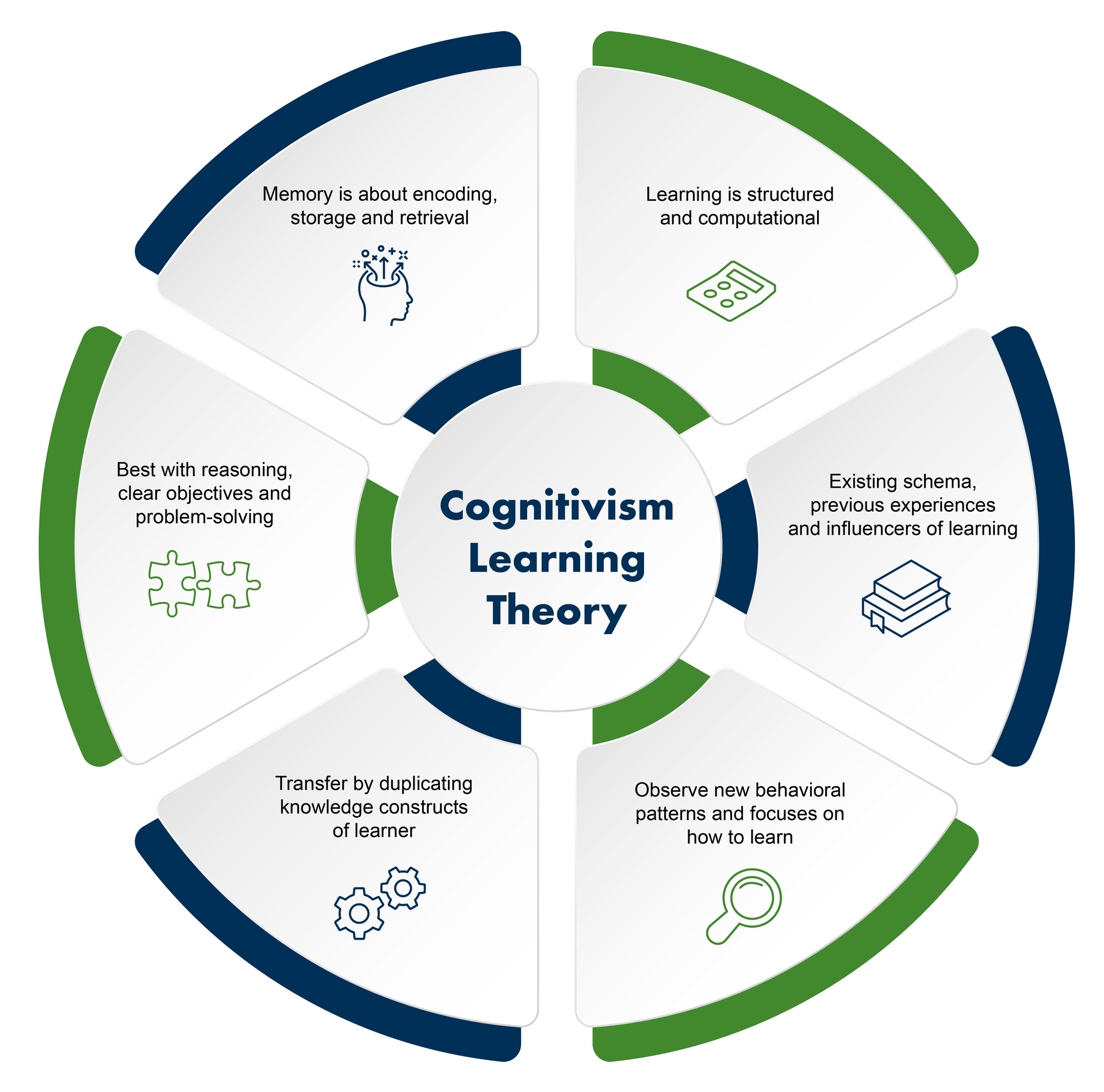
In education, cognitivism highlights how children build mental schemas, which are like frameworks helping them organize and interpret information. According to this theory, learners actively engage with new information by organizing and interpreting it based on their existing knowledge structures. Mental schemas help individuals make sense of the world and guide their understanding by through attention, encoding, and retrieval. This active construction of knowledge is important in cognitive development and allows you to create meaningful learning experiences. Figure 2.10 summarizes the key points of the cognitivism learning theory.
Figure 2.10. Cognitivism Learning Theory
Bloom’s Taxonomy
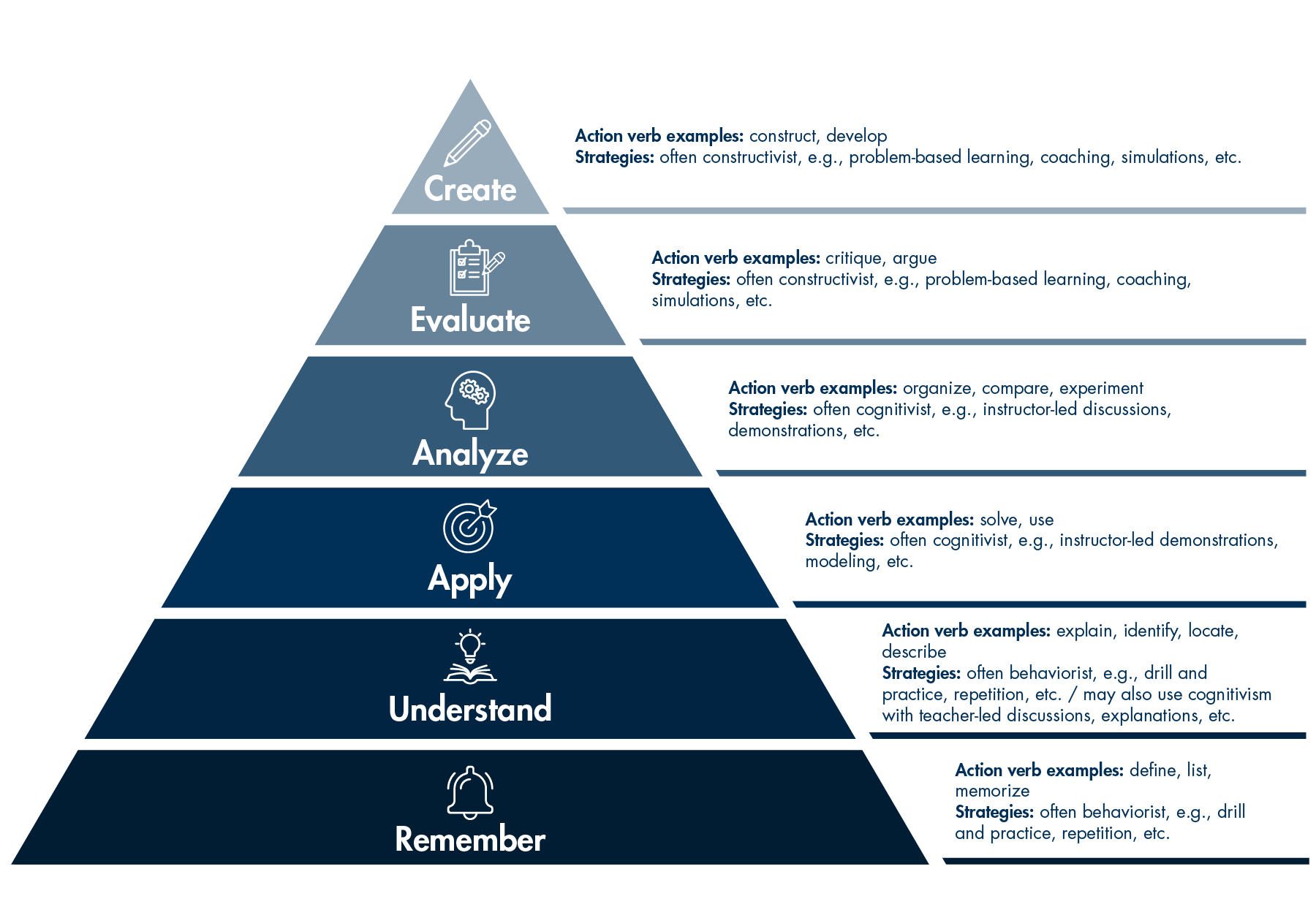
From a cognitivism perspective, Bloom's taxonomy emphasizes the importance of understanding how learners process and make sense of information. Bloom's revised taxonomy is a framework that classifies educational objectives into six levels of cognitive complexity: remembering, understanding, applying, analyzing, evaluating, and creating. In the classroom, you will be able to use Bloom's taxonomy to design instructional activities that promote higher-order thinking skills and encourage deeper understanding.
For example, when teaching a concept, you can begin by asking students to remember key facts or information related to the topic. This may involve activities such as memorization or recall exercises. Once students have proficiency in remembering the information, they can move on to the understanding stage, where they are asked to explain the concept in their own words or provide examples to demonstrate comprehension.
Applying Bloom's taxonomy, you will design tasks that require students to apply their understanding of the concept in real-world contexts or solve problems using the information they have learned. This might involve case studies, simulations, or hands-on activities that encourage students to transfer their knowledge to new situations.
As students progress through Bloom's taxonomy, they are challenged to analyze, evaluate, and create using the information they have learned. This may involve tasks such as comparing and contrasting different ideas, critiquing arguments or interpretations, or generating original solutions to problems. By scaffolding instruction to move students through each level of Bloom's taxonomy, you can support cognitive development and promote deeper learning outcomes. Figure 2.11 outlines the revised taxonomy, which consists of six cognitive processes arranged from lower-order thinking skills to higher-order thinking skills.
Figure 2.11. Bloom’s Taxonomy
Information Processing Theory
Information processing theory is an important part of the theory of cognitivism. Cognitivism focuses on understanding mental processes, where information processing compares how human brains work to how computers work. It suggests that our brains take in information, work with it, store it, and retrieve it when needed, just like a computer does. It highlights the role of attention, perception, memory, and problem-solving in cognitive development.
From a cognitivist perspective, information processing theory provides clues about how learners encode, manipulate, and retrieve information. It highlights the importance of sensory input, attentional processes, and working memory when first taking in information. As students engage with new learnings or skills, they focus on the important information, think in different ways, and combine their new learnings with what they already know.
Additionally, according to information processing theory, it is crucial for children to store and organize information in their long-term memory for future use. This theory emphasizes the role of rehearsal, elaboration, the addition of details, and meaningful encoding in transferring information from working memory to long-term memory. Retrieval strategies, such as recognition and recall, allow learners to access stored information when needed, which makes problem-solving and decision-making easier for them.
Overall, information processing theory within the framework of cognitivism provides a thorough understanding of how individuals acquire, store, and utilize knowledge. By examining the cognitive processes involved in learning, you will be able to design instructional strategies that provide optima
Constructivism Learning Theory
Constructivism, is a significant theory in education that emphasizes active learning, student-centered instruction, and the construction of knowledge through personal experiences and interactions. Constructivist teacher strategies are centered around the building of knowledge by engaging students in meaningful learning experiences. When you use constructivism in the classroom you will encourage inquiry, exploration, and discovery, provide opportunities for students to construct their understanding of concepts through hands-on activities, group discussions, and real-world problem-solving tasks.
A well-known constructivist, Maria Montessori's educational philosophy stressed the importance of self-directed learning and hands-on exploration, which aligns with the idea of discovery learning. Self-directed learning means to take control of your own learning, setting goals, finding resources, and solving problems independently. Discovery learning involves exploring and solving problems independently, utilizing curiosity and problem-solving abilities to uncover fresh ideas and concepts. Her approach to learning has supported a network of “Montessori” schools, whose academic structure focuses on learning through creative student choices, student-centered hands-on learning, and collaborative play.
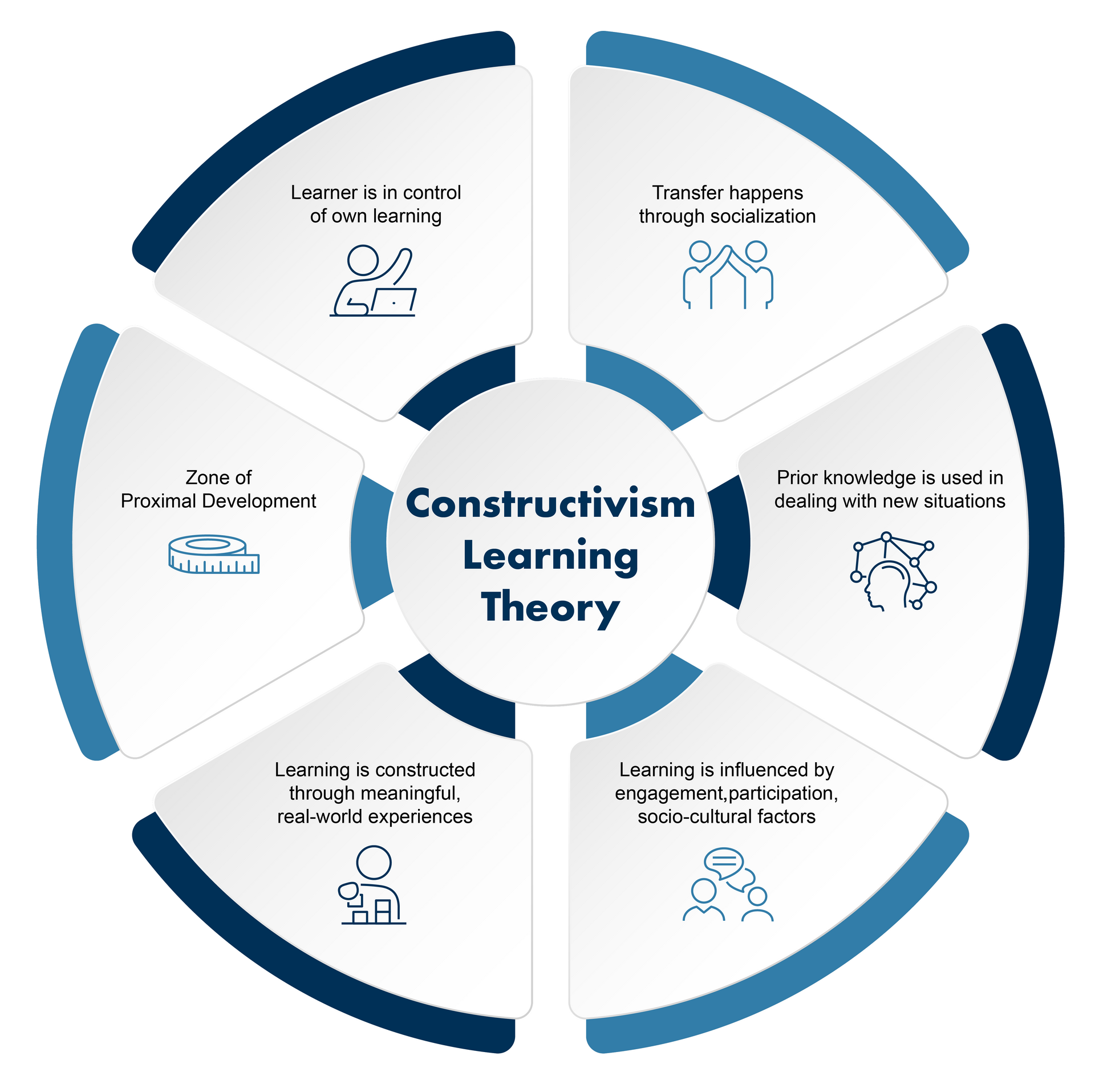
Principles of constructivism include the idea that learning is an active process in which individuals construct meaning based on their prior knowledge and experiences. Learners are seen as active participants in their own learning, rather than passive recipients of information. As a constructivist you will act as a facilitator or guide, supporting students as they navigate through challenging tasks and providing scaffolding to help them build upon their existing knowledge.
Social constructivism, another influential perspective, highlights how both individual thinking and social factors shape learning. Essentially, constructivist teaching methods blend cognitive and social elements, encouraging active learning and collaboration. Social constructivism stresses the importance of social interactions and learning by observation. These perspectives together emphasize how children's thinking and social interactions work together in the learning process.
Figure 2.12. Constructivism Learning Theory
The Shift from Behaviorism to Constructivism in Education
The shift from behaviorism to constructivism, with the influence of cognitivism, marks a significant transformation in educational theory and practice. Behaviorism focuses on observable actions and how external rewards and punishments shape behavior, whereas cognitivism focuses on how people think, remember, and solve problems. Constructivism further transforms this view by emphasizing how learners actively build their understanding through experiences and social interactions. This shift has significantly impacted modern teaching methods.
Behaviorism focuses on how rewards and punishments affect behavior through direct instruction and repetition, but it does not consider how students process information internally. Cognitivism introduced the idea that understanding mental processes like memory and problem-solving is crucial for effective learning. This perspective led to new teaching strategies focusing on how students process and organize information.
Inspired by Jean Piaget and Lev Vygotsky, constructivism shifted the focus to how students create knowledge through hands-on activities and social interactions. Teachers now design lessons that promote exploration, questioning, and applying knowledge to real-world situations, which helps students understand and think critically.
Social constructivism, introduced by Vygotsky, added that learning is best achieved through social interactions, making group projects and discussions central to teaching methods. This approach also changed assessment practices, moving from memorization to evaluating how well students apply and think about their knowledge.
The shift from behaviorism to constructivism, incorporating insights from cognitivism, has led to a more dynamic and student-centered educational approach. It emphasizes active learning, social collaboration, and meaningful application of knowledge, resulting in richer and more engaging learning experiences that support the development of critical thinking skills and deeper understanding.
Lev Vygotsky’s Cognitive Development Theory
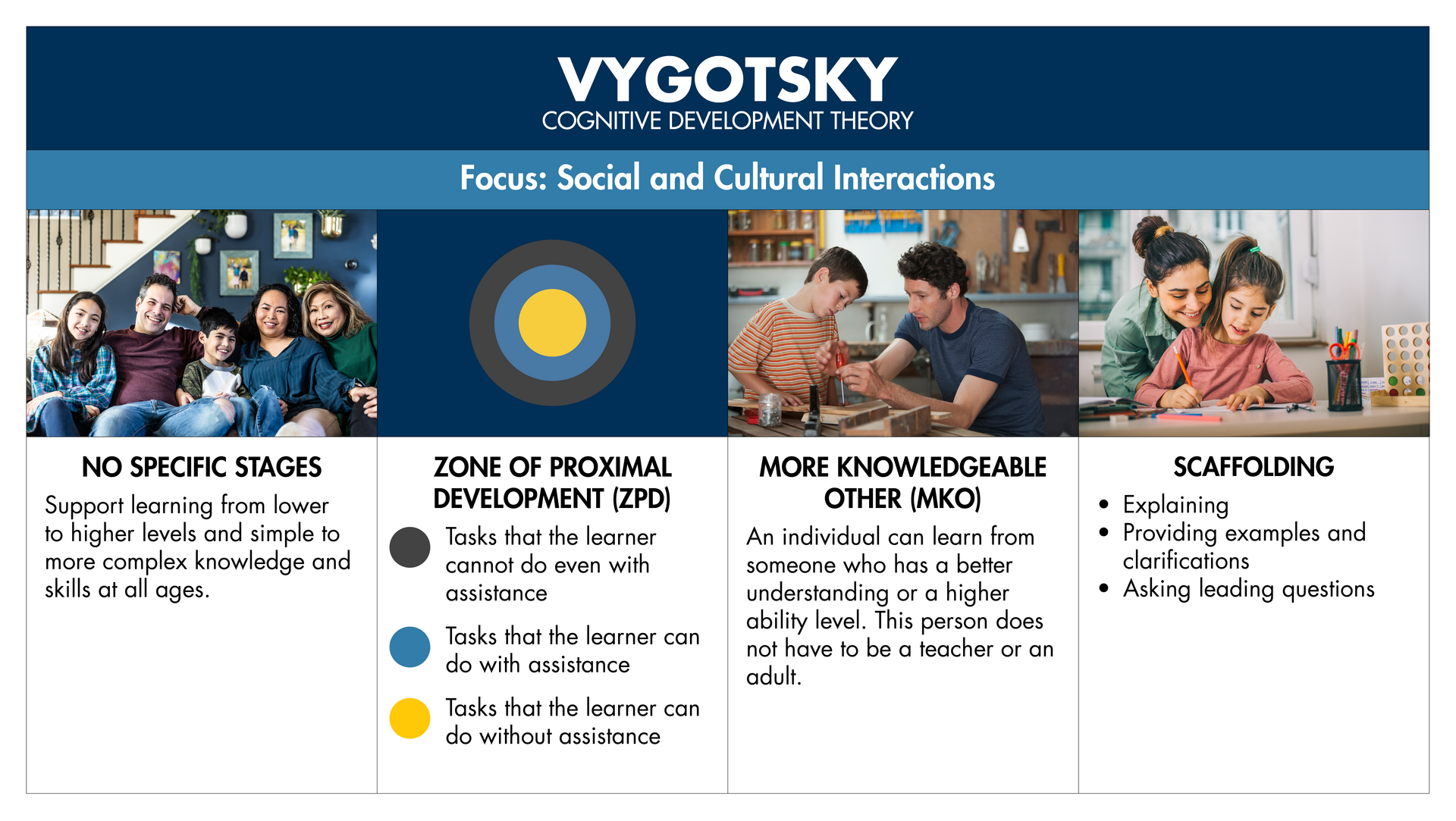
At the core of constructivism is the idea that learning is an active process where students build new knowledge based on what they already know and experience. This theory emphasizes that learners actively create meaning through their interactions and experiences. A key part of constructivism is Lev Vygotsky's Cognitive Development Theory, which focuses on how children learn through their interactions with others and their cultural environment.
Central to Vygotsky's theory are the concepts of the Zone of Proximal Development (ZPD) and the More Knowledgeable Other (MKO). The ZPD represents the gap between what a learner can do independently and what they can achieve with guidance. The MKO, often a teacher or a peer, provides support within this zone. Scaffolding, where the MKO gradually reduces assistance as the learner becomes more capable, is essential. This approach helps students tackle more challenging tasks and build their knowledge through social interaction and collaboration. Figure 2.13 summarizes the key points of Vygotsky's cognitive development theory.
Figure 2.13. Vygotsky Cognitive Development Theory
John Dewey’s Principles of Education
John Dewey is considered to be the founder of Constructivism.
Comparison of Learning Theories
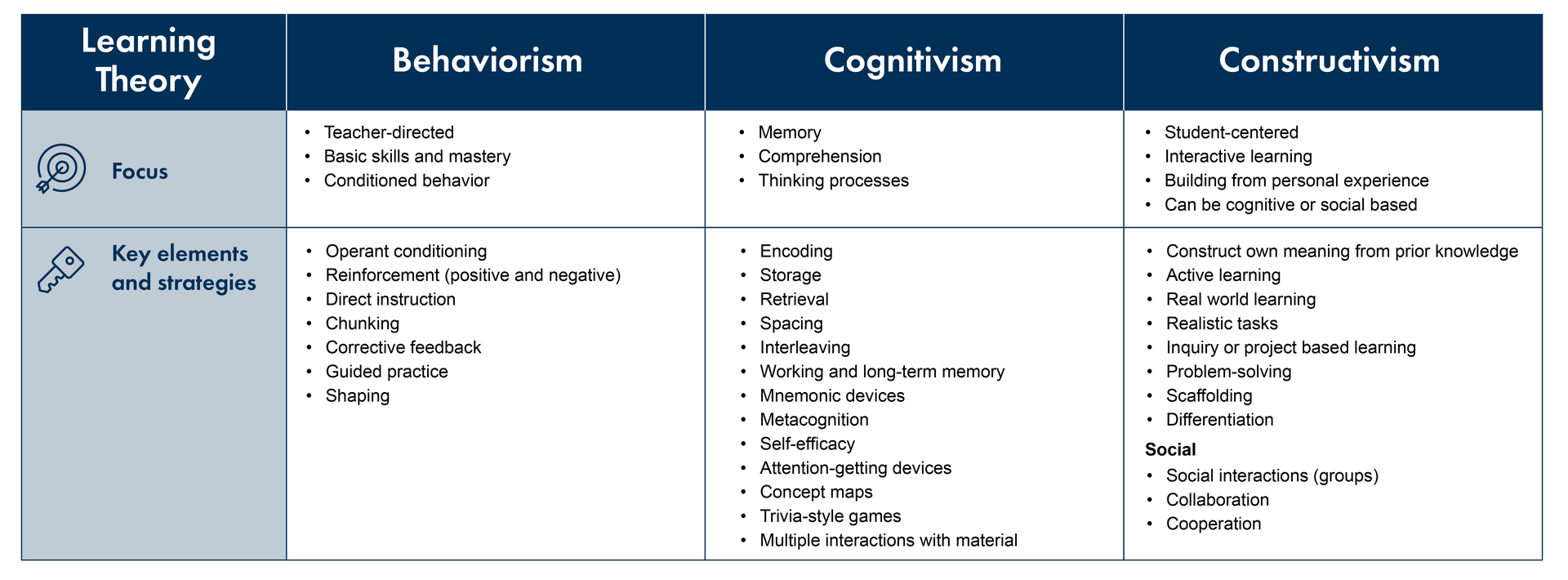
Figure 2.14 examines the major learning theories of Behaviorism, Cognitivism, and Constructivism in the categories of focus and key elements and strategies.
Figure 2.14. Major Learning Theories
Learning Theories in the Classroom
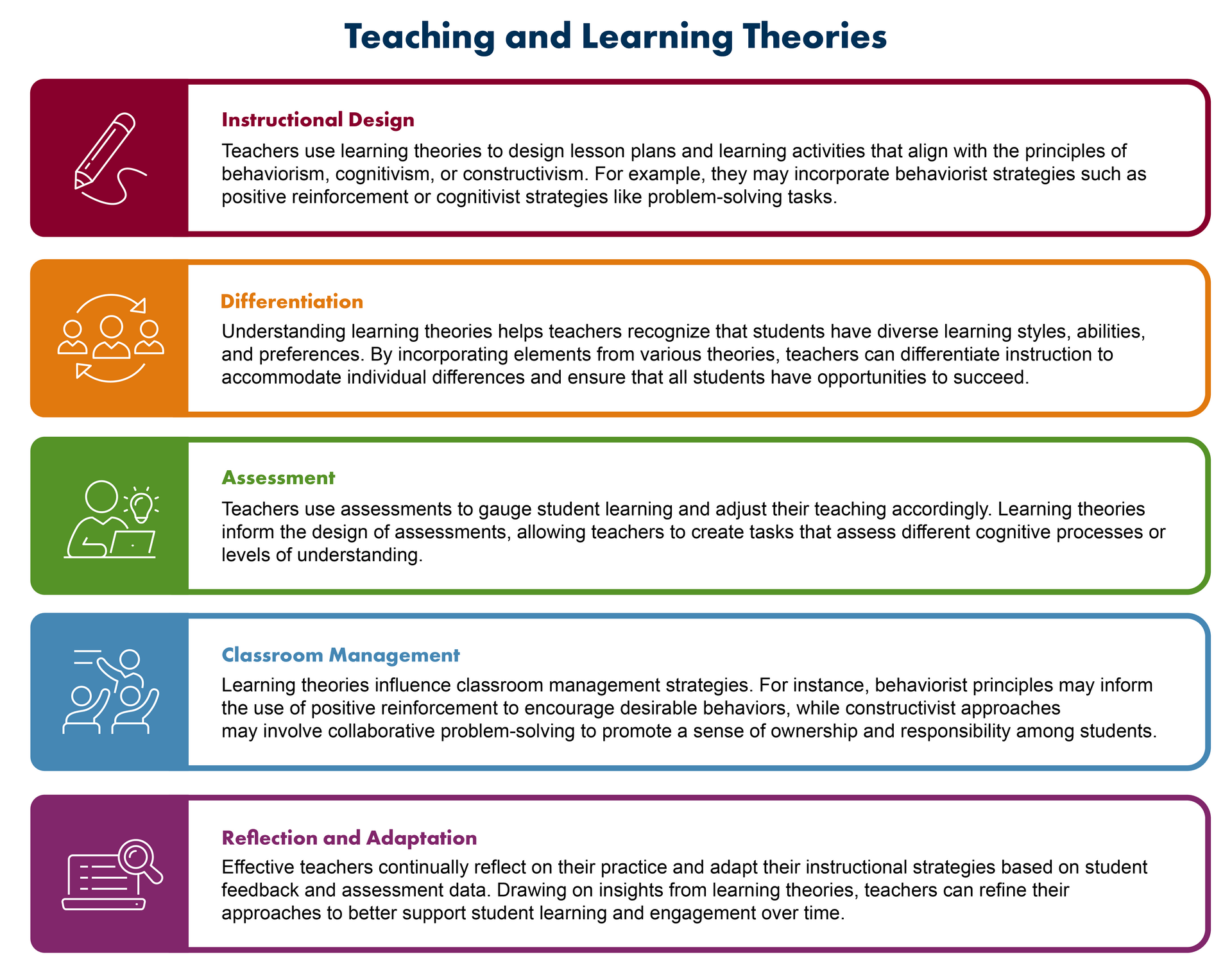
As a classroom teacher, you will use learning theories to inform your instructional practices and increase student learning. Often, you will not strictly use just one theory but rather you will combine several to meet the various needs of your students and address different learning objectives effectively. Here are some ways you may use learning theories as a classroom teacher:
Figure 2.15. Teaching and Learning Theories