Sociology Final
What do we mean by equality?
Social inequality: the unequal distribution of social goods, such as poney, power, and status
- Equality of opportunity: everyone has equal chances in the beginning, but luck or skill brings varying results
- Two people go to the same college, get the same degree, get a job at the same company, but one ends up getting promoted and one doesn’t
- Equality of condition: situations need to be altered in order to compensate for inequalities in the relative starting positions
- EX: affirmative action
- Equality of outcome: everyone ends up with the same amount of resources regardless of “fairness”
- How can we modify the social structure around us to create equality and equity?
What is stratification?
- A system that puts categories of people into a hierarchy
- Race inequality
- Gender inequality
- Education inequality
- Income inequality
- neighborhood
- ethnicity
- Wealth
- Societies vary in what categories are used to sort people, and how unequal those categories are
- Our focus this week: economic stratification (e.g. social class inequality)
- Sociologists view social class inequality in the US as a structural problem
Forms of stratification
- Estate system: politically-based
- Caste system: religiously based
- Closed stratification system (cannot moved between ranks)
- Ascribed status
- Class system: economically based
- Open stratification system (can move between ranks)
- Achieved status
- Socioeconomic status: an individual’s position in a stratified economic social order
- Status hierarchy system: social prestige-based
- Elite mass dichotomy system: power is held by a few leaders
Stratification in the United States
- socioeconomic status: an individual’s position in a stratified economic social order
- Social class: a group of individuals who share a similar economic position based on income, wealth, education, occupation
- Income: the amount of money you earn from employment or investments
- Does Not account for wealth
- A lot of people will lie about their income on surveys, or not disclose it at all
- Also, a salary in alabama may make you wealthy but that same salary in Boston may make you poor based on the different costs of living
- Also just asking about occupation doesn't help either → for example teachers get paid widely different amounts depending on states
- Wealth: the total amount of money you have
- Elderly usually have a low income, but high amount of wealth
- When studying this, researchers get middle class as a common answer because people will know someone who is of a higher socioeconomic status and someone of a lower socioeconomic status, so it can hard to study
- In the end, we used education as a measure of socioeconomic factors since all of these other factors are hard to measure and get accurate
Stratification in the United States
- Upper class
- The top 1% (net worth); income from investments (vs, wages)
- Prestige and power: what kinds of things do upper class members control?
- Politics, consumer culture
- Middle class
- Varying definitions and operationalizations
- Bachelor’s degree or higher
- Working class
- 4 year or 2 year degrees
- More job precarity (not stable, a lot of turnover) than upper tiers
- Poor
- Living in poverty below the official poverty threshold (2019 Boston, fam of 4: 26, 500)
- Unemployed or underemployed (only working 15-20 hours a week)
- Occupations require less experience
Recall: marx and Conflict theory
- Karl Marx
- Groups with different resources and interests always struggle
- Societies are based on social class conflict: capitalists and workers
- Capitalists exploit workers by taking more value of their work than what they pay workers in wages
- Conflict theory
- Society’s economic and political structures produce (and reproduce) divisions, inequalities and conflicts
- Conflict among competing interest is the basic, animating force of society that leads to change
- Marx and Weber on social class
- marxist framework: class is antagonistic and exploitive
- False consciousness: workers unable to see their exploitation and oppression
- Class consciousness: workers start to see their struggles; workers realize that they have solidarity against owners of means of production; workers must struggle to obtain means of production
- Weberian framework: class is about more than just economics; need to consider status, common identify, common interests
- Weber: social classes can be distinguished on the basis of common life chances or opportunities in the marketplace
- Unionization of starbucks workers: workers developing class consciousness
- Amazon buying companies like whole foods: marx would believe they are exploiting workers
Life expectancy
- Life expectancy increased among all income levels, but life expectancy is still 10 years higher for the highest income quartile compared to the lowest
- Also, life expectancy increased at a higher rate in higher income individuals than lower income individuals
What affects health?
- Employment status; occupation; income
- Knowledge about health, healthcare
- Access to resources…healthy food, medical care, education
- Social support systems; social networks; “connections”
- Eating habits, physical activity, smoking
- Residential location/neighborhood
- Stress
- race
reading
Miele | Wilson | Gora | |
|---|---|---|---|
Social supports | Wife Brother in law was on the board of another hospital (strength of weak ties) | Family (had negative habits of eating fried foods) | Husband has unhealthy habits like smoking |
Hospital | Had choice between two high quality hospitals Had knowledge and social ties attached to better hospitals to know that they were better (health literacy, education) | Got to choose intermediate hospital that had higher wait times than the private hospital, but could still perform the procedure | Given no choice of hospital, had to transfer later on because city hospital couldn't perform the proper procedure |
Job | Does not have a physically demanding job, can recover while also performing his job at his desk, can reduce his hours without risk of getting fired. | Also has a physically demanding job, but is part of union that gives him time off for his illness | Had a physically demanding job, so when she got sick she quite literally could not work Without work, she couldn't get paid Appointments would take up the whole day, so she couldn't go to work and get paid, but also risk getting fired because her job has high precarity (she is easily replaceable if she can't commit to work) |
Is social class ascribed or achieved?
- Social mobility refers to the movement of individuals between different prepositions of a social stratification system
- Horizontal (changing companies, but keeping the same job)
- Vertical (promotion)
- Upward mobility: when someone moves from a lower social class to a higher social class
- Downward mobility: moving from a higher social class to a lower social class
- Meritocracy: the idea/belief that status and mobility are based on individual attributes, ability, and achievement
- Sociology is concerned with what social structures allow or don't allow this social mobility or upward mobility to take place
Social mobility
- Structural mobility: when societal changes enable groups of people to experience upward or downward mobility
- Attributed to changes to society as a whole- not individuals
- Recessions, great depression
- Exchange mobility: the idea that if some individuals experience upward mobility, other individuals will experience downward mobility
- Intragenerational mobility: difference in social class occurring within an individual’s lifetime
- Comparing siblings, one files for bankruptcy after being super successful, within their lifetime
- Intergenerational mobility: difference in social class across generations of a family
- Child gets a bachelor's degree when their parents didn't
What determines social mobility?
- Capital!
- Economic: how much money you have
- Human: the knowledge or skills you have to do something. As a surgeon you need to gain the human capital to conduct the surgery
- Cultural: knowledge you have of a particular culture that allows you to be a part of and interact with different cultures
- Social: resources that come from social ties
- Socioeconomic status of who your friends with not only can give you social capital, but that pool you have to choose from is highly based on place/location.
The growing wealth gap in the US
- The income and wealth gap between the most privileged classes and the rest of the population has been growing for nearly 40 years
- The top 1% of households int eh US earned less than 10% of the total national income in 1980 but now earn over 20%
Global inequality has increased dramatically since the 19th century
- More recently, between country inequality has declined
- Within-country inequality has increased
Global inequality
- Has increased dramatically over the past centuries
- Between country inequality has declined
- Within country inequality has increased
- GINI coefficient/GINi index: one way of measuring and comparing inequality across countries
- Ranges 0 to 1 (perfect equality to complete inequality)
- US exhibits greater inequality than other industrialized economies
- The wealthiest 1% of the world’s population owns 50.1% of all household wealth in the world
- The US doesn't have a history of taking care of the poor (like europe’s feudalism did, which created a social safety net for them)
What is poverty?
- Poverty: a condition of server deprivation due to economic circumstances
- Absolute poverty: condition where a household’s income falls below the necessary level to purchase goods and physically sustain its measures (e.g. food, housing)
- Relative poverty: a measure of poverty based on the median income in a particular location
Measuring poverty
- Often uses statistical measures of income
- 1960s: official poverty measure (OPM) compares pre-tax cash income against a threshold that is set at three times the cost of a minimum food diet in 1963 and adjusted for family size
- 2011: supplemental poverty measure (SPM)
- Cash income + non cash benefits (food, shelter, etc) -(minus) necessary expenses
- Expands definition of household
- Geographic adjustments (cost of living
Poverty and recessions
- Recessions: a period of economic decline lasting a year or more
How is poverty distributed in the US?
- Household structure: households headed by single mothrs are much more likely to be poor than in married-couple or single father families
- Education: high rate of poverty for adults who have not completed high school
- Paid work: those with no earnings are substantially more likely to be poor than are those with earnings in the bottom third of the distribution
- Disability: for poeple aged 18 to 64 with a disability, the 2018 poverty rate was 25.7% or 3.8 million people living in poverty
- race/ethnicity : the poverty rate is approximately two times higher for african american hispanic, and native american families than it is for whites and asian-american families
- Region: the south has the highest poverty rate The poverty rate is lowest in the northeast
- Compared with similar industrialized nations, the united states has greater inequality and higher rates of poverty.
How has poverty been addressed in the US/
- AFDC (aid to families with dependent children): provided cash welfare payments for needy children/families; states entitled to unlimited reimbursements for benefits- began in 1930s
- Lyndon johnson’s “war on poverty” declared in 1964
- Cultural theories of poverty
- Underclass: notion of deviance is added to culture of poverty thesis
- Perverse incentives: idea that people would choose a safety net over labor market participation
- Major welfare reform in 1996 under clinton
- Workfare: work requirements for benefits receipt
- We began to view poverty as a type of crime, people deliberately choosing to not work, which is where workfare came in, people needed to have a job to receive welfare
- TANF (temporary assistance for needy families): state administered financial assistance and related support
- Range of what is needed to qualify for TANF, how often people can receive TANF, can vary by state
- SNAP (supplemental nutrition assistance program): federal program for food purchasing assistance
- EITC (earned income tax credit): allows low and moderate income families to use credits to reduce the taxes they owe, potentially increases their tax refund
- Medicaid and CHIP
- Housing: public housing, section 8 housing (a voucher to live in non-government housing)
Video
- Highlights how job precarity, and access to benefits, and time (don't have time to wait in the waiting room of the social service office if the hours overlap with your job that requires you to be there certain hours) contributes to poverty
$2 a day reading
- Sell plasma
- Scrap for metal
- Sell SNAP (trade it for straight cash)
- Stigma around SNAP
- SNAP doesn't cover a lot (clothes, diapers, formula, hygiene products) so it might be better to just take the money in cash
- Also you can get food at other places (food banks) for free so it might be better to have a cash floor that can go towards cars, education, transportation , etc
- Among children in “$2 day” families, 7 of 10 had a family in the abor force. Jobs today are different than jobs a few decades ago
- Unsafe conditions
- Underemployment: have a job, but can’t get enough hours
- inconsistency/precarity: lack of protection over jobs
- What states do with the money the federal government gives them from TANF varies greatly by state, qualifications are different, what individuals can do with that TANF money once they get it is different, how long those funds last are different, how much they receive in the first is different by state
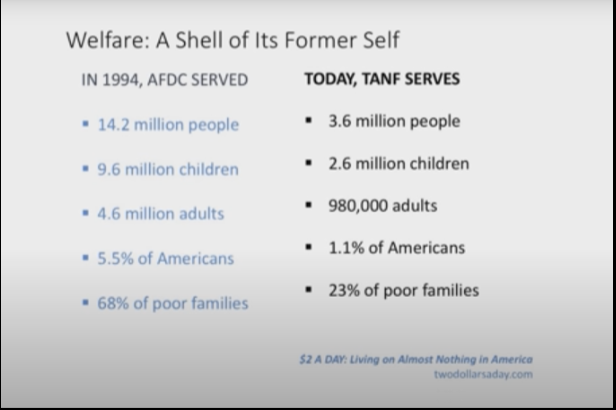
One of the best policies to help get families out of poverty is the expanded child tax credit
- $2000 tax credit for every child, expanded during pandemic
- Also during the pandemic. Free school lunch and breakfast for MA public schools, health insurance assistance, uneomployemtn assistance
- If it hasnt been for american resucue plan and these government assistance during the pandemic, poverty would have increased cretalty, but because of this, poverty was kept down,
- All of these government assistance programs give people cash, which helps people more because they can spend it on their individual needs
- 3 million fewer children would have been in poverty in 2022 had child tax credit expansion been renewed
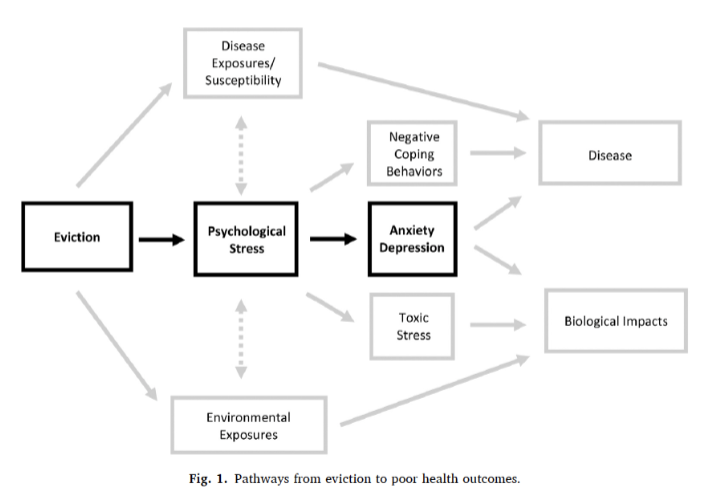
Eviction epidemic in the United States (especially during the pandemic)
- “Without sustainable shelter, everything else falls apart)
- “Eviction filings during the pandemic will have lasting negative consequences for renters”
- Despite programs protecting families from being physically evicted, landlords could still file evictions and even if the family didn't physically evicted that eviction filing affects their credit store and therefore there ability to find a new landlord when that protection expired after the pandemic
- Housing surveys are rigged because they dont ask the homeless population
Poverty, children, and families
- Of every 100 children in the US, 20 live in a household with income below the poverty line
- Big target of these services because childhood is such a big developmental time frame, poverty and its resulting health, social, and financial effects can have a life long lasting impact
- Different theories of how poverty affects children’s well-being.
- Material needs (food, clothing, shelter)
- Parenting
- Susan mayer: it's not just about income
- Income alone has a big influence on meeting material needs
- Non-monetary factors play a bigger role than previously thought
- Stress from being in poverty can affect their attention span in school
- It is easier to parent in the way you want to parent when you do not have the stress of worrying about housing, job instability, and basic needs
- Cash floor: how much cash does the family have to respond to an unexpected crisis. If there's no cash floor, there's only immediate focus on the short term, you can’t plan for the future
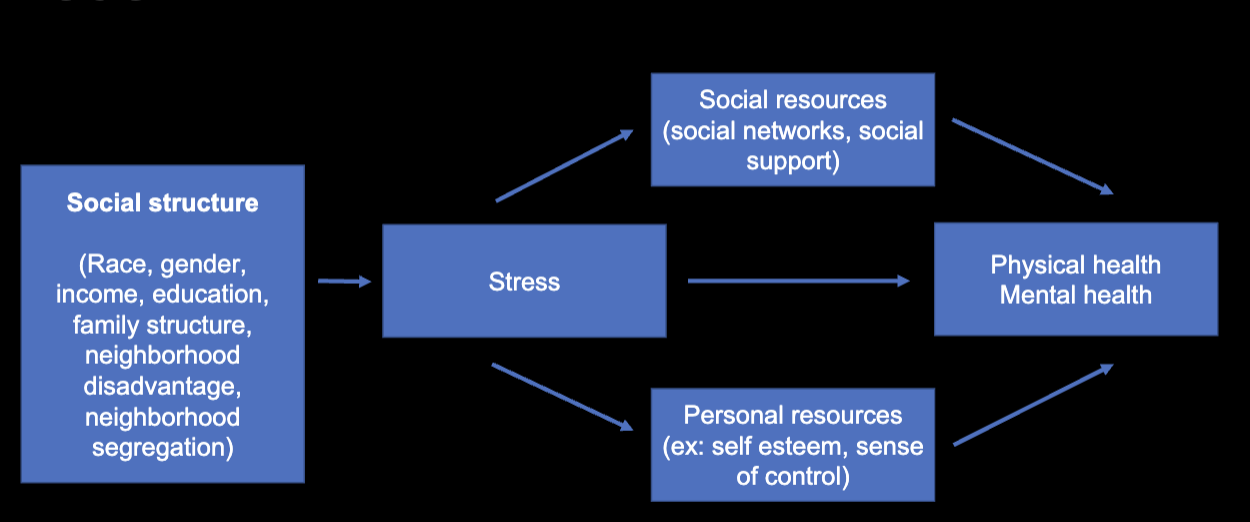
How does poverty affect health/ Stress process model
- Adolescents who experience eviction are more likely to experience poor health
Sex and Gender
- Sex: the different biological and physiological characteristics of males and females, such as reproductive organs, chromosomes, and hormones
- Gender: the socially constructed characteristics of women and men, such as norms, roles, and relationships of an between groups of women and men
- Essentialist arguments: explain social phenomena as natural or using biological determinism- i.e. what do you do in the social world is a direct result of who you are in the natural world
The social construction of gender
- Gender is collectively defined, that humans use to make distinction among themselves
- Gender norms: social definitions of behavior assigned to particular sex categories
- Gender “established patterns of expectations for individuals, orders everyday life and is built into the major social organizations of society”
- Gender is socially constructed, but it doesn’t mean it's not real
The social construction of gender
- Gender isn't something we are, its something we do
- Cisgender: people whose gender corresponds to sex assigned at birth
- Trasngender: people whose gender does not correspond to sex assigned at birth
- Androgynous: gender presentation is not distinctively masculine or feminine
- Other cultures: third gender; greater fluidity between genders
Theories of gender and power
- Deceptive distinctions
- Many observed behavior differences between women and men are not about individual gender differences
- Gender differences arise from the roles individuals occupy rather than from some innate force
- Essentialists arguments: explain social phenomenon as natural or using biological determinism- i.e. what you do in the social world is a direct result of who you are in the natural world
- Sociologists reject this theory
Explanations of gender differences
- A man playing football who is acting bold and aggressive
- Deceptive distinctions: the sport of football and his role as a football player requires him to be bold and aggressive to be competitive, to do well in the game
- Essentialist argument: men have more testosterone which causes them to be more bold and aggressive
Theories of gender and power
- Hegemonic masculinity a form of social organization in which men are dominant and privileged
- Social problems that exists within a dominant group in a society tend to be invisible
- Changes over time (ex: culturally idealized form of manhood)
- Privilege is seen as normative and everyday life, so problems rising within that dominant group that holds that privilege, is not always seen
- Us has a very narrow definition of masculinity which can cause behavioral, social and metal problems within boys
- highlights sociological imagination (how we are perceived affects how we act), sticky labeling (are you seen as a man? Are you seen as too feminine?), medicalization (their behavior is labeled as a disorder rather than a manifestation of depression), dramaturgical theory (putting on a face)
- Social problems that exists within a dominant group in a society tend to be invisible
Feminism
- “First wave”: a social movement advocating for women's rights (the right to vote)
- “Second wave’ (1960s-1970s)
- Focus on equality and discrimination; “the personal is policitical_
- Betty friedan’s the feminine mystique
- “Third wave” (1990s): sees women's lives as intersections; incorporates race and class
- - claimed that the second and first waves primarily focused on the rights of white women, adnt that women of all backgrounds, races, and cultures and their experiences need to be taken into account
Gender (in)equality: major theories
- Conflict theory
- Marxism and feminism: gender- not class- was the driving force of history
- Unequal gender relations are at the root of all social relations
- Gender relations persist because the dominant group (men) exploit of oppress subordinate groups (owmen)
- Friedrich engels (german sociologist): the same owner- worker relationship seen in the labor force could also be seen in the household
- Interactionist theory
- Meanings of gender are created through social interaction and social norms
- “Doing gender”- west and simmerman- an inetractionsit theory of gender
- We continue to reaffirm and reproduce gender norms and gender as a social construct through our interactions
- Functionalist theory
- Recall: functionalism sees society as a complex system with parts that work together to promote solidarity and stability
- Talcott parson” “Sex role theory”: sees a gendered division of labor as functional for stable society
- Heterosexual nuclear family considered the ideal arrangement
- Division of labor: women take care of the home; men provide for the family
- intersectionality
- Third wave feminism’s critique of the second wave
- Career choices: opportunities and constraints
- Intersectionality (kimberle crenshaw): a conceptual framework and effrot to address social inequality based on intersecting social constructions (such as race, class, and egender) manifested at both the individual and popualtion levels
- Matrix of domination- Patricia Hill Collins
- The nature and extent of a person’s oppression is a function of multiple factors, not just one
- Mother and HIV: an intersectional approach
- Racism
- Gender inequality
- Classism
- HIV-related stigma
- Motherhood
- Access to care
- Quality of care
- Individual; health outcomes (physical, mental, and social)
- Population health outcomes (physical, mental, and social)
- Third wave feminism’s critique of the second wave
- Gender (in)equality in education and the labor market
- more women are enrolled in college than men
- Since 1980, women have increased their presence in most of the 10 highest paying occupation in the US
- contraceptives were made more widely available in the 1980s, which allowed women to go to college and postpone childhood. This also increased the median age of marriage, so women could focus on school, education, and their careers rather than focus on raising a family at such a young age
- Men’s enrollment is decreasing because a lot more men are in the military or in trades that don't require a college degree. It has also been observed that they just dont want to go to college
- However, men still hold more STEM degree than women do
- For every dollar a man makes, a women males 82 cents
- There is evidence though that higher paying jobs tend to pay women more in the sector of ages 25-30, its 92 cents for every dollar a man makes
- Women are still earning less than men due to job selection, employers anticipating maternity leave, sexism, discrimination
- Glass ceiling: a metaphor to describe barriers that women face in the workplace that prevent them from reaching higher positions
- Discrimination (sexism): including sexual harassment
- Occupational segregation: certain occupations are more likely to have a greater share of women than men
- Mother hood
- Opting out
- Maternity leave
- Solution: parental leave?
The Motherhood PEnalty
- Corell, benard, Paik 2007 study in the american journal of sociology
- Research question: is there a motherhood penalty?
- Experiment:
- Control group: job applicant was member of neighborhood organization
- Treatment group: job applicant member of parent-teacher association
- Equally qualified women, differing only by parental status indicated on resume
- Part 1: laboratory- rate applicants on various qualifications
- Part 2: audit study- callbacks
The motherhood penalty
- FIndings:
- Mothers judged as being less committed, less competitive compared to non-mothers, lower recommended salary
- Mothers less likely to receive a callback
- Wage penalty increases with number of children- 7% wage penalty per child
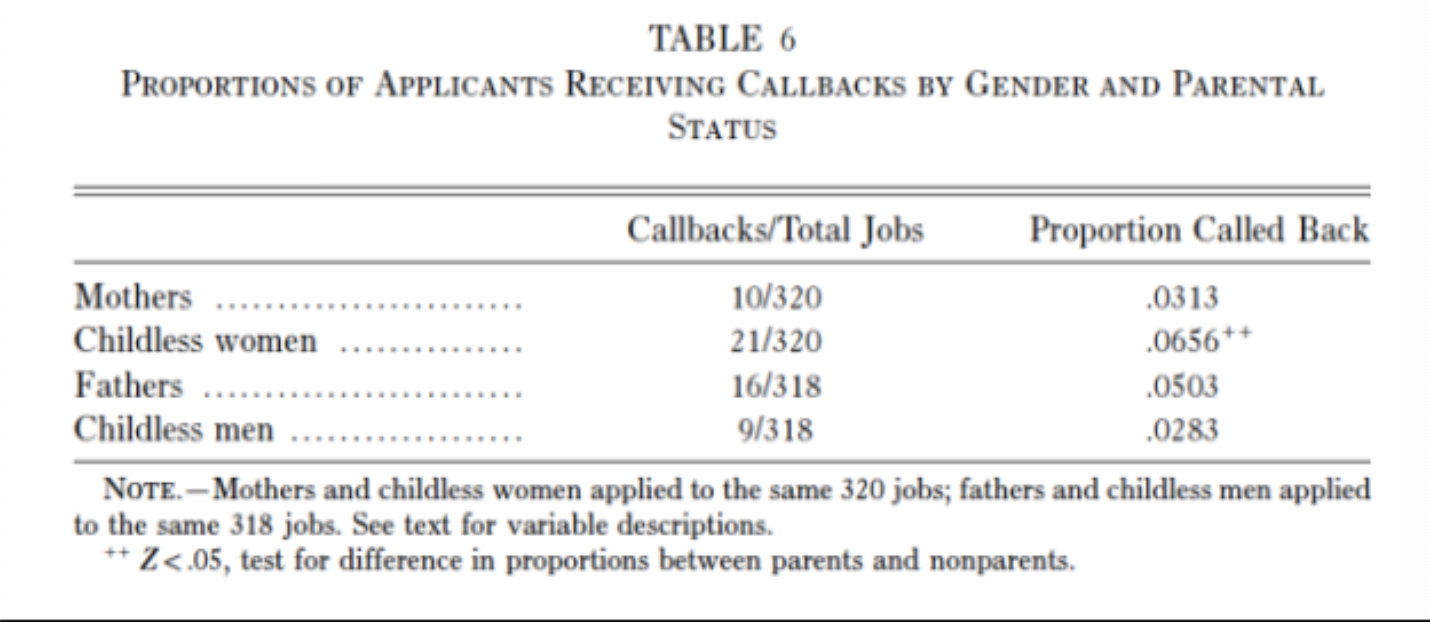
- (motherhood penalty and fatherhood bonus)
- Fatherhood bonus in dollars, by professional status, occupational cognitive education (OCD) and race/ethnicity, adjusted for human capital
- Being of a different race however negates the benefits of the fatherhood bonus
- Glass ceiling: an invisible limit on women’s climb up the occupational ladder
- Glass escalator: the accelerated promotion of men to the top of a work organization. Especially in feminized jobs→ token man in the occupation (teaching, nursing). DOes not happen in the reverse, women to nto get promoted faster in a male dominated field, she is actually under more scrutiny.
- The government and companies will offer parental leave to both parents, but fathers usually don't take it even if it's offered to them, so the company norms around parental leave are diminished
- Also the point of hiring more women/mothers starts at the hiring process, so offering parental leave does not necessarily fix that
- In 4/10 families, mom is the primary breadwinner and the percentage of women participating in the workforce is increasing
- However, since the start of the pandemic, women have lost 5.4 million net jobs, compared with 4.4million jobs lost by men because of the service and hospitality jobs they usually are a part of
- Occupational segregation: patterns of occupational fields being dominated by either men or women
- Leisure and hospitality industry: 54% women
- Education and health services (non essential) industry: 77% women
- Though dads are doing more childcare than they did in the 1960s, but moms still do a higher percentage overall
- In same sex couples, a higher percentage of them share the responsibility between child care and being the breadwinner than different sex couples
Doing and Undoing Gender
- Studies of heterosexual couples and housework: wives often retain primary responsibility for housework, regardless of whether they work, or promotional contribution to family income
- Studies of saem-sex couples reveals how the deeply isntiutionalied nature of gender is reflected and maintained through housework
- Some couple: more equality in housework, more sensitivity it equality within the relationship
- Key takeaway: gendered norms regarding housework hold different meanings for same-sex. These findings push on our theories of gender and heteronormativity in those theories
Gender and longevity
- If women are disadvantaged relative to men, why do they live longer, on average?
- Gender norms around healthcare- men are less likely to go to the doctor
- Type of job- women have less physically laborious jobs and ones without as many occupational hazards
- Men are more likely to be overweight, smoke and drink excessively, and adhere to treatment regimes, moms and socialization around aggression and violence
Transgener health
- Trasngender persons in the US are more likely than cisgender counterparts to report
- Poor physical health
- Mental health issues (anxiety, depression, substance abuse)
- Higher rates of HIV
- Attempt suicide
- Postpone or avoid medical care
- Lack health insurance
- Hide gender identity from health care provider
- It can be hard to find social networks with people who share your same identity and/or respect you because 57% of transgender people report family rejection
- Often discriminated in the workplace, in the social world, in healthcare settings
Prep for quiz tuesday
Sex: the perceived biological differences that society typically uses to distinguish males from females
Gender: a social position; behaviors and a set of attributes that are associated with sex identifies
sexuality : desire, sexual preference, and sexual identify and behavior
Essentialist: arguments explaining social phenomena in terms of natural, biological, or evolutionary inevitabilities
Androgynous: neither masculine or feminine
Transgender: describes people whose gender does not correspond to their birth sex
Cisgender: describes people whose gender corresponds to their birth sex
Hegemonic masculinity: the condition in which men are dominant and privileged and this dominance and privilege is invisible
Feminism: a social movement to get people to understand that gender is an organizing principle in society and to address gender based inequalities that intersect with other forms of social identity
Patriarchy: a nearly universal system involving the subordination of femininity to masculinity
Structural functionalism: a theory to which society’s many parts- institutions, norms, traditions, and so on- mesh together to produce a stable, working whole that evolves over time. Best embodied by Talcott Parsons
Sex role theory: Talcott parson;s theory that men and women perform their sex roles as breadwinners and wives/mothers, respectively, because the nuclear family is the ideal arrangement in modern societies, fulfilling the function of reproducing workers
Intersectionality: the idea that it is critical to understand the interplay between social identities such as race, class, gender, ability status. And sexual orientation, even though many social systems and institutions (such as the law) try to treat each category on its own
Matrix of domination: intersecting domains of oppression that create a social space of domination and, by extension, a unique position within that space based on someone’s intersectional identity along the multiple dimensions of gender, age, race, class, sexuality, location, and so on
Sexism: occurs when a person’s sex or gender is the basis for judgment, discrimination, or other differential treatment against that person
Sexual harassment: an illegal form of discrimination revolving around sexuality that can involve everything from inappropriate jokes to sexual “barter” (where victims feel the need to comply with sexual request for fear of losing thier job) to outright sexual asault
Glass ceiling: an invisible limit on womens climb up the occupational ladder
Glass escalator: the accelerated promotion fo men to the top of a work organization, especially in feminized jobs
Bisexual: an individual who is sexually attracted to both genders/sexes
Homosexual: the social identity of a person who has sexual attraction to an/or relations with people of the same sex
Heteronormativity: the idea that heterosexuality is the default or normal sexual orientation from which other sexualities deviate
Sexual orientation
- Sexuality: desire, sexual identity, sexual preference, and behavior
- Sexual orientation: how one identifies their physical and emotional attraction to others
- Described using socially constructed labels (gay, lesbian. Homosexual, heterosexual, bisexual, pansexual, asexual)
- Heteronormativity: idea that heterosexuality is the fault or normal sexual orientation from which other sexualities deviate
- There is enormous variation in how humans have sex, what it means to them
- Sexual orientation can be considered as having different components
- Attraction
- Behavior
- Identity
- Norms practices, beliefs, about sex and sexual orientation change over time
- Early 1800sL sex between men and women for reproduction, not please (“production economy”= the body was an instrument of work)
- By late 1900s: sexual pleasure was considered normal, valued
- Kinsey (1948): proposed sexuality as a continuum, challenging, homosexuality as abnormal
- Fourcault (1978): classifying homosexuality as deviance represents a way for Sexuality and social control
- Society creates boundaries to draw distinction regarding what is normal/abnormal acceptable/unacceptable through
- Providing a perspective, norms
- Providing informal or formal social control
- Source of sanctions
- Shaping access to resources
- Social and cultural institutions exert social control over sexuality
- Education
- Sex ed in school
- Dress codes
- bullying
- What cultural, political, ideas we are exposed to in school and by friends in school
- Government
- Legalization of same sex marriage
- Anti discrimination laws regarding sexuality
- Bathroom bills
- Laws against HRT, IVF, adoption, foster parent eligibility, abortion, birth control
- Healthcare
- Many transgender people don't have insurance
- Gender transitioning surgery and the requirements needed to get one
- religion
- Exclusion of certain groups based on sexuality, gender
- Growing acceptance → pope said priests can now bless gay couples
- Differences between religions on acceptance of genders, rights/abilities, sexualities
- Education
Sexual orientation and discrimination
- In some states (but not all) employers were significantly less likely to hire a gay job candidate
- Employers who emphasized the importance of stereotypically male heterosexual traits (aggressive, self-starter) were most likely to discriminate against openly gay men
Race and ethnicity
- Race is a social construct, what we have considered to be race has changed over time
- Race is real because it had and still has discriminatory consequences a
- US census has been collecting data on race since it started in 1790
- For every dollar that white household with children has, black households with children have 1 cent
- One of the most significant contributors to the racial wealth gap in the US is redlining
Race and ethnicity
- Race: a system that humans created to classify group of people based on shared characteristics- typically physical characteristics such as skint one
- Sociologists think of race as a social construct, a concept that humans invented to help understand or justify some dimension of the social work
- Ethnicity: typically refers to a common culture, religion, history or ancestry shared by a group of people
- E.g. mexican americans, cuban american, puerto ricans., irish americans, jewish americans
- The salience of race/ethnicity can vary across individuals, contexts, and time
- Can be central to life
- Can be salient at religious ceremonies, family gatherings
- Can be basis for stigma, discrimination
- “ As soon as someone classified you as different on the basis of your phenotypical (racial) features, you lose the ability to choose your ethnic identity. It becomes racialized- subsumed under a forced identifier, label or racial merker of otherness that you cannot escape”
Racialization
- The formation of new racial identities by creating ideological boundaries of difference around group of people
- Hispanic has always been viewed as an ethnicity (especially on government forms) but the biden administration wants to make it a race for the 2030 census
Race and ethnicity on the US census
- 1790: first census- race/ethnicity based on “free,” “slave”
- 1870: added chinese as a category
- 1930: added mexican as a category
- 1970: people allowed to choose their own race and it becomes a marker of self identification (before people would just come to your residence and do it for you) question about hispanic ethnicity added
- These changes are reflective of population changes, specifically those populations that are of policial concern in regards to immigration
- 1980: “some other race” option added to race question
- 2000: repondents given the option of selecting one or more racial idenities
- 2020: census bureau recommends creating one combined race/ethnciity question, but was not approved
- They found that many hispanics selected the some other race category because they didn't identify as white
Racial groups in the US (2020 census)
- Black or african american
- American indian or alaska native
- Asian
- Native hawaiian or pacific islander
- White
- Some other race
- Proposal for reformatted race/ethnicity question
- Latinx, latino. Hispanic, or spanish origin
- Middle eastern or north african
Changes in race over time
- Our understanding of race and ethnicity is affected by the categories used to officially measure race and ethnicity, and by individuals’ own ideas about their identity and ancestry
- “One drop rule:” the inclusion in many state laws that declared anyone with any African ancestry at all to be Black
- Race is a system of hierarchy, ethnicity is not
- Ethnicity is something you define, race is something society defines for you
- Initially anyone who immigrated to the US was considered non-white
Race and Racism
- Racism: a set of beliefs, ideologies, or institutional practices that are based on the idea that one or more racial groups possess different or unequal traits that make them inferior to another group
- Institutional racism: the ways that core institutions (e.g. legal, education) are embedded with racial biases and practices that reproduce racial inequality
- Racism is also structural and systemic: it is interwoven in a series of linked, mutually reinforcing systems- education, policing, banking, housing, employment, immigration, land use, elections, health care, and more
- For every 1 dollar of wealth white families have, black families have 1 cent and hispanic people gave 8 cents
- For every 1 dollar of income white families have, black families have 46 cents and hispanics have 48 cents
Structural racism, housing, and wealth
- racial/ethnic wealth gaps are also maintained by gaps in:
- Accumulated earnings over a lifetime
- Retirement saving
- Student loan debt
- Homeownership (the biggest contributor to wealth)
Systemic racism, housing, and wealth
- 1930s: home owners' loan corporation (HOLC)- grants loans to homeowners in financial difficulties
- Declared black neighborhoods a “liability” and “eligible for aid”
- Practice spread throughout the mortgage industry
- Deemed illegal in 1968
- Redlining: government practice of outlining in red the sections of a city that were considered “high risk” and then rejecting loan applications from people living in those areas
- Public education is funded by property taxes so in areas with low rates of homeownership, where minority communities were mostly renting, public education was not funded as well in those areas with high rates of renters
- When there was white flight from certain neighborhoods because they thought there were too many minority families, property values dropped which in turn led to a less funded public education system combined with that fact that those minority families mostly rented (because they were denied homeownership by the banks)
- As a result of white people having home ownership, they can put thier wealth in other places, like towards a college fund or just savings rather than having to put their income towards their rent
- Also white families are more likely to purchase a home early to have an early start to that wealth as well as have fmailila help with making that down payment
- Also interest rates on mortgage are determined by credit as well as if they bank deems someone to be “risky”, which can take the form of race discrimination
Homeownership rates in the US
- 73.3% Non-hispanic americans
- 42.1% black americans
- 47.5% hispanic or latino americans
- 50.8% american indians or alaska natives
- 57.7% asian or pacific islander americans
What is spatial inequality?
- The various opportunities, benefits, and disadvantages that come with living in a certain environment
- How do we measure spatial inequality?
- Administrative records, i.e. census tract characteristics
- Concentration: the spatial clustering or density of population grou[s
- EX: concentrated poverty
- Social environment: social elements of workplaces, schools, or neighborhoods, including norms, local institutions, social relationship, trust, amd safety
- Physical environment: built features of the neighborhood such as housing, green spaces, services and amenities, toxic substances
- Residential segregation: the degree to which different segments of the population, typically classified by race, ethnicity, or social class, live apart
Quiz Prep
- Race: a group of people who share a set of characteristics- typically, but not always, physical ones- and are said to share a common bloodline
- Racism: the belief that numbers of separate races possess different and unequal traits
- Scientific racism: 19th century theories of race that characterize a period of feverish investigation into the origins, expanations, and classifications of race
- Ethnocentrism: the belief that one's own culture or group is superior to others and the tendency to view all other cultures from the perspective of one’s own
- Ontological equality: the philosophical and religious notion that all people are created equal
- Social darwinism: the application of Darwinian ideas to society- namely, the evolutionary “survival of the fittest”
- Eugenics: literally meaning “well born;” a pseudoscience that postulates that controlling the fertility of populations could influence inheritable traits passed on from generation to generation
- Nativism: the movement to protect and preserve indigenous land or culture from the allegedly dangerous and polluting effects of new immigrants
- One drop rule: the belief that “one drop” of black blood makes a person black, a concept that evolved from US laws forbidding miscegenation
- Miscengenation: the technical term fro interracial marriage, literally meaning “a mixing of kinds;” it is politically and historically charged, and sociologist generally prefer the ter exogamy or outmarriage
- Racialization: the formation of new racial identify by drawing ideological boundaries of difference around a formerly unnoticed group of people
- Ethnicity: one's ethnic quality or affiliation. It is voluntary, self-defined, non hierarchical, fluid and multiple, and based on cultural differences, not physical ones per se
- Symbolic ethnicity: a nationality, not in the sense of carrying the rights and duties of citizenship but in the sense of identifying with a past or future nationality. For later generations of White ethnics, it is something not constraining but easily expressed, with no risks of stigma and all the pleasures of feeling like an individual
- Straight line assimilation: robert park’s 1920 universal and linear model for how immigrants assimilate: they first arrive, then settle in, and achieve full assimilation in a newly homogenous country
- Primordialism: clifford geertz’s term to explain the strength of ethnic ties because they are fixed and deeply felt or primordial ties to one’s homeland culture
- Pluralism: the presence and engaged coexistence of numerous distinct groups in one society
- Segregation: the legal or social practice of separating people on the basis of their race or ethnicity
- Genocide: the mass killing of a group of people based on racial, ethnic, or religious traits
- Subaltern: a subordinate, oppressed group of people
- Collective resistance: an organized effort to change the power hierarchy on the part of a less powerful group in a society
- Prejudice: thought and feelings about an ethnic or racial group, which lead to preconceived notions and judgements (often negative) about the group
- Discrimination: harmful or negative acts (not mere thoughts) against people deemed inferior on the basis of their racial category, without regard to their individual merit
- Color blind racism: the view that racial inequality is perpetuated by a supposedly color blind stance, that ends up reinforcing historical and contemporary inequalities, disparate impact, and institutional bias by “ignoring: them in favor of a technically neutral approach
- Institutional racism: institutions and social dynamics that may seem race neutral but actually disadvantage minority groups
Environmental justice
- Environmental benefits (ex: outdoor recreational spaces)
- Environmental burdens (ex: exposure to toxic waste sites)
- Can also be applied to considerations of the social environment
- Environmental justice: the fair distribution of benefits and burdens across the entire population
- Why do factories plant themselves in low-income neighborhoods?
- These areas have low voter turnout and companies have more political power
- These voting times and meetings happens during times in the day where people cant go to them because of their job, or they are working multiple job or have to take care of multiple kids that they can voice their opinion on these issues
- Where you live has a huge effect on later in life oppurnuities, especially on future generations like your kids in terms of obesity rates, health outcomes, education, employment
The complex issues of gentrification
- Gentrification: a shift in the population of a community bringing in new residents who are more affluent- and sometimes from a different racial or ethnic group- than original residents
- What are concerns and consequences?
- Micro-segregation
- Zoning regulations
- Policies around rent and property tax control
- Property values increase with gentrification, which raises property taxes and landlords can raise their rents, thus pushing the original residents out
- Newer business catering to the wealthier residents may not be culturally relevant and could be too expensive, compared to the old neighborhood and push out business that were culturally relevant → both cultural and income displacement
- What are the pros
- Could raise property taxes and improve public education system
- New employment and resources
Institutional racism: the ways that core institutions (e.g. legal, educational) are embedded with racial biases and practices that reproduce racial inequality
- “There are contemporary, present-fay structural factors that are perpetuating initial historical insults
- Can be explicit (e.g. Jim Crow laws)
- Can be color-blind (“race neutral”)
Colorblind racism
- Practices that end up reinforcing historical and contemporary inequalities and institutional bias by “ignoring” them in favor of technically neutral approach
- Ideologies claiming not to see race
Bias: a tendency to view things in a particular way
Implicit bias: associations held in our minds that we may be unaware of
Explicit bias: bias that we are openly consciously aware of
Prejudice: preconceived- usually unfavorable- beliefs, attitudes, and opinions about members of a group
Stereotype: widely-shared perceptions about eh personal characteristics, tendencies, or abilities of members of a particular group
Discrimination: the unjust treatment of different groups of people; can be “doing: and “not doing”
Peggt McIntosh and the “invisible knapsack of privileges” (1988(
- White privilege as an “invisible knapsack” of unearned asset that white people can count on each day
- Everyday interactions with strangers
- Protecting children from people who may not like them
- Cosmetic and medical products
- “I was taught to see racism only in individual acts of meanness not in invisible systems conferring dominance on my group”
- Racial advantage (or privledge_ as not having to think about one’s own race very often in day to day life
How Racism is Bad for our Bodies article
- Latina women’s blood pressures were measured when they were told they had to work with a racist white individual for a group project or not
- Blood pressure went up when students were given information that the student they were going to work with had said they had racist attitudes on the survey. However, these two people never actually had to interact with each other, just the anticipation that would have to work with someone with racist attitudes was enough to induce a stress response
- Showed that many minorities and people of color feel this anticipatory stress on a daily basis which can be damaging to health because of this chronic stress
Racism, discrimination, and health
- Discrimination is associated with increased risk of
- Depression
- Common cold
- Hypertension
- Cardiovascular disease
- Breast cancer
- Mortality
- Vigilance: the preparation for an anticipation of discrimination
- How often do you
- Prepare for possible insults from others, before leaving home
- Feel that you always have to be very careful about your appearance
- Try to avoid cetrain situations or places
- Chronic social stress → over activation of the biological stress system
- Relates to the stress process model
- How often do you
How can we study implicit bias?
- Implicit association test (IAT)
- Oftentimes, experiments! Example like audit studies, other lab experiments
What can be done to address implicit bias?
- Implicit bias training: mixed evidence
- Bias trainings are not applicable to real work scenarios
- Psychologist Gordon Allport’s contact theory: how does interaction with members of other groups affect prejudices if there's no competition, more communal space?
Is eliminating implicit bias enough?
- Recall: systems,structures, and institutions
- Camara phyllis Jones’ A Gardener's Tale
- Gardner is government
- Power to decide
- Power to act
- Control of resources
- Dangerous when
- Allied with one group
- Not concerned with equity
- Institutionalized racism
- Initial historical insult
- Structural barriers
- Inaction in face of need
- Societal norms
- Biological determinism
- Unearned privilege
- Gardner is government
- 3 levels of racism
- Institutionalized
- Personally mediated
- internalized
What is health?
- Health: a state of complete, physical, mental, and social well being
- Illness: the subjective experience of a disease, condition, or set of symptoms
- The social meaning of the condition
- Disease: the biological condition
The sociological perspective of health
- Public health: focus on the description and prevention disease and illness
- Epidemiology: study of the frequency, patterns, and determinants of health-related states and events
- Sociology: study of aspects of society responsible for social patterns in morbidity and more
The sick role
- The rights and responsibilities of a person who has a socially legitimate illness
- Concept developed by Talcott Parsons
- Socially legitimate: consistent with the norms and values within a society
- Parsons was a functionalist and believed illness disrupts the function of society, and with illness, people can perform their functions in society
- In order to regain function we need to have these rights and responsibilities when people are sick, so they can regain their health and come back to their function in society:
- Two rights:
- Exempt from normal social roles (without moral judgment)
- Not responsible for their condition
- Two responsibilities
- Seek medical advice/treatment
- Medical treatment, quality healthcare isn't available to everyone
- Religious reasons, cost, and time all influence people’s access to healthcare
- Follow the expert advice and try to overcome their disease or condition
- Some chronic illnesses can’t be overcome and ones social role may change after developing that illness
- people ‘s illness may be caused by where they live, they may have genetic conditions which is controlled by other people, not themselves
- Seek medical advice/treatment
Class discussion on crack cocaine vs opioid epidemic
- Crack cocaine epidemic (1980s/1990s)
- Punishment
- Criminalized
- Crack cocaine is smoked, sold in smaller quantities (but thought to be cheaper)
- Significantly harmed low income black communities and significantly set back any progress in racial equality
- 100:1 crack cocaine: powder cocaine ratio
- Person A: charged with possession of 1 gram of crack cocaine. Mandatory minimum sentence: 5 years
- Crack cocaine was primarily used by low income black communities
- Person B: charged with possession of 100 grams of powder cocaine. Mandatory minimum sentence: 5 years
- 98 grams of powder cocaine was the mandatory minimum
- Powder cocaine was more popular among wealthy, white families → why you could get away with it more
- Person A: charged with possession of 1 gram of crack cocaine. Mandatory minimum sentence: 5 years
- MA does not distinguish but at the federal level there is an 18:1 ratio (can have 18g of powder cocaine for 1 g of crack cocaine)
- Opioid epidemic (~2000-present)
- empathy (incl. From political leaders)
- Funding
- Rehabilitation
- Public health approach → focus on prevention
- 3 different waves
- Wave 1: rise in prescription opioid overdose deaths (natural and semi-synthetic opioids and methadone)
- Wave 2: rise in heroin overdose deaths
- Wave 3: rise in synthetic opioid overdose deaths (tramadol and fentanyl, prescribed or likely manufactured
- Opioid epidemic was concentrated in the suburbs, among white americans, and among women
- Pandemic drove up opioid related issues, especially among socially disadvantaged communities
- Difference in response could also be because we realized that we over criminalized crack cocaine and thus set back racial equality tremendously, so we decided to take a more holistic approach, that our health practices have changed to prioritize recovery
Responses to drug use and addiction
- Decriminalization (e.g. marijuana)
- Oregon tried to decriminalize small amounts of cocaine and heroin but experienced problems
- Drug courts: expanded access to addiction treatments rather than community service or jail time
- Safe injection sites (SIS): distribution of an training in Narcan
- Big push to make librarians trained with Narcan because many people go to the library for free resources (heat, AC, free wifi) and thus there are many overdoses there
- Drug and addiction treatment is sharply segregated by income, as those with money can access methadone clinics and use an alternate treatment
Health and illness are socially constructed
- The meaning of health and illness are socially constructed through social norms and interactions
- The meaning of health and illness vary over time and across cultures
- Example: medicalization (e.g. alcoholism)
- Illness can have consequences independent from biological effects (like stigma applied to you because of an illness you have)
Why the social construction of health/illness matters
- Individual identity and illness experience
- The development of medical research/knowledge
- What we deem as an emerging illness/medical problem affects funding, policy, research, healthcare
- Ex: balding, menopause, HRT
- What we deem as an emerging illness/medical problem affects funding, policy, research, healthcare
- Policy
- Health care
Health and illness and social phenomena
- What is the role of labels when it comes to medical conditions
- May prompt doctors to have conversations about risk factors for their diseases
- Access to earlier treatment
- The DSM (The diagnostic and statistical manual of mental disorders): a standard categorization of mental, behavioral, and learning conditions
- Changes in DSM influence how mental illness is understood and treated
- Hoarding was added to the DSM 5 → is that now viewed as a medical problem?
- Changes in DSM influence how mental illness is understood and treated
Alzheimers
- There is a test that can test if you have high levels of amyloid plaques and tau tangle proteins present in your blood, but they found that some of those individuals who were labeled as having high levels of these proteins, were completely lucid and never developed alzehimers down the line, but for some it was indicative of an alzheimer's diagnosis
- Does this cause anticipatory stress if its not completely accurate or is this good for early diagnosis and can help drugs (like the one approved a few weeks ago) work better because you are catching alzheimers early before symptoms start
Contested illness
- What is labeled as a disease or qualifies as biological is often socially negotiated
- Contested illness: medical conditions that are disputed or questioned by medical experts; lack apparent medical explanation or medical consensu
- Sometimes met with skepticism, or dismissed as psychosomatic- that is, caused by mental health factors such as stress or anxiety
- How does a conditions or disease gain medical legitimacy
- Diagnostic criteria, cuase
- Trajectory
- Treatment
Socioeconomic status and health
- On average, people with higher socioeconomic status tend to have better health
- Why? Three main theories
- Selection theory: this relationship is spurious, not causal
- Drift explanation: the directionality in this relationship is reverse (health → eocnomic status)
- You need to be healthy to go to school, to then get a good paying job, have better success, less bias when getting a offered a jon, can work more hours
- Social determinants theories: social status determines health
- Key theory within this perspective: fundamental cause theory
Fundamental cause theory: the origins
- Leading causes of dealth in US, 1850-1900
- Pneumonia
- Influenza
- Tuberculosis
- GI infections
- Diphtheria
- All have to do with space, sanitary conditions, hygiene practices, access to medical care and treatment, advanced treatment
- Leading causes of dealth in the US today
- Heart disease
- Cancer
- COVID-19
- Accidents
- Stroke
- Alzheimer's disease
- Diabetes
- No matter what time period you look at, high socioeconomic status theory equates to less deaths from these diseases
Proximal risk factors for hypertension: if you change one of these things, there will be direct, mesaurable effects on hypertension
- Overweight
- Drinking
- Smoking
- Stress
- Exercise
- Diet
Distal factors (risks of risks→ what increases your risk of these risks) for hypertension:
- housing/neighborhood
- Financial stability
- Food access
- Access to healthcare
- time/flexibility
- Family environment/social network
- Genetics
- Age
- Race
- Socioeconomic status affects all of these distal factors which is why it affects a;; the proximal factors and eventually the health outcome (hypertension)
Fundamental causes
- Influence multiple risk factors
- Influences multiple disease and health outcomes
STigma in health and illness
- Recall: stigma: a negative social label that change your behavior toward a person and also changes that person’s self concept and social identity
- Stigmatization of medical conditions can lead patients to avoid care and have negative effects on well-being
- Stigma is socially constructed- there is nothing inherently stigmatizing about a condition or disease
- EX: addiction, STIs/STDs
How are health disparities studied
- Health disparities: differences in health that arise due to unfair and unequal social forces
- Often studied in terms of social patterns in morbidity (having a disaease) and mortality (death)
- Socioeconomic status
- race/ethnicity
- Gender
- geography/neighborhood
- Marital status
- Age and the life course
What makes something a fundamental cause?
- “The reason for such persistent associations, and the essential feature of fundamental social causes, is that they involve access to resources that can be used to avoid risk or to minimize the consequences of disease once it occurs”
- “ an additona;l condition… for fundamental causes to emerge is change over time in the disease afflicting humans, the risk for those diseases, knowledge about risks, and effectiveness of treatments
- Contextualize risk factors! “Knowledge, money, power, prestige, and social connectedness are transportable from one situation to another
Social determinants of health
- Historical and contemporary social, economic, and political factors that drive social patterns in heath
- The conditions in which people are born, grow, live, work, and age
- Upstream determinants: macro-level social contexts and social forces such as social policies, culture, socio economic opportunity
- Downstream determinants: health behaviors
Infant mortality
- As education goes up, infant mortality goes down (across all racial ethnic groups)
- Non hispanic blacks have higher infant mortality no matter than education level compared to other racial groups
- Even if everyone had a college education, socioeconomic status doesn't include racism and discrimination and those profound effects on health
- Relates to article that this black women with a high level of education, high socioeconomic status, and chose a hospital in a rich, white neighborhood was still not viewed as competent, health professionals did not listen to her multiple times, which resulted in her baby dying
- Example of master status where race is playing an overriding role in health outcomes. Shows that socioeconomic status does not always determine health, racism and discrimination plays a very large role as well - even if you have a high socioeconomic status, if you are black, your health outcome will still be bad
- Racial bias kews algorithms widely used to guide care from heart surgery to birth, study finds
- We often focus on identities, statuses, social positions
Racial/ethnic health disparities
- Numerous health diabetes by race/ethnicity in the United States American Indivians and Alaskan NAtives
- Life expectancy of 5.5 years less than average of all other races in US
- High rates of chronic liver disease, cirrhosis diabetes, suicide, assault, and other health outcomes
- Hispanic and Latinx Americans
- Higher rates of diabetes, HIV/AIDS, cervical cancer, chronic kidney disease
- In 1019, overall life expectancy in years was 85.7 for the Asian population, 82.2 for the Latinx population, 78.9 for the white population, 75.3 for the black population, and 73.1 for the american indian and alaskan native population
- Authors examine rates of low birth rate in Postville Iowa before and after a 2008 US immigration and customs enforcement (ICE raid)
- Higher birth weights among babies of US born mothers and immigrant mothers
- Low birth weights increased after the raids for foreign born latina mothers and US born latina mothers, but actually decreased for non-latina white mothers. Likely because the latina mothers experienced a lot of stress at the beginning and during the pregnancy thus causing the low birth weight
- Even US born Latina mothers have this increase in stress, likely because they still feel alienated and stressed in their environment because no everyone can tell that they are US born, they still may be treated as if they are foreign born and ostracized and discriminated against because they still look Latina and like an immigrant
- Since the pandemic, Asian americans have experienced higher levels of discrimination compared to whites
- COVID-19 related discrimination partially explains the disproportionate mental health impact of the pandemic on Asian Americans
- All links back to the stress process model
Mental Health, sex, and gender
- Females are more likely than males to take antidepressants medication at every level of depression severity
- Men less likely to seek out mental health care and treatment because of stigma
- Cultural norms and scripts around gender as well as healthcare, can explain these disparities in medication and treatment taking, acknowledging illness
Social institutions: a refresher
- A complex group of interdependent positions that, together, perform a social role and reproduce themselves over time
- Enduring practices and rules (both formal and informal that organize a central domain of social life
- Provide individuals with resources, whole also imposing rules on how we act
- Examples: mass media, the government, the economy, family, the health care system, the education system
WHat is a health care system?
- Health care systems: organizations that deliver and fund care
- Health insurance systems: methods for paying for health care, without which care would be paid for “out of pocket”
- Our healthcare system is embedded within our larger society. Health care systems are influenced by a society’s values and ideologies
Health care systems
- Universal health care: all people have affordable access to medical services they need
- General types of systems
- Public: shared public system, often funded through taxes
- Private market: health insurance offered by a private entity (as opposed to the government)
- Two major types of public or governmental health care coverage in the US
- Medicaid: individuals and families with low incomes
- Medicare: ages 65 and older or under 65 with a disability
- Issues of ongoing debate, political concern: uninsured, underinsured
- Often make international comparisons to assess which country has the “best” system
- Different wealthy nations have different approaches to universal coverage
U.S. health and health care compared to other higher-income countries
- Highest chronic disease burden and obesity rate (2x OECD average)
- Highest number of hospitalizations from preventable causes and the highest rate of avoidable deaths
- People in the US had fewer physician visits
- People in the US use some expensive technologies, such as MRIs, and specialized procedures, such as hip replacements, more often than peers countries
- The US our persons its peers in preventive measures
- Concerns that if we move to a universal, medicare-for all system, less money will go towards research and funding
What would you measure to assess the performance of a health care system?
- Frequently used indicators
- Access to care
- Care process
- Administrative efficiency
- Equity
- Health care outcomes
- High healthcare costs in the US come from all the innovation and research, a large focus on primary care and prevention, as well as expensive technology like MRI and CAT scans
Medicare for All
- Pros
- Salaries increase because employees don't have to have a chunk of their salary take out for employee health insurance
- Improved population health
- Doctor access → certain doctors aren't blocked because you don't have a specific insurance
- Increased financial stability
- Cons
- Cost → raising taxes
- Similar narratives around welfare → people are against creating a social safety net, conceived people won’t go to work if thee state provides healthcare
- Insurance companies have a lot of employees, so all of those jobs would be lost
- Wait times could increase (like in Canada)
- Quality of care
Affordable Care Act (ACA)
- Attempted to address problems in the US health insurance market by
- Expanding medicaid eligibility
- Allowing young adults to stay on parents’ insurance through age 26
- Mandating that all Americans purchase insurance or else you would be fined
- Eliminating “risk adjustment” based on preexisting medical conditions
- Establishing health exchanges for people to “shop” for health insurance
- Passed by congress in 2010
- Did the ACA achieve universal coverage
- No
- Number of uninsured people did drop from 17% to 10%, but there's still that 10% that doesn’t have health insurance
Affordable Care Act (ACA): SOme key changes
- Eliminate the mandate that each person in the US have health insurance. People didn’t like that the government was mandating something of them
- States could require that Medicaid beneficiaries work or go to school
- Availability of “skinny plans” for longer periods
- If you need short term health insurance plan, you could get a skinny plan
Sources of health insurance in the US (2022)
- Employer only: 48.7%
- Medicaid only: 15.2%
- Medicare only: 6.8%
- Medicaid and private insurance: 2.4%
- Medicare and private insurance: 7.6%
- Military: 1.3%
- Uninsured: 8%’
Who is uninsured?
- American indian and alaskan natives: 19.1%
- Hispanic: 18%
- Non-expansion states: 14.1%
Reasons for being uninsured among uninsured nonelderly adults, 2019
- Coverge not affordable: 73.7%
- Not eligible for coverage: 25.3%
- Do not need or want: 21.3%
- Signing up was too difficult or confusing: 18.4%
- Cannot find a plan that meets needs: 18.0%
- Lost job: 2.8%
Medical debt leaves people with lingering financial problems
- Used all of savings: 27%
- Received a lower credit rating: 40%
- Took on credit card debt: 31%
- Unable to pay for basic necessities (flood, rent, heat): 26%
- Delayed education or career plans: 20%
- Took out a mortgage against your home or took out a loan: 11%
- Had to declare bankruptcy: 3%
Even if we had universal healthcare, the distal factors that affect health are still present
- Racism and discrimination
- transportation/access to care
- Housing
- Air quality
- Green spaces
- Food desserts
- Cost of living
What is political sociology
- Political sociology asks
- How do people make states?
- How do people influence states?
- How do people interact with states?
- How does government power influence society?
- How does the use of power intersect with dimensions of social inequality?
Power and authority
- Power: the ability to carry out one’s will over others despite resistance
- Authority
- The justifiable right to exercise power
- Power that people accept because it comes from a source that is perceived as legitimate
- Royal family has authority but no power
- Influencers, robbers have power but not authority
Power and authority
- Milgram experiments (shocks)
- Stanford prison experiment
- Ehtical concerns but also, popaultion was not random (ad was put out offering money and wanted people who were interested in prison experiments, also told the “guards” that they were specially selected so that might have primed them to be abusive”
- Shows power of authority over a person and how the environment can impact authority.
Types of “legitimate” authority
- Charismatic: based on the personal appeal of an individual leader
- JFK, influencers, donald trump
- Traditional: based on appeals to the past or long-established way of doing things
- Royal family
- Rational-legal: based on legal, impersonal rules that have been romanticized and rationalized; often based on a position but not necessarily individual
- The president of anything, any elected official
- Authority figures can be a blend of these three
Rational legal authority
- Power is not in a particular person but in a system or ideology
- Example: bureaucracy
- Weber: bureaucracy as an “iron cage” that “parcels out the soul”
- Weber’s characteristics of bureaucracy
- Specialization
- Impersonality
- Hierarchy
- meritocracy
Bureaucracy and drug prescription
- Research question: why was OxyContin, a prescription painkiller, distributed more in some US states than others since it was introduced to the market in 1996?
- Experimental approach: “triplicate states” vs “non triplicate states”
- Triplicate program (5 states, 4 of them being the most populous in the US): doctors had to fill out 3 forms, one to keep for themselves, one to the pharmacy, and one to the giverbnemnt
- Overall, our estimates imply that non-triplicate states would have had an average of 36% fewer drug overdose deaths and 44% fewer opioid overdose deaths in 1996-2017 if they had been triplicate states
- By making the process more tedious and annoying, doctors are less likely to overprescribe
- Doctors were also being watched by other organizations, so they wouldn't prescribe under the table and were more careful with who and how often they were prescribing these drugs. As a result purdue pharma also started marketing less in these states
Sociology of politics
- Democracy: a system of government in which the power lies with the people, who can vote and participate in the political system
- What is civic engagement? How could you measure this?
- How active you are in government
- Can measure voter turnout, if people know who there senators are, if people keep up with news, if they are active in local elections and even maybe run in these reactions
- Who votes and why/why not?
- Age phenomenon: Younger people tend to vote democratic and as they get older they start to vote republican
- Generational phenomenon: Gen-Z will always vote democratic, even as they get older. Baby boomers and Gen-X as a generation always vote republican because they are older
- Older generations may have different life priorities, care about certain issues more because they affect you more when you are older
- Women have a slightly higher voter turnout than men. Women tend to be primary caregivers so maybe they have more time. Also historically women couldn’t vote, so women today may feel more empowered to vote. More women also go to college which may propel them to vote. Higher levels of education correlates directly with higher voter turnout. Also, there are a lot of women's health issues at the forefront of elections, which may make them more motivated to vote. Additionally, women interact with the government more on a daily basis (health care, childcare, etc)
Who gets to vote in the US/
- Disenfranchised: not allowed to vote legally, in most cases because of felony or being incarcerated
- Felony disenfranchisement not evenly distributed in the US, states vary extremely in an incarcerated individual’s right to vote
- Main and vermont have no restrictions
- The most strict states ban your right vote for life
- States in the middle only let prisoners vote when they are released or on parole
- Some states have razor thin margins between candidates, so it is likely that if these disenfranchised individuals were allowed to vote, that would have changed the presidential winner of the state and perhaps the entire election
2000 US presidential election
- George w. Bush (R ) vs Al Gore (D)
- Florida recount
- Electoral votes: Bush: 271, Gore: 266
- Uggema nd manza study (2002): used estimates of voter turnout, voting patterns, and felon disenfranchisement to estimate impact on 2000 election
- Assumed 68.9% would vote democrat; 50% lower turnout than non-felony convicted population
- “Although the outcome of the extraordinarily close 2000 presidential election could have been altered by a large number of factors, it would almost certainly have been reversed had voting rights been extended to any category of disenfranchised felons… If disenfranchised felons in Florida had been permitted to vote, Democrat Gore would certainly have carried the state, and the election”
Civic life
- Requires the belief that other institutions have the potential to make a social impact or a difference in the world
- Children of incarcerated (or formerly incarcerated) parents are:
- Less likely to vote
- More likely to report discrimination in their day-to-day lives
- Report less trust in government
What else explains political nonparticipation
- Two perspectives
- Civic voluntarism model” focuses on individual motivation, ability to participate, political orientation, mobilization efforts
- Legal and procedural barriers
- It can be hard for disadvantaged communities to access voting through transportation or childcare or have the time to vote
- In many states you also need to present an ID to vote. Getting a driver's license is very hard, some states have address requirements, so if you are moving around it can be hard to get one, if you are a migrant or undocumented you likely can't get an ID at all.
Rules and resources family as a social institution provides
- Resources
- Social network
- money
- Emotional support
- transportation
- Education
- Religion
- Food and shelter
- care
- Rules
- Based on guardian/authority→ the oldest gets more respect
- Teaches you norms of society, socialization
- How to dress
- How to talk
- How to dress
- Expectations on how you should do in school
What makes a family?
- “a householder and one or more other people living in the same household who are related to the household by birth, marriage, or adoption.” (US Census Bureau)
- “groups of related people, bound by connections that are biological, legal, or emotional.”
- Kinship systems: the set of rules that define who coins as a member of the family, the names given to different types of family, and expectations for how family members relate to one another
Why do definitions of family matter?
- What rights do groups legally recognized as families have?
- Taxes
- Custody over children
- Citizenship by birth
- End of life decision making/ medical decision making
- Who can legally sign off on paperwork for school
What makes a family?
- Family is a dynamic, ever-changing social institution
- Understandings of family depend upon context
- Geography
- History
- Culture
- How do we choose romantic partners
- Based on your social networks and settings you are in
- People want to marry within your ancestry, social class, religion, race, ethncity, political affiliation
How do we choose romantic partners?
- Endogamy: marriage to someone within one’s social group
- Exogamy: marriage to someone from a different social group
- Loving vs virginia: 1967 supreme court case that ended anti-miscegenation laws (laws that said interracial couples could not marry)
- Monogamy vs polygamy
The evolution of the American family
- Preindustrial families: the home as a site for both work and production
- Industrial revolution: division between work and home
- Work outside the home → paid wage
- Idea that womanhood centers on domestic responsibility and child rearing (cult of domesticity)
- Families would move near a big city for a better job, but it would be too expensive to bring the whole family so only the nuclear family moved and these kinship networks start to weaken as families spread out geographically from each other
- 1970s: significant changes in the organization of work and family life
- Women are entering the workforce, cult of domesticity (idea that women are responsible for the home and childcare) begins to weaken
Is the “traditional family” a myth?
- Families are subject to norms, just like any other social arrangement
- Traditional family idea is neither timeless nor universal, but developed in response to a specific time
Family forms and changes
- Nuclear family: a family that consists of a father, mother and their (usually biological) children
- Blended family: a family with a step-parents, step-sibling, or half-sibling
- Extended family: familia networks that extend beyond the nuclear family and may extend beyond the home
- Almost 40% of new marriages involve a partner who has been married before
Families have gone from “grapevines” to “beanpoles”
- Grapevines represent family trees, which were very spread out and wide, because families lived less time, so families wouldn't have more than three generations. Families were also having more kids which contributed to the grapevine structure
- A beanpole is tall and skinny because people are living longer so more generations are present, but also people are having fewer kids. However this put more demand on the middle generation because they have to care for both aging parents and young children
Family and health: aging
- Family members are linked throughout each life state
- Family relationships become especially important with age. Why?
- Stress of “sandwich generation” Important source of social support, social control, and also social stain
Major changes in marriage and family
- Divorce
- Historically went way up but is now declining
- More single parent families
- More multigenerational households
- Sandwich parents (or sandwich generation)
- Cohabitation: romantic partnership where people are living together, but not married
- Delay and decline of marriage
- Boomerang kids
- Kids who leave the house to go to college and then move back in after
Changes in families in the US
- Families re smaller today than in previous generations, multiple generations can live together
- 40% of children are born to parents who are not married
- 40% of mothers now primary breadwinners for families
- In US, “people partner unpartner, and repartner faster than people do in other western nations”
- Providing care can be easy if your sharing a household, also cost of living has increased so it can be hard for different generations to split into different houses
- Marriage rates have been declining
- More people are pursuing their careers
- More acceptance of other family forms, not getting married, living with a partner without getting married
- People liek to be financially stable before they get married, which is harder to do nowadays
- During recessions marriage rates decline because of wanting to be financially stable before entering into a marriage
- Contraception use has increased, people don't enter into marriage because of a pregnancy
- Many young people had parents who got divorced, so they dont want to get married and potentially cause that stress and strain on their own kids
Divorce rates are down in the US
- 1970s: emergence of “no-fault” divorce
- You didn't need to prove that your partner did something wrong/bad to get a divorce
- Women become more financially independent, less dependence on a spouse for finances
- Fewer people getting married, means fewer people getting divorced
Education
Why is sociology? Why schools?
- Education:the process of gaining knowledge and skills
- Schools (K-12) are key instructions that shape society and people's lives. How?
- Central sociological questions
- How do schools shape society
- How does education intersectwith social inequality?
What do schools DO for society?
- functionalist perspective:
- Schools help society run smoothly, teach students how to play particular roles
- Schools perform manifest and latent functions (remember our earlier discussion of the teacher strike)
- Conflict theory
- Schools affect and are affected by (in)equality in society
- Students from different social groups compete (grades, recognition, etc)
- Social interactionist theory
- Focus on everyday interactions (e.g. how are rules enforced? Student-student interactions, student-teacher interactions)
- Power of teachers’ expectations
The achievement/opportunity gap
- Achievement gap: differences in academic achievement between groups
- Achievement gaps are often studied by social class, race/ethnicity, gender, school district
- Opportunity gap: focuses on what opportunities students have to succeed (rather than assuming all students start out with equal chances to succeed)
What does social inequality in US schools like like today?
- Intensely segregated
- Doubly segregated by race and by class
The achievement/opportunity gap
- Coleman report (1966)
- A systemic, large scale evaluation of data from students and school facilities
- Found that family background and peers explain more of student achievement gaps than school resources
- Family social class was the biggest contributor to student achievement
- 1980s: focus on reducing class size (project STAR); short and long term benefits stronger for low-income students and students of color
- When social class is controlled;
- Black and White test gaps shrink
- Black students have higher graduation rates
- Black students are less likely to be held back a grade
- From the coleman report: when students of lower social classes went to school with more students of upper social classes, they did better academically
- Largest achievement gap: between lower income and higher income children
Differences among schools
- Coleman’s finding (early 1080s): catholic schools, on average, tend to outperform non-Catholic private schools
- Communities surrounding the Catholic church- parents’ common affiliation- gave parents a stronger basis for developing social ties (i.e. higher levels of social capital)
- Catholic schools characterized by dense parental networks (intergenerational closure) had higher average student achievement
Tracking
- The “sorting function” of school (according to functionalists), and also the “paradox” of education
- Tracking involves dividing students into different classes accordion to ability of future plans
- In higher education: often includes encouraging students to choose a major early on that opens up the most labor market opportunities
- Students placed in higher tracks have better teachers, better resources =, easier access to college (through APs) which limit students who were not placed in the high tracks
- Tracking can shape individual students’ identity
- The pygmalion effect or self-fulfilling prophecy; when behavior is modified to meet pre existing expectations
- Example: rosenthal and jacobson’s symbolic interactionist study
- Stereotype threat: when members of negatively stereotyped groups are placed in a situation where they fear they may conform those stereotypes
Hidden curriculum
- The unstated, implicit rules, values, and lessons that students learn about society, norms of behavior, and power and authority
- The nonacademic and less overt socialization functions of schooling
- A key way schools socialize students, teaching them how to behave and preparing them for the roles they will play in society
- Taught subtly, often informally
Types of capital
- Human capital: the knowledge and skills that make someone more productive and bankable (what you know)
- Social capital: the information, knowledge of people, connections that help individuals gain power, resources, or leverage social networks; the resources that people access through their social ties (who you know)
- Cultural capital: symbolic, interaction resources that people use to their advantage in various situation; usually non-financial (how to act)
- In short supply
- Valued by schools and other institutions
Cultural capital
- Concerted cultivation: styles of parenting that include deliberate approaches for preparing children for future successes
- Annette laureu (recall: parents, schools, and socialization)
- Middle and upper class parents are more likely to engage in concerted cultivation
- Concerted cultivation → cultural capital
- Social and cultural capital help to explain how schools shape social reproduction
- Embodied: knowledge or a skill that resides within us
- Objectified: objects, material items that can symbolically convey social status
- Institutionalized: when cultural capital is legitimized through a formal system (like academic credentials, professional certification)
College education and credentialism
- Credentialism: the overemphasis on qualification such as college degrees in order to be hired for a job
Family as a social institution
- Families as sources of rules and resources
- Major changes and trends in family structures over times, and some reasons for these shifts
- Divorce
- Delay and decline of marriage
- Single-parent families
- Multigenerational households
- Cost of living is increasing
- People are having less kids, makes it possible
- Cost of long term care is unaffordable
- Sandwich parents (or sandwich generations)
- Cohabitation
- Boomerang kids
The cohabitation revolution
- Cohabitating: living together in an intimate relationship without formal legal or religious sanctioning
- Now most common form of romantic relationships where people live together
- Changing social norms: premarital cohabitation and sex was not the social norm before
- Makes more sense financially
- May be better for the relationship: seeing if you and your partner can actually live together before making it official
- About 24% of all never-married Americans between 25 and 24 years old are cohabiting
“The nuclear family was a mistake” -David Brooks
- Reinforced gender inequalities
- Can cause stress between parent and child, spouse and spouse
- Creates stark difference against include same sex couples, amy differentiate them in society
- Reinforces narrative of motherhood penalty, fatherhood bonus
- The nuclear family isn't as popular anymore, families are much more diverse now
Marriage and Health
- You can get health insurance through a spouse if you cant get it through your employer
- In being married, someone can keep track of your care and health→ reminding you to go to the doctor, taking you to the doctor, helping you improve your health
- Marriage could also cause chronic stress (or reduce it)
- On average, people who are married tend to have better overall health people who are not married.
- Marital resource model
- Stress model
- Strength of happy marriage on health is comparable to smoking, obesity
- In unhappy marriages, divorce may yield health benefits for spouses
- Divorce and unhealthy marriage can negatively impact kids, may reduce resources available to them in terms of finances, parental caregiving and time spent with them
- Depends heavily on the couple itself and the outcome of the divorce
The division of household labor
- Breadwinner-homemaker model: a gendered labor arrangement in which one partner (usually the man) worked outside the home to earn money, and another partner (usually the woman) stated at home to do the housework, child care, and other household labor
- Dual earner arrangement: both spouses have wage-earning jobs
The Second Shift
- The second shiftL unpaid labor inside the home that is often expected of women after they get home from working at paid labor outside the home
- Thebaud: second shift is magnified the more successful the woman is at work
- Norms are changing where there isn't a “mommy” war between working and Stay at home moms. There now be an opposite shift where it is looked down upon to stay at home
- Mothers and fathers are spending more time on childcare, but more childcare tasks still fall on mothers
Institutional intersections
- Family and medical leave act of 1993: “entitled to take unpaid, job-protected leave for specified family and medical reasons with continuations of group health insurance coverage under the same terms and conditions as if the employee had not taken leave”
- Social implications of school
- Higher SES peers → social capital, more parental involvement
- Social background
- neighborhood/geography
- Cultural capital
- Social norm around going to college because parents went to college
- Financial implications of school
- Extra curriculars
- Facilities
- teachers/ faculty
- Policies and tax allocation to different school districts have led to decreased financial segregation
- Social segregation is a lot harder to address
Sociology of religion
- Important: sociology of religion is not theology, it is a social institution
- Social constructs that change over time
- Unified by specific set of beliefs
- Influences, expectations, and beliefs are formed by rules and resources that religions create
- Can attain social networks, resources, caretaking, resources from religious community
- Sociological questions
- How does religion organize social liFE?
- How is religion a resource that mobilizes call to action?
- How do people use religion in their lives?
What makes religion a social phenomenon
- A system of beliefs and practices around sacred things that guide belief and action
- Religious beliefs help shape social behavior by setting expectations and helping people distinguish between right and wrong
- Religions can seem quite different, but many share the same tenets
Religion as a social institution
- Religions have complex and integrated sets of norms
- Religious practices and beliefs are related to societal values
- Religion often meet several basic needs
- Durkheim: religion is a powerful social force
Durkheim, functionalism, and religion
- What does religion do for society?
- Gives people a connection to a work bigger than themselves
- Gives people a larger sense of purpose
- A key source of social solidarity, social connection, social comfort
- A way for people to think about the presence of injustice and suffering
- Peter Berger: religion as a “sacred canopy” that stretches over society, now it's kind of like everyone is walking around with their own sacred umbrella with their own belief system
Elements of religious institutions
- The sacred and the profane
- Rituals
- Response to suffering and injustice
- Theodicy: explanations for why suffering injustice exist
Ritual
- Collective effervescence
- Feelings of connection with a larger social group
- Like sports. But sports aren't concerned with the sacred and profane
- Feelings of connection with a larger social group
What is sacred? What is profane?
- Sacred: something that is religious or holy; things that are “set apart”
- Profane: ordinary, mundane things of everyday life (not sacred)
Durkheim
- Religion promotes unity, solidarity, strengthens the collective conscience
Marx
- “The opiate of the masses”
- Used to keep public quite, subservient, felt as religion was a source of division and conflict that divided people up
- Both would probably be surprised religion is still alive today, believed that overtime science would take the place of religion
Secularism and pluralism in the US
- Peer berger: without religio, life is meaningless
- Secularism: a general movement away from religious and spiritual belief and toward a rational, scientific orientation
- Pluralism: the presence of numerous distinct religious groups in one society
- How would you measure secularism?
- Change in Church attendance
- Look at whether people are getting religious education, what kinds of religious education people may be getting in public schools
- How religion is prevalent in schools, hospitals, education, political system
- How religious someone is= religiosity
- How religious someone is not not necessarily equate with how often they go to church
What does it mean to have so many religions in society?
- Secularization theory: the more society became urban and industrialized, the more likely you were to meet people of a different religion; religion fades in significance; pluralism creates a “plausibility crisis”
- Increase in religious diversity → increase in religious competition → decrease in religious participation
- Sacred canpoy is going to disappear from society
- Religious competition theory (finke and stark): having many religions leads to higher religiosity, as religion increasingly “market” themselves or change to attract more members
- Increase in religious diversity → increase in religious competition → increase in religious participation
- Because they are competing, religions may put more effort into advertising and trying to attract new members
- With competition, comes more choices for people, so they can maybe choose a church that best fits them, which increases religious participation
Trends in the US and worldwide
- 53% of people in US think religion is important to them, more than all of europe
- Religious freedom, historically settlers came her for religious freedom and to spread their religion
- Religion is intertwined with community, schools, daily life in the South
- Major declines in church membership and church attendance
- Number of people who affiliate with no religion have increased
- Christianity members are declining
- But the number of people who say they have religious or spiritual beliefs are holding steady or rising
- Changes in education, media that give people more access to opinions and beliefs so people feel like they can still be religious without going to church
- Individual disagreement with church as more issues like LGBTQ rights have become more prevalent
- Idea that you can be spiritual without being religious and vice versa
- Generational effects → lower attention spans, more things and activities are on sundays so people don't go to church, homilies don't feel relevant to younger generation
Competition and commercialization
- Rational choice perspective: competition is good
- Religion as “transformed” from a shared public resource to a consumer item
- Ex: pop culture elements
- Ex: inclusion of secular activities
- Megachurch: a church with ~2000+ weekly attendees
- Emphasize creativity, flexibility
- Large venues, ordinary facades
Religion and heath
- Well established finding in sociological research: religious service attendance → better health protective against premature mortality
- Religion gives people a sense of meaning and purpose in life, may make them less dressed about death
- Helps to establish community ties, create stronger social networks, a palace for closed triads in which everyone cares for each other
- Unhealthy habits are looked down upon in many religions, which makes people less likely to engage in them
Looking from religion to the economy
- Weber
- Protestantism is a necessary basis for capitalism
- They worked a lot, believed that the harder you worked, the more likely you were to be saved
- Because they worked a lot, they had a surplus of money, which is needed for a capitalist society
- Saving was really important, spending was looked down upon
- Making money is permissible, but spending on pleasure is not
- Protestantism is a necessary basis for capitalism
Economic sociology
- Economic sociology studies social and institutional dimensions of economic behaviors
Capitalism
- The US and the industrialized world. We have capitalist economies
- Risk and profit are private, not controlled by the state
- Decentralized: no single person or institution controls the entire system
- Profit-driven: most businesses seek to earn profits
- What is life like in a capitalist economy?
- Most people work in some sort of private organization
- Most businesses try to make a profit
- There is also inequality- capitalist societies are wealthy overall, but some people are really wealthy
Transition to capitalism
- The basis tenets of capitalism (adam smith)
- Competition
- Specialization
- Using money (rather than bartering)- inherently social
- Bartering → a leal currency
- Trading a sheep for a cow
- Money is socially connected → we all have to agree that it has the same value and it is worth something in our society
- Agreements between individuals → contracts between corporations
- Piecework payment → wage labor → salary
- Piecework payment: you get paid based solely on the number of things you created and then sold (no base salary)
- Wage labor: paid based on time spent, not product produced
- Separation of public and private spheres, work and leisure
Money is modern economies
- Most modern economies have a system of credit-money
- We keep track of value with dollars, pesos, euros, etc (in ancient times- gold, silver)
- Fiat money: money that the government guarantees as legal tender
- Printed and controlled by central governments
- Bitcoin and cryptocurrency is not fiat money
- Banks trust (social factor) that we will pay back loans so that they can deposit money to people
Work and occupations
- Early 1900s: only men worked, paid a family wage
- Family wage structure
- Favored married men with children over single men or married men without children
- Reinforced the motion the women should not work
- A factor that made women see marriage as the only way to have financial security
- Today in the US
- Longer working hours, fewer vacation benefits, less generous family leave policies
Changes in capitalism and the future of work
- 4 day work week
- 100% output/work product and 100% of the pay, in 80% of the time
- Pros
- Less commute time → save money on gas → improved environment effects
- Reduced cost for companies, on electricity, water, utilities, etc if the office is only open for 4 days instead of 5
- Increase in happiness, motivation
- Improve efficiency, cut down on breaks, social times
- Cons
- Can you really fit 100% of your work expectation sin 80% of the time → could cause more stress
- How would this work for hourly wages, for other sectors like healthcare or education? Would schools have to move to a 5 day work week?
- Does Not work for restaurants, can't just get more customers in 4 days as you would 5 days
- People might bring more work home with them
- Has be adopted on a giant scale for businesses to work with each other and deadlines it be
Work and occupations: Marx’s theory of alienation
- People are dominated by forces of their own creation than then confront them as alien powers
- Workers lose the right to conceive of themselves as directors of thor own actions and the value of their work
- People become alienated from
- The product
- Never sees the end product, she doesn't sell it, she doesn't buy it or can't afford the product she is making
- The process
- Because of such a highly specialized task, these workers never see the finished product, the rest of the process
- Other people
- Not working with others who are creating or designing the computer, just focus don one task, no cooperating or interacting with other people in the factory
- Themselves
- Mundane task separates herself from her work. She doesn't have to think about what she's doing
- Personality is stipped away because all she is asked to do is press a button
- The product
- Healthcare sector has a lot of this specialization
- Doctors often don't get to see people through an entire course of illness. General physician → specialist → surgeon → inpatient hospital → rehab facility
Changes in capitalism and the nature of work
- Service sector: section of the economy that provides intangible services
- Much work in the service sector involves emotional labor: “thr work we do to evoke or suppress feeling or emotion in the service of doing paid work- that is, by managing emotion”
- The commodity is emotion, you are expected to provide an emotion as part of your work
- Flight attendants, people who work in funeral homes, cashiers
- Hochschild: study of flight attendants
- Jobs that call for “displaying” the right emotion
- “Feeling rules”
- Ratings are new way we develop trust among strangers with gig economy
Dimensions of population change
- Fertility, mortality, migration
Demographic transition
- Theory of how populations change ein respect to size, growth
Stage 1: war, pandemic, famine → population is low
Stage 2: death rate drops dramatically, probably modern medicine (water sanitization, public health efforts, vaccination). Population goes up because the fertility rate is still high
Stage 3: death rate falls and then stabilizes, birth rate starts to fall. Could be due to increase in education (postponement of having kids), living conditions increase, grapevine → beanpole family structure. Families don't need as many kids, iud people are living longer you have more working age adults, so you don't need more kids to fill that void
Stage 4: birth rate is decreasing, death rate stays the same, approaching replacement level fertility. Usually in countries with high levels of economic development
Stage 5: birth rate reaches replacement level fertility and eventually falls below → leads to population decrease
Demographic dividend
- What is it? The accelerated economic growth that can result from a rapid decline in fertility and death rates and subsequent shift in population age structure
- Fewer births → greater working, age population (18-65) relative to dependent-age population
- More people in labor force and fewer children to support → massive increase in economic opportunity
- If social, economic, and investments are made in ehealth, education, government, economy
- Has an adequate healthcare system, access to contraception, educational institutions,
- Investment in women and their careers, investment in women getting college degress → postponement of marriage and having children. Creating polciies that allow women to stay in the workforce
- Thailand went through this demographic transition
- Age dependency ratio: young population (under age 15) and older popualtion (65 and older)
The APC of studying populations and population health
- Age effects: variations linked to a person’s biological age
- Physiological changes linked to aging
- Accumulation of social experiences linked to aging
- Period effects: result from external factors that affect all age groups alive at a particular time in history
- Examples: war famine, pandemic, recession
- Cohort effects: results from the unique experience of a group as they move across time
- Examples: risk of a particular health outcome given year of birth
- COVID-29 and its effects on mental health would be period. How to baby boomers differ from millennials in terms of educational attainment is cohort
Age Cohort
- Different age groups that live through the same set of shared events or experiences that had some influence on their lives
- Global health has improved, but what are the social responsibilities that come with the improvement
- Racall: age-dependency ratio
- Concepts from week on family, “sandwich generation”
Theories of aging
- Functionalist perspective: the role of older adult sin society
- Disengagement: withdrawal from society and social relationships
- Activity: older adults seek new roles to maintain social activity
- Continuity: older adults try to maintain equilibrium in their social lives
- Conflict perspective: older adults are in conflict, competition with other age groups
- Looking for jobs, competing against younger generations who may have different and more wanted skills
- Symbolic interactionist perspective: everyday interactions shape older adults’ identities
- Agism → can be used a master status
- People Yelling because they assume older adults can't hear, that older adults are incompetent of caring for themselves, using technology, being active members of society
- Agism → can be used a master status
What is social change? How does it happen?
- Transformations in social institutions, political organizations, and cultural forms of society across time
- Collective action: a collaborative effort that takes place in groups and diverges from the social norms of the situation
- Any kind of voluntary action by a group → a protest, flashmob, everyone coming to class today
What does collective action look like?
- Crowd collective action: face to face
- Protests, strike, riot, walkout, sit in, march
- Mass collective action: close proximity isnt needed
- Boycotting a company and thus not buying their products, using a hashtag, calling your senator, writing letter/emails
When does collective action happen?
- contagion theory: collective action arises because of people’s tendency to conform to the behavior of others
- Convergence theory: collective action happens when people with similar ideas and tendencies gather in the same place
- Emergent norm theory: emphasizes the influence of leaders in promoting norms that members of a group follow
- Usually there some kind of issue, event, or catalysts that causes this collective action
- Does not explain why some people do not participate
Social movements
- Social movements: collective action that is purposeful, organized and institutionalized
- 4 general types, differ based on who the movement is attempting to change, nd how much change is being advocated
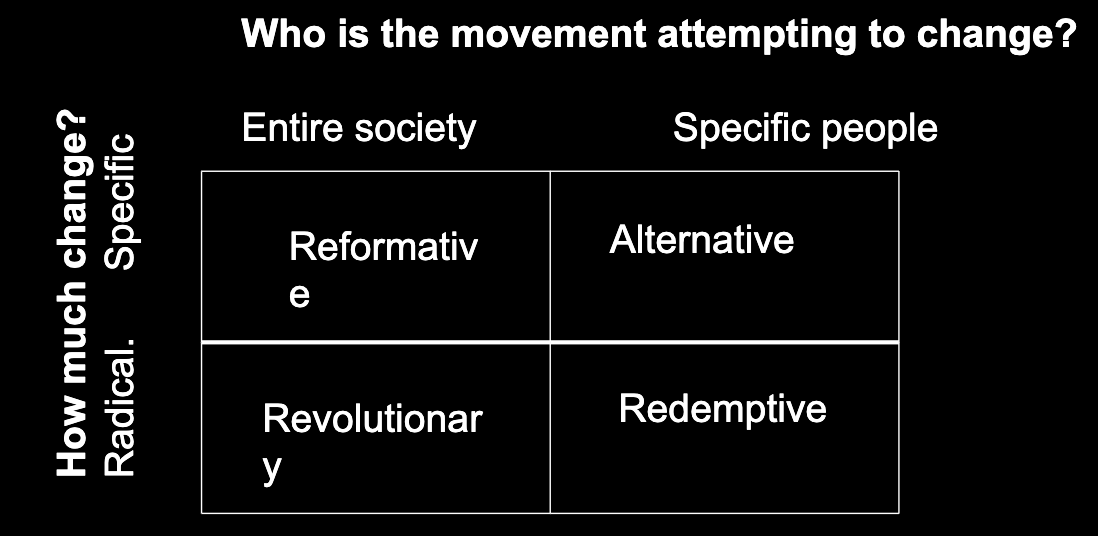
- Mothers against drunk driving: alternative
- Alcoholics anonymous: redemptive. Its trying to change a person’s entire lifestyle
- civil rights movement: revolutionary
- Reformative: women's suffrage movement, environmental movements
- A Lot of movements switch between these as they progress
Other ways of categorizing social movements
- strategies/tactics: for example, violent vs nonviolent
- Focus: who is targeted? Individuals or groups? A political system?
- Range: local? Regional? National? Global?
- Scope and type of change: norms? Laws? Innovation?
- Framing: diagnostic, motivational; alignment and other movements
The evolution of social movements in 3 stages
- Emergence: the social problem is identified
- Coalescence: resources are mobilized; concrete action is taken
- Routinization (or institutionalization): a formal structure develops t removed the cause
- Main failure happens between coalescence and routinization
- People lose interest, people’s opinions can change within the group
- How do you know a social change succeeded? When they aren't needed anymore
Occupy wallstreet movement
- Success: brought attention to movement and social issue of inequality in the work palace, between the rich and the poor, the large wealth gap, garnered a lot of support across the country. First movement to use a hashtag
- Failure: wasn't clear goal, violence, lack of engagement with existing political structure
What causes social change?
- Technological innovations
- New ideas and cultural identities
- Conflict
- Social institutions
- Population