Unit 3
Biomolecules (macromolecules)
Carbohydrates *
Lipids
Proteins *
Nucleic Acids *
* Polymers: chemicals made up of many repeating units called monomers
Dehydration RXN (condensation)
Short polymer with and H and monomer with OH connect to form a polymer with H2O
Hydrolysis RXN
Large polymer with H2O breaks into short polymer with and H and monomer with OH
Enzymes: proteins that allow rxns to take place
Hydrolytic enzymes: enzymes that use water to break down polymers
Carbohydrates
Empirical formula: CH2O
Monomers of carbohydrates are called Monosaccharides.
Functions:
Provide energy for all organisms
Structure of plant fungi and bacteria
Communication for cells
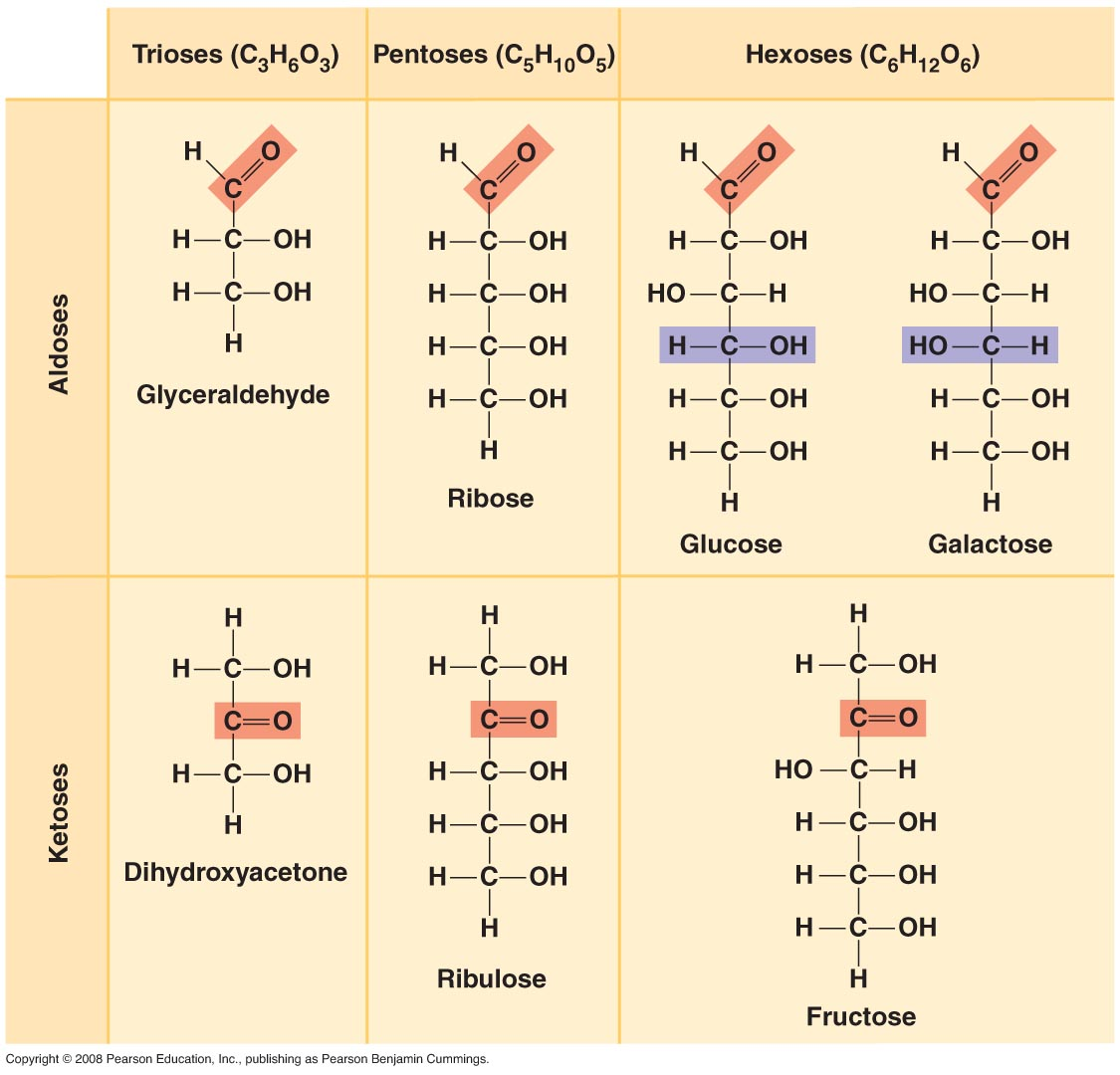
Glucose
Structure of Glucose
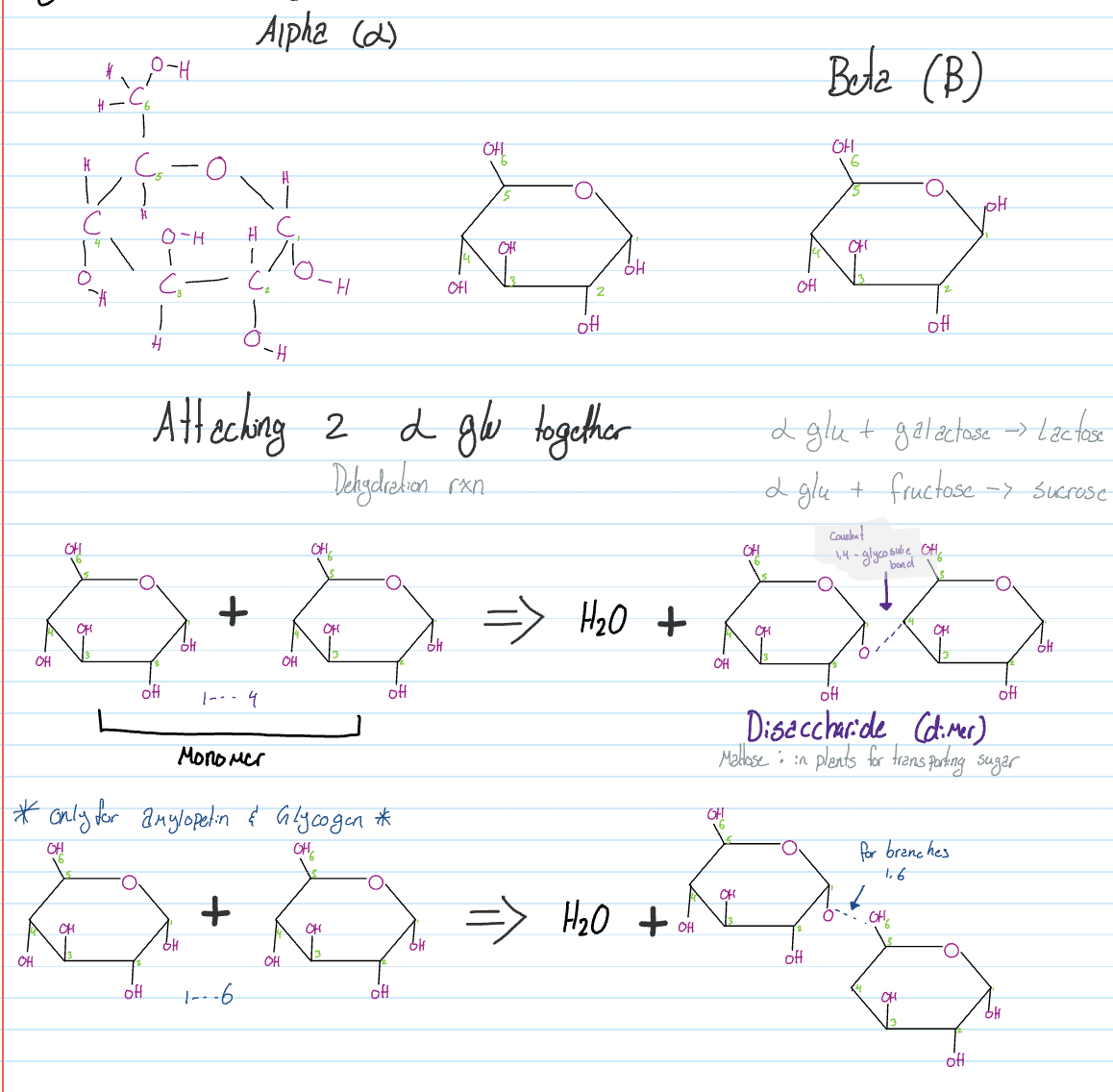
If a B glu and B glu connect one of them has to flip.
Polysaccharide
Starch
Very long chains of A-Glu (1000>)
Amylose - short chain
Amylopein - branch
Storage of energy for pants
Glycogen
Very long branched chains of A-Glu (1000>)
Highly branched
Storage of energy in liver/muscle cells
Chitin (CH2ON)
Exoskeleton of insects
Makes up cell wall of fungi
Straight chain
Cellulose
Only made up of B-Glu
Makes up the cell wall for plants
Made up of straight chains
What makes cells strong and rigid?
H bonds between cellulose molecules
Microfibril: a group of cellulose molecules holding onto each other
When many are stacked, they form the cell wall
Adaptive tissue: fat tissue
Our body stores sugar as glucose and excess sugar is stored as body fat
Proteins
All functions in the body are carried out by proteins
Protein could be used as energy once all other sources run out, this state is called starvation
Components
20 different types of amino acids
Nonpolar (hydrophobic)
Polar (hydrophilic)
Electrically charged (ionic)
Examples:
Nonpolar: Methionine
Polar: All polar amino have O or N at it’s end
Except for Cysteine, helps for 3D structure of proteins
The basic structure of an amino acid:
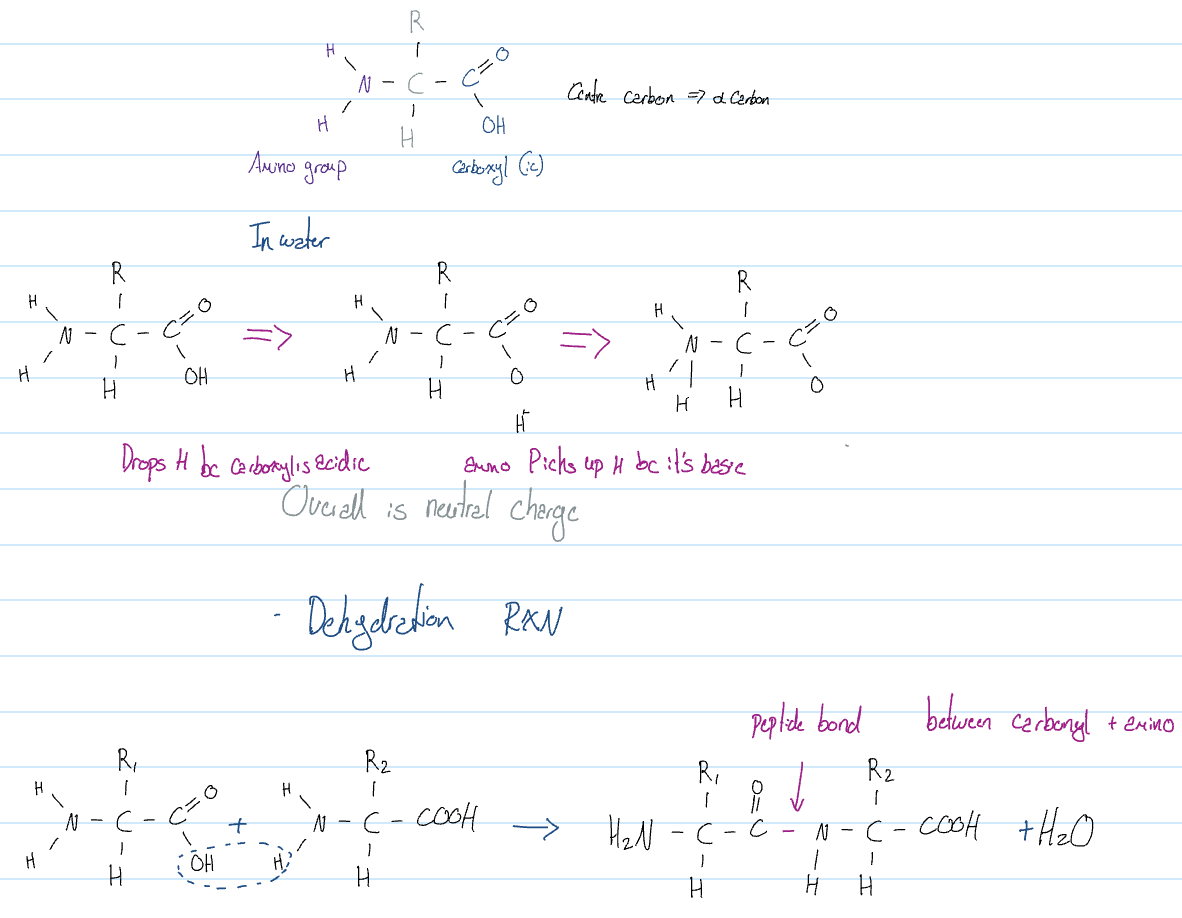
Elements found in all proteins
Carbon
Oxygen
Nitrogen
Hydrogen
Sulfur
Structure level of proteins
Primary structure 1°
Tells the number of amino acids
Types of amino acids
Sequence of amino acids
Secondary structure 2°
Folding of the 1° structure using H-Bonds
α Helix (spiral)
Exp: collagen, holds cells together
β pleated sheets
Exp: keratin, for hair and nails
Fibrous Protein
Proteins that have up to the 2° structure and they are insoluble in water, nonpolar, hydrophobic
Tertiary structure 3°
Further folding and twisting of previous structures by using Intra molecular forces such as:
H Bonds
LDF
Ionic bonds
Dip Dip
Disulfide bridges
Exp: hemoglobin or insulin
Globalor proteins:
They have 3° structure or higher, and they are soluble in water
Quateunary structure 4°
Found in proteins that have 2 or more polypeptide chains held together by intra-MF
Exp:
Hemoglobin: 4 polypeptide
Indulin: 2 polypeptide
Denaturation
loss of protein structure leading to loss of functions
Caused by:
pH
Temperature
Pressure
Salt → have charged when dissolved in H2O, disrupts ionic bonds
↑ maybe reversible or irreversible
Structure of protein
Defence → antibodies → protects from bacteria and viruses
Enzymes → Alpha amylase → breaks down starch
Structure → collagen → molecules have 2° fibers have 4°
Communication → insulin (dec glucose) glucagon (inc glucose)
Storage → ferritin → stores iron
Transport→ calcium pump → moves Ca^2+ across membrane
HDL → lipids around body
Hemoglobin → transports O2 in blood
Contractile proteins → myosin and actin → contract & move muscles
Receptors → insulin receptor → detect hormones
Nucleic Acid
Central dogma: All life depends on DNA
DNA:
deoxyribonucleic acid
Double helix
It has 2 strands with H-Bonds in the middle.
RNA: ribonucleic acid
1 strange with different types
mRNA (message) - carries the info from the nucleus to the cytoplasm
tRNA (transfer) - brings the correct amino acid during protein synthesis
rRNA (ribosomal) - needed in structure for ribosomes
call structure that builds proteins
miRNA (micro) - regulates gene expression
DNA → RNA → PROTEINS
from DNA to RNA: Transcription
from RNA to protein: Translation
Transcription:
It happens in the nucleus
Type of chemical remains the same but the structure changes
Translation:
Happens in the cytoplasm
Type of chemical changes and so does the structure
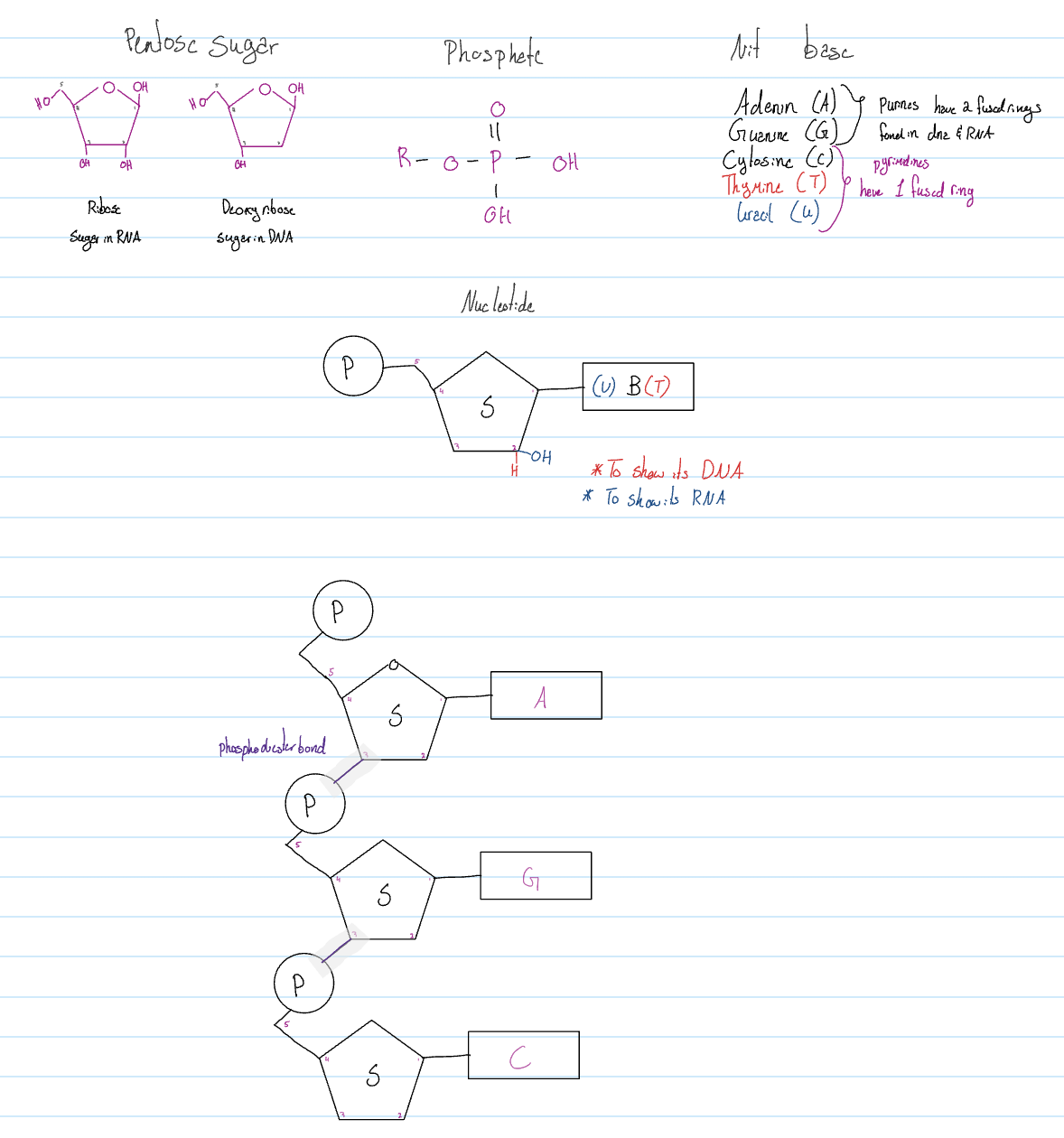
Monomers of nucleic acids: nucleotides
Made up of:
Nitrogenous base ↓H⁺ attached to C1
Pentose sugar C5H10O5
Phosphate group Always attached to C5
Lipids
Fats
Animal sources
Solid at room temp
Saturated
Oils
Plant source
Liquid at room temp
Unsaturated
Basic functions of lipids
Energy storage
Insulation
Cell membranes (make new cells)
Communication for hormones
Defence
Triglycerides
Used for energy storage
Made up of
1 glycerol
3 fatty acids
Fatty: hydrocarbon
Acid: carboxyl
Structure
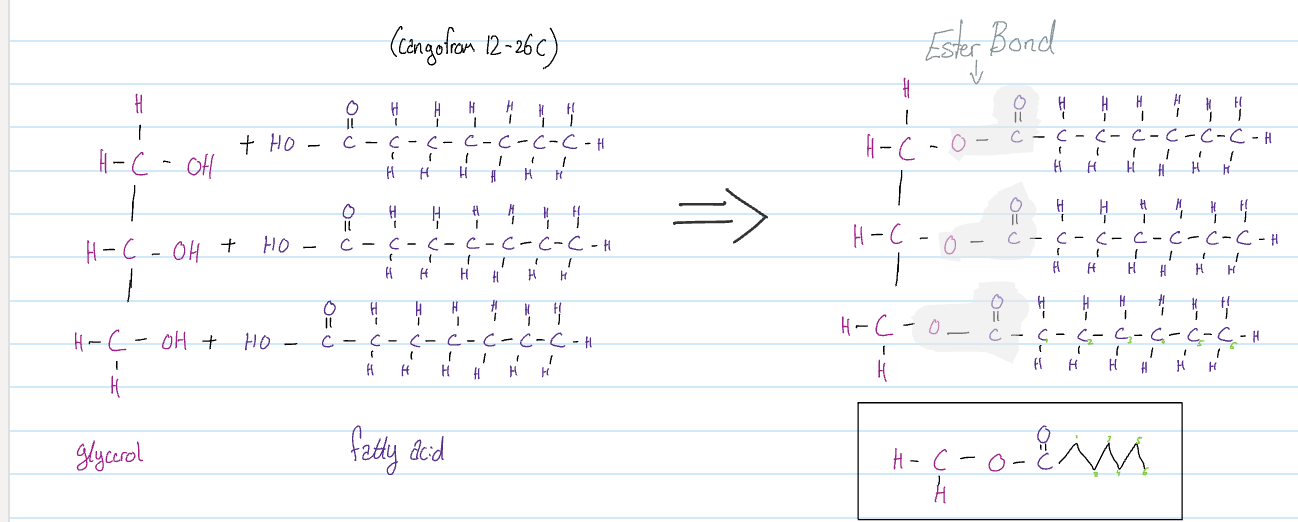
Esterification: the process of creating an ester bond rxn between alcohol and fatty acid
Types of triglycerides
Saturated triglycerides
All three fatty acids must have single bonds ONLY
Monounsaturated
One and only one
double bond must be present, causing one of the fatty acids to move downwards, allowing it to be liquid at room temp. Because it leaves space for it to move and become a liquid
Polyunsaturated
Has two or more double bonds present. It can be on the same fatty acid
Vitamins
V. are special chemicals needed for proper metabolism
Nonpolar are stored in adopost tissue
Polar ones cannot be stored
Retinol: V A1 alcohol nonpolar
Retinal: V A aldehyde nonpolar
VD: nonpolar cholesterol-based forms on skin
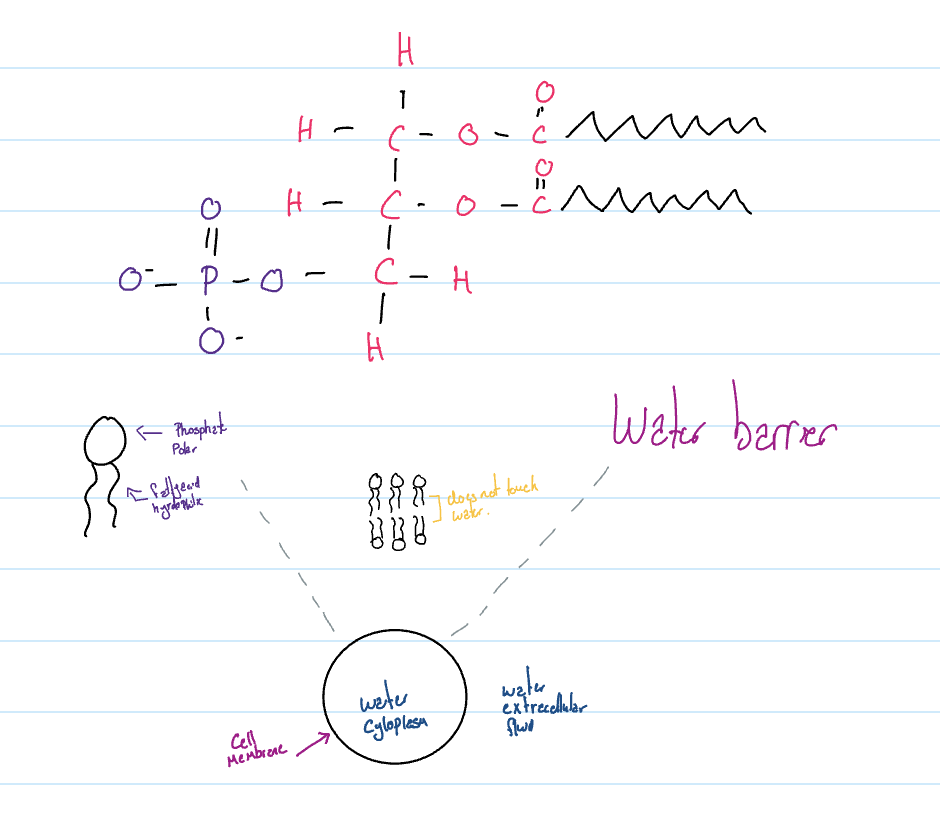
Phospholipids
Create the cell membranes.
Made up of:
Glycerol
2 fatty acids
Phosphate group
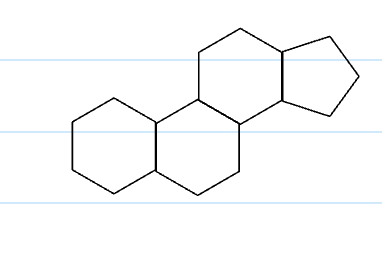
Steroids
Creation of hormones
Membrane stability (flexibility)
Regulates fluidity
More cholesterol more rigid
Components
Cholesterol
Waxes
For defence
Made up of:
Long chained alcohol
Long chained fatty acid