Life in A Fluid Medium
Density
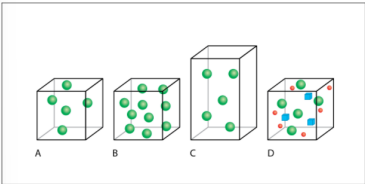
The figures on this slide are from https://manoa.hawaii.edu/exploringourfluidearth/ The site is geared toward high school students, but you may find it useful as a primer if you haven't had a science class in a while or oceanography.
Density is a measure of how much mass there is in a given volume. The symbol ρ represents density and the typical units we will use in this class are grams per cubic centimeter (g cm-3 ).
In this figure, volume is represented by boxes and individual particles of matter are represented by colored shapes.
If the amount of matter is increased without changing the volume, then the density increases (Compare panel A to B). If volume increases without an increase in mass, then the density decreases (Compare panels A & C). Adding additional matter to the same volume also increases density, even if the matter added is a different type of matter (Compare panel A to D).
Density is difficult to impossible to accurately measure in the ocean, so marine scientists use temperature and salinity to calculate density.
• Density = mass per unit volume
• Typical units g cm-3
• Density difficult to accurately measure in the ocean
• Use temperature and salinity to calculate
Buoyancy
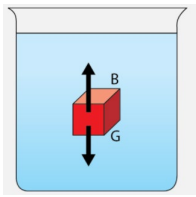
The density of seawater relative to that of a living organism determines whether the organism is buoyant or will sink. Organisms that live in the water column have morphological adaptations that increase their buoyancy and help them maintain position.
The motion of any object is due to forces. Vertical—up-and-down—movement of water masses or floating organisms in the ocean can be explained in terms of two forces:
• The gravitational force (G) of the earth pulls downward and is proportional to the mass of an object. The gravitational force on an object is also called weight. The force due to gravity is greater on objects that have more mass.
• The buoyant force (B) of water pushes up. In the third century B.C., the Greek philosopher Archimedes was the first to describe buoyancy. He observed that the volume of water pushed out of a tub, or displaced, by an object was equal to the volume of the object. The buoyant force of the water is equal to the weight of the water displaced. This concept is known as Archimedes’ Principle, and it explains why objects sink or float.
An object accelerates when the forces on that object are unequal. An object will always move in the direction of the greater force.
• Sinking is a downward vertical movement that occurs when the gravitational force (G) on an object is greater than the buoyant force (B) supporting it (G > B).
• Rising is the upward vertical movement that occurs when the gravitational force is less than the buoyant force (G < B).
If all of the forces on an object are balanced, there is no acceleration. In the water, an object might remain still either at the surface or within the water column.
• Surface floating occurs when an object stays at the surface, because the forces are balanced at the surface (G = B).
• Subsurface floating, or neutral buoyancy, occurs when an object maintains its position in midwater, neither sinking nor rising (G = B).
But what does this have to do with density? The density of organism relative to the density of water determines if it will float, sink, or be neutrally buoyant:
If the density of the organism is less than the density of the water, gravitational force will be less than the buoyant force (G < B), and the object will rise to the surface. A fish inflating its swim bladder is using an adaptation that follows this principle.
If the density of the organism is equal to the density of the water, the organism will float in middle of the column of water because the gravitational force and buoyant force are balanced (G = B). In this case the organism is said to be neutrally buoyant. Many single-celled photosynthetic organisms have projections that increase their volume and reduce their density to maintain position in the sunlit surface layers of the ocean. '
If the density of the organism is greater than the density of the water, the organism will sink because the gravitational force is greater than the water’s buoyant force (G > B). Deep-diving mammals and larvae moving from the water column to the sediment have adaptations to increase their density to assist with sinking.
Viscosity I
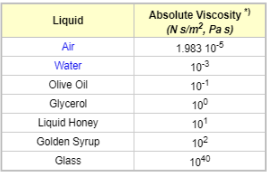
Viscosity is a measure of the resistance of a fluid which is being deformed by either shear stress or tensile stress. In essence, viscosity as a measure of fluid friction and resistance to flow. The less viscous a fluid is, the greater its ease of movement (fluidity). For example, water is "thin" and pours easily (lower viscosity) and honey is "thick" and more difficult to pour (higher viscosity).
In technical terms, dynamic (aka absolute) viscosity is the tangential force per unit area required to move one horizontal plane with respect to another plane at a unit velocity when maintaining an unit distance apart in the fluid. Dynamic viscosity is expressed with the SI units of poise which convert to more familiar units of force • time per unit area:
1 N s/m2 = 1 Pa s = 10 poise
You can see the viscosity of some familiar fluids in the table.
Viscosity II
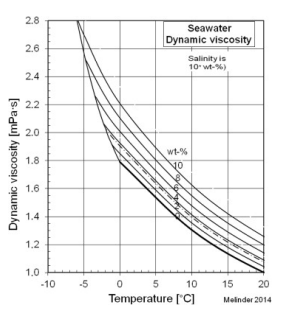
The viscosity of seawater is influenced by temperature, salinity, pressure and exopolymers excreted by organisms. The graph below shows how the viscosity of water relates to salinity and temperature. Increasing temperature decreases absolute viscosity. Increasing salinity usually increases water's viscosity.
Laminar and Turbulent Flow
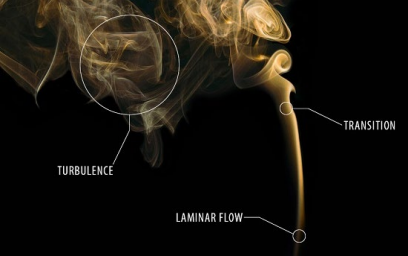
Picture a faucet running very slowly. The water coming out is glassy and orderly. If there is nothing to change the flow or the path, nothing will change - the flow will look the same an hour later. This is called laminar flow.
Now imagine an open fire hydrant. Here, for this faster or larger scale motion, the flow pattern is changing all the time. Although its average motion is in one general direction, within the flowing water there are irregularities everywhere. The flow is turbulent. Turbulent flow while proceeding in a particular direction, like laminar flow, has the added complexity of random velocity fluctuations. The flow patterns never repeat themselves.
Fluid flow that is slow tends to be laminar. As it speeds up, the flow transitions into complicated, random turbulent motion. Laminar flow also occurs in tubes with small diameters (such as blood vessels), at low water densities and at high viscosity. Turbulent flows occur for the opposite conditions: high speeds, large diameters, high densities and low viscosity.
Reynold's Number I
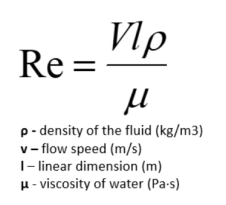
In the early 1880's, a scientist named Osborne Reynolds studied the conditions in which the flow of fluid in pipes transitioned from laminar flow to turbulent flow. He used a small stream of dyed water flowing through a clear pipe under well controlled conditions. The experiments helped to popularize the use of Reynolds number (Re) for dynamic similarity—the dimensionless ratio of inertial forces (numerator) to viscous forces (denominator): At low Reynolds numbers, flows tend to be dominated by laminar (sheet-like) flow. At high Reynolds numbers, flows tend to be turbulent.
Reynold's Number II
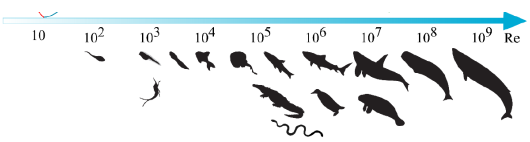
Reynolds numbers also help constrain the relative inertial and viscous effects of a fluid on objects in the fluid. Under high Re (Re >1000), objects in the fluid are dominated by inertia meaning they tend to keep moving when a force is applied to them (imagine pushing off the side of a pool and gliding through the water). Under low Re (Re < 1), objects do not move unless a force is applied because viscous forces dominate.
This figure is from a thesis written by Marion Segall (2017). It shows the scale of Reynolds numbers for swimming animals of different sizes, from larvae to large mammals.
Not included in the figure above are examples of when viscous forces dominate small organisms travelling at low velocity. Organisms such as flagellates and cilliates stop moving the moment they stop swimming. Take a minute or two to watch these small organisms moving in seawater to help you visualize the importance of viscous forces at small scales.
Link to video on youtube: https://youtu.be/kbrY6cvrOUs
Water Flow
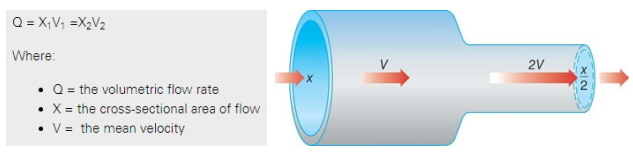
One of the fundamental principles used in the analysis of uniform flow is known as the Principle of Continuity, or Continuity of Flow. This principle is derived from the fact that mass is always conserved in fluid systems regardless of the pipeline complexity or direction of flow. It means that if there is a steady flow volume through a rigid pipe, the volume entering one end will equal the volume exiting the other end. The diameter of the pipe may vary over the length and the pipe may split, but the principle holds. The product of the velocity and the cross-sectional area remain constant. Expressed mathematically we have:
Q = X1V1 =X2V2
Where:
Q = the volumetric flow rate
X = the cross-sectional area of flow
V = the mean velocity
This figure from the textbook demonstrates that as the cross-sectional area is reduced by half, the velocity of the water must double to conserve mass and maintain a constant flow volume.
If you are already zoning out and thinking- who cares, 'cause how many pipelines are there in marine organisms? - then start to imagine organisms that are tube like or have pipe-like structures.
Water Flow in Sponges
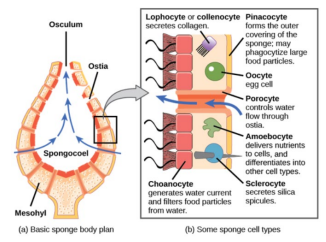
Let's consider a sponge. Sponges have tiny pores called ostia in their outer walls through which water is drawn. Cells in the sponge walls filter food from the water as the water is pumped through the body and out the osculum. The flow of water through the sponge is in one direction only, driven by the beating of flagella of specialized cells called choanocytes which line the surface of chambers connected by a series of canals.
Choanocytes can produce currents of water with velocities of around 50 µm s-1; yet the exit velocity out of the channels is on the order of 1cm s-1. The total cross-sectional area of the ostia adds up to several thousands of times the cross-sectional area of the excurrent canal (osculum).
This short video shows flow through a sponge. https://www.shapeoflife.org/video/sponges-filter-feeding-made-visible
Bernoulli's Principle
Bernoulli's principle applies the principle of conservation of energy to pressure changes in pipes and burrows or along surfaces (such as the seabed). The principle states that at points along a horizontal streamline, higher pressure regions have lower fluid speed and lower pressure regions have higher fluid speed.
It might be conceptually simplest to think of Bernoulli's principle as the fact that a fluid flowing from a high pressure region to a low pressure region will accelerate due to the net force along the direction of motion. The pressure that Bernoulli's principle is referring to is the internal fluid pressure that would be exerted in all directions during the flow, including on the sides of the pipe. This is different from the water pressure in your shower - that is the pressure the fluid exerts on you when you step into the flow and stop its motion.
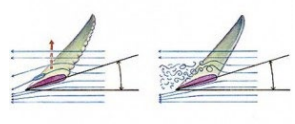
Some flatfish and the flippers and fins of marine mammals are shaped like airfoils- curved on top and flat on the bottom:
This geometry creates lift that can be explained using Bernoulli's Principle. As water encounters the fish or flipper, it flows more rapidly over the curved side than over the flat side. This creates a pressure differential and lift- lower pressure on the curved side and higher pressure pushing up from the flat side.
Surfaces and Obstructions
Drag is the force exerted by a fluid stream on any obstacle in its path or felt by an object moving through a fluid. Like friction, drag acts in a direction that is opposite to the motion of the swimming organism or water flow.
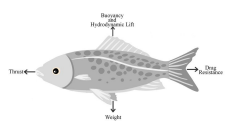
Drag is generated by the difference in velocity between a solid object and a fluid, in our case water. There must be motion between the object and the water. If there is no motion, there is no drag. It makes no difference whether the object moves through the water (e.g. swimming fish) or whether the fluid moves past a static solid object (e.g. coral attached to the seafloor).
We can also think of drag as hydrodynamic resistance to the motion of the object through the fluid. This source of drag depends on the shape of the organism and is called pressure or form drag. As water flows around a body, the local velocity and pressure are changed. The pressure exerted on the upstream part of the object is not exactly counterbalanced by an equal pressure on the downstream side. Since pressure is a measure of the momentum of the water molecules and a change in momentum produces a force, a varying pressure distribution will produce a force on the body. Pressure drag increases proportionally to the cross sectional area exposed to the current and to the square of the current velocity.
Boundary Layers
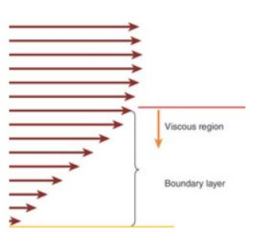
We can think of drag as hydrodynamic friction, and one of the sources of drag is the skin friction between the molecules of the water and the solid surface of an organism or the seafloor. Along the solid surface, a boundary layer of low energy flow is generated and the magnitude of the skin friction depends on conditions in the boundary layer (see figure; the solid surface is the yellow line at the bottom).
The boundary layer conditions depends on the viscosity of the water and the relative magnitude of the viscous forces to the motion of the flow, expressed as the Reynolds number. At low Re numbers, skin friction dominates the drag force; it becomes less important at high Re numbers.
Case Study: Fish Shape
The material in the three case studies is an abridged, edited version of an article published in American Scientist (Fish, Frank, and G. V. Lauder. "Not just going with the flow." Am. Sci 101.2 (2013): 114-123.).
Swimming fish and dolphins appear to move effortlessly through the water. Even when they glide, they don’t seem to lose any speed. However, the principles of hydrodynamics dictate how water flows around an animal. This flow determines the forces the animals must generate and the energy they must expend to move. Animals propelling themselves through water must contend not only with pushing back on the fluid but also with forcing their way through an incompressible medium.
Manipulation of flow is accomplished both passively and actively. Animals use passive mechanisms involving design of the body and texture of their surfaces, which alter flow conditions against the body surface in order to reduce drag. On the other hand, active control of flow involves mobile fins and paddles, which regulate water movements that are shed into the wake as vortices.
Whether minnows or whales, swimming animals propel themselves by producing a thrust force in opposition to a resistive drag force. Thrust and drag are the yin and yang of hydrodynamics. Under conditions of a constant swimming speed, thrust and drag must balance each other. To swim fast, animals need to be able to minimize drag and maximize thrust. The amount of thrust and drag generated has ramifications on the total energy cost of swimming. As the animal pushes against the fluid medium to propel itself, it transfers kinetic energy from its body motions to the water. In addition, drag consumes energy from the movement of the body, which decelerates the animal unless it is countered by propulsive motions produced by muscular actions.
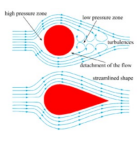
==Pressure drag is dependent on the shape of the body==. The hydrodynamic association between pressure and velocity of a fluid is described by the Bernoulli principle. Remember the principle states that pressure and velocity are inversely related, so that as velocity decreases, pressure increases and vice versa. As the water follows the contours of the body, it accelerates and thus reduces the pressure. Before being ejected into the wake, the flow decelerates again with an increase in pressure, but not to the same extent as at the front of the body. The difference in pressures around the body generates an imbalance in forces and results in the pressure drag.
The physical manifestation of the pressure drag is the width of the wake: Narrow wakes represent less pressure drag than broad wakes. If the energy within the boundary layer flow is insufficient to maintain a downstream direction of flow, the pressure changes will cause the boundary layer to prematurely separate from the body surface, forming eddies, increasing vorticity and producing a broad wake. Thus the drag is minimized particularly when fluid moving along the body surface remains attached.
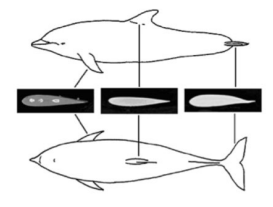
Flow is controlled mainly by streamlining the body shape to minimize drag. It is no accident that fish, dolphins and even submarines have an elongated, teardrop design. This shape gives the lowest drag per volume. Pressure differences are minimized and the boundary layer remains attached, keeping the wake narrow.
Jim Rohr and Michael Latz at the Space and Naval Warfare Systems Center demonstrated this fact for gliding dolphins. These researchers were able to visualize the flow around the dolphins using bioluminescence from marine phytoplankton. Shear stresses within the flow around the body perturbed the unicellular plankton and caused it to light up.
This video from a recent news report shows the phenomenon: https://youtu.be/7SaqoURs5MY
Check your understanding: Drag is produced by equal amounts of frictional and pressure forces resulting from the interaction of the fluid and the body.
Case Study: The Surface of Fish
Frictional drag is caused by friction between the skin and a thin layer of fluid in close proximity, called the boundary layer. The fluid touching the skin adheres to it without slipping due to the viscosity or “stickiness” of the fluid. Because of this no-slip condition, the friction due to viscosity shears the flow within the boundary layer. This shear is like pushing on the top of a deck of cards lying on a table: The bottom card stays fixed in position while the top card moves with the hand and all the cards in between are displaced slightly. The boundary layer possesses energy that maintains its flow against the skin. However, the frictional shear within the boundary layer represents energy lost as drag.
Fish can secrete mucus or slime over the body to reduce frictional drag. The slime is a combination of lipids and proteins, many of which contain long chains of molecules, and some of which can act as surfactants (lowering the surface tension of a fluid). The slime similarly reduces the viscosity of the water around the fish. For instance, the barracuda, Sphyraena argentea, possesses slime that reduces frictional drag by as much as 66 percent, and the fish can reach speeds of up to 27 miles per hour in short bursts.
Although it might intuitively seem that a smooth surface will help minimize drag in swimming animals, a rough skin can actually be more effective in controlling flow over the body and reducing drag. A textured surface can generate turbulence within the boundary layer region near the body surface. Although this turbulence increases the frictional drag, it infuses more energy into the boundary layer. The energy added by turbulence stabilizes the boundary layer by allowing it to overcome adverse pressure changes. The turbulent boundary layer is thus less likely to separate and increase the pressure drag. The same formation explains why golf balls with dimples travel faster and farther than smooth balls. The dimples cause turbulence near the ball surface and this increased energy delays flow separation and narrows the width of the wake.
Fish have a variety of complex structures on the body surface that may act like golf ball dimples. Swordfish, Xiphias gladius, have an elongated rostrum (or snout) with a rough surface of craters and bumps, which may act to induce turbulence in the boundary layer over the body. Many bony fish are covered with small ctenoid scales (named for the small tooth-like projections on the scales’ posterior, downstream edge) that could also alter boundary layer flow.
Shark skin is covered with numerous small denticles that typically have three ridges on the surface and downstream-facing prongs. These closely packed denticles extend above the skin surface and into the boundary layer region. Separate regions of the body display denticles with specialized shapes. Denticles near the head can have a flat paver-like surface and reduced ridges, whereas those on the body and tail possess long prongs and deep ridges.
Studies have revealed that shark skin denticles enhance swimming speed. The increase in swimming speed may be the result of drag reduction, as the denticles function to generate a turbulent boundary layer. But experimental data on water flow over shark skin also suggest that the denticles alter flow in a way that might enhance thrust. Imaging flow over flexible membranes made of shark skin shows that a vortex is formed adjacent to the surface. This vortex contains a low-pressure region that acts to enhance the thrust produced by the skin. When denticles are removed, the leading edge vortex moves farther away from the surface, and the effect of the low-pressure suction on propulsion is lessened.
Case Study: Schooling
The wriggling body of a fish produces much of the vorticity that is shed into its wake. The action of the tail as it reaches its maximum sideways deflection rolls the vorticity up into a vortex. As the vortex drifts away for the fish, a new vortex forms with an opposite spin direction as the body flexes and the tail reverses direction. The alternating vortices are linked three-dimensionally. The continuous lateral undulations of the body and tail organize the wake as a staggered array of interconnected vortex rings. These vortex rings induce a jet flow that is oriented to the side and backward and laced through the center of the rings. The jet flow produces thrust to overcome the drag of the body. Optimal thrust propulsion and efficiency can be achieved by controlling the pattern and periodicity of the vortices in the wake.
The generation of vorticity is an inevitable consequence of propulsion in a fluid medium. The vorticity shed into the wake represents a substantial loss of energy for swimming animals. But animals can swim more efficiently if they are able to extract energy from the swirling vortices. Aquatic animals often travel in highly organized formations such as schools. By aligning themselves in a defined pattern, individuals in the group can take advantage of flow patterns generated by others to reduce drag and enhance locomotion performance. Vortices generated by leading individuals pass backward and impact trailing individuals.
Watch this computer generated view of the vortices from swimming fish. (https://insidehpc.com/2018/06/supercomputing-fish-save-energy-swimming-schools/)
Daniel Weihs of Technion-Israeli Institute of Technology determined that the optimal configuration of a school of fish is a diamond pattern. As the leading fish leaves two rows of vortices in its wake, the spinning fluid has a forward-directed component on the side away from the fish. Trailing fish use the forward-directed velocity of the vortex by swimming laterally. As the trailing fish is swimming in the same direction as the tangential velocity, its relative velocity is less than the swimming speed of the school, so the individual fish experiences a reduced drag. Fish in a diamond configuration experience a reduction of the force generated for swimming by a factor of four to six.
Small cetaceans often position themselves beside and slightly behind the maximum diameter of a larger animal. In this position, the smaller individual gains an energetic benefit. This effect is vital particularly for young dolphins to maintain speed with their mothers. The flow that is channeled between their bodies induces an attractive force due to the Bernoulli Effect, which draws the infant along with the mother. Weihs estimated that a neonatal dolphin could use this mechanism to gain up to 90 percent of the thrust needed to move alongside its mother. Although the young gain a benefit, the larger mother will experience increased drag from her towed offspring. In the next case study we’ll see a video that includes this behavior.
Case Study: Maneuverability
Every free-swimming animal requires flow manipulation to satisfy two opposing functions: stability and maneuverability. Stability acts to self-correct for disturbances and maintains a desired postural attitude. Maneuverability does the opposite by allowing a controlled instability to create a change in direction, as well as enabling the animal to stop and start. Swimming animals, which are suspended in the water without a solid support to lean against, must be plastic enough to do both, but with an economy of action so as not to uncontrollably destabilize their entire system. Morphological additions can control the pattern of flow for improved stability and maneuverability.
Boxfish are encased in a rigid, bony carapace. This form compromises stability control, as the fish is incapable of flexing its body and must instead use combinations of movements by its fins. These extra movements would drain the fish of energy as it stabilizes its body and holds position in a water current. However, the carapace is equipped with structures called keels that aid in passively stabilizing the body. The keels are located dorsally and ventrolaterally (on each side of the belly). Vortices are generated as water flows past the keels. These vortices generate suction forces that increase as the fish is angled to the flow. The forces return the body to a more stable orientation.
This video shows a boxfish moving in a current. (https://www.youtube.com/watch?v=cRybPGYNdB0)
Although stability is important to swim straight ahead or hold position in a flow, ==maneuverability may be more important as animals rarely move in straight lines==. When life and death are on the line, complex movements are needed for prey to outmaneuver a predator, or for a predator to turn fast enough to catch elusive prey.
Humpback whales use their elongated pectoral flippers, which can be up to a third of the length of the body, to execute tight turns, corral fish, and catch prey that are many times smaller and more maneuverable than the whale. Just like an airplane performing a banking turn, the flippers generate a lift force that turns the whale. The magnitude of the lift is correlated with the angle at which the flippers meet the oncoming water flow (called the angle of attack). The lift will increase until the angle of attack reaches a critical point known as stall, where there is a dramatic loss of lift. On an airplane, a stall can be catastrophic, but for a whale buoyed up by the water, a stall would mean the inability to complete a turn and the loss of a meal, or as in the video linked below, the potential death of a calf.
See the maneuverability of this humpback defending her calf. (https://www.youtube.com/watch?v=aSia-HeDfKQ)