Fundamental Info Systems Module 1
Question 1 | |
Based on class notes, which of the following items are components of a complete information system? Check all that apply. | |
application silos | no |
information | yes |
business processes | yes |
hardware | yes |
people | yes |
data | yes |
revenue | no |
software | yes |
Question 2 | |
Based on class notes, match each brief definition below to the most appropriate term. | |
Prompts | Answers |
unorganized facts | data |
processed facts | information |
instructions coded within an information system | software |
interrelated steps to accomplish a task | business process |
tangible physical parts of an information system | hardware |
Question 3 | |
Consider an order transaction in a grocery store point of sale check out system. | |
For each element listed below, indicate if it represents an input, output, storage or processing component. | |
Prompts | Answers |
reduce inventory on hand | processing |
newly printed coupons to encourage later product purchases | output |
patron’s credit card number | input |
a table which lists product UPC codes and unit prices | storage |
sales receipt | output |
a file which lists UPC product codes and quantity of inventory on hand | storage |
universal product code (UPC) of item purchased by consumer | input |
compute sales tax | processing |
Question 4 | |
Based on class notes, match each example below to the most appropriate term | |
Prompts | Answers |
an unprocessed log of computer hardware errors | data |
average numeric grade awarded by course number | information |
Zoom meeting app | software |
dependent activities needed to design new automobile parts | business process |
document camera | hardware |
Question 5 | |
Which phrase refers to a characteristic of older "legacy systems" that made it difficult to share information and coordinate activities? | |
Show answer choices | |
application silo | |
Question 6 | |
Indicate whether each activity below would more likely be performed using an operational (or transactional) information system or a management support system? | |
Prompts | Answers |
planning when and how much inventory to purchase | management support system |
determining whether a company's revenue has seasonal patterns | management support system |
processing stock purchases and sales | operational system |
registering new patients to a medical practice | operational system |
Question 7 | |
Indicate which type of enterprise system would most likely support each of the business functions below. | |
Prompts | Answers |
ensure enough seats and wheels are available when needed to manufacture bicycles | supply chain management system |
keeping track of web site visitors who requested tile samples and showed an interest in the company's products | customer relationship management system |
provide general enterprise capabilities to manage data used and support managerial tasks such as planning, analysis and decision-making | business intelligence and analytics system |
automates all basic operational proceesses of a business | enterprise resource planning system |
share manufacturing and engineering expertise to create an innovative new portable photocopier | knowledge management and collaboration system |
Question 8 | |
For each job function below, indicate to which job role it most appropriately belongs. | |
Prompts | Answers |
interview faculty to determine their preferred functionality for a new learning management system | system analyst |
identify unusual credit card transactions | data analyst |
build a new mobile phone app for a local television station | programmer |
ensure data is optimally stored to maximize speed and response times of hotel reservations | database administrator |
prepare and coordinate a schedule to roll-out mobile computers to personnel at a medical practice | project manager |
head of IT department | CIO |
install data visualization software in academic computer labs | IT support specialist |
Question 9 | |
For each activity below, indicate which non-routine cogntive skill it exemplifies. | |
Prompts | Answers |
remaining skeptical of an accusation made without facts and reason | critical thinking |
understanding interdependencies between parts of an economy and recognizing the whole is not necessarily the sum of its parts | system thinking |
recgonize commonalities of situtaions in different contexts | abstract thinking |
offering different promotions to randomly selected groups of customers to determine which promotion is best | ability to experiment |
finding novel approaches to minimize injuries in a warehouse | creativity |
finding compromises when affected persons have conflicting goals | collaboration skills 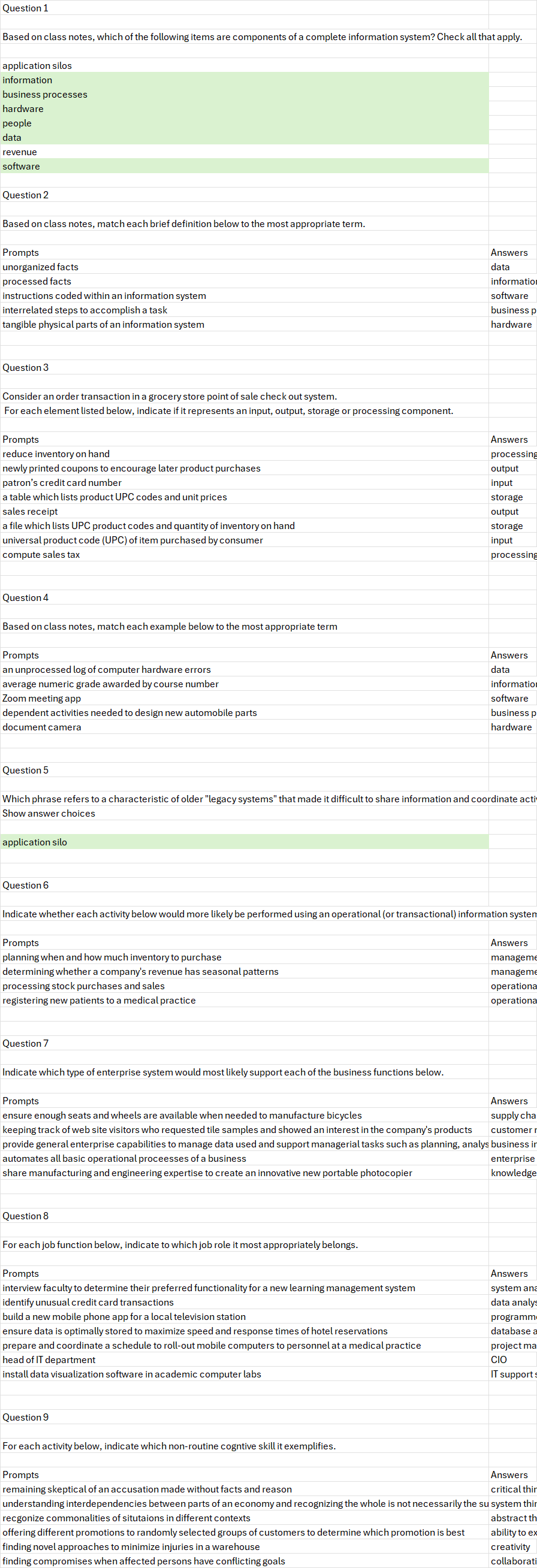 |