memory
INTRODUCTION
Deese-Roediger-McDermott (DRM) Paradigm :: given a list of words related to the word spider. ppl later try to remember list. likely people will misremember (erreneosly recall) seeing the word spider. shows that memory is reconstructive in nature
BASIC TERMINOLOGY
encoding :: when the info is first being learned. aka study
storage :: what info is being stored in the brain + how. aka retention interval
retrieval :: how we access prioro experiences to makes use of them in the present. aka test
retrieval cue :: any piece of info that can be used to access other info that is stored in memory
free recall and recognition tests :: ways that researchers use to test a participant’s ability to remember items from an encoding phase
free recall test :: no additional info to help participant to remember
recognition test :: participants are shown both old + new items
MULTI-STORE MODEL
patient H.M. :: had seizures; surgery to remove large protion of hippocampus on both sides of brain; suffered from aterograde amnesia but had normal IQ, could hv short convos + learn complex motor skills; changed the way we think about human memory
Atkinson & Shiffrin :: first proposed the multi-store model in 1968
short term memory :: where info is stored for the near future, but not stored permanently
Long term memory :: where short term memory items can be stored permanently if it is rehearsed
7 ± 2 items :: the max amt of items a person can remember in short term memory according to George Miller
chunks :: what info in a set can be organized into for ease of remembering; allows ppl to store more info in short-term memory. Ex. HJLWDS vs. CBCFBI → CBC / FBI
serial position curve :: shows that memory performance is usually best for items that were presented earlier or later of the encoding phase 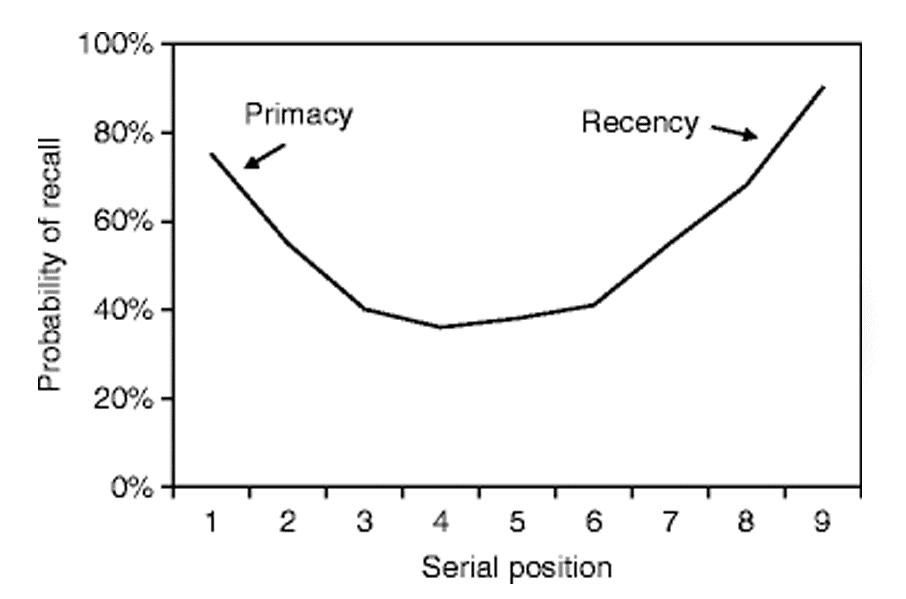 primacy effect :: memory performace is good for item encoded early in the list. has the most opportunity to be rehearsed. can be strengthened or weakened
recency effect :: memory performance is good for items ecoded last in the list. are still active in the short-term memory just before the memory test. can only be diminished or remain as is
GENERAL PRINCIPLES OF MEMORY
levels of processing principle :: 3 levels of encoding an item: shallow, moderate and deep. the more we try to organize + understand the material, the better we remember it
shallow processing :: lil effort, focuses on superficial + physical characterisics of a stimulus; results in poor memory performance
moderate processing :: some effort, focuses on acoustic characteristics of stimulus; results in moderate memory performance
deep processing :: more effort, focuses on semantic meaning of a stimulus; results in better memory performance
critisms of the levels of processing principle :: 1. hard to scale up. 2. logic is circular; whatever study method lead to better memory will be considered deep + whatever methods lead to worse memoery willl be considered shallow
encoding specificity :: suggests that you encode ALL aspects of the experience like environment or how you were feeling - the context
FORGETTING
negatively accelerating forgetting curve :: shows that intially we rapidly forget things then later slowly forget things
decay :: information is stored but then gradually fades as a function of time
interference :: inabiliy to access infromation from memory due to other similar information 'competing’ for retrival
- forgetting should be viewed as loss of access rather than passive decay
MEMORY ILLUSIONS AND FLUENCY
Loftus study :: 3 real, 1 fake childhood memory; people can be convinced of fake memories
Seamon and colleagues study :: repeatedly imagining an event can lead to a false memory even if its a fake memory
fluency :: the ease with which an experience is processed, some easier (more fluent) than others
attribution :: judgment tying together causing w effects. ex. we can give (attribute) a reason why we are experiencing processing fluency
becoming famous overnight :: shows example of misattribution