Chapter 5

Learning
A relatively permanent change in behavior, knowledge, capability, or attitude
acquired through expperience
cannot be attributed to illness, injury, or maturation
However, certain changes such as physical growth and maturity have nothing to do with learning and are genetically programmed
Classical Conditioning
A type of learning through which an organism learns to associate one stimulus
stimulus
Any event or object in the environment to which an organism respponds
Classical conditioning was an accidental discovery by Russian physiologist Ivan Pavlov (1849-1936)
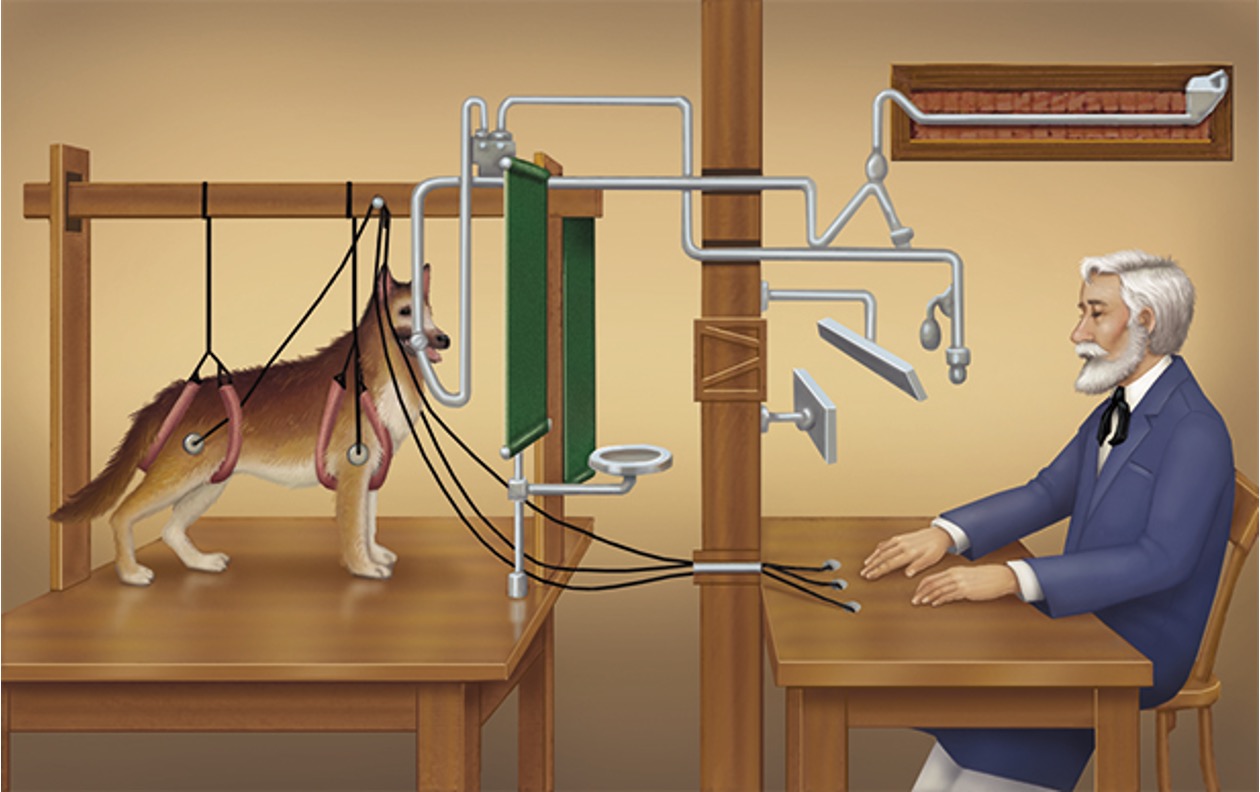
Pavlov and the Process of Classical Conditioning
Neutral Stimulus (tone) is presented shortly before an unconditioned stimulus (food)
Naturally elicits an unconditioned response (salivation)
After repeated pairings, the conditioned stimulus alone (the tone) comes to elicit the conditioned response (salivation)
Pavlov’s Classical Conditioning
learning hasn’t occured
Unconditioned Stimulus (US)
elicits unconditioned response without learning
e.g., food, loud noise, light in eye, puff of air in eye
Unconditioned Response (UR)
response elicited by an unconditioned stimulus without learning
e.g., salivation, startle, contraction of pupil, eye blink
Unconditioned and Conditioned
Conditioned Stimulus (CS)
a neutral stimulus that, after repeated pairing an US, becomes associated with it then elicits…
A conditioned response
Conditioned Response (CR)
learned response elicited (to bring out) by CS as a result of repeated pairing with an US, for example, a tone
Higher-Order Conditioning
Conditioned stimuli are linked to form a series of signals
Changes to Conditioned Responses
Extinction
Weakening and disappearance of CR as a result of repeated presentation of CS without US i. e., forgetting
Spontaneous Recovery
reappearance of extinguished CR when organism is exposed to CS following rest period
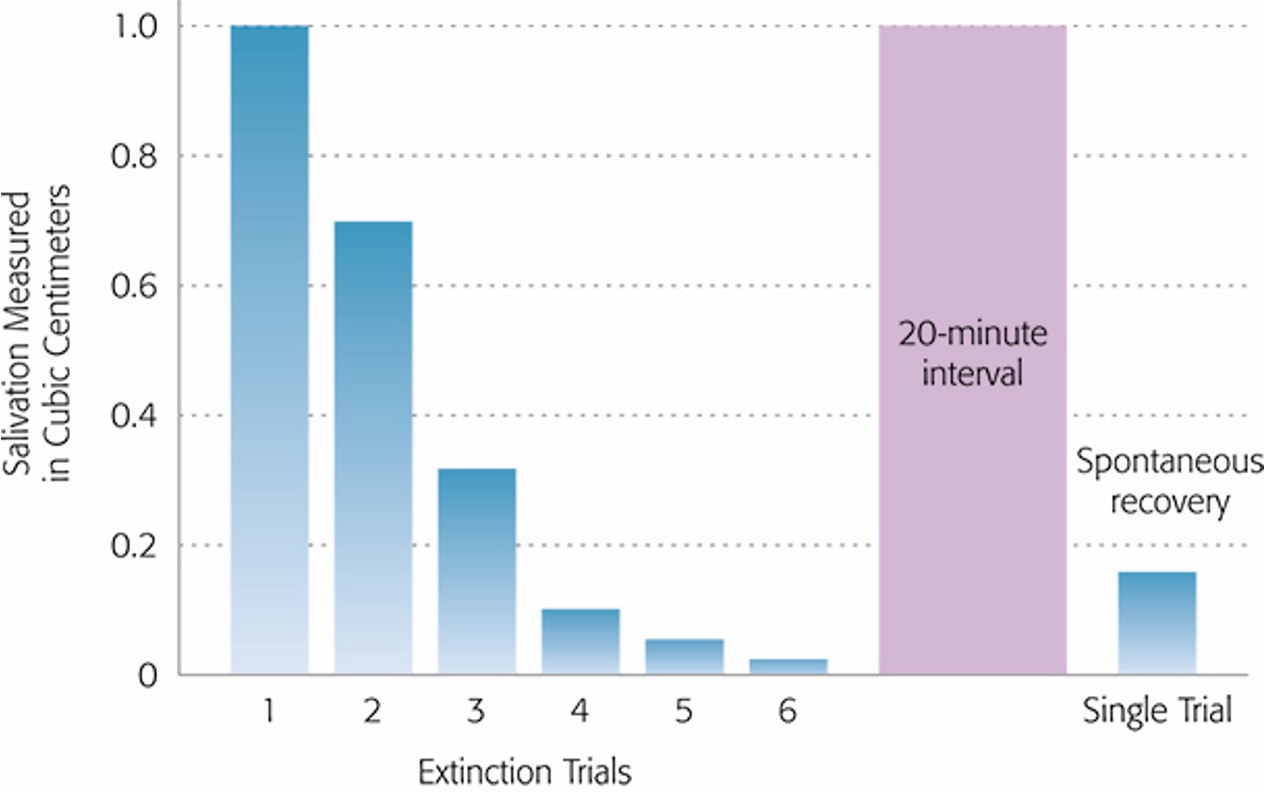
Types of Conditioned Responses
Generalization
Tendency to make a CR to a stimulus that is similar to the original CS
Discrimination
learned ability to distinguish between similar stimuli
CR occurs only in response to the original CS, not to similar stimuli
John Watson and Emotional Conditioning
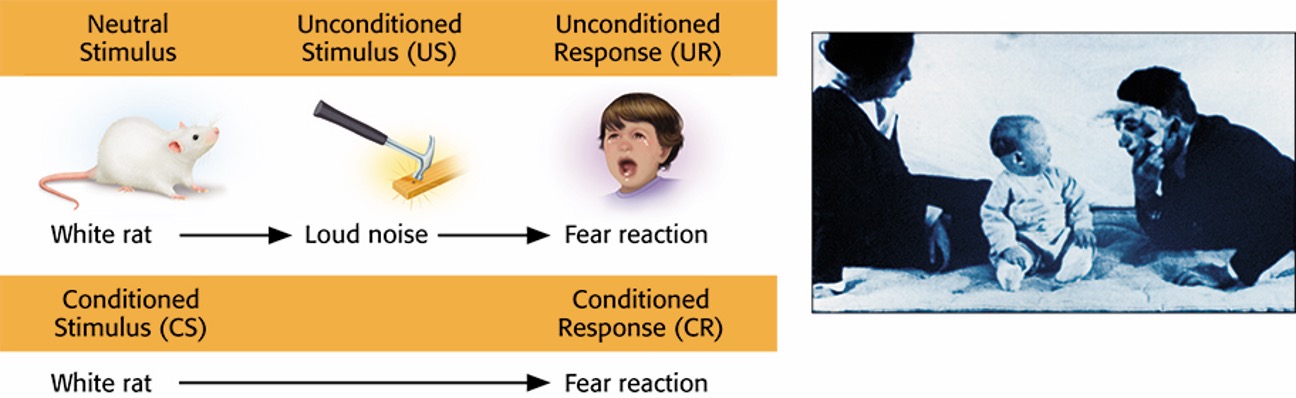
Watson and Rayner (1920) “Little Albert” Study
A child was classically conditioned to fear a rat
Conditioned fears persist and modify personality throughout life
Mary Cover Jones (1924) later used classical conditioning to remove fears in another child
The Cognitive Perspective
Pavlov and Watson
classical conditioning involved the repeated pairing of CS and US
Robert Rescorla
A critical element is whether the CS provides information that enables the organism to reliably predict the occurrence of the US
Biological Predispositions
Organisms are biologically predisposed to acquire fears from objects that may pose a threat to survival
Martin Seligman (1972): most common fears “are related to the survival of the human species through the long course of evolution”
Taste Aversion
not necessarily a survival mechanism
the intense dislike and/or avoidance of particular foods that have been associated with nausea or discomfort
biologically adaptive for survuval
Psycological or personal preference may be influenced by genetic predisposition

Operant Conditioning: Thorndike, Skinner, and the Consequences of Behavior
Law of Effect (Edward Thorndike)
The Consequence or effect of a response determines the tendency to respond in the same way in the future
The behavior is either strengthened or weakened based on the consequences of that behavior
Organisms tend to repeat behaviors that bring about pleasant or desired consequences
Operant Conditioning
The consequences of behavior are manipulated to increase or decrease or decrease (modify) the frequency of an existing behavior or create a new one
Operant - voluntary behavior that accidentally brings about some kind of consequence
The Process of Operant Conditioning
Shaping
learning in small steps rather than all at once
rewarding successive approximations of desired response
used to condition complex behaviors in people as well as in animal training
Reinforcement - Any event that follows a response and serves to strengthen or increase the probability that the response will be repeated
Results in strengthening a behavior
Ideally, only desired behavior(s) should be reinforced
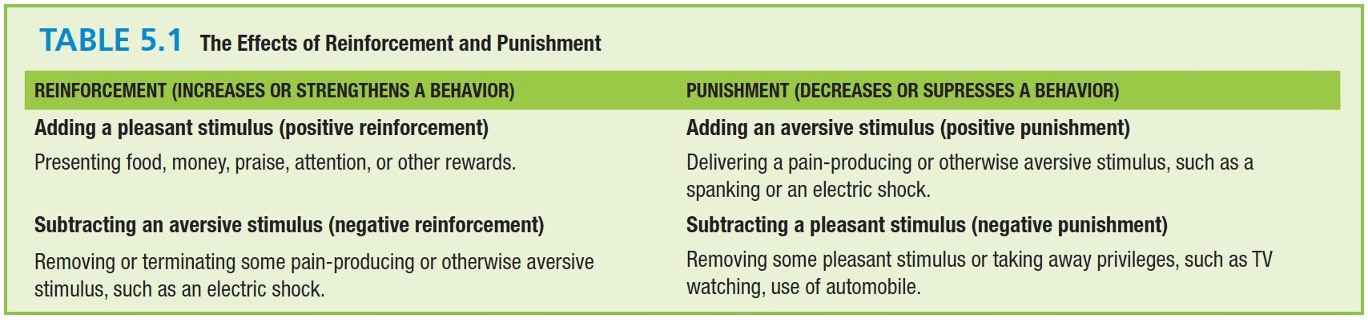
Positive Reinforcement - Addition of a consequence intended to increase the likelihood of a behavior/response occurring
Negative Reinforcement - removal of a consequence intended to increase the likelihood of behavior/response occurring
Positive and negative reinforcement involves the addition or removal of a consequence, does not necessarily refer to “good” or “bad”
Reinforcement
Primary Reinforcer
A reinforcer that fulfills a basic physical need for survival and does not depend on learning; life sustaining, i.e. eating.
Secondary Reinforcer
a reinforcer that is acquired or learned through association with other reinforcers i.e., money, praise, applause, attention
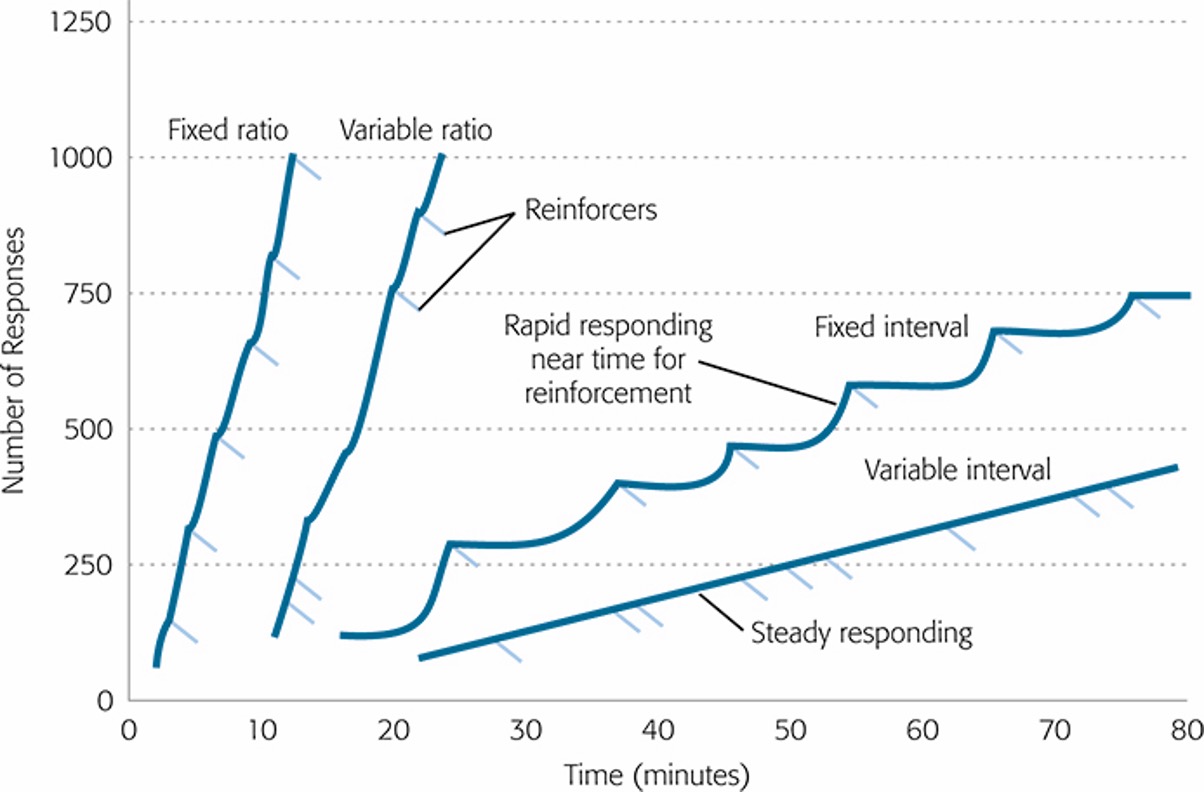
Schedules of Reinforcement Ratios and Intervals
A systematic process for administering reinforcement which influences the operant conditioning process
Ratio - number of occurrences
Interval - related to time, number of times
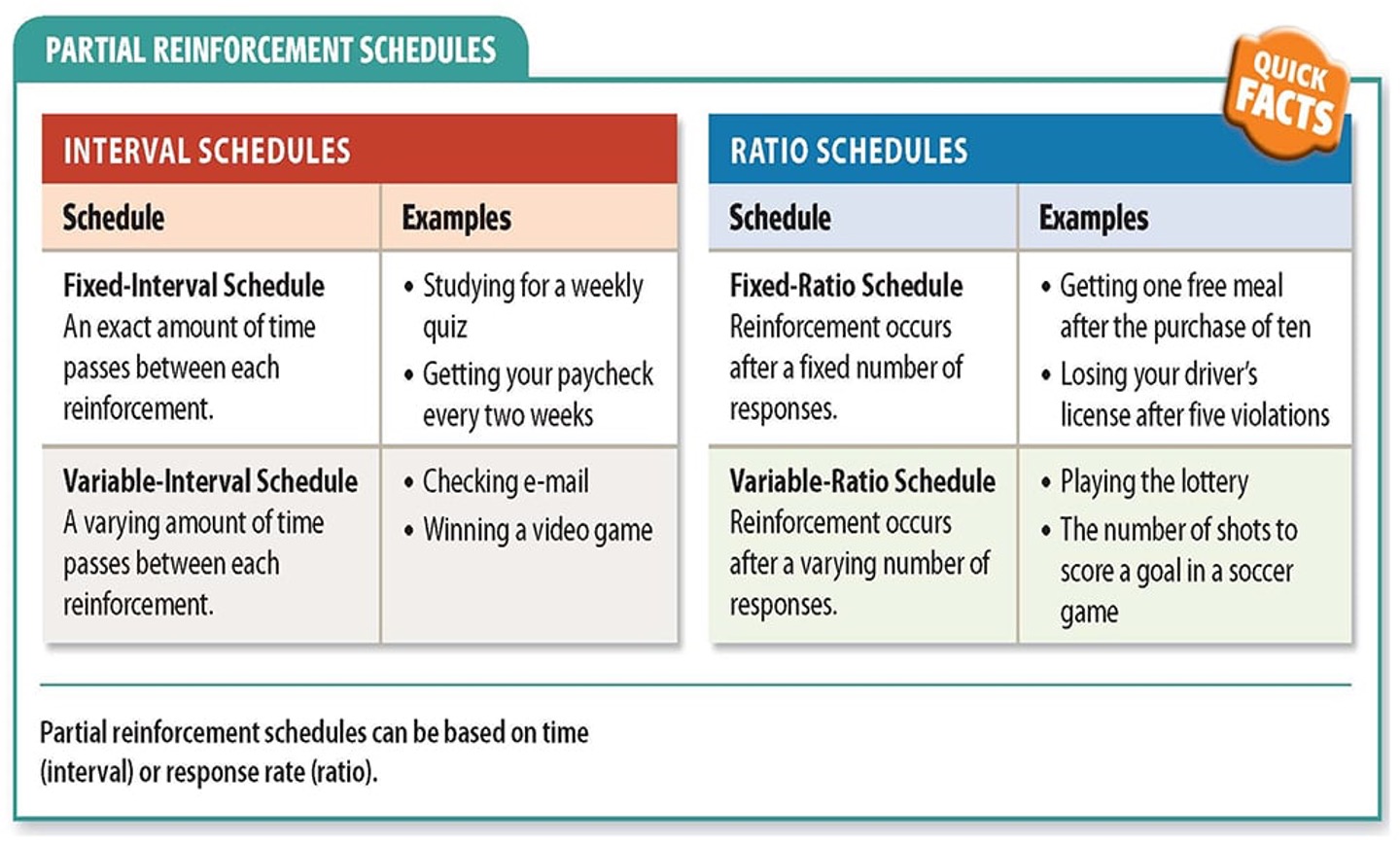
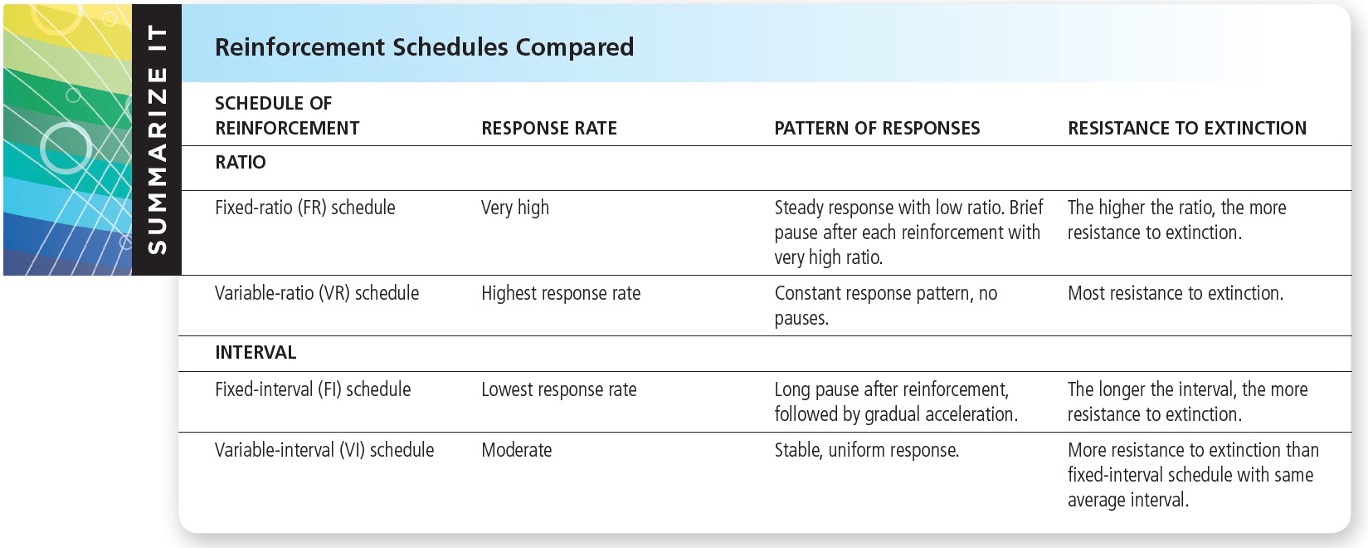
Schedules of Reinforcement - Ratios: based on # of occurences
Fixed-Ratio (FR)
The reinforcer is given after a fixed number of correct, non reinforced responses; using the ATM (1-1); predictable.
Variable-Ratio (VR)
The reinforcer is given after a varying number of non reinforced responses; maquinitas, (slot machines)
Fixed-Interval (FI) time based
The enforcer is given in response to the first correct response after a specific period of time has elapsed; for example, getting paid every Friday
Variable-Interval (VI) decreases extinction chances
The reinforcer is given after first correct response following a varied period of time
Operant Conditioning: Punishment
Punishment
A consequence or action enacted to decrease or eliminate the frequency of an undesired behavior
Types of Punishment
Positive Punishment
Decrease in behavior that results from adding a consequence
Negative Punishment
decrease in behavior that results from removing a consequence
Disadvantages of Punishment
Punishment does not necessarily extinguish undesirable behavior
suppresses the behavior when the punishing agent is present
Indicates that behavior is unacceptable but does not help to develop more appropriate behavior
Consequences of Punishment
The punished often become fearful and feel angry toward the punisher
Frequently leads to aggression
Is the punisher practicing self-control?
What are the punishers motives?
Alternatives to Punishment
Removing the rewarding consequences of undesirable behavior may be the best way to extinguish it
not giving in to a child’s demands during a trantrum
becoming aware of prior unintended reinforcement
ignoring misbehavior that is performed merely to get attention and giving attention to more appropriate behaviors
Using positive reinforcement can make good behavior more rewarding
Plus, let’s not forget consistency re: schedules or reinforcement
parents oftentimes apply punishment only after their own patience is exhausted
Escape and Avoidance Learning
Escape Learning
performing a behavior because it prevents or terminates an aversive event; i.e. paying bills on time to avoid late charging
Avoidance Learning
Engaging in behaviors to avoid anticipated aversive consequences or conditions
For instance, not riding in a car with an intoxicated driver or putting off study time because it interferes with party time
Problems with Avoidance Learning
Too much avoidance learning, however, can be maladaptive;
avoiding situations because anxiety, fears and phobias, social withdrawal, participating in class
The avoidance behavior is negatively reinforced and thus strengthened through operant conditioning
Procrastination - maladaptive avoidance behavior
Maladaptive Learning
Learned Helpnessness
exception to learning escape or avoidance behaviors; may foster dependency
Passive resignation to aversive conditions due to repeated exposure to inescapable or unavoidable events; oftentimes as a result of trauma, severe punishment, etc…
Applications of Operant Conditioning
Behavior Modification
using the learning principles of classical conditioning, operant conditioning, or observational learning to change undesired behavior
used to change self-injurious behavior in children and adults with autism
Utilizes the Behavioral perspective rather than a pure Cognitive perspective
Biofeedback - devices which monitor physiological functions i.e. heart rate, anxiety, blood pressure, allowing a person to regulate these activity levels
Token Economy: motivates socially desirable behavior by reinforcing it with tokens, ex. Cigarettes, allowance, toys, money.
Cognitive Learning
Cognitive Processes - using your mental processes such as thinking, knowing, problem solving, planning, remembering, and forming mental representations
Requires mental effort
Using mental effort
Learning by Insight
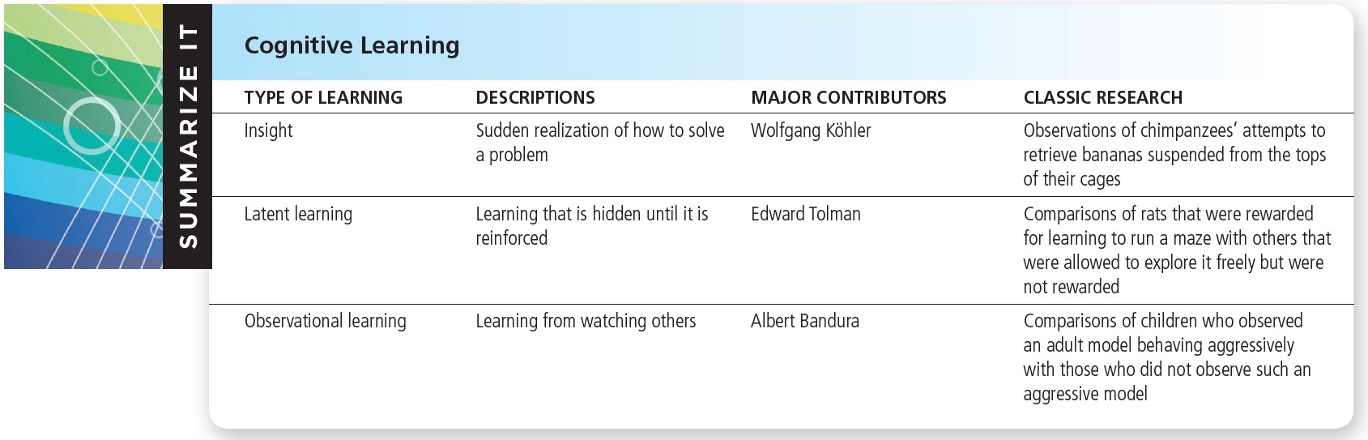
Insight
Sudden realization of the relationship between elements in a problem
“lightbulb over-the-head” moment
makes solution apparent
Unique pattern of interaction involving several different brain areas
Kohler studies with chimpanzees-the banana dilemma.
Chimpanzees appeared to give up in attempts to get bananas
sudden realization relationship between elements in a problem situation
Behavior seemed to be based on insight, not trial-and error learning
Latent (hidden Learning)
Tolman: learning could occur without apparent reinforcement and not be demonstrated until the organism was motivated to do so.
Involves formation of a “cognitive map”
Sort of like “accidental or unintentional learning.”
Observational Learning or Social Cognitive Learning Theory
Alberta Bandura
Learning by observing the behavior of other and the consequences of that behavior; learning by imitation
The model is the individual who demonstrates a behavior or whose behavior is imitated
effectiveness of model related to status, competence, and power
“To do or not to do”
The Four processes of observational learning: determine whether learning is occurring.
Attention
Retention
Reproduction
Reinforcement
Bandura: simply watching model does not necessarily result in learning (such as in learning dance moves, acquiring work skills, etc..)
Effects of the Multitasking Environment
More time spent multitasking may leave a subject less capable of managing thought processes when not multitasking (stimulus overload)
Multitasking causes us to develop the habit of attending to everything in the environment rather than filtering out useless information
Different tasks require different intensities in focus
Dilutes our ability to focus and concentrate
Learning from Media: Television and Other Entertainment Media
“Bobo Doll” Studies (Bandura, 1961)
Do children imitate aggressive behavior
Recent research
Individuals who watch the most violence as children are more likely to engage in acts of violence as adults
Aggression and Violence in Media
Recent Research
Brain imaging - patterns of neural activation develop by watching violent media
Children also imitate prosocial behavior.
Media may also teach children not to engage in aggressive acts
Fact: asocial, antisocial, and prosocial behaviors are often represented in media
Learning from Media: Gaming
Research on gaming has produced a number of varying and conflicting outcomes including:
1) increases feelings of hostility and decreases sensitivity to violent images
2) increases aggressive behavior
3) neither increases hostility nor decreases sensitivity