exam 2 A&P
Ch 6 bones and structure
Which of the following are not components of the skeletal system?
Answer: tendons
After a fracture of the diaphysis has healed, the thickened region that results is called the
Answer: external callus.
________ accounts for almost two-thirds of the weight of bone.
Answer: Calcium phosphate
A ________ is a rounded passageway for the passage of blood vessels and/or nerves.
Answer: foramen
Excessive growth hormone after puberty could result in
Answer: acromegaly.
Which of the following is formed by intramembranous ossification?
Answer: both the roof of the skull and the clavicle
Which of the following is not a characteristic of compact bone?
Answer: It is the site of hematopoiesis.
The central canal of an osteon contains
Answer: blood vessels
A transverse fracture of the wrist that may be comminuted is called a ________ fracture.
Answer: Colles
________ free calcium from bone to maintain blood calcium levels.
answer: Osteoclasts
Which bone is NOT formed via intramembranous ossification?
Answer: femur
Secondary ossification centers occur in
Answer: the epiphyses.
What structure allows a bone to grow in length?
Answer: epiphyseal cartilage
How does calcitonin act to lower blood calcium? (Module 6.11C)
Answer: Decreases osteoclast breakdown of bone matrix, decreases calcitriol production, decreases intestinal absorption, and increases renal excretion
A rounded hole through a bone is termed a
Answer: foramen.
In a ________ fracture, one side of the shaft is split, and the other side is bent.
Answer: greenstick
A shallow depression on a bone is termed a
Answer: fossa.
During the process of ________, an existing tissue is replaced by bone.
Answer: ossification
The structural units of mature compact bone are called
Answer: osteons.
________ are stem cells that develop into osteoblasts.
Answer: Osteogenic cells
Damage to a bone because of extreme load, sudden impact, or stresses applied from an unusual direction is called a
Answer: fracture.
________ bone does not contain capillaries but receives nutrients through its canaliculi.
Answer: Spongy
Ch 4 tissues
All of the following are part of the inflammation response except
Answer: production of the collagenous framework.
Which type of tissue fills internal spaces of the body?
Answer: connective
The three types of connective tissue include
answer: connective tissue proper, fluid connective, and supporting connective.
Which membranes line cavities that communicate with the body's exterior?
Answer: mucous
Each of the following is an example of dense connective tissue, except
Answer: areolar connective tissue.
Gap junctions can be found in all of the following tissues except
Answer: skeletal muscle.
The watery fluid component of blood is called
Answer: plasma.
The epithelium is connected to underlying connective tissue by
answer: a basal lamina.
The tissue that always has a "top" and a "bottom" is ________ tissue.
Answer: epithelial
Cartilage is separated from surrounding tissues by a fibrous
Answer: perichondrium.
Describe the two primary types of glands. (Module 4.8A)
answer: Endocrine glands release their substances into the interstitial fluid; exocrine glands release their secretions into ducts that open onto an epithelial surface.
The body's most delicate type of epithelium is the ________ epithelium.
Answer:simple squamous
________ attach skeletal muscles to bones, and ________ connect one bone to another.
answer: Tendons; ligaments
Ch 5 integumentary system
What is the most common type of cells in the subcutaneous layer?
Answer: adipocytes
The two components of the integumentary system are the
answer: cutaneous membrane and accessory structures.
If the epidermis, dermis, and part of the hypodermis are burned, it is classified as
answer: full thickness.
Skin can regenerate effectively even after considerable damage has occurred because
answer: stem cells persist in both epithelial and connective-tissue components of the skin even after injury.
The layer of dividing cells at the base of the epidermis is the
answer:stratum basale.
Rickets can be prevented by
Answer: Adequate sunlight and dietary intake of cholecalciferol are needed.
Identify the five layers of the epidermis (from superficial to deep). (Module 5.2B)
answer: stratum corneum, stratum lucidum, stratum granulosum, stratum spinosum, stratum basale
Describe a typical strand of hair. (Module 5.7A)
answer: A keratinous strand produced by basal cells within a hair follicle.
________ glands produce perspiration.
Answer:merocrine sweat
A thickened area of scar tissue covered by a shiny, smooth epidermal surface is called.
Answer: a Keliod
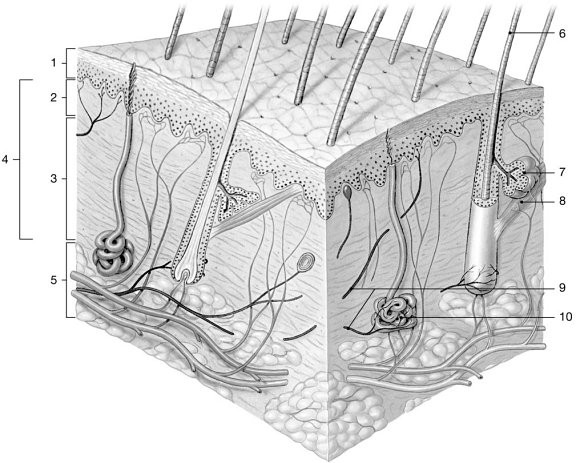
Which layer contains most of the accessory organs?
Answer:3
All of the following are functions of accessory structures of integument except
answer: production of skin pigments.
Accessory structures of the skin include all of the following except
answer: the epidermis.
Insensible perspiration takes place in the
answer:stratum corneum.
Wrinkles in elderly individuals are the result of
answer: loss of elastic filaments in the reticular layer of the dermis.
Distinguish among a first-degree, second-degree, and third-degree burn. (Module 5.5A)
answer: A first-degree burn affects only the surface of the skin. A second-degree burn affects the whole epidermis and some of the dermis. A third-degree burn destroys the epidermis and the dermis and extends into the subcutaneous layer.
All of the following are characteristics of the epidermis, except that it
answer: is vascularized.