Gas Law's Unit Assessment
KMT
Conceptual questions about relationships between pressure, volume, temperature, and number of moles
Particle Diagrams
Gas Law Calculations
Unit Conversions
Kinetic-Molecular Theory
A theory that explains the states of matter and is based on the idea that matter is composed of tiny particles that are always in motion
Helps explain observable properties and behaviors of solids, liquids, and gases
Applies to Ideal Gas
Gas atoms/molecules move rapidly and randomly
The fast motion of gas particles gives them relatively large amount of kinetic energy
Even at room temperature, a molecule of oxygen travels at a speed of about 500 meters per second
At higher temperatures, the gas particles have even more energy and move even faster
This movement is random since the particles are moving/colliding too fast for us to predict
Gas particles are really spaced out
The size of the particles doesn’t matter. We treat all gases (ex. CO2 molecules as tiny spheres)
This means that we can compress gases – but this takes energy
The particles of gas may either be atoms or molecules
Ex: Squeezing a balloon
Gas particles bounce off each other without losing energy
In the real world, some energy is lost to friction
Elastic Collision: When there is no overall loss of kinetic energy; kinetic energy may be transferred from one particle to another during elastic collision, but there is no change in the total energy
Kinetic Energy: The energy an object possesses because of its motion
Ideal Gas: An imaginary gas whose behaviour fits perfectly fits all five assumptions of the Kinetic Molecular Theory
Real Gases: Gases that don’t follow KMT assumptions
Basic Gas Laws
Gay-Lussac Law: At constant volume (v) and moles (n); Pressure (P) & Temperature (T) are directly related
Equation: P1 / T1 = P2 / T2
Acronym: GPT

Charles Law: At constant pressure and moles, Volume (V) and Temperature (T) are directly related
Equation: V1 / T1 = V2 / T2
Acronym: CVT

Boyles Law: At constant temperature and moles; Pressure (P) and Volume (V) are inversely related
Equation: P1 ⋅ V1 = P1 ⋅ V2
Acronym: BPV

Ideal Gas Law
Equation PV = nRT
OR
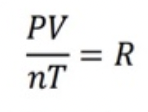
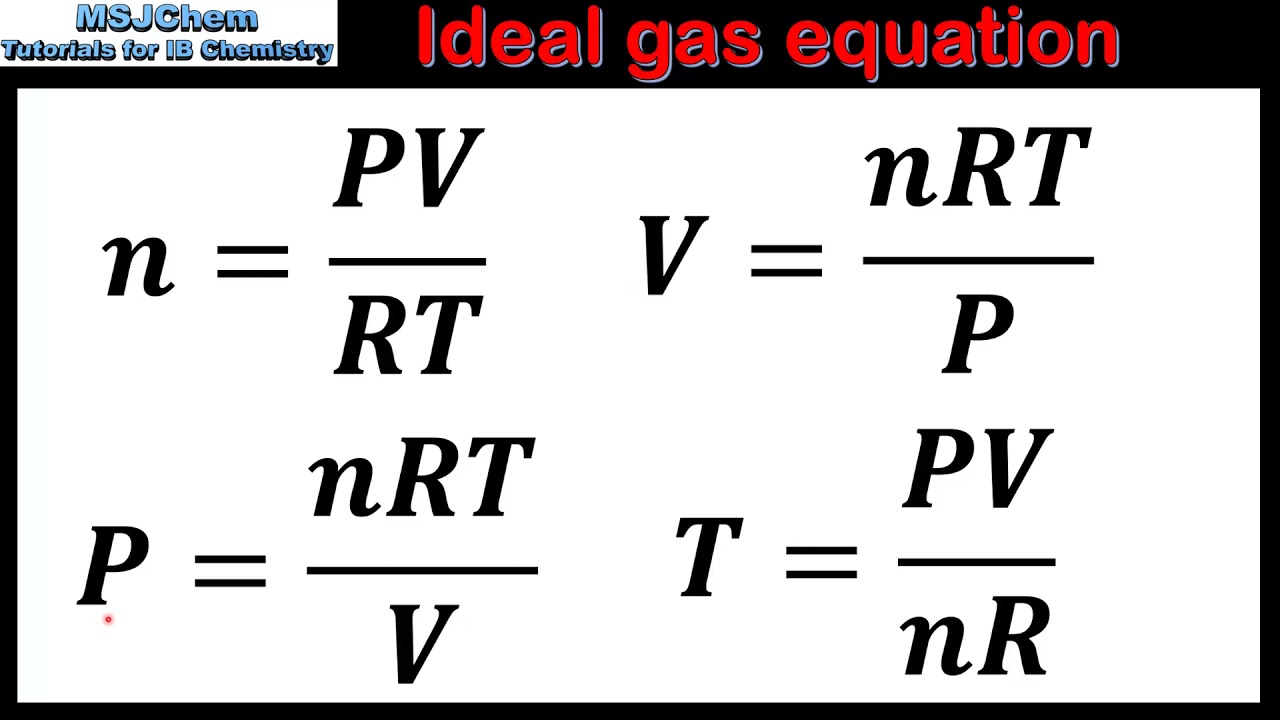
R = Universal gas constant
Have to use L
Combined Gas Law
PV/T = K
OR

dsafdsa
safdsa