Smartwork Chapter 16-21 Biology Midterm 3
The reproduction of cells is also known as cell division.
What happens to chromosomes when a cell is about to divide? The chromosomes become compacted.
A photographic representation of the chromosomes is a type of micrograph called a(n) karyotype.
Chromosomes that have replicated consist of two copies that are still joined to each other. The two copies are referred to as a pair of sister chromatids.
Several different types of chromosomes make up each set in eukaryotes. What describes how chromosomes are numbered? Size
Cell division refers to the reproduction of cells.
How many different types of autosomes do humans have? 22
When a cell prepares to divide, the chromosomes become more tightly compacted. This process decreases the apparent length of the chromosomes and increases their diameter.
Each human cell has a total of 46 chromosomes.
Which of these terms refers to the visual appearance of the full complement of chromosomes in a cell? Karyotype
True or false: In sexual reproduction in eukaryotes, each parent contributes one set of chromosomes to the offspring.
The two copies of a replicated chromosome are called sister chromatids.
When the cells of an organism carry two sets of chromosomes, that organism is said to be diploid or 2n.
In an organism, each set of chromosomes is composed of several different types of chromosomes. The chromosomes are numbered according to size.
The letter n is used in genetics to refer to a set of chromosomes.
In humans, there are 22 different types of autosomes.
Sperm and egg cells are known as gametes.
How many chromosomes are in a human cell? 46
In a diploid organism, the members of a pair of chromosomes are called homologs.
Which of the statements below are true for chromosomes in eukaryotic cells?
Diploid cells have two versions of each chromosome / Diploid cells have a maternal homologue and a paternal homologue.
DNA sequences on homologous chromosomes are very similar.
A diploid organism contains two sets of chromosomes.
The sequence of growth, replication, and division that produces new cells is called the cell cycle.
Geneticists use the letter n to represent a set of chromosomes.
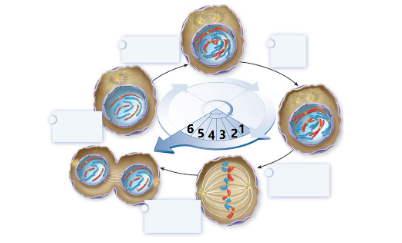
This figure depicts the cell cycle in eukaryotes, including the M phase. Match the number to the appropriate phase.
- Prophase
- Prometaphase
- Metaphase
- Anaphase
- Telophase
- Cytokinesis
The gametes are the sperm and egg cells.
Match the stages of the cell cycle to the correct cell activity.
G1) A cell grows and becomes committed to divide.
S) Chromosomes are replicated.
G2) A cell makes protein for chromosome sorting and cell division.
M) A cell divides into two daughter cells.
If an organism is diploid, the two members of a pair of chromosomes are called homologues or homologs.
During interphase of the cell cycle, the cell grows and copies which of the following in preparation for cell division? Chromosomes
The DNA sequences are very similar but not identical on homologous chromosomes.
Identify the stage in the cell cycle that is considered the non-dividing stage.G0
In multicellular eukaryotic organisms, the production of new cells follows a highly regulated sequence of growth, DNA replication, and division. This sequence is referred to as the cell cycle.
In the G1 phase, what cues help a cell accumulate changes that might cause it to progress through the rest of the cell cycle? Signaling and environmental
G1
The following is a diagram of the eukaryotic cell cycle. Match the letter to the appropriate phase.
- G1
- S
- G2
- Interphase
- M
In a cell's life, cell growth occurs primarily during what phase? G1
Put the events of the cell cycle into chronological order. Begin at the top with the events of the G1 phase.
- Cell grows and commits to divide.
- Chromosomes are replicated.
- Cell makes proteins for chromosome sorting and cell division.
- Cell completes mitosis and cytokinesis.
While preparing to divide, the cell grows and copies its chromosomes during interphase.
During which phase of the cell cycle are the chromosomes replicated? S phase
In a phase of the cell cycle the cell has postponed proceeding through G1 and is considered non-dividing. It is called the G0 phase.
In the G2 phase, the cell synthesizes proteins needed for chromosome sorting and cell division.
Environmental conditions and the presence of signaling molecules help a cell in the G1 phase to accumulate changes that might cause it to progress through the rest of the cell cycle.
During the eukaryotic cell cycle, the first portion of M phase is mitosis.
The G1 phase is usually when cell growth occurs.
Which is the longest phase in the cell cycle? G1 phase
The phase of the eukaryotic cell cycle where chromosome replication occurs is the S phase.
Which of the following cell cycle phases is the shortest? M cycle
Cells produce proteins that are necessary for chromosome sorting and cell division during what phase of the cell cycle? G2 phase
The cell cycle of a fast-dividing adult cell in mammals is usually in the range of 10-24 hours
The M phase of the eukaryotic cell cycle consists of two parts. The first part, in which the chromosomes are divided equally between two daughter nuclei, is called mitosis.
Both external and internal factors determine if a cell will divide or split.
The progression through the cell cycle is highly regulated to ensure that the nuclear genome is intact and the conditions are appropriate for a cell to divide.
The advancement of a cell through the cell cycle is promoted by cyclins and cyclin-dependent kinase.
The shortest phase in the cell cycle is the M or mitotic phase.
In order to be active, cdks must bind to proteins called cyclins.
Which of the following statements about the length of the cell cycle is true?
It varies considerably among different cell types of an individual.
Which of the following are internal factors that affect cell division?
Cell cycle control molecules and checkpoints.
Cell cycle progression is tightly regulated to ensure that the nuclear genome is intact and the conditions are appropriate for cell division.
The G1 cyclin is made in response to sufficient nutrients and growth factors.
What two proteins are responsible for advancing a cell through the phases of the cell cycle?
Cyclins and cyclin-dependent kinases
A type of cyclin accumulates late in G2. It then binds to a cdk and forms a complex needed to advance the cell into the M phase. It is known as mitotic cyclin.
To be activated, the kinases controlling the cell cycle must bind to a cyclin.
As the cell advances through mitosis, mitotic cyclin is degraded.
Checkpoint proteins act as sensors to determine if a cell is in the proper condition to divide.
The levels of which cyclin increase when nutrients and growth factors are in good supply? G1 cyclin
The three critical regulatory points found in the cell cycle of eukaryotic cells are called checkpoints.
Which cyclin is needed to advance the cell into the M phase? Mitotic cyclin
Upon detection of DNA damage, the checkpoint proteins prevent the formation of active cyclin/cdk complexes.
Mitotic cyclin is degraded as the cell progresses through mitosis.
Both the G1 and G2 checkpoints check for damage of which of the following? DNA
To assess if a cell is in an appropriate condition to divide, the cell employs sensors called checkpoint proteins.
The third checkpoint in the cell cycle is called the metaphase checkpoint.
Which of the following are internal factors that affect cell division?
Cell cycle control molecules and checkpoints.
In order to determine if a cell is in the proper conditions to divide, a cell employs three critical regulatory points called checkpoints.
The metaphase checkpoint determines if all chromosomes are attached to the spindle apparatus.
If DNA damage is detected, the formation of active cyclin/cdk complexes is blocked by checkpoint proteins.
At the G2 checkpoint, proteins check for DNA damage.
Which of the following is the third checkpoint in the cell cycle? The metaphase checkpoint
Which of these checkpoints will stop the cell cycle if the chromosomes are not correctly attached to the spindle apparatus? Metaphase
The checkpoint proteins prevent the division of a cell that has DNA damage or abnormalities in the chromosome number.
Both the G1 and G2 checkpoints check for damage of which of the following? DNA
If a chromosome is not correctly attached to the spindle apparatus, the cell cycle will be stopped at the M checkpoint.
The metaphase checkpoint determines if all chromosomes are attached to the spindle apparatus.
What proteins delay the division of a cell that has DNA damage or abnormalities in the chromosome number? Checkpoint proteins
Mitotic cell division is a process by which a cell divides to produce two new daughter cells that are genetically identical to the original cell.
The process of mitotic cell division encompasses mitosis, where the nucleus divides into two nuclei, and cytokinesis, where the mother cell divides into two daughter cells.
Mitotic cell division is important for asexual reproduction and for the production and maintenance of multicellularity.
In preparation for cell division, the chromosomes are replicated and compacted into sister chromatids.
In preparation for division, the structures that become very condensed and can easily be viewed with a microscope are the chromosomes.
Mitotic cell division in humans is cell division that results in two diploid daughter cells.
Which protein is necessary to hold the sister chromatids together at the centromere? Cohesion
In humans, the cells that contain only 23 chromosomes are called haploid.
Meiosis is the process in which a cell that is diploid divides to produce haploid cells.
True or false: Meiosis is very important because it creates diploid daughter cells for sexual reproduction. False
Which two key events occur at the beginning of meiosis but not mitosis? Crossing over and formation of bivalents
The process of forming a bivalent is termed pairing, or synapsis.
How many chromosomes does a human gamete possess? 23
In most eukaryotic species, homologous chromosomes are connected during a portion of meiosis via a protein structure called the synaptonemal complex.
A diploid cell divides to produce haploid cells by a process called meiosis.
In a bivalent, a physical exchange between chromosome segments is termed a(n) cross over.
Which of these is one of the significant results of meiosis?
It creates haploid gametes for sexual reproduction.
Exchange of chromosome segments between homologues at the beginning of meiosis increases genetic variation in offspring.
Bivalent formation and crossing over are two key events that typically occur at the beginning of which of these? Meiosis only
Meiosis I sorting separates which of these? Homologous chromosomes
Synapsis is the process of forming a(n) bivalent.
The synaptonemal complex connects homologous chromosomes during meiosis.
In prophase I of meiosis, the replicated chromosomes condense, the homologous chromosomes form bivalents, and crossing over occurs.
Crossing over is best described as which of these?
It involves a physical exchange of chromosome segments in the tetrad.
Which of these is the process by which homologues exchange chromosome segments at the beginning of meiosis to increase genetic variability in offspring? Crossing over
In mitosis, a pair of sister chromatids is attached to both poles while in meiosis I a pair of sister chromatids is attached to just one pole via kinetochore microtubules. What phase is described here? Prometaphase
Homologous chromosomes are separated from each other during meiosis.
During metaphase I of meiosis, the bivalents are organized along the metaphase plate. In particular, the sister chromatids are randomly aligned in a double row rather than in a single row as in mitosis.
Put the events of meiosis I in order, beginning with the earliest event at the top.
- Replicated chromosomes condense, form bivalents, and crossing over occurs.
- Nuclear envelope is completely broken down and the spindle apparatus is entirely formed.
- Bivalents are aligned along the center of the cell.
- Homologous chromosomes separate and move toward opposite poles.
- Chromosomes decondense and nuclear envelope re-forms.
It is unlikely that any two human gametes will have the same combination of homologous chromosomes because the homologues are similar but not identical. Therefore, the random alignment of homologous chromosomes that occurs in metaphase I of meiosis provides a mechanism of vast genetic diversity.
The formation of bivalents and subsequent crossing over occur in what phase of meiosis? Prophase I
Homologues are pulled toward opposite poles of the cell during anaphase I of meiosis.
The joined pairs of sister chromatids reach their respective poles, and then decondense, at telophase.
In prometaphase, there is a key difference between mitosis and meiosis I. In mitosis, a pair of sister chromatids is attached to both poles. In meiosis I a pair of sister chromatids is attached to just one pole via kinetochore.
The end result of meiosis I is that two nuclei are produced, each with half the number of sister chromatids. Thus, meiosis I is said to be a(n) reduction.
During metaphase I, homologous chromosomes align along the center of the cell as bivalents, or tetrads.
In general, meiosis I is followed by cytokinesis before meiosis II can start.
What metaphase I event provides a mechanism for vast genetic diversity? Random alignment
The sorting events of meiosis II and mitosis are similar, but the chromosome content at the start is different.
What occurs during anaphase I of meiosis?
Homologous pairs of chromatids move to opposite poles.
The homologs arrive at their respective poles and the nuclear envelope reforms to produce two separate nuclei. These events occur during which phase of meiosis? Telophase I
In what phase of meiosis are sister chromatids separated? Anaphase II
Meiosis I produces two haploid nuclei from an original diploid cell.
What statement about mitosis and meiosis is correct? Sister chromatids are separated both during mitosis and meiosis.
Which of the following occurs between the first and second meiotic divisions? Cytokinesis only
True or false: Meiosis II and mitosis have similar sorting events, but different starting points. True
Homologues are pulled toward opposite poles of the cell during anaphase I of meiosis.
During the cell cycle, when does DNA replication occur? Prior to mitosis and prior to meiosis
The sister chromatids are separated during anaphase II of meiosis.
Which of the following statements correctly compare mitosis and meiosis? Crossing over occurs in meiosis but not normally in mitosis and sister chromatids are separated during both mitosis and meiosis.
Crossing over rarely occurs during mitosis but is common in meiosis because homologues synapse to form bivalents only during prophase of meiosis I.
The end result of meiosis II (after cytokinesis) is four daughter cells that are haploid.
DNA is replicated in the S phase of the interphase falling between meiosis I and meiosis II. false
A zygote is created when two haploid cells, called gametes, fuse.
Crossing over occurs commonly during meiosis but rarely during mitosis because during prophase of meiosis I, the homologues synapse to form bivalents.
Which of the following is the end result of mitosis in a diploid organism? Two daughter cells are diploid
While asexual reproduction is less costly, sexual reproduction is commonly utilized because it generates genetic diversity.
The sequence of events that produces another generation of organisms is known as a(n) life cycle.
When two haploid gametes unite, they create a diploid cell called a(n) zygote.
During the life cycle of a diploid animal, what process produces haploid gametes? Meiosis
The process in which two haploid gametes unite to form a diploid zygote is called sexual reproduction.
Because most species of animals are diploid and their haploid gametes are considered to be a specialized type of cell, animals are viewed as diploid-dominant species.
Put the events that occur during the fungal life cycle in the correct order. Begin at the top with the production of reproductive cells.
- Some cells from a multicellular haploid organism develop into reproductive cells.
- Haploid reproductive cells unite to form a diploid zygote.
- Meiosis of the zygote produces 4 haploid spores.
- Repeated mitotic cell divisions produce a haploid multicellular organism.
Which of the following are the main disadvantages of sexual reproduction?
It involves lots of time and energy and it requires specialized body parts.
A life cycle is best described as the process that produces another generation of organisms.
Most fungi and some protists are considered haploid-dominant species because the multicellular organism is haploid.
Put the events of an animal life cycle in the correct order. Begin at the top with the production of gametes.
- Meiosis occurs in the cells within testes and ovaries to produce haploid gametes.
- During fertilization, sperm and egg unite to create a diploid zygote.
- Repeated mitotic cell divisions produce a diploid multicellular organism.
Animals are viewed as diploid-dominant species because most species are diploid and their haploid gametes are considered to be a specialized type of cell.
During the fungal life cycle, meiosis of the zygote produces four haploid spores.
Which of the following organisms exhibit an alternation of generations? Plants
Which of these are typically haploid-dominant species? Fungi and protists
The haploid multicellular organism produced during the plant life cycle is known as a(n) gametophyte.
In honeybees, female larvae fed and bathed in royal jelly throughout their development will become queen bees.
Mendelian inheritance is characterized by three general rules: 1. Except in the case of rare mutation, genes are passed unaltered from generation to generation; 2. Each gene obeys Mendel’s Law of Segregation; and 3. During crosses, two or more genes obey Mendel’s law of independent assortment.
Modification of a gene or chromosome during gamete formation that alters a gene's expression but does not change the DNA sequence is known as epigenetic inheritance.
The term which describes changes in gene expression that are not related to variations of the DNA sequence, yet are transmissible and are reversible, is epigenetic.
The process of X-chromosome inactivation occurs during embryonic development in female mammals and leads to the silencing of one of the two X chromosomes found in somatic cells. This is an example of a(n) epigenetic change.
Which of the following characterize an epigenetic effect? The change must be passed from cell to cell and causes a change in gene expression.
In the somatic cells of female mammals, the genes on one of the two copies of the X chromosome are not expressed. This phenomenon is known as X-chromosome inactivation.
Which of the following statements best describes epigenetic changes during the life of an individual? Some epigenetic changes are permanent while others are reversible.
The phenomenon of X-chromosome inactivation was first proposed in 1961 by the British geneticist Mary Lyon.
All female honeybee larvae are initially fed royal jelly during development. However, those that are weaned at an early stage and switched to a diet of pollen or nectar become worker bees.
What is a Barr body? A highly condensed X chromosome
Epigenetic inheritance refers to epigenetic changes that occur during gamete formation.
What evidence did Mary Lyon have when she proposed the concept of X-chromosome inactivation? Some female mammals exhibited a complex pattern of inheritance of coat colors, such as that observed in calico cats and the presence of a highly condensed structure in the cells of female mammals, which was possibly a condensed X chromosome.
What type of inheritance describes X-chromosome inactivation? Epigenetic
An example of X-chromosome inactivation is found in some female cats, which have a coat color containing randomly distributed patches of black and orange fur. This is called the calico pattern of coat color.
X-chromosome inactivation refers to the process that occurs in female mammals, when the genes of one of the two X chromosomes are not expressed.
What is an example of mosaicism? Calico coat patterns in cats
Who first advanced the idea of X-chromosome inactivation? Mary Lyon
Which of the following statements is true regarding a female mammal that is heterozygous for an X-linked gene? Some of the somatic cells will express one allele, the others will express the other allele.
A highly condensed X chromosome is known as a(n) Barr body.
The observation by scientists of a highly condensed structure found in the cells of female cats that may be one of the X chromosomes and the observation of the complex pattern of coat color inheritance in calico cats led Mary Lyon to propose the phenomenon of X-chromosome inactivation.
Some female mammals are composed of two different types of cells because they are heterozygous for X-linked genes and experience X inactivation. This phenomenon is best described by the term mosaics.
Why does dosage compensation occur in mammals? To equalize the expression of X-linked genes in males and females
The calico coat pattern in female cats is an example of mosaicism due to X-chromosome inactivation.
Why does dosage compensation occur in mammals? Barr body
In a female mammal heterozygous for an X-linked recessive allele, what proportion of somatic cells will express the recessive allele? 50%
Some people are born with abnormalities in the number of their sex chromosomes. For example, people born with triple X syndrome have three X chromosomes, and those born with Klinefelter syndrome have two X chromosomes and one Y. How does X inactivation proceed in these cases? All of the X chromosomes are inactivated except for one.
Which of these sequences plays a critical role in Barr body formation? The x inactivation center (Xic)
Female mammals that are heterozygous for X-linked genes, and are thus composed of two types of cells, are known as which of the following? Mosaics
How does X-chromosome inactivation take place? The Xics are counted, allowing the cell to inactivate all but one X chromosome.
The expression of X-linked genes is equalized in male and female mammals by the process of dosage compensation.
What is the most likely potential consequence of mutation in the Xic region of an X chromosome? Both X chromosomes are expressed
In a mammalian cell that contains two X chromosomes, one of the X chromosomes will become a(n) Barr body.
What are the medical consequences if a human female possesses two active X chromosomes? This is a lethal condition
In triple X syndrome, how many X chromosomes are converted into Barr bodies and why? two , because one active X chromosome is needed
The Xist gene, which is involved in X inactivation, encodes a(n) RNA molecule.
The region on the X chromosome that is known to play a role in Barr body formation is known as the X inactivation center.
X-chromosome inactivation is accomplished when all of the Xics are counted, allowing the cell to recognize and inactivate all but one of the X chromosomes.
How is the Xist gene involved in X-chromosome inactivation? It synthesizes RNA, which coats one of the X chromosomes. Proteins then associate with the RNA, promoting compaction into a Barr body.
A mutation that results in both X chromosomes being expressed most likely occurred in the X inactivation center region.
A lethal condition will arise in a human female embryo that possesses two active X chromosomes.
What is encoded by the Xist gene of the X chromosome? An RNA molecule
The compaction of the X chromosome into a Barr body arises from the actions of the Xist gene.
The process of X-chromosome inactivation involves the gene Xist, which encodes a very long RNA molecule. This molecule coats one of two X chromosomes, thus starting a process that ultimately leads to compaction of the chromosome into a Barr body.
What is the most likely potential consequence of mutation in the Xic region of an X chromosome? Both X chromosomes are expressed
What are the medical consequences if a human female possesses two active X chromosomes? This is a lethal condition
The formation of Barr bodies is due to the expression of the Xist gene.
Individual bacterial cells may exist as single units or remain associated with each other after cell division to form higher arrangements. These include which of the following? Pairs, chains, and clumps
The number of chromosome copies depends on the bacterial species and on growth conditions, but a bacterium typically has 1 to 4 identical chromosomes.
The bacterial species and the growth conditions determine the number of chromosomal copies found in the bacterial cell.
Bacterial chromosomes are usually tightly packed in an area of the cell known as which of the following? Nucleoid region
Which of the following statements about the bacterial chromosome are true? Has direct contact with the cytoplasm & localized to a nucleoid region
Which of the following statements best describes bacteria? Unicellular and widespread on Earth
The genome of a typical bacterium consists of a circular chromosome that carries a few thousand genes.
A bacterium typically has 1-4 identical copies of its chromosome.
A typical bacterial chromosome consists of a molecule of double-stranded and circular DNA.
What determines the number of chromosomal copies found in the bacterial cell? Bacterial cells and growth conditions
The largest part of bacterial DNA consists of gene sequences, primarily those that encode protein.
The region of a bacterial cell where the chromosome is tightly packed is known as the nucleoid region.
The bacterial chromosome typically has a single origin of replication, which is a few hundred base pairs long.
Unlike the eukaryotic nucleus, the bacterial nucleoid region is not a separate cellular compartment bounded by a(n) membrane.
Characteristics of a typical bacterial genome include which of the following? Circular chromosomes and several thousand genes
What are features that lead to bacterial chromosome compaction? Chromosome loops and supercoiling
On average, how long is a bacterial chromosome? A few million base pairs
Which of the following sequences account for the largest part of bacterial DNA? Gene sequences
The compaction of a chromosome is represented in this figure. Match the letter to its appropriate description.
- Formation of loop domains
- Loop domains
- Proteins anchoring loops
- Supercoiling
Bacterial chromosomes have a single copy of a region that functions as the assembly site for the proteins required for DNA synthesis. This region is termed the origin of replication.
Histone proteins are involved in the compaction of eukaryotic DNA only.
The compaction of a bacterial chromosome occurs by two processes: the formation of loop domains and by DNA supercoiling.
During the compaction of the bacterial chromosome, chromosomal segments are folded into structures called loop domains.
Small, circular pieces of DNA that exist separately from the bacterial chromosome are known as plasmids.
Many bacterial cells have DNA-containing plasmids that are separate from the bacterial chromosome.
A clone of genetically identical cells on a petri dish is called a bacterial colony.
Unlike eukaryotic DNA, bacterial DNA is not wound around histone proteins to form nucleosomes.
Cell division in most bacteria occurs by a process known as binary fission.
What term refers to small, circular DNA molecules that exist independently of the bacterial chromosome? Plasmids
Bacterial cells commonly contain chromosomal DNA and which of the following structures? Plasmids
Binary fission can be divided into four main steps. Arrange these in order, starting with the earliest at the top.
- Chromosome replicates and cell enlarges
- Cell begins to divide
- A cell wall is formed between the two cells
- Two daughter cells are formed
When placed on a solid growth medium in a petri dish, an E. coli cell and its daughter cells undergo repeated cellular divisions and form a clone of genetically identical cells called a bacterial colony.
When placed on a solid growth medium in a petri dish, an E. coli cell and its daughter cells undergo repeated cellular divisions and form a clone of genetically identical cells called a binary fission.
The protein FtsZ forms a ring that separates the two daughter cells during binary fission.
In general, bacteria reproduce by binary fission.
Binary fission results in the production of two identical daughter cells.
Which of the following characteristics apply to binary fission? Genetic contribution from one parent & formation of two daughter cells
Which of the following proteins plays a direct role during binary fission in bacteria? FtsZ
The process that gives rise to the structures and functions of living organisms is called development.
What is the underlying factor that produces different developmental pathways in different types of species? The genetic makeup
In animals and flowering plants, the zygote divides to produce a multicellular embryo and eventually an adult organism.
In animals and flowering plants, development begins when a sperm and an egg unite to produce a(n) zygote.
The process through which a cell undergoes structural and functional changes to become a more specialized type of cell is called cell differentiation.
In biology, the term development refers to a series of changes in the state of a cell, tissue, organ or organism.
Developmental biologists study developmental genetics in model organisms so that they can understand scientific principles that apply broadly to many species.
The development of an organism is under the control of its genetic makeup.
What is a model organism? A species used to study scientific principles that apply broadly to other species.
After it divides the zygote becomes a multicellular embryo.
What organisms are invertebrates that are used as model organisms for the study of developmental genetics? Fruit fly and nematode worm
What is a zygote? The cell that results from fertilization
Changes in the morphology and function of the cell that result in specialization are called differentiation.
True or false: Animals develop by pattern formation, while plants do not.
How do developmental biologists study developmental genetics? They use various model organisms.
An organism that is studied by many scientists so that they can compare results and determine scientific principles that are broadly applicable is called a(n) model organism.
In a multicellular organism, the body plan is produced by what process? Pattern formation
What are the two most commonly used model invertebrate animals in developmental genetics? C. elegans and D. melanogaster
In animals and flowering plants, development begins when a sperm and an egg unite to produce a(n) zygote.
Which of the following are axes along which animal bodies develop? Anteroposterior, left-right, and dorsoventral.
Both animals and plants develop by pattern formation.
Developmental biologists study developmental genetics in model organisms so that they can understand scientific principles that apply broadly to many species.
Match the letter on the image to the animal body plan axis depicts.
- Dorsoventral axis
- Left-right axis
- Anteroposterior axis
Various cues that cells receive at appropriate times during development provide them with information regarding their location in the body relative to other cells. This type of information is known as positional information.
Which of the following are ways in which cells can respond to positional information? Cell differentiation, cell migration, cell division, and cell death
Pattern formation in animals is usually organized along three axes: the dorsoventral axis, the anteroposterior axis and the left-right axis.
True or false: Animals develop by pattern formation, while plants do not.
Morphogens provide positional information by acting in a concentration-dependent manner.
This image shows the body plant found in many seed-bearing plants. Letter A indicates the root-shoot axis, and letter B highlights the radial pattern of growth.
The threshold concentration of a morphogen is the concentration above which the morphogen will exert its effects.
During development, cells receive positional information which provides them with cues regarding their location relative to other cells in the body.
The phenomenon in which transcription factors control whether or not certain genes are expressed at a specific time in a particular cell type is known as differential gene regulation.
What explains the profound morphological and physiological differences that are observed in different cells in the same organism? Different genes are turned on and off in certain cells during development
Chemical molecules that impart positional information through their concentration gradient are called morphogens.
A cell will be restricted to a particular developmental pathway if a morphogen is present at a high concentration.
The four generalized phases in the development of an animal are: (1) organization of the body along axes, (2) organization of the body into several smaller regions, (3) organization of cells in ways that produce body parts, and (4) cell differentiation, where cells change morphologies and become specialized.
Undifferentiated cells that divide and supply the cells that constitute the body of all animals and plants are known as stem cells.
During the development of a multicellular organism, transcription factors control whether or not certain genes are expressed at a specific time in a particular cell type; this phenomenon is known as differential gene regulation.
Different cells in the same organism can have profound morphological and physiological differences that arise due to regulation of the expression of genes.
All stem cells have two common characteristics: they have the capacity to divide, and their daughter cells can differentiate into one or more specialized cell types.
Morphogens provide positional information by acting in a concentration-dependent manner.
When a stem cell divides, one of the daughter cells remains a stem cell, while the other differentiates and the two daughter cells have different fates.
The threshold concentration of morphogen is the concentration above which the morphogen will exert itself.
Why is it important that stem cells be able to divide asymmetrically? By doing that they can continue dividing throughout the life of an organism generating specialized cells.
The stem cells that divide and supply the cells that constitute the body of a plant or animal are undifferentiated.
Which of the following criteria are used to categorize mammalian stem cells? Their ability to differentiate and the developmental stage
The phenomenon in which transcription factors control whether or not certain genes are expressed at a specific time in a particular cell type is known as gene regulation.
Which of the following are features that all stem cells have? They can divide and their daughter cells can differentiate into one or more cells.
What are possible fates for a daughter cell of a dividing stem cell? It can remain a stem cell and it can become a specialized cell.
The fertilized egg is considered to be a(n) totipotent stem cell.
The capability of stem cells to undergo a(n) asymmetric pattern of division and differentiation is crucial as it allows them to continue dividing throughout life and generate a population of specialized cells.
In mammals, stem cells are categorized according to their developmental stage and their ability to differentiate.
During the development of a multicellular organism, transcription factors control whether or not certain genes are expressed at a specific time in a particular cell type; this phenomenon is known as differential gene regulation.
A Totipotent stem cell can produce all of the cell types of an organism and give rise to an entire organism.
Which of the following is a totipotent cell? The fertilized egg
Match each type of stem cell to the type of differentiated cells it can produce.
- Totipotent - can produce all specialized cells and give rise to an entire organism
- Pluripotent - can produce all specialized cells but not an entire organism
- Multipotent - can produce several types of specialized cells but not all
- Unipotent - produces one type of specialized cell
The pluripotent stem cells found in the blastocyst stage during mammalian development are called embryonic stem cells.
A totipotent cell is one that can give rise to all cell types in the adult organism.
Which of the following are correct descriptions of stem cells? Multipotent, totipotent, pluripotent, and unipotent.
Stem cells in the embryo that will later give rise to sperm or egg cells are called embryonic germ (EG) cells.
Match each type of cell in humans with its correct description.
- Fertilized egg cell - totipotent
- Embryonic stem cell - pluripotent
- Bone marrow cell - multipotent
- Skin cell - unipotent
Embryonic germ (EG) cells can differentiate into every or nearly every cell type of the body. That is why they are said to be pluripotent.
In mammals, embryonic stem cells are pluripotent cells that are derived from the inner mass cells of the blastocyst.
Why are stem cells important in human medicine? They can be used to produce cells which can replace cells that have died due to disease of injury.
Stem cells that can differentiate into every or nearly every cell type of the body are called pluripotent cells. An example would be embryonic stem cells.
What is the most common source of ES cells? Unused human embryos produced by in vitro fertilization.
Embryonic germ cells are stem cells in the embryo that will later give rise to sperm or egg cells.
Embryonic germ cells are pluripotent.
To treat diseases and injuries that involve cell and tissue death, embryonic stem cells can be used.
Typically, ES cells that are used for research are obtained from human embryos that were produced using a method of assisted conception called in vitro fertilization.
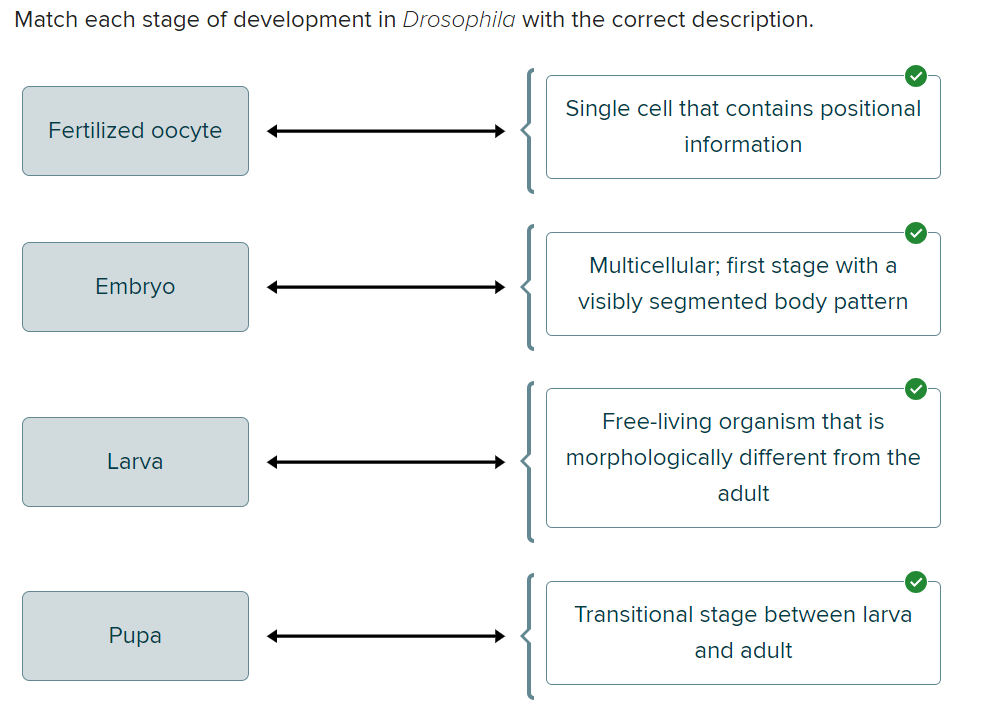
The fertilized oocyte of D. melanogaster is an elongated cell that has a(n) anterior and a(n) posterior end that correspond to those in the adult.
One of the key processes in the development of Drosophila is the separation of the body into segments.
In Drosophila, the embryo is subdivided into visible segments grouped into three body regions: head, the thorax , and the abdomen.
In the fruit fly, segmentation genes control the segmentation pattern.
A normal fruit fly develops one pair of wings from the second thoracic segment. In the fly shown here, the third thoracic segment has the same characteristics as the second thoracic segment, resulting in four wings instead of two. This fly is most likely the result of a mutation in homeotic genes.
What statement about the fertilized oocyte in fruit flies is true? It has an anterior and posterior end which correspond to those in the adult fly.
Why are homeotic genes important in animals? They influence the development of segment characteristics.
During insect development, when is segmentation first established? In the embryo.
In the fruit fly, homeotic genes control the development of a particular segment or group of segments.
Segments in the fruit fly can be grouped into which areas? Head, abdomen, and thorax
How does the bithorax mutation affect development of a fruit fly? It results in a fly with four wings.
Genes that alter the pattern of segment formation in the fruit fly are called segmentation genes.
A homeotic mutation that results in a duplicated thoracic segment in D. melanogaster is called bithorax.
If the Antp gene is incorrectly expressed in an anterior segment of a fruit fly, the adult develops legs where antennae are normally found.
What group of genes is responsible for the development of particular structures, such as wings and legs, in specific segments of an animal? Homeotic genes
What is a homeobox? A sequence within a homeotic gene that encodes the DNA-binding portion of a transcription factor.
In Drosophila, the genes that specify the fate of a particular segment or region of the body are termed homeotic genes.
Homeotic proteins typically contain two domains that are important for their function: a DNA-binding domain and a transcription-activation domain.
The bithorax mutation results in two identical thoracic segments. As a result, the fly has no halteres, but has a total of four wings.
The homeobox encodes a DNA-binding region of the homeotic protein called the homeodomain.
In the fruit fly, segmentation genes control the segmentation pattern.
A homeotic protein binds to DNA sequences called enhancers, which are are found in the vicinity of specific genes that control development. The binding activates the enzyme RNA polymerase to begin transcription.
What is the effect of abnormal expression of homeotic genes in certain segments of the developing fruit fly? Segments develop with the wrong type of body part.
Genes that are evolutionarily derived from the same ancestral gene and so have similar DNA sequences are called homologous genes.
Homeotic genes contain a 180-bp DNA sequence which encodes a protein domain called the homeodomain. This DNA sequence is known as the homeobox.
Which of the following is a feature of homeotic genes in animals? They are homologous
Homeotic genes encode products that bind to specific DNA sequences to promote transcription of specific genes.
In vertebrates, Hox genes are homologous to genes that control development in simpler invertebrate species. The term Hox gene is an abbreviation for homeobox-containing genes.
The homeodomain of homeotic protein consists of alpha-helices that can bind the protein to DNA.
The Hox genes found in mammals are evolutionary related to the fruit fly's homeotic genes.
The primary function of homeotic proteins is promoting developmental changes in an animal by activating the transcription of specific genes.
Genes that have a common evolutionary origin are termed homologous genes.
Research has shown that the Hox genes in mammals are important for determining the fate of regions along the anteroposterior axis.
The homeotic genes in mammals are known as the Hox genes.
A homologous group of homeotic genes is found in all animals except sponges.
True or false: Hox genes in the fruit fly and those in the mouse and other mammals are evolutionary related.
What is the role of Hox genes in mammals? They determine the fate of regions along the anteroposterior axis.
The use of techniques to study a genome is referred to as genomics.
Functional genomics could differentiate between cancer and normal cells by determining which genes are being expressed.
The field of study that investigates the expression of a genome is termed functional genomics.
The procedure that is aimed at determining the order of bases in a DNA molecule is called DNA sequencing.
A widely-used type of DNA sequencing is called the dideoxy chain-termination method.
The molecular analysis of the entire genome of a species is called genomics.
Why would functional genomics be used to study gene expression in normal versus cancer cells? To analyze which genes are turned on and off.
Functional genomics is best described as the study of genome expression.
A nucleotide missing the -OH group at the 3' position and used in DNA sequencing reactions is called a ddNTP.
The order of bases contained in DNA molecules can be determined by the method of DNA sequencing.
Some of the newer sequencing approaches rely on optical detection methods that make it unnecessary to perform gel electrophoresis.
One method to determine the base sequence of DNA is called the dideoxy sequencing method.
A collection of all the RNA sequences, including mRNA and noncoding RNAs, produced by a single organism is called a(n) transcriptome.
Functional genomics could differentiate between cancer and normal cells by determining which genes are being expressed.
A DNA microarray is best defined as a small slide that is dotted with many different sequences of single stranded DNA, each corresponding to a short sequence within a known gene.
A ddNTP is a nucleotide that has a 3' position with a missing hydroxyl group.
A small slide dotted with different sequences of DNA and can be used to identify which genes are transcribed by a specific cell is called a DNA microarray.
Next-generation sequencing methods include nanopore sequencing. In this approach a strand of DNA is passed through a protein nanopore in response to a(n) electric current.
Complementary DNAs are derived from mRNA molecules. A method for sequencing these complementary DNAs using next-generation sequencing methods is called RNA-sequencing.
Which of the following describes a collection of all of the messenger RNA sequences produced by a single organism under defined conditions? Transcriptome.
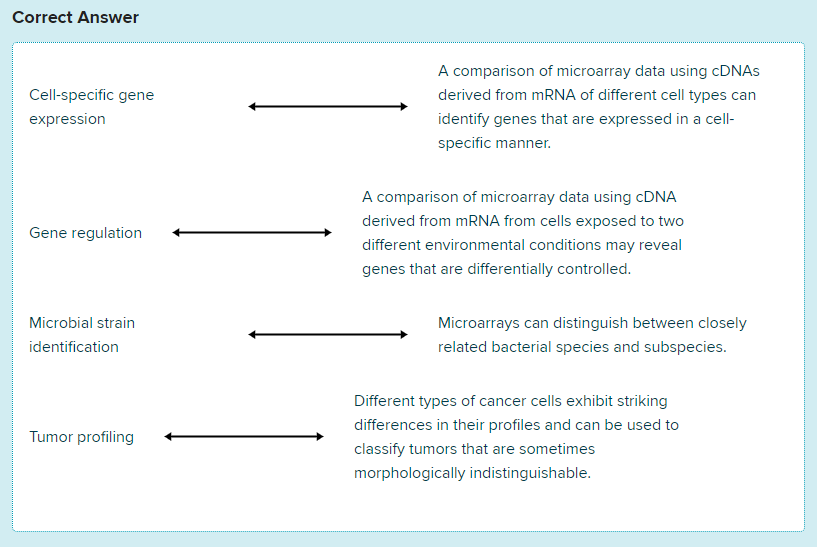
The DNA on a microarray slide is single-stranded.
Genes in living cells can be altered using an approach called CRISPR-Cas technology.
What technique can be used to identify which genes are transcribed by a specific cell? DNA microarray
In the CRISPR-Cas technique, the target gene is recognized by a single guide RNA.
The function of Cas9 in CRISPR-Cas technology is to make a double-stranded break in the target gene.
RNA-Seq is a method used to sequence complementary DNAs derived from RNAs.
Microarrays are successfully used in tumor profiling because cancer cells differ in their gene expression.
CRISPR-Cas technology is used to mutate genes.
The CRISPR-Cas9 technology is used to introduce breaks in target genes. A researcher can add a synthetic double-stranded segment of DNA that is homologous to the region where the break occurs. This homologous DNA is called the donor DNA. It can be swapped in by a double-crossover event, thereby introducing a specific mutation in the target gene.
Researchers have made a modification to the natural CRISPR-Cas system. They have created a(n) single guide RNA that binds to both the target gene and to the protein Cas9.
The replacement of missing or malfunctioning genes by the addition of new genes to a patient’s cells is known as gene therapy.
In CRISPR-Cas technology, the protein Cas9 makes a double-strand break in the target gene.
In 1999, a patient in a clinical trial died from an adverse immune reaction to gene therapy treatment.
In the CRISPR-Cas9 technique, a double-stranded break is made in the target gene. If the break is repaired by a process called end joining, the gene may incur a small deletion, which may inactivate the gene.
Methods that involve the introduction of a gene into a patient or altering a gene already inside a patient’s cells in an effort to treat or cure a disease are collectively called gene therapy.
One of the main challenges to gene therapy experiments is the inadvertent activation of cancer-causing genes.
Studying the genomes of bacteria provides insight into which of the following? Evolution, basic genetic mechanisms, and ways to combat bacterial infections.
How many base pairs are in one megabase pair (1 Mb)? 1 million
Most bacterial chromosomes are circular in shape.
In bacterial and archaeal genomes, 1 Mb of DNA contains approximately 1,000 genes.
In addition to chromosomes, bacteria often contain genetic material in plasmids, which are circular pieces of DNA that exist independently of the bacterial chromosome.
Why are researchers interested in the genomes of bacteria and archaea?
The information obtained can be applied to organisms with more complex genomes, including humans, bacteria are used as tools in research and biotechnology, and bacteria and archaea may provide insight as to how life has evolved since the first common ancestor.
With respect to their size, plasmids are smaller than the bacterial chromosome.
A bacterial chromosome is 5 Mb in length. How many base pairs does it contain? 5,000,000
Eukaryotic genomes are typically larger and more complex than those of their bacterial and archaeal counterparts.
Bacterial chromosomes are usually circular and double-stranded.
Why are researchers interested in sequencing eukaryotic genomes?
It makes it easier for researchers to identify and characterize the genes of model organisms, they can use this information to better identify and treat human diseases that are caused by mutation, they can use this information to develop breeds of livestock and crops with improved traits for greater yields, and the information can be used to better understand evolutionary relationships among organisms.
For prokaryotic species, each megabase pair of DNA encodes about how many genes? 1,000
The nuclear genome of eukaryotic species is usually found in sets of chromosomes that are linear in shape.
True or false: All of the genetic material of a bacterium is found in its chromosome.
Which eukaryotic organelles contain DNA? Mitochondria and chloroplasts
How does the size of a plasmid compare to the size of a bacterial chromosome? Plasmids are smaller than a bacterial chromosome.
Eukaryotic genomes contain more genes compared to bacterial and archaeal genomes.
Which type of genome is most complex? eukaryotic
An organism's genome size is the total amount of DNA, measured in megabase pairs.
Sequencing the genomes of eukaryotic species gives insight into evolutionary relationships among organisms and genes associated with human disease.
The genome found in the nucleus of eukaryotic species is usually organized in what way? Sets of linear chromosomes.
In general, the size of eukaryotic genomes is correlated with body complexity and cell complexity.
In addition to the nucleus, eukaryotic cells contain DNA in mitochondria and chloroplasts.
Eukaryotic genomes that are unusually large often contain a large proportion of repetitive sequences.
Which of the following statements is TRUE regarding the origin and evolution of homologous genes? They are introduced into the genome by gene duplication, and evolve as each version accumulates its own mutations.
The total amount of DNA, measured in megabase pairs, that a species has, is its genome size.
What are homologous genes? Two or more genes that are derived from an ancestral gene and so have similar functions.
What is the outcome of a misaligned crossover during meiosis? One chromosome with a gene duplication, one chromosome with a deletion, and two normal chromosomes.
The size of eukaryotic genomes varies widely, but in general, increases in genome size are correlated with increases in cell complexity.
Two closely related eukaryotic species may have very different genome sizes due to the presence of repetitive sequences.
Two or more homologous genes within a single species are known as paralogs.
Homologous genes are often the result of gene duplications.
Multiple gene duplication events followed by sequence divergence can result in a group of paralogs with different but related functions, known as a gene family.
Two or more genes that are derived from the same ancestral gene are known as homologous genes.
True or false: The sole objective of the Human Genome Project is to obtain the DNA sequence of the entire human genome.
If a misaligned crossover occurs during meiosis, what chromosome types will the four daughter cells inherit? Two normal chromosomes, one chromosome with a duplication, and one chromosome with a deletion.
Approximately how many base pairs in length is the human genome? 3.2 billion
What are paralogs? Homologous genes with the same species.
Due to the information gained from the Human Genome Project, researchers may be able to identify the genetic basis of common disorders.
How do gene families arise? Multiple gene duplication events followed by sequence divergence.
What are the goals of the Human Genome Project? Select all that apply.
To develop programs that address the ethical, legal, and social implications of the information obtained from the Project, to sequence the entire human genome, to analyze the genomes of model organisms, to develop technology for the generation and management of human genome information, and to identify all human genes.
What are the potential benefits of the Human Genome Project? Improved diagnosis and treatment of genetic diseases and identification of the genetic basis of common disorders.