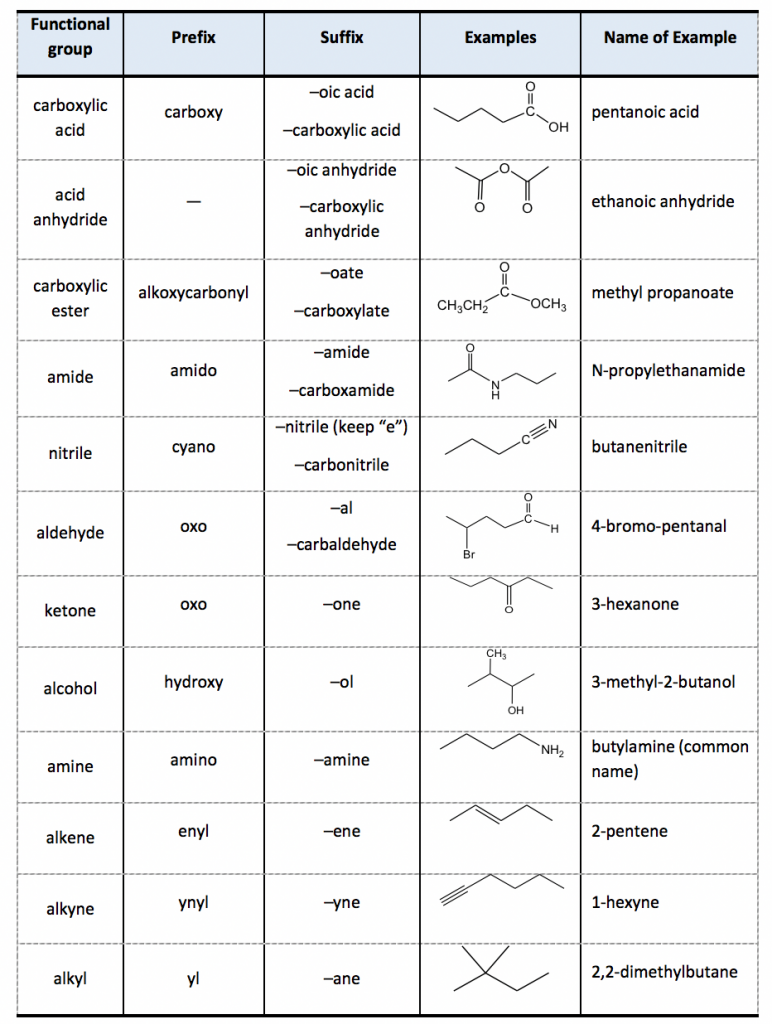
Functional Groups
stoic number = # of sigma bonds attached to atom + # of lone pairs attached to atom
= 4 —> sp3 hybridized
= 3 —> sp2 hybridized
= 2 —> sp hybridized
sigma bond = orbitals facing each other
pi bond = orbitals not facing each other (parallel)
acid base: kw = ka x kb
14 = pka + pkb
use to subtract pkb to find pka of other side. The higher pka is the weaker acid, which is favored, so that side (react or prod) is favored.
chiral: nonsuperimposable
center carbon, must have 4 bonds to 4 different groups attached
try taking mirror image to check
enantiomers: stereoisomers that are mirror images of each other
stereoisomers: isomers that differ in the 3D arrangement if atoms
# of stereoisomers = 2^n where n = # of chiral centers
when drawing enantiomers, you can do 2 things
change dashes to wedges, and wedges to dashes and leave to og shape
draw the mirror image of the enantiomer
have same magnitude but different direction of rotation of polarized light
rotate plane of light in equal/opposite direction
clockwise - dextrorotary (d/D/+).
counter - levorotatory (l/L/+).
specific rotation [a] = (a(observed))/(c*l).
where c = concentration (g/mL).
where l = path length
racemic = 50:50 with no overall rotation: notation is (d,l)
form when achiral species react to give chiral product
can ingold prolog convention: each chiral center is assign and absolute configuration R(clock), S(counter)
ID chiral center
assign priority to groups
rotate so lowest priority (usually H) is at the back
draw arrow from 1st priority to 3rd.
if arrow went clockwise - assign configuration R, if arrow went counter - assign configuration S
Double bond becomes 2 single bonds to the same atom, triple becomes 3 single bonds
newman projections: looking down a molecule
dot represents front carbon
circle represents back carbon
stablest = lowest energy = gauche interractions (staggered)
unstablest = highest energy = eclipsed (aligned with one another)
hammond postulate: species similar in energy and structure have transition states that more closely resembles the structure of the closest stable species.
exo resembles reactants
end resembles products
bromination is endo
chlorination is exo
free radicals:
carbon: sp2, single e- in p orbital, less than octet - electron deficient - 3º H is most stable
carbocations: completely empty p orbital - electrophilic/ strong acids - 3º H is most stable
carbanions: sp3, sp2, or sp, lone pair in one hybrid - formal (–) charge - nucleophiles/strong bases - Methyl is most stable
all single bonds (sigma)
ex: (linear)
methane (1 C) - CH4
ethane (2 C) - C2H6
propane (3 C) - C3H8
butane (4 C) - C4H10
once exceded 6 carbons, there is a broader amount of ways to arrange the atoms
nomenclature:
Step 1: Number the carbons - first substituent should be closest to #1
Step 2: Note the position of each substituent - List First!
ex: substituents are at carbons 3 and 5: list by saying 3, 5
Step 3: determine prefix (di, tri, tetra, penta, hexa, hepta, octa…) by how many of each substituent there are - List Second!
ex: two of the same substituents: di
Step 4: identify substituents (by # of Cs: 1=methyl, 2=ethyl, 3=propyl/isopropyl, 4=butyl/isobutyl/secbutyl/tertbutyl).
is iso when 3 carbons connected to one central
root: # of C in longest chain -
1: meth
2: eth
3: prop
4: but
5: pent
6: hex
7: hept
8: oct
9: non
10: dec
diastereomers = double bonds
not mirror images
Multiple chiral centers:
dif configuration at each center = enatiomers
Dif at some = diastereomers
max # of diastereomers = 2^n
Meso compound: achiral
plane of symmetry
mirror images
not enatiomers