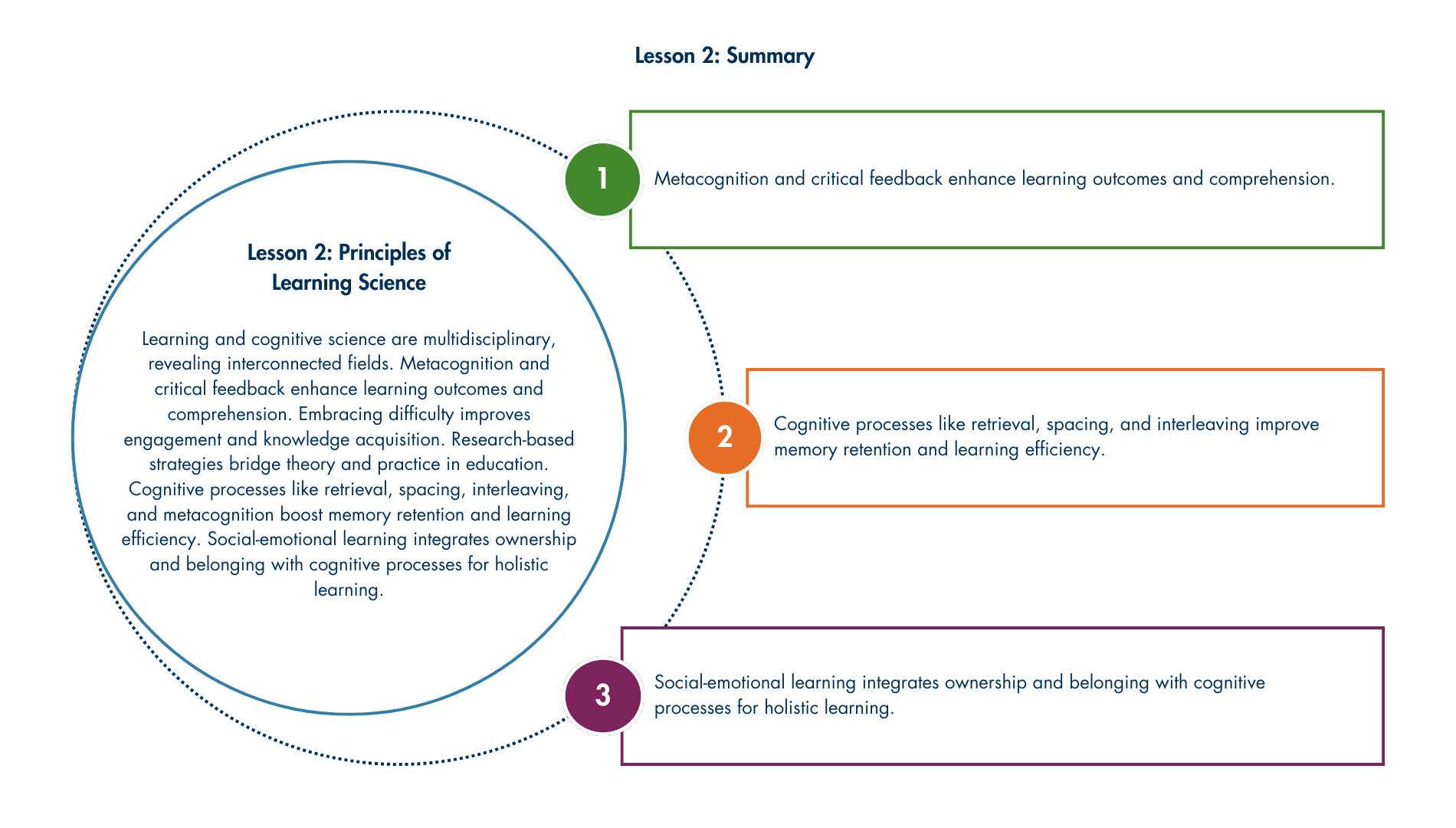
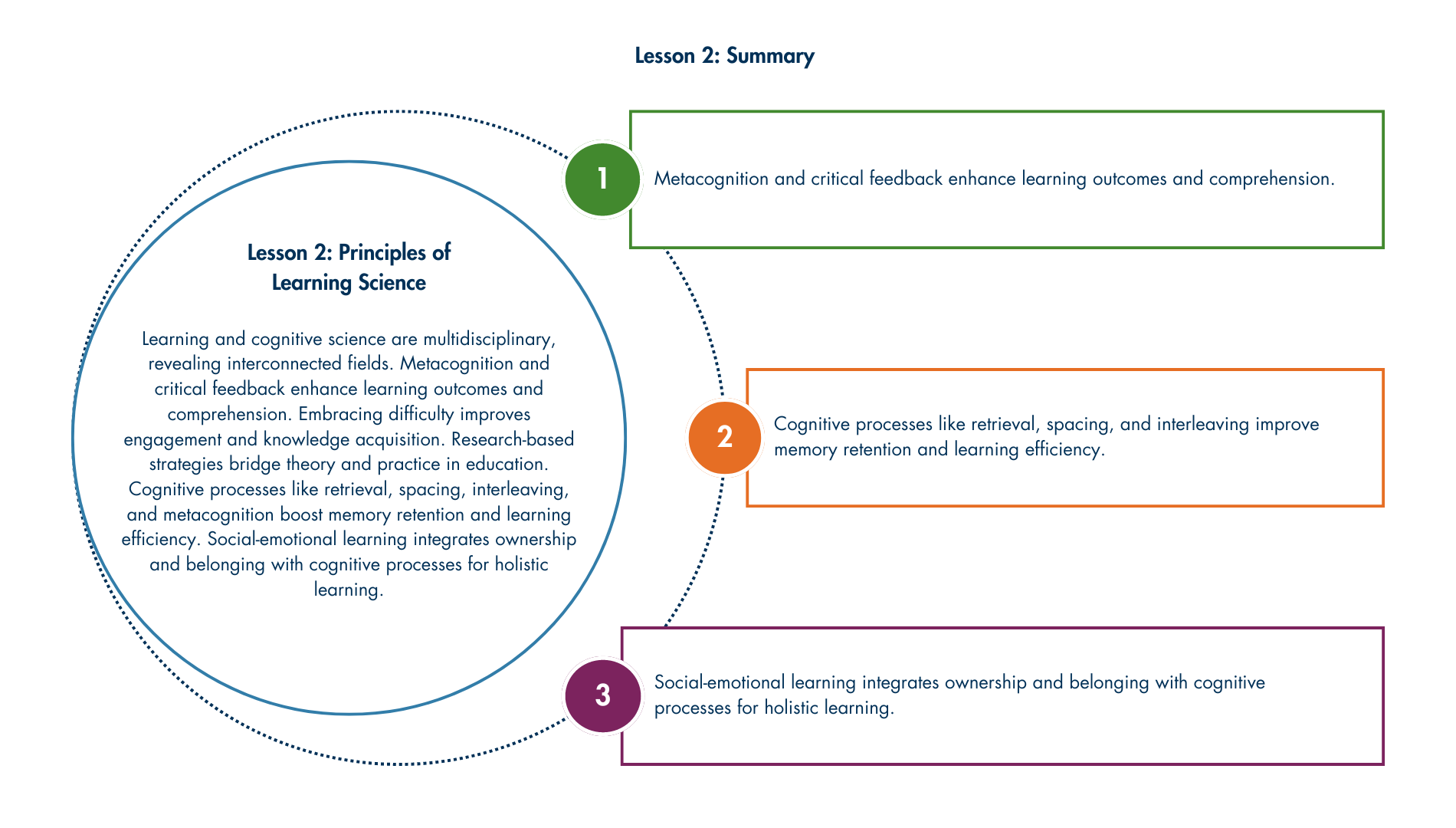
Principle of Learning science
Encoding, Storage, and Retrieval
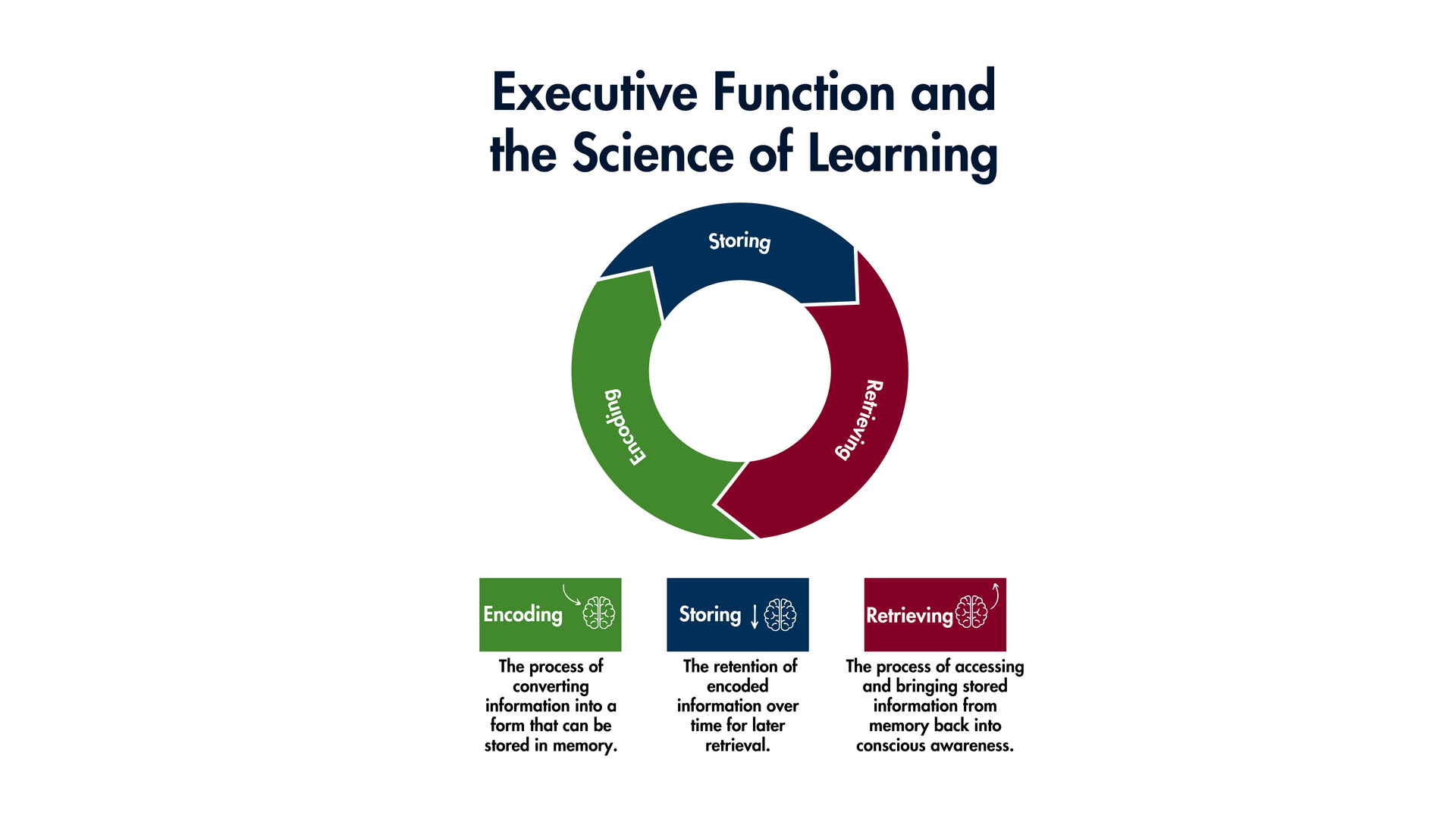
To better understand how we learn and remember things, it is important to know how different parts of our brain work together. This helps us grasp the basic stages of encoding, storage, and retrieval in the learning process.
Encoding refers to the initial processing of information, where sensory input is transformed into a form that the brain can store and use.
Storage involves retaining this encoded information over time, while retrieval is the process of getting stored information when needed.
Feedback plays a vital role in refining our learning strategies by providing information about our performance, guiding future actions.
Metacognition, on the other hand, involves awareness and understanding of one's thinking processes, enabling learners to monitor and regulate their learning effectively.
The relationships among encoding, storage, retrieval, and metacognition interact to allow effective learning.
Learning Strategies
In cognitive psychology, scientists investigate how the mind functions, focusing on how we learn, remember, perceive, and solve problems. This field significantly influences education by providing insights into these cognitive processes, which are essential for developing effective teaching strategies and enhancing learning outcomes. Topics such as perception, memory, language, and reasoning are particularly important, as they help educators understand how students process information and apply it to problem-solving in educational settings. This field deeply influences classroom teaching, helping educators understand effective strategies for student learning. By applying principles from cognitive psychology, teachers can improve learning experiences for their students. For example, in your own classroom, you might incorporate strategies like retrieval practice, spacing, interleaving, and feedback-driven metacognition to enhance learning outcomes. See table 1.1 for explanations and examples of these strategies.
Table 1.1. Learning Strategies
Strategy | How It Works | Example |
Retrieval Practice | actively recalling information from memory, such as answering questions or completing quizzes, which strengthens long-term retention | Instead of just re-reading notes, students practice recalling information without looking at their materials. |
Spacing | spacing out study sessions over time rather than cramming all at once, which promotes better retention and understanding | Rather than studying for six hours the night before a test, students might study for one hour each day over six days. |
Interleaving | mixing up different types of problems or topics during study sessions, which enhances learning by promoting deeper understanding and transfer of knowledge | Instead of practicing one type of math problem at a time, students might practice a mix of addition, subtraction, multiplication, and division problems. |
Feedback driven Metacognition | using feedback from assessments and evaluations to reflect on and regulate one's own learning strategies and understanding | After receiving feedback on an essay, a student reflects on areas for improvement and adjusts their writing strategies accordingly. |
These challenges can enhance student engagement, motivation, and long-term retention of information. When students encounter manageable difficulties, such as through retrieval practice, spaced practice, or interleaving, they are forced to engage more deeply with the material, leading to stronger learning outcomes. Desirable difficulty refers to introducing challenges or obstacles during learning that are neither too easy nor too difficult but just right for learning. By embracing desirable difficulty in the classroom, educators can create learning environments that foster resilience, critical thinking, and mastery of complex concepts.
This approach not only promotes a growth mindset but also empowers students to take ownership of their learning journey, as they become more adept at identifying their strengths and weaknesses.
Learning and Science
When we study learning science, we learn how our brains gather and retain information. Learning science, also known as the science of learning, explores how the human brain acquires and processes information. It draws from various fields, such as neuroscience, cognitive psychology, and education, to understand how people learn best. Research-based best practices are teaching methods and strategies that have been scientifically proven to enhance student learning and achievement. These practices are informed by evidence from studies conducted in educational research and learning science and are also called evidence-based practices.
One area of focus within learning science is executive function, which refers to the set of mental skills that help individuals plan, focus attention, and remember instructions successfully. Executive function plays a crucial role in academic success as it enables students to manage their time effectively, regulate their emotions, and make sound decisions. For example, teaching students organizational skills, such as using planners or digital calendars, can help them manage their assignments and deadlines more efficiently, thereby improving their executive function.
Research-based best practices impact classroom teaching by providing educators with evidence-based strategies and practices to improve student learning. For instance, incorporating retrieval practice into classroom activities, such as regular quizzes or review games, helps students strengthen their memory and recall of information. Similarly, spacing out learning sessions over time instead of cramming before exams improves long-term retention of material. By matching instruction with these best practices, teachers can create a supportive learning environment that promotes student engagement, critical thinking, and academic success.
Below are ways that executive function can support student learning:
Planning | Helps student break down tasks into manageable steps, set goals, and create a timeline for completing assignments. |
Working memory | Allows student to hold information in mind while completing tasks, such as remembering instructions or key concepts during a test. |
Self-regulation | Helps student manage emotions, stay focused, and control impulses, leading to better behavior and academic performance. |
Organization | Enables student to keep track of assignments, materials, and deadlines, leading to improved time management and productivity. |
Flexibility | Allows student to adapt to changes in routine or unexpected challenges, leading to better problem-solving skills and resilience. |