A.2.2.1 Macronutrients
What is food important for?
Food is required because every organism needs to keep taking it in and breaking it down to resupply itself with the materials it needs to survive and provide energy.
What is the relationship between nutritional requirements and health?
The food we consume has a specific nutritional value, which we follow as our body requires particular requirements to maintain itself and remain functioning. The nutrients that they provide are important continuing factors because they result in influencing our growth, development, functional abilities and health
What do we mean by the terms undernourishment, malnutrition, and over-nutrition and how can these affect health?
Undernourishment: not receiving enough food to continue
Malnutrition: an unbalanced diet and not eating enough of a quantity of food
Over-nutrition: the intake of nutrients is oversupplied
Micro and Macronutrients
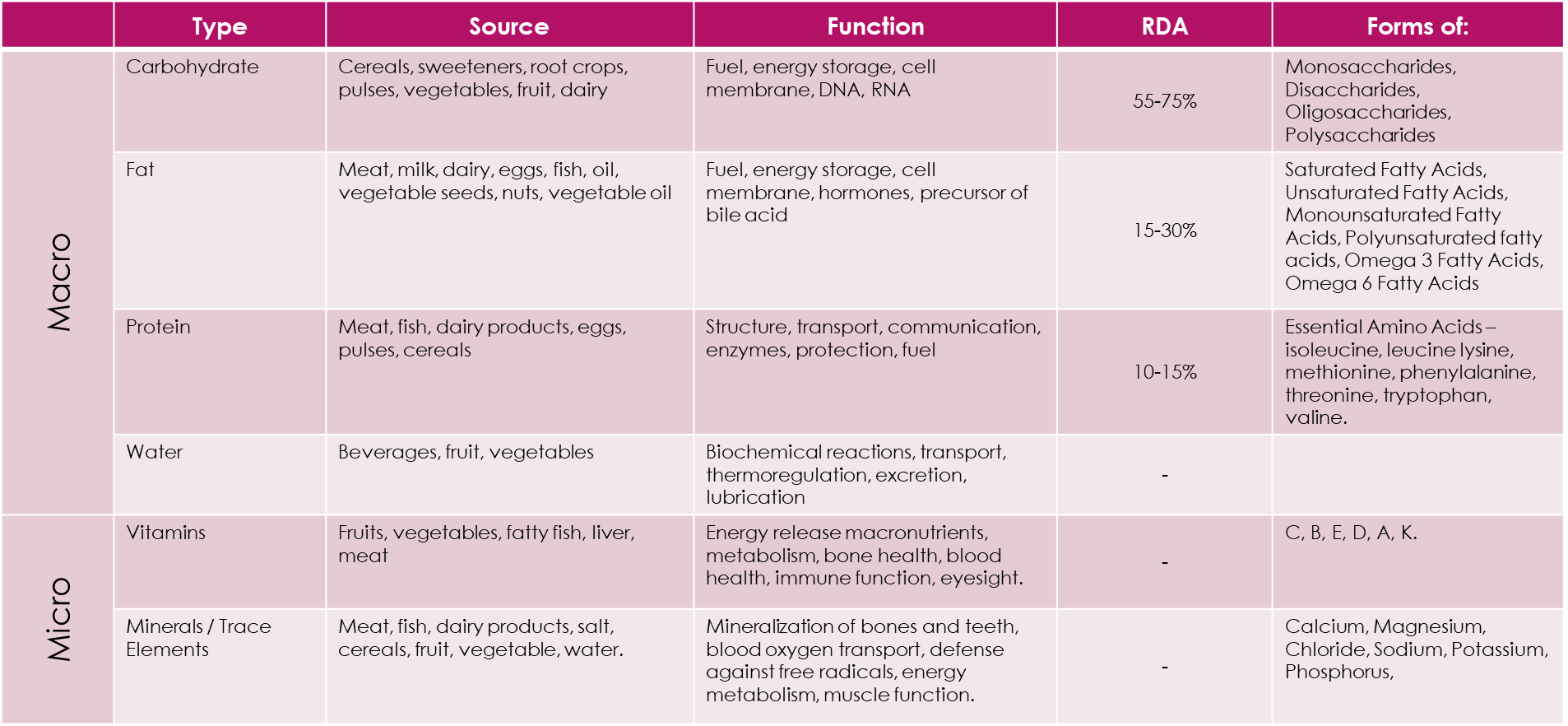
| Type | Source | Function | RDA | Forms of: |
Macro | Carbohydrates (mono/polysaccharides) | Cereals, sweeteners, root crops, pulses, vegetables, fruit, dairy products | Fuel, energy storage, cell membrane, DNA, RNA | 55-75% | Monosaccharides, Disaccharides, Oligosaccharides, Polysaccharides |
| Fat (lipids) | Meat, milk, dairy, products, eggs, fish oil, vegetable seeds, nuts, vegetable oil | Fuel, energy storage, cell membrane, hormones, the precursor of bile acid | 15-30% | Saturated Fatty Acids, Unsaturated Fatty Acids, Monounsaturated Fatty Acids, Polyunsaturated fatty acids, Omega 3 Fatty Acids, Omega 6 Fatty Acids |
| Protein (amino acids) | Meat, fish, milk, dairy products, eggs, pulses, cereals | Structure, transport, communication, enzymes, protection, fuel | 10-15% | Essential Amino Acids – isoleucine, leucine lysine, methionine, phenylalanine, threonine, tryptophan, valine. |
| Water (H2o) | Beverages, fruits, vegetables | Biochemical reactions, transport, communication, enzymes, protection, fuel | - |
|
Micro | Vitamins | Fruits, vegetables, fatty fish (such as salmon, and mackerel) fish oil, liver, meat | Energy releases macronutrients, metabolism, bone and blood health, immune function, and eyesight. | - | C, B, E, D, A, K. |
| Minerals / Trace Elements | Meat, fish, milk, dairy products, salt, cereals, fruits, vegetables, water | Mineralization, of bones and teeth, blood oxygen transport, muscle function, maintenance of acid-base balance, cellular fluid balance | - | Calcium, Magnesium, Chloride, Sodium, Potassium, Phosphorus, |
What are the energy content values per 100g?
Carbohydrates: 1760kJ
Lipids: 4000kJ
Protein: 1720kJ
Adipose tissue is a type of connective tissue in the body that stores fat. It plays a crucial role in energy storage, insulation and protection. Found under the skin, bone marrow or around internal organs
Lipids
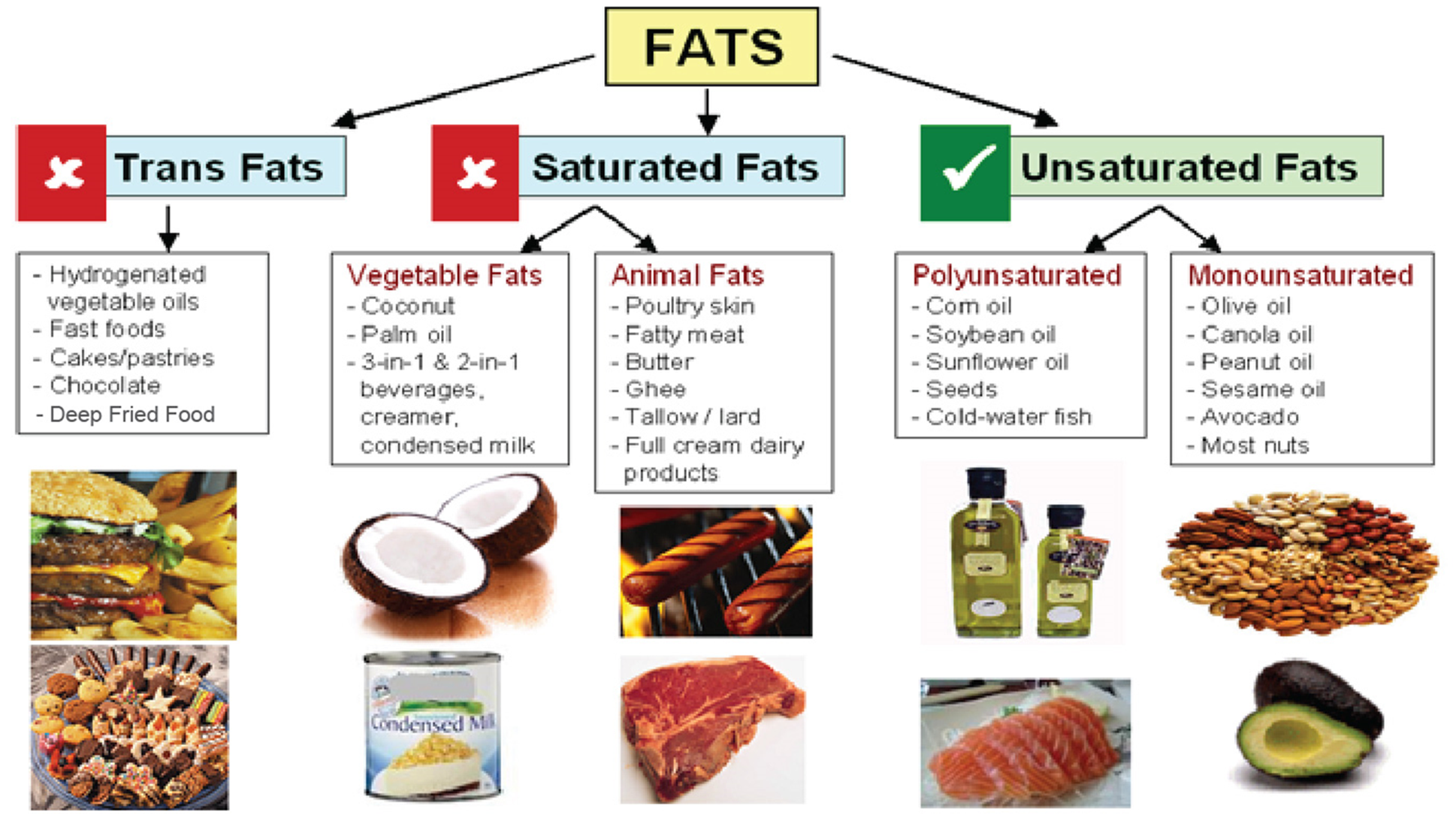
There are two types of fats:
Saturated
Unsaturated
1. Saturated Fats
Only single bonds between the carbon atoms
Saturated with hydrogen
Bad fats = lead to heart diseases
Solid at room temp
Found in animal fats and tropical oils
2. Unstarurated Fats
Missign hydrogen results in double bonds between carbon
Liquid at room temperature
Good fats reduce the number of LDL (cholesterol)
Plant-based Fats
Trans Fats
Man-made fats in a lab we take hydrogen out whilst maintaining the chains straight which will increase the shelf life of foods.
They are worse than saturated fats even though they are a type of unsaturated fat
Amino Acids
Function: growth, maintenance, repair of tissues, making enzymes, hormones and antibodies
It is made up of C, H, O and Nitrogen
Its functions can be broken into 4 groups:
Structural
Support and shape for the body
Muscles, bones and skin
Protective
Defend agasint threats
Antibodies: fight infections
Mucus: traps pathogens
Transport
help in carrying substances and sending signals
Examples are plasma proteins, hormones, receptors and neurotransmitters
Enzymatic
Speed up chemical reactions in the body
There are two types of amino acids
Essential
Non-essential
1. Essential
You must have these to live
There are 9
Cannot be synthesized by the body
Obtained through diet
2. Non-Essential
It is important for building proteins but not essential in your everyday diet
11 main non-essential amino acids
Can be synthesized by the body
8 are conditional meaning the body is not capable of producing enough of them when presented with stress or illness