influence of others
<<PART 1<<
PRESENCE OF OTHERS
Norman Triplett :: participants would work faster when surrounded w others (cyclists, children w string)
co-actor :: another individual performing the same task
audience :: a group of ppl watching an individual perform a task
social facilitation :: the inc performance that occurs in the presence of co-actors or an audience
Robert Zajonc :: presence of others = inc arousal; simple tasks = performance enhanced, complex tasks = performance hindered
SOCIAL LEARNING THEORY
social learning theory :: we learn appropriate behaviours by modelling and imitating the behaviour of others
Albert Bandura :: Bobo doll experiment- if adults played aggressively the kids are likely to play aggressively too. their behaviour was influenced by others. monkey see, monkey do
CONFORMITY
norms :: unwritten but commonly accepted rules for how to behave
autokinetic effect :: a staionary light in a pitch black room will appear to move about randomly bc the dot of light against a uniform dark bkg, you mistake the movement of the image on you retina as actual motion of the light
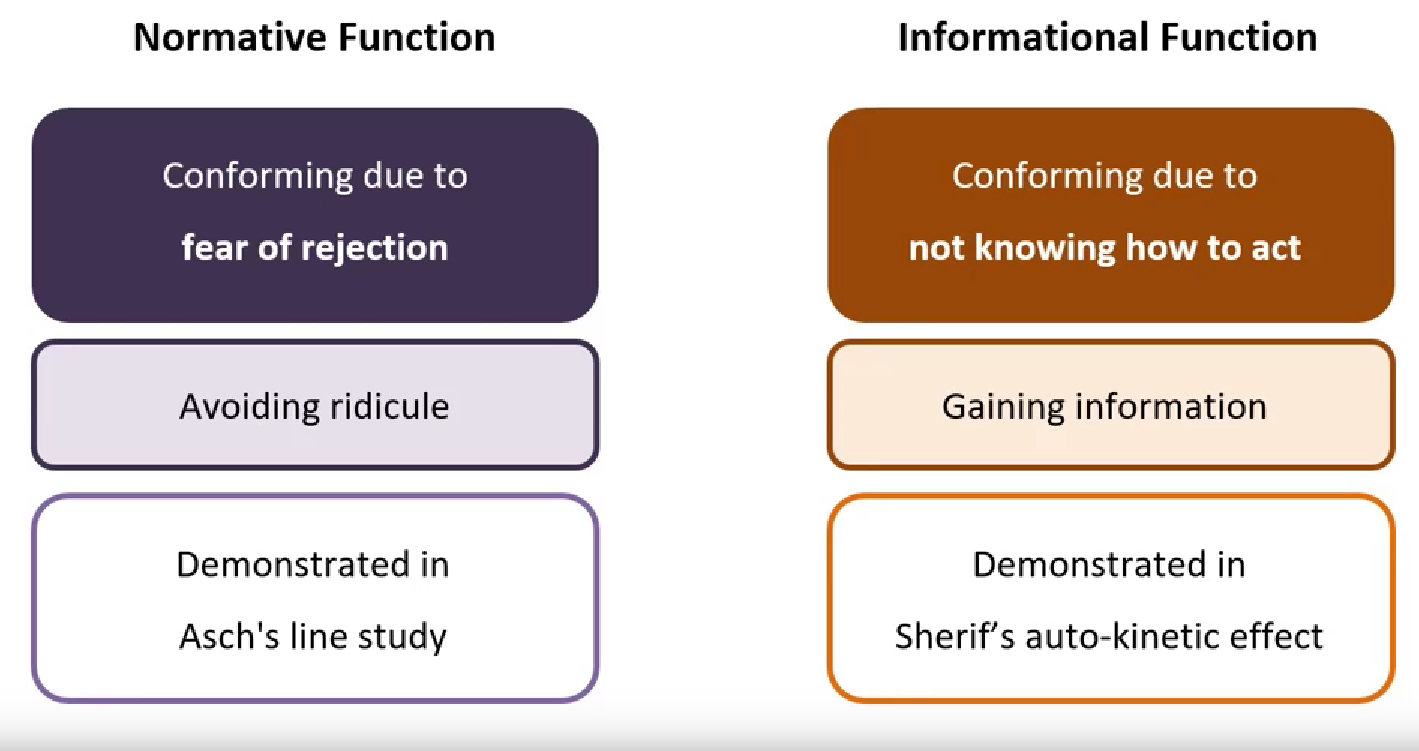
Muzafer Sherif :: did experiment w autokinetic effect. when in a room w other participants the responses to how much the dot moves will converge despite having a drastically different starting points
norm formation :: when a norm forms; convergence is an example of this
Solomon Asch :: asked a group which of the comparison lines does the sample line match with. real participant is the 6th + they would sometimes conform with the incorrect answer of the rest of the group
normative function :: the role of others in setting standards for our conduct based on a fear of rejection. (ex. fashion, peer pressure)
informational function :: the role of others in providing information abt an ambiguous situation
Deutsch & Gerard :: line test in cubical, anonymous. lights in front participant showed the answer of other participants. normative function does not apply. participants still went along w the wrong answers of the rest of the group on a number of trials, esp when the answer was less clear
GROUP DYNAMICS
James Stoner :: studied the ‘risky shift’ effect. gave groups scenarios + had them choose the lowest acceptable probability of success. surprisingly groups accepted a lower probability of success than the mean decision of the individuals before the group decision
risky shift effect :: suggests that groups are either always more risky or less risky that individuals depending on the situation
group polarization :: group decision making tends to lead to more extreme views by strengthening the original inclinations of the individual group members
groupthink :: Janis Irving. a group decision making environment that occurs when a group cohesiveness becomes so strong it overrides realistic appraisals of reality and alternative opinions (mob mentaility)
preventing groupthink :: 1) be impartial. 2) Critical evaluation. Devil’s advocate. 3) Subdivide the group. 4) Provide a second chance
BYSTANDER EFFECT
questions to ask before deciding to act :: 1) is it truly an emergency? 2) if yes, should I be the one to respond?
Latane & Darley :: individual vs group in a room w smoke seeping in. Also individuals in talking in a group talking over an intercom. Pluralistic ignorance + diffusion of responsibility
pluralistic ignorance :: when each individual in a group sees nobody responding in a given situation, they conclude that the situation is not an emergency
diffusion of responsibility :: in deciding whether we have to act, we determine that someone else in the group is more qualified 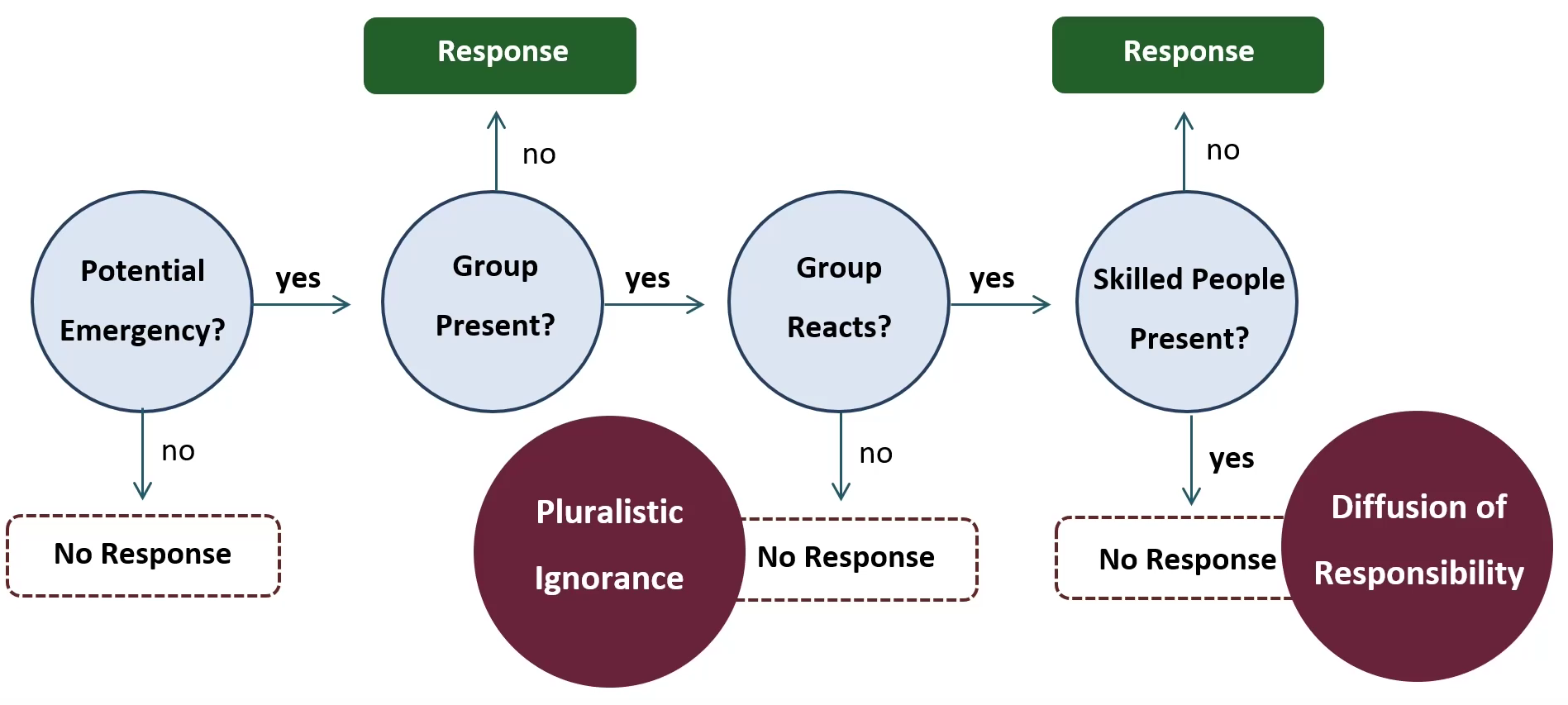
direct :: when seeking help in an emergency it is best to be ________
contagious :: helpful behaviour is _________
social loafing :: individuals seem to be less motivated when working a group than when working alone
<<PART 2<<
OBEDIENCE
other factors of milgram’s study :: distance bw the subject and the individual they were harming; they way the experimenter was dressed; the proximity of the experimenter to the teacher
bad :: milgram’s study also shows that people are ____ judges at predicting their behaviour
COGNITIVE DISSONANCE
cognitive dissonance :: a state of psychological discomfort brought on by conflict bw a person’s attitude and their behaviour
justification :: can ease dissonance
THE STANDFORD PRISON EXPERIMENT
deindividuation :: in a group situation, the loss of a sense of personal responsibility and restraint
PERSUASION
similarity to audience :: according to Goethals and Nelson, similarity to audience is the most important criterion for persuading someone to change their lifestyle choice
one-sided argument :: effective when audience is already leaning towards your position
two-sided argument :: effective when audience initially disagrees w your position
central appeal :: well reasoned, factual, two-sided arguments. Effective for academic audiences
peripheral appeal :: well presented, easy to understand messages. Effective for non-academic audiences
TECHNIQUES IN PERSUASION
foot in the door technique ::a request that seems outrageous in isolation, is seen as being less unreasonable if it follows previous requests of escalating magnitude
low-ball technique :: an escalation of the terms of an agreement after someone has already agreed to comply
<<CHAPTER 10: INFLUENCE OF OTHERS<<
self-perception theory :: proposed by Bem. Indicates that we don’t necessarily hv a special insige into outselves. we sometimes hv to figure out who we are in a way that is similar to how we gigure out who others are are\; by assessing behaviour
inc in price :: an ______________ of an luxury item can make them more appealing by drawing on a desire for respect + adimiration
door-in-the-face technique :: start by asking for soemthing completely unreasonable + then greatly scale back your request