2.17 Light-Trapping Pigments
Photosynthesis:
Chloroplasts convert light energy into glucose
Overall reaction:

Photosynthesis occurs in two stages:
Light Reactions in the thylakoid of chloroplast
Calvin Cycle in the stroma of chloroplast
Cross-section (two-dimensional representation) of leaf shows photosynthetic cells
contain chloroplasts
Cross-section of chloroplast shows thylakoid membrane system and stroma (surrounding fluid)
Structure of Chloroplast
Thylakoid
flattened discs that contain chlorophyll
Stroma
central cavity with enzymes and a suitable pH
Grana
thylakoids in flat stacks to increase SA:Vol ratio
Light-Trapping Pigments
Photosynthetic pigments capture energy from photons of sunlight
Photons - packets of energy that have properties of particles and waves
Have a characteristic wavelength (distance covered in one cycle of wave
Most energetic photons travel at shorter wavelength
ROYGBIV
red has the least amount of energy
violet has the most amount of energy
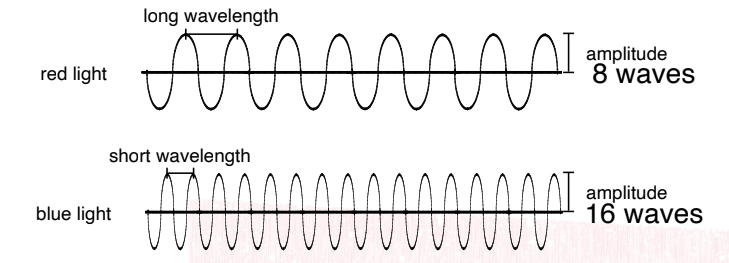
Compare red light (long wavelength) and blue light (short wavelength)
Although amplitude of each wave is the same
Many more waves per unit time for blue light
we’ll have to know how to draw and label the electromagnetic spectrum
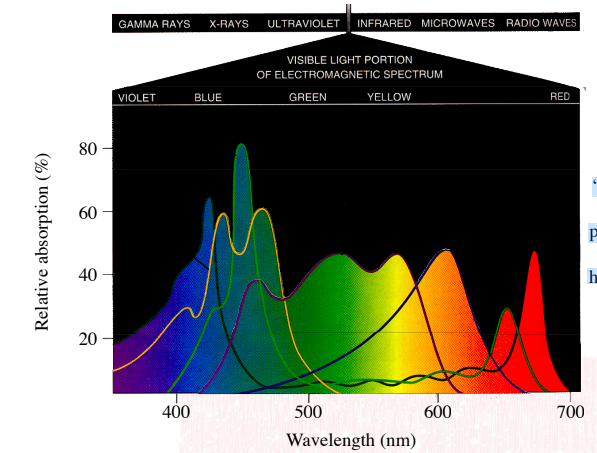
Photosynthetic pigments are sensitive to specific ranges of spectrum
Electrons within pigment are excited by a specific wavelength of light
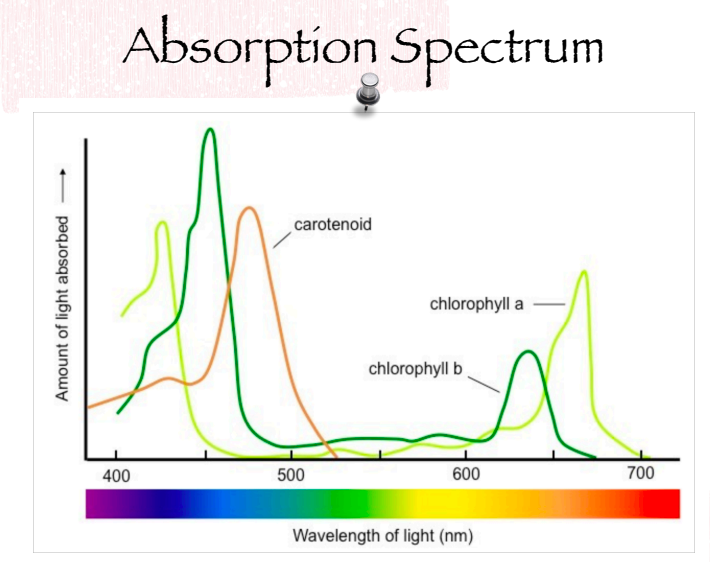
Carotenoids absorb some blue and green wavelengths
Phycobilins absorb most of green, yellow and orange wavelengths
In autumn, chlorophylls breakdown revealing presence of other pigments
Chlorophyll a and chlorophyll b absorb blue and red wavelengths, while
reflecting and transmitting middle of spectrum (green and yellow)
Leaves appear green because “chlorophylls” are most abundant pigments, but other pigments are hidden beneath this overpowering green colour
what plants absorb to use photosynthesis/why are they green - test
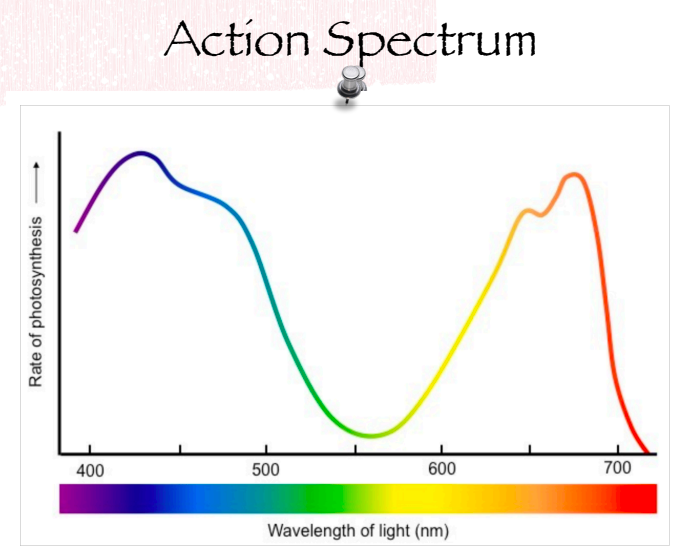
 IB will ask the difference between Absorbtion & Action Spectrum
An action spectrum shows the wavelengths of light used for photosynthesis