Topic 3: Personality, Values and Motivation
Learning outcomes
Describe personality, the way it is measured, and the factors that shape it.
Describe the Myers-Briggs Type Indicator (MBTI) personality framework the Big Five model, and describe their strengths and weaknesses.
Identify the 3 traits of the Dark Triad and describe the contrasting ideas of the approach-avoidance framework.
Discuss how the concepts of core self-evaluation (CSE), self-monitoring, and proactive personality contribute to the understanding of personality.
Describe how the situation affects whether personality predicts behaviour.
Describe the differences between person-job fit and person-organization fit.
Topic flowchart:

What is personality?
Personality = the sum of ways in which an individual reacts to and interacts with others
Most often described in terms of measurable traits that a person exhibits such as shy, aggressive, submissive, lazy, ambitious, loyal, and timid
*Note: If someone displays cognitive dissonance, this can affect our perception of their personality, as it may lead to inconsistencies between their thoughts, feelings, and behaviours.
What determines personality?
Genetics:
Personality reflects heredity and environment with heredity being the most dominant factor.
Environmental factors do have some influence → many aspects of personality can be shaped by experiences, cultural background, and social interactions.
Aging influences levels of ability however basic personality is constant.
In the book “Blueprint” by Robert Plomin, it suggests that all psychological traits show significant genetic influence (Typically account for 50-70% of the variation).
In Twin studies: genetics more influential than parents.
Parenting account for close to 0% of the variation (although abusive parenting is known to cause problems).
Other non-family environmental factors that explain the rest of the variation are more akin to random events in our lives.
Since 2010s, inexpensive tests have set off a wave of definitive studies linking specific combinations of genes (polygenic scores) with psychological traits.
How is personality measured?
Self-report surveys → most common method, error-prone as people can answer based on how they wish to be perceived, evaluate a series of statements to gauge an individual's traits and tendencies.
E.g. The Big-Five Model → where traits show a strongly supported relationship to job performance.
What are the 5 traits examined in the The Big-Five Model?
Extraversion
Agreeableness
Conscientiousness - the quality of wishing to do one’s work or duty well and throughly
Emotional Stability
Openness to Experience
Why are these 5 traits relevant and what aspects of worklife do they affect ?
Extraversion → linked with better interpersonal skills, greater social dominance and are generally more emotionally expressive → (in the workplace) linked with higher performance, enhanced leadership, higher job and life satisfaction.
Agreeableness → usually workers are better liked and more compliant & conforming → (in the workplace) can lead to higher performance & decreased levels of disobedient / devious behaviour.
Conscientiousness → workers demonstrate greater drive, discipline, effort and persistence with better organisation and planning → (in the workplace) workers display higher performance, enhanced leadership and better retention.
*however greater levels of perfectionism can sometimes lead to increased stress and anxiety, potentially hindering collaboration and innovation within teams.
Emotional stability → less pessimistic with lower hyper vigilance → (in the workplace) linked with higher job and life satisfaction and lowered stress levels.
Openness → higher levels of learning, more creative, more flexible & autonomous → (in the workplace) employees are easily trainable, adaptable to change and show higher leadership qualities.
Personality and Situations
- The effect of traits on organisational behaviour depends on the situation
Situation strength theory = the way personality translates into behaviour depends on the strength of the situation.
Analyse situation strength in terms of:
Clarity
Consistency
Constraints
Consequences
Trait activation theory (TAT) = predicts that some situations, events or interventions “activate” a trait more than others.
e.g. i.e. someone who works in a independent environment may seem introverted but in times of networking/ team activities may thrive and dominate in the conservation as they are actually high in extraversion.
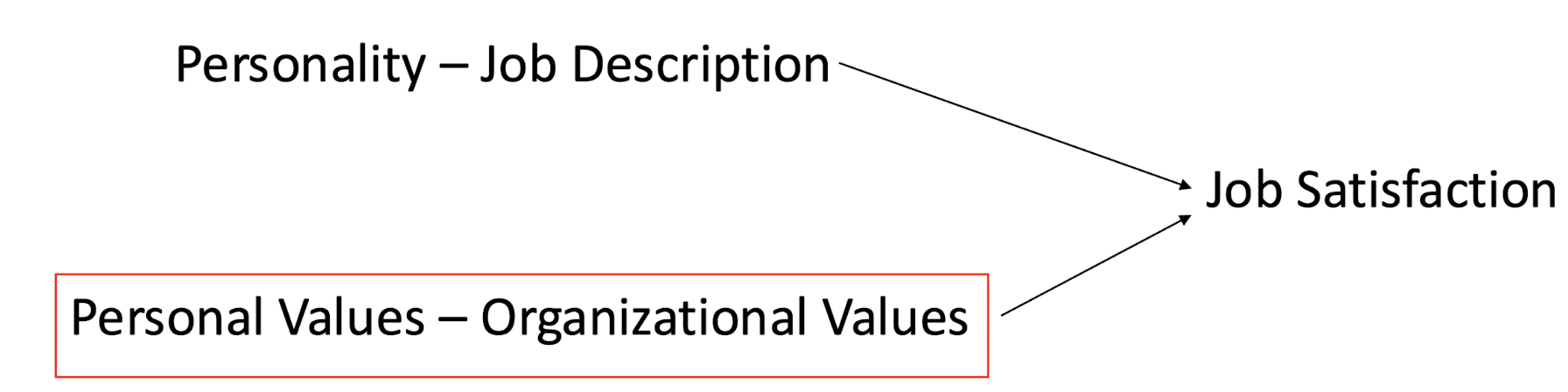
Personality-Job Fit
→ where the a person’s personality fits the demands of the job description and thus leads to higher job satisfaction
However Personality-organisation Fit is often more important as the organisational culture can directly influence an individual's effectiveness and satisfaction, fostering a sense of belonging and alignment with shared values.
E.g. If the values deeply conflict with your own, this can lead to burnout, and disengagement in their work
i.e. someone who is working in fast-fashion retail but are highly environmentally conscious themselves will feel a conflict in their values, potentially leading to lowered job satisfaction
How can an organisation apply knowledge of personality & values when constructing a team ?
• Consider screening via conducting personality tests for job candidates
• Use personality tests in training and development to help employees better understand themselves and team members, and facilitate communication
• Evaluate your employees’ jobs, their work groups, and your organisation to determine the optimal personality fit
• Account for employees’ situational factors when examining their behaviour.
• Lower the situation strength to better ascertain personality characteristics
• Find a good match for the team/company values
Motivation
What is motivation?
Motivation = The processes that accounts for an individual’s intensity, direction, and persistence of effort toward attaining an organisational goal
Dictated by:
Intensity = the amount of effort put forth to meet the goal
Direction = efforts are channeled toward organisational goals
Persistence = how long the effort is maintained
What is Maslow’s Hierarchy of Needs Theory?
= It is a psychological framework that categorises human needs into 5 levels, often depicted as a pyramid, ranging from basic physiological needs at the bottom to self-actualisation at the top.
The 5 levels include:
Physiological Needs: The most basic human needs such as food, water, and shelter.
Safety Needs: Security and protection from physical and emotional harm.
Love and Belongingness Needs: Social needs including relationships, friendships, and a sense of community.
Esteem Needs: The need for respect, self-esteem, and recognition from others.
Self-Actualisation Needs: The desire to achieve personal growth and fulfill one's potential.

What is Self-Determination theory?
= People prefer to have control over their actions so when they feel they are forced to do something they previously enjoyed, motivation will decrease
E.g. in Marcia’s case in the slides
“It’s strange,” said Marcia. “I started work at the Humane Society as a volunteer. I put in 15 hours a week helping people adopt pets. And I loved coming to work. Then, 3 months ago, they hired me full-time at €18 an hour. I’m doing the same work I did before. But I’m not finding it nearly as much fun.”
This case shows that intrinsic motivation can diminish when a passion becomes a job, highlighting the importance of aligning personal values with professional responsibilities.
Cognitive evaluation theory = Proposes that the introduction of extrinsic rewards for work (pay) that was previously intrinsically rewarding tends to decrease overall motivation
Self-concordance = considers how strongly people’s reasons for pursuing goals are consistent with their interests, personality and core values
What is goal setting theory and how is it related to motivation?
= Goals increase performance when they are specific, difficult and accepted by employees demot
When employees are committed to these goals, they are more likely to be motivated to achieve them, leading to a greater sense of accomplishment and intrinsic satisfaction.
What is management by objectives (MBO) ?
= Converts overall organisational objectives into specific objectives for work units and individuals → decreasing the workload on certain employees, creating an even distribution of tasks among team members, and enhancing accountability and clarity in performance expectations.

Why is self-equity theory often the root cause of an employee’s lowered performance?
Self-efficacy theory = An individual’s belief that he or she can perform a task
*A.K.A social cognitive theory or social learning theory
Self-efficacy increased by:
1. Enactive mastery: gain experience which reduces fear associated with a task.
2. Vicarious modelling: see someone else do the task
3. Verbal persuasion: someone convinces you that you have the skills
4. Arousal: get energised
How is Equity-theory related to employee performance / motivation?
Equity theory: Employees weigh what they put into a job situation (input) against what they get from it (outcome)
They compare their input-outcome ratio with the input-outcome ratio of relevant others

How is Expectancy-theory related to employee performance / motivation?
Expectancy theory = posits that employees are motivated to act in a certain way based on the expectation that their efforts will lead to desired outcomes, linking the effort they put into their work directly to the performance they achieve and the rewards they receive.
Seen in 3 relationships:
Effort-performance relationship
Performance reward relationship
Rewards-personal goals relationship
