Gas exchange
Def: The exchange of gases between an organism and its surroundings (i.e humans and the air), including the uptake of oxygen and the release of carbon dioxide.
How are multicellular organisms adapted to carry out gas exchange?
Gas exhange in humans
All cells need:
Oxygen
Carbon
Water
Minerals
Amino acids
Carbohydrates: sugar
All cells need to respire: 6O2 + C6H12O6 → 6CO2 + 6H2O
Volume of an organism = reflection if metabolic need to exchange respiratory gases.
Surface to volume ratio
Gas exchange surfaces need:
To be thin
To be large
To be moist
Branches in lungs and internal gills create a larger surface area for gas exchange.
Animals in water are cold blooded - there is not enough oxygen in water to sustain warm-blooded organisms.
When we do exercise: Chest cavity widens, more alveoli develop to allow for more air passage
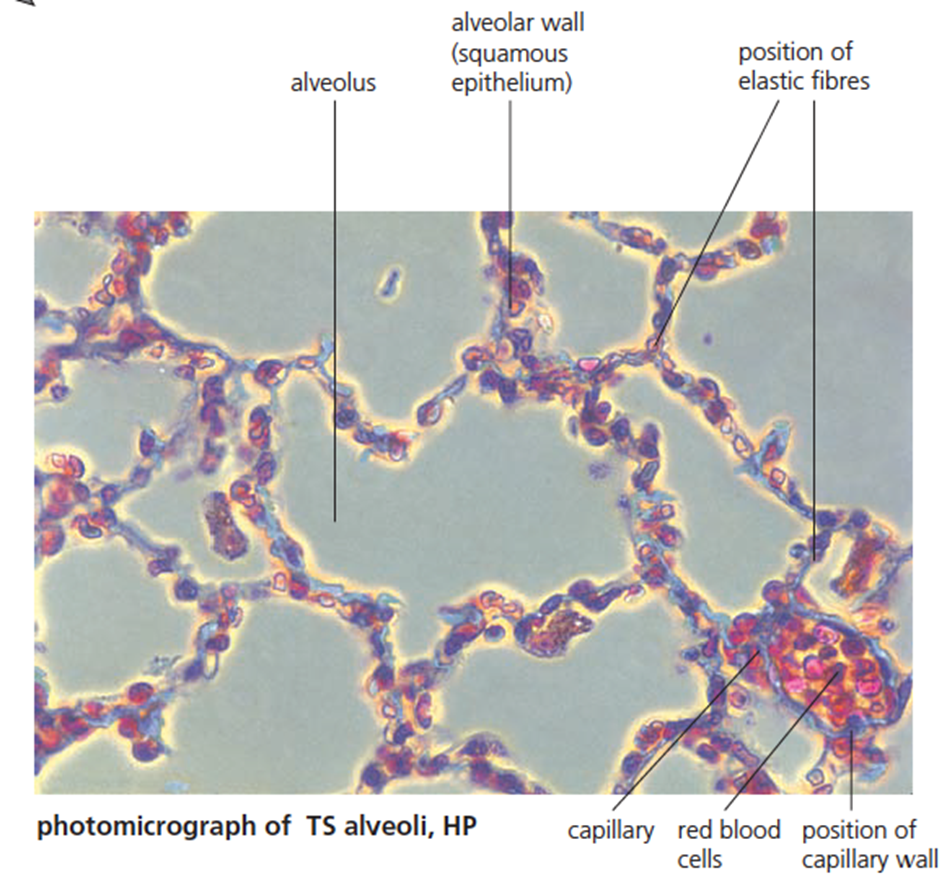
Red blood cells widen alveoli
Boyle’s law: an increase in volume will lead to a decrease in pressure and vice versa: increase in volume = greater space with the same amount of gas exchange to be carried out decreases pressure.
Inspiration (breathing in):
Diaphragm muscle contracts, creates increased volume in the lungs
Increased volume = less pressure per. Boyle’s law, creates a partial vaccum (draws in breath automatically to restore pressure)
Surfactant = a protein film that lines the inner surface of the alveoli. The surfactant reduces the surface tension of the inner surface and prevents the alveoli from collapsing when expiration takes place.
Gas exchange in plants
Plants exchange respiratory gases with the atmosphere
Leaves are wide and thin with few layers: large surface area to volume ratio, efficient diffusion
Two primary energy producing processes in plants: cell respiration & photosynthesis
Aerobic cell respiration creates ATP constantly (glucose + oxygen → water + CO2)
Photosynthesis produces glucose when light is present (CO2 + water → glucose + oxygen)
Thus, rates of reactions are not equal
Leaf adaptations to gas exchange:
Cuticle: prevents excessive water loss
Palisade mesophyll: contains chloroplasts, placed in the upper part of the leaf to recieve max amount of sunlight
Spongy mesophyll: below the palisade layer, above stomata, provides surface area for gas exchange
Veins: contain phloem and xylem, which transport water through the leaf and through root systems respectively
Stomata: microscopic openings in the lower leaf layer, allow CO2 to enter and oxygen + water vapour to exit the leaf
Guard cells: control the opening/closing of stomata
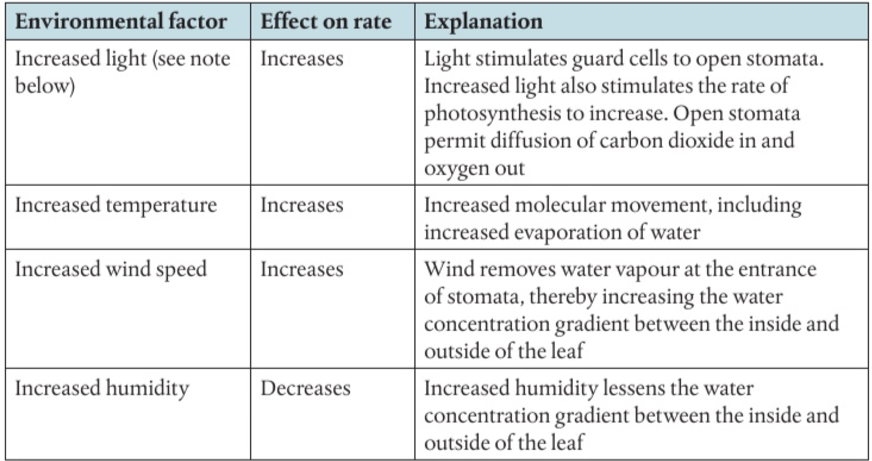
Transpiration: evaporation through open stomata
Leaf opens stomata to recieve CO2, cannot control which gases exit/enter through open stomata, leads to oxygen diffusion and transpiration
Plants need:
Minerals:
Phosphates for DNA backbone
Nitrogen for DNA bases and amino acids