SCI 8 REVIEWER - 1st Term
SCI REVIEWER FIRST SUMMATIVE
Outline:
- Life Processes
- Biological Discoveries
- Filipino & Foreign Scientists
- The Microscope: Parts & Their Functions
Introduction to Biology
Biology (bio (life) + logos (to study))
- Deals with the study of living organisms and their life processes
Biology is split to three main parts:
- Zoology - Animals
- Botany - Plants
- Microbiology - Microorganisms such as Bacteria, viruses, and organisms
TRADITIONAL FIELDS OF BIOLOGY | |||
|---|---|---|---|
Taxonomy | naming and classification | Embryology | formation and development of organisms |
Cytology | cell structure and function | Morphology | Forms and structures of organisms |
Genetics | heredity and variation | Evolution | Origin and differentiation of organisms |
Ecology | organism-environment relationship | Biochemistry | Biochemical composition |
Physiology | parts and functions of organisms | Immunology | Immune system |
L1: LIFE PROCESSES
- This distinguishes living things from non-living things.
- Cellular Organization
- Cells → Tissue → Organs → Organ System → Organism
- Energy Processing
- The constant energy requirement of a living thing.
- Metabolism: chemical reactions in the body cells that change food into energy
- Anabolism - The process wherein energy is used to break down complex molecules into simpler ones.
- Catabolism - The process of creating complex molecules from simpler molecules to release energy.
- Growth & Development
- Response to Stimuli/Homeostasis
- Adaptability to one’s environment
- Capability of reproduction
- Locomotion and movement
- Digestion and excretion
- Respiration
L2 & 3: FOREIGN AND LOCAL BIOLOGISTS AND THEIR DISCOVERIES
FOREIGN SCIENTISTS
- Aristotle
- Father of Biology
- Father of Zoology
- First known attempt to classify animals into groups according to their similarities and differences.
- Carolus Linnaeus
- Father of Taxonomy
- Published Systema Naturae and Species Plantarum.
- Developed a more systematic way to classify animals and plants.
- Binomial nomenclature - the system of naming organisms using two Latin words (Scientific Name)
- Louis Pasteur
- Pastuerization - process of killing microorganisms by heating
- Developed vaccines against anthrax, cholera, and rabies
- Charles Darwin
- Father of Evolution
- Published “On The Origin of Species by Means of Natural Selection” which became the basis for the Theory of evolution.
- Alexander Fleming
- Penicillin - antibiotic from mold species
- Rosalind Franklin
- Contributed in understanding the molecular structures of DNA.
- James Watson and Francis Crick
- Made clarifications about DNA.
- Discovered the double-helix model which gave rise to modern molecular biology.
LOCAL SCIENTISTS
- Francisco Fronda
- Father of Poultry Science in the Philippines
- Father of Thai Poultry Industry
- Contributed to the development of poultry in the Philippines and in Asia.
- Benjamin Cabrera
- Publishes more than one hundred studies about parasitology and public health.
- Conducted a study on filariasis– a parasitic disease from the infestation of nematode worms.
- Paulo Campos
- Established the first and best-known Radioisotope Laboratory in the country
- Clara Lim-Sylianco
- Studied mutagens, antimutagens, and bioorganic mechanisms and made lots of publications about them.
- Her books are used in colleges throughout the country for studying chemistry.
- Quintin Kintanar
- He did pharmacological studies of Philippine medicinal plants and fat, liver, and lipoprotein metabolism.
- He did a study on the safety and effectiveness of coconut water as an intravenous fluid.
- William Padolina
- Contributions on natural products, coconut chemistry, biotechnology, and in research.
L4: MICROSCOPE: PARTS & THEIR FUNCTIONS
Compound Microscope
- An instrument that is used to view magnified images of small specimens on a glass slide
- Has three sections:
- Mechanical parts: adjustments and support
- Magnifying parts: enlarging the specimen
- Illuminating parts: providing light
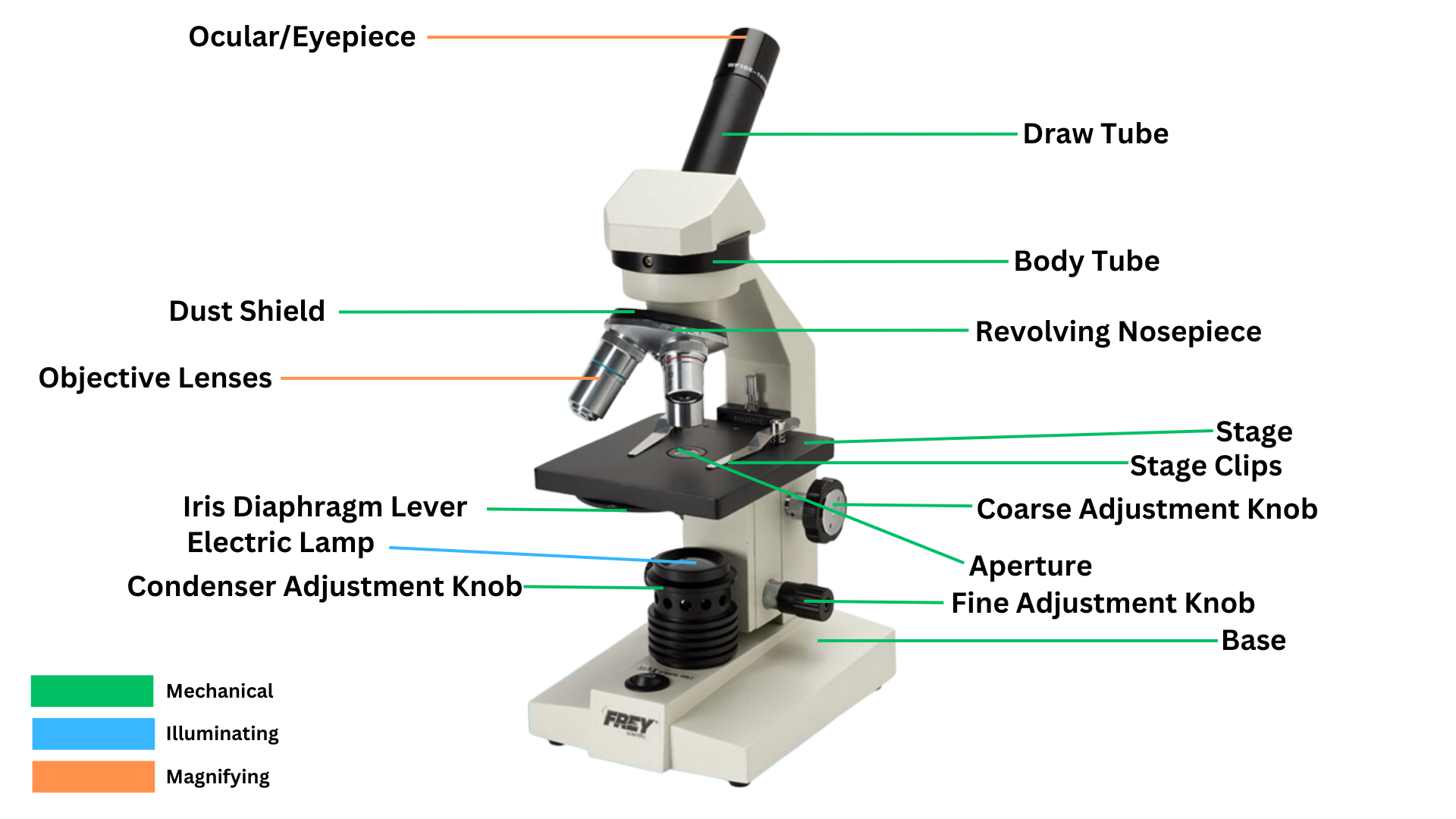
MECHANICAL PARTS
- Base - bottommost portion; supports the entire microscope
- Stage - platform where the specimen is placed
- Stage Clips - secures the specimen onto the stage
- Aperture - hole in the stage through which the base light reaches the stage
- Body Tube - attached to the arm; bears the lenses
- Draw Tube - cylinder structure on top of the body tube that holds the ocular lenses
- Revolving/Rotating Nosepiece - rotating disc where the objectives are attached
- Dust Shield - lies at the top of the nosepiece; keeps dust from settling on the objectives
- Coarse Adjustment Knob - knob used to elevate/lower the stage to bring the specimen into approximate focus
- Fine Adjustment Knob - smaller knob for delicate focusing bringing the specimen into perfect focus (sharpening details)
- Condenser Adjustment Knob - elevates/lowers the condenser to regulate the intensity of light
- Iris Diaphragm Lever - for opening/closing the diaphragm
ILLUMINATING PARTS
- Electric Lamp - built-in illuminator beneath the stage
MAGNIFYING PARTS
- Ocular/Eyepiece - lenses found on top of the body tube to magnify the image produced by the objective lenses; ranges from 5X to 15X
- Objective Lenses - metal cylinders attached below the nosepiece for magnification
- Low Power Objective (LPO) - lowest magnification (10x)
- High Power Objective (HPO) - higher magnification (40x)
- Oil Immersion Objective (OIO) - highest magnification (100x); usually used with synthetic oil or cedar wood