Ecology
Definitions:
Ecology:The study of how organisms interact with eachother as well with there enviorment
Enviorment:Where all living things and non-living things that exist on earth
Biotic:All living organisms in an ecosystem
Ex:grass,skunks,lions,whales bacteria etc
Abiotic:All non-living things in an ecosystem
Ex:water,wind,soil
Ecosystem:a complex self-regulating system in which biotic factors interact with eacother and with abiotic factors
Sustainability of the enviorment:The population of living organisms can contiue to interact and reproduce indefinitely to perserve biodiversity
Biodiverstity:The number of different types of organisms in an area.The more organisms,the more biodiverse the area,and thherefore a more healthy and sutible enviorment
Habitat:Where organisms live
A niche:The role or job the organisms play in its ecosystem
Ex:Bears catch fish
Types of ecosystems:
Open Ecosystem:An ecosystem where organsims can freely eneter and leave
Ex:Forest,city,stream
Closed Ecosystem:An ecosystem where organsisms can not freely leave or enter
Ex:Aquariums,zoo,farm
Ecological levels of organizations
Biosphere:The region of the earth where all life exisits
Atmosphere:The layer of gases that surroned the earth
Lithosphere:The earths soil and outer layer
Hydrosphere:All water on earth
Biome:A large geographical area that contains simlar ecosystems
Biomes
Biome | Climate | Plant and animal popultaion |
|---|---|---|
Dessert |
| Droughts,resistan plants Plants-catus,prickly pears Animals-lizard,snakes,camals |
Grassland |
| Plants- grass,wheat,corn Animals-prarie dogs,bison,antelope |
Marine (salt water,oceans and seas) |
| Plants- red algae,blue-green algae,diatoms Animals-lobster,whales,cod barnicles,muscles,shrimp,tuna |
Fresh water |
| Plants- grasses,ferns,lily pads Animals-trout,muskrat,beavers,clams |
`Tropical Rain forest |
| Plants-cines,banboo,broad leafed plants Animals-Boa constrictor,phytons,monkey, sloths |
Tundra |
| Plants-shurbs,moss,lichen Animals-mostiqutos,caribou,polar bbear,artic fox,snowy owls |
Boral forest |
| Plants-spurce trees,fir trees, blueberries Animals-Wolf, black bears, squirrels, eagles, hawk |
Temperate deciduos forest |
| Plants-Maple trees, roses, oak trees, grass Animals-Deer, fox, woodchuck |
Definitions:
Ecosystem:A collection of communities that have similar population
Communities:formed from the interaction of imany ppopulations of different species
Populations:a group of members of the same species that lkive jin the same area
species:a group of similar organims that vcan reproduce with eachother and produce offspring that can reproduce
Producers:produce their own food through photosythesis
Consumers:dont produce there own food but eat plants and animals to surive
Decomposers:chemically breeakdown organic matter into its nutrients
*Importnt*: H2O+CO2+light energy→C6 H12 O6 +O2(for photosyntheseis)
Ecological Pyramid
its necessary that there is a relatioship between the 3 thropic levels
(autotrophic,heterotropic and decomposers)
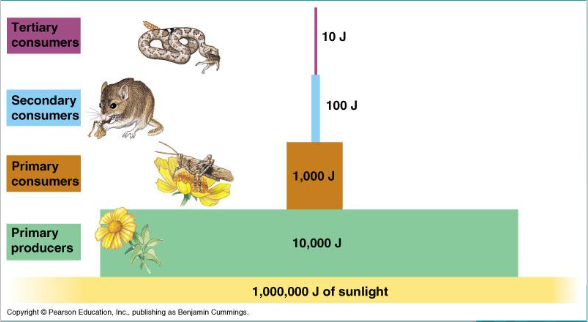
As energey passes along the food chain, it deacreases due to energy loss from the transfer from one organism to the next
-Pyramid of numbers
The further up the food chain the more organisms would need to be eaten to supply enough energy to support life
Example:Grass100 →mice10→hawk1
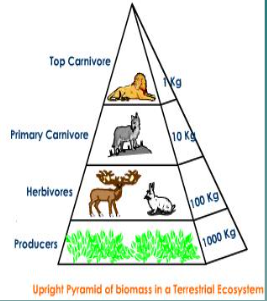
-Pyramid of Biomass
Takes into account the mass of each organism in a food chain (not just the number of organisms as in a pyramid of numbers)
-Pyramid of Energy
Takes into account the energy transferred in a food chain (not just the number of organisms or their masses)
This is the most accurate type of ecological pyramid