Developing Through the Life Span
Developmental Psychology’s Major Issues
Developmental Psychology - a branch of psychology that studies physical, cognitive, and social changes throughout the life span
Cross-Sectional Studies - research that compares people of different ages at the same point in time. Since it follows different people, the study might be skewed one way or another
longitudinal Studies - research that follows and retests the same people over time. Since it follows the same people, people move or leave that will therefore have to leave the study
Explore 3 different Areas:
Nature and Nurture: Genetics vs experience. Interactions between biological, psychological and culture
Continuity and Stages: What part of development is gradual/continuous. What parts are abrupt? development is viewed either as a slow, ongoing process or as a process of maturation guided by instructions programed into DNA
Stability and Changes: What traits exist throughout our life? How do we change as we age? Stability marks ones personality as one ages. The ability to change gives individuals hope for a brighter future
In all of the different developmental theories, there is the same timeline. The order of the timeline is the same for each person, but when they do it is different
Nature vs Nurture
Our genes are created by sperm + egg = people
But our experiences also shape us.
Family teaches us how to act.
“You think you just fell out of a coconut tree? You exist in the context of all in which you live and what came before you.” Kamala Harris
But even though our experiences shape us, humans collectively share many similarities (life spans, speaking to infants lovingly,
We all share a human nature
Nature and nurture work together to shape development
Continuity and Stages
Do humans grow constantly (like a tree) or in stages (like a butterfly)?
If it is viewed through experience and learning, it is constant (tree)
Viewed through biology, it is seen as a process of maturing (distinct stages programed into our DNA)
Brain does grow rapidly during childhood/puberty
Stability and Change
When we see an old friend do we
realize it is “the same old Ella
think of them as strangers
Some characteristics are stable (nice kids grow up to be nice adults)
But science cannot predict all changes
People learn new coping mechanisms
Many troubled kids grow up into mature, healthy adults
People realize that they have changed, but are skeptical if they will change in the future
Hindsight bias
Prenatal Development and the Newborn
Conception
Mom released a egg. Dad released sperm. After one sperm entered the egg, the egg stopped all other sperm from entering.
Chromosomes - threadlike structures made of DNA molecules that contain the genes
DNA (Deoxyribonucleic acid) - a molecule containing the genetic information that makes up the chromosomes.
Genes - the biochemical units of heredity that make up the chromosomes; segments of DNA.
Genes are either active (expressed) or inactive
External factors can “turn on” genes, allowing them to be expressed.
Hereditary - the genetic transfer of characteristics from parents to offspring.
Genome - the complete instructions for making an organism, consisting of all the genetic material in that organism’s chromosomes
Each person is one of a kind due to genetic variation!
Everything is related to genes and gene expression (height, intelligence, aggressiveness) This means that different people have different expressions
Environment - Every external influence, from prenatal nutrition to social support in later life. Affects your DNA.
Hight might be influenced by your diet
Interaction - the interplay that occurs when the effect of one factor (such as environment) depends on another factor (such as heredity).
One baby is friendly, the other is not. The friendly baby then gets more positive social interaction, which leads them to be a friendly person. The second baby received negative social interaction, which reinforces their negative personality
Epigenetics - the study of the molecular ways by which environments can influence gene expression (without a DNA change).
How environment can cause Genes to be expressed or unexpressed.
Car crashes can cause health issues (Parkinson’s disease) Some event can turn on the switch for Parkinson’s disease.
Epigenetic Markers - molecules that trigger or block genetic expressions.
When they are attached to a DNA segment, they can “turn off” that part of DNA
Pre-Natal: Drugs, toxins, nutrition, stress
Post-Natal: Neglect, Abuse, unstable home life
Juvenile: Social Contract, Environment competitivity
Adult: Cognitive Challenges, Exercise, Nutrition
Prenatal Development
Zygote - the fertilized egg; it enters a 2-week period of rapid cell division and develops into an embryo.
Less than half survive the first
After the first week the cells begin to specialize into different organs
Prenatal stages: Before Birth
Embryo - the developing human organism from about 2 weeks after fertilization through the second month.
The inner clump of cells becomes the embryo, the outer cells form the placenta
When the organs develop!
Fetus - the developing human organism from 9 weeks after conception to birth.
Teratogens - agents, such as chemicals or viruses, that can reach the embryo or fetus during prenatal development and cause harm.(drugs, cleaning products, law care products)
While the placenta tries to keep harmful molecules out of the fetus, it can’t stop them all (think of a baby with fetal alcohol syndrome and how it affects the kid’s nervous system)
Increase alcohol consumption is linked with congenital disorders, future behavior problems, and lower intelligence
Fetal Alcohol Syndrome - physical anomalies and cognitive function deficits in children caused by heavy prenatal alcohol exposure. In severe cases, symptoms include a small, out-of-proportion head and distinct facial features.
The alcohol has epigenetic markers that turns specific genes on or off when they shouldn’t be
The Competent Newborn
Reflex - a simple, automatic response to a sensory stimulus, such as the knee-jerk response.
Newborn babies are born with certain reflexes aimed to help them survive
Think of how when something touches a babies cheek, they turn towards in, thinking it is a nipple, and they try to suckle.
Startle Reflex - arms/legs spring out, fist clutched, loud cry
Grasping Reflex - babies grab something that is in their hand
Turn their heads to hear voices,
They know the voices they hear from the womb
Babies are able to distinguish their mothers smell from others
Sense of smell and hearing is great days after birth, and only increases in ability
Temperament - a person’s characteristic emotional reactivity and intensity.
Babies temperament differ immediately. Some are calm while others react strongly to stimulation
Twins and Adoption Studies
Twins happen when:
the zygote either splits in two
two eggs were fertilized by two different sperm
Identical (Monozygotic) Twins - individuals who developed from a single fertilized egg that split in two, creating two genetically identical siblings.
Fraternal (dizygotic) Twins - individuals who developed from separate fertilized eggs. They are genetically no closer than ordinary siblings, but shared a prenatal environment.
Twins are often used to study nature vs nurture. They do this by
vary the home environment while controlling heredity.
vary heredity while controlling the home environment.
Identical vs Fraternal Twins
Since identical twins have identical genes, does this mean they behave the same? Studies show that they are more similar than fraternal twins in their behavior
Separated Twins
In Columbia, two sets of identical twins (4 kids in total) were swapped, so each twin thought they had a fraternal twin instead of an identical twin.
Each identical twin had similar behaviors, even though they were separated at birth.
But the environment also had a large impact, as the twins that were raised in the city had better nutrition → taller/healthier.
However, wouldn’t it be possible to find common similarities with a complete stranger? (me and Clara both like forged in fire, but we are not twins)
Biological verses Adoptive Relatives
Adoption changes the genes while controlling the environment. This asks 3 questions:
How much do adopted children resemble their biological parents, who contributed their genes?
How much do they resemble their adoptive parents, who contribute a home environment?
While sharing a home environment, do adopted siblings come to share traits?
Apart from identical twins, people who grow up together (biologically related or not), do not resemble each other in their personality.
But adoption is important in instilling important beliefs and values.
Infancy and Childhood
Maturation - biological growth processes leading to orderly changes in behavior, mostly independent of experience. Mostly caused by genetics
Severe abuse or deprivation can slow development
Genetic patterns are “factory-set” and are difficult to change
Maturation (nature) sets the basic course of development; experience (nurture) adjusts it
Physical Development
Brain Development
Babies have most of the brain cells they will ever have
The nervous system is immature. After birth the nervous system has a rapid growth spurt that enables the abelites.
Ages 3-6, the frontal lobes grow the most (areas of reasoning and planning). This increases kids ability to control their attention and behavior.
The association areas (thinking, memory, language) are the last to develop.
Language and agility continue to grow well into puberty, and grow rapidly.
Synaptic Pruning happens when a certain area becomes unused.
Something traumatic happens during a certain stage, it may affect their brain development at their stage
Genes lay down the basic design of the brain, but our experiences fill in the details.
Lack of stimulation can cause human brains to slow and decrease cognitive development
Babies can benefit from human touch
In NICUs, premature babies can grow, gain weight, develop neurologically faster thanks to skin-to-skin touch.
Skin-to-skin with parents can cause preemies to have better cognitive development, lower aggressiveness, and lower hyperactivity 20 years later
Nature + Nurture develop our synapses. Experiences can strengthen some neural pathways while disuse can cause others to weaken.
Critical Period - a period early in life when exposure to certain stimuli or experiences is needed for typical development.
Lack to exposure to spoken, written, or signed language can cause a child to never be proficient in any language.
For typical brain development, early stimulation is critical.
But Brain development does not end in childhood thanks to neuroplasticity.
Environmental influences
A rat in a impoverished environment leads to an impoverished rat brain cell
Neural Pathways are not as developed
A rat in an enriched environment (toys, friends) leads to an enriched brain cell
More developed neural pathways
Motor Development
As muscles and nervous system grow/develop, babies gain control over their movement
While most babies can walk by around 15 months, these differ
some by 11 months, some by their first birthday
Some communities in Africa, Caribbean and India massage/exercise their babies, which can lead to faster walking.
Crawl → walk → Run
Genes do decide motor development
Identical twins typically walk on the same day
The development of the cerebellum creates the readiness to walk
maturation does determine other physical skills
bowl/bladder control
Brain Maturation and Infant Memory
Infantile Amnesia - Blank space in our memory from birth to around age 4
Babies can learn and remember certain things
By 20 months, children who learn where to find a toy in a room will remember the location six months later
Babies are also able to re-remember forgotten language
British adults who had spoken Hindi in their childhood were able to relearn the subtle differences in sounds in Hindi.
What the conscious mind does not know and cannot express in words, the nervous system and our unconscious mind somehow remember.
Cognitive Development
Cognition - all the mental activities associated with thinking, knowing, remembering, and communicating.
When did we become conscious?
Children physically think differently than adults
Jean Piaget (psychologist) discovered that a child’s mind develops through a series of stages. This upward march begins with the newborn’s simple reflexes, and it ends with the adult’s abstract reasoning power.
A mind is like a ladder. You cannot jump rungs, you must have a firm grip of the rung you are on before you begin to climb.
The force driving us “up the ladder” is the desire to make sense of our experiences
Thought that kids were active thinkers who are constantly trying to construct a more advanced understanding of the world
Schema - a concept or framework that organizes and interprets information.
Assimilation - interpreting our new experiences in terms of our existing schemas.
Accommodation - adapting our current schemas to incorporate new information.
A baby might think everything that walks on all 4s is a Dog, but this is not true
The original Dog Schema is too broad and it begins to narrow the schema
Piaget’s Theory and Current Thinking
Thought that Cognitive Development came in four stages: Sensorimotor, preoperational, concrete operational, and formal operational.
Sensorimotor
In Piaget’s theory, the stage (from birth to nearly 2 years of age) at which infants know the world mostly in terms of their sensory impressions and motor activities.
Babies live in the present, and do not have object permeance (the awareness that things continue to exist even when not perceived. It forms at around 8 months, but is slowly being formed)
Young children think like scientists, testing things and learning from patterns
Preoperational Stage
in Piaget’s theory, the stage (from about 2 to 6 or 7 years of age) in which a child learns to use language but cannot yet perform the mental operations of concrete logic.
Pretend play is important at this stage. Enjoyed by a child who can think in symbols; too young to preform mental operations
Egocentrism - in Piaget’s theory, the preoperational child’s difficulty taking another’s point of view. No Empathy, cannot be reasoned with
When you ask a kid to “show mom the picture”, they hold the picture up to their own eyes, not moms
Concrete Operational Stage
in Piaget’s theory, the stage of cognitive development (from about 7 to 11 years of age) at which children gain the mental operations that enable them to think logically about concrete events.
Conservation - the principle (which Piaget believed to be a part of concrete operational reasoning) that properties such as mass, volume, and number remain the same despite changes in the forms of objects.
Kids won’t understand that the amount of milk remains the same even if the glass changes shape (tall vs short)
During the Concrete Operational Stage, kids become aware of Conservation
Formal Operational Stage
in Piaget’s theory, the stage of cognitive development (usually beginning about age 12) at which people begin to think logically about abstract concepts. Kids Gain empathy (put themselves in other peoples shoes)
If x happens, then y will happen
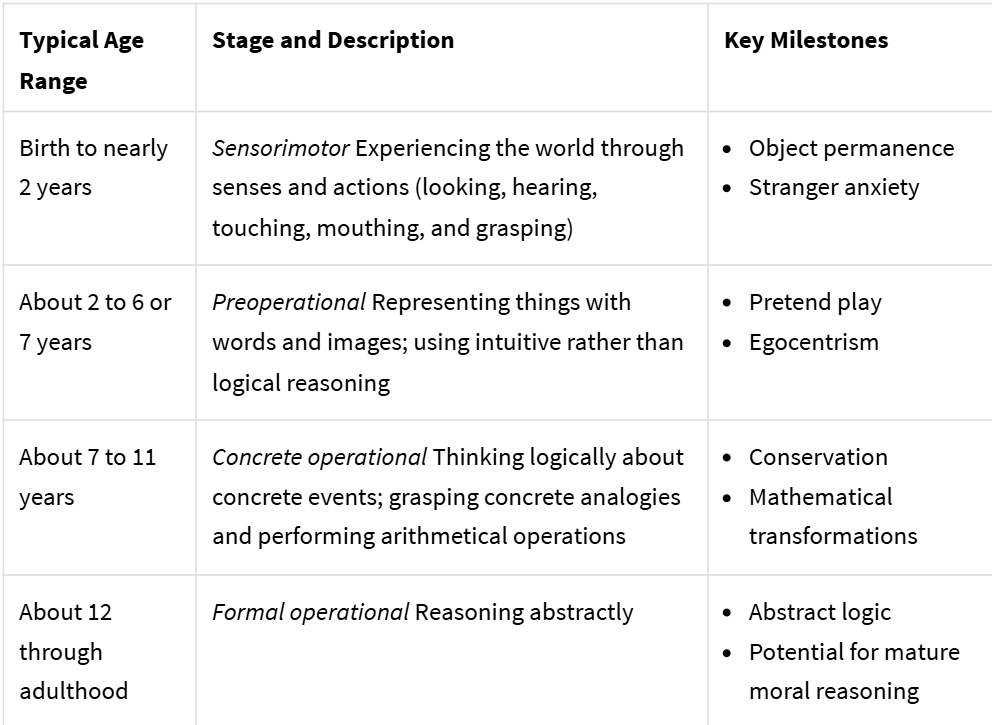
Reflecting on Piaget’s Theory
He identified significant cognitive milestones that each child will achieve when they are growing
Human cognitive growth unfolds in the same way as Piaget described
But, human cognitive growth is more continuous and fluid than Piaget thought
An Alternative Perspective: Vygotsky and the Social Child
Vygotsky emphasized how the child’s mind grows through interaction with the social environment.
Scaffold - in Vygotsky’s theory, a framework that offers children temporary support as they develop higher levels of thinking.
The environment a child is in creates the framework/support for the kid to learn and grow
Language is so important, as by age 7, kids will begin to think and use words to solve problems.
Adults who use self talk (saying you got this) have better performance
Kids who talk to themselves when solving math are better at it
Language supports social mentoring as building blocks for thinking
Theory of the Mind
People’s ideas about their own and others’ mental states — about their feelings, perceptions, and thoughts, and the behaviors these might predict.
The ability to “read others minds” and then change our behavior
Think of a kid changing their behavior in order to make their parent buy them a toy
Between ages 3-4 children worldwide use theory of mind to realize others may hold false beliefs
Ages 4-5 children anticipate false beliefs by friends
Children with autism spectrum disorder have difficulty understanding that another’s state of mind differs from their own
Social Development
Babies are social creatures
Stranger Anxiety - the fear of strangers that infants commonly display, beginning by about 8 months of age.
Babies have Mental schemas of who their caregivers look like, and will resist being given to someone unfamiliar
Origins of Attachment
Attachment - an emotional tie with others; shown in young children by their seeking closeness to caregivers and showing distress on separation.
In the 1950s, scientists had baby monkeys put in a cage with only a blanket. When the blanket was taken away to be washed, the moneys were upset and distressed.
The scientists made two fake “moms”, one with a bottle full of milk, and one with the blanket. The babies all chose the mom with the blanket.
Attachment Differences
Secure attachment - In their mother’s presence, the babies play comfortably, happily exploring their new environment. When she leaves, they become upset. When she returns, they seek contact with her. You can trust that someone will take care of you.
Insecure Attachment - either anxiety or avoidance of trusting relationships. Babies with this are less likely to explore their surroundings, and are more clingy with their mother.
Insensitive and unresponsive mothers often had insecurely attached infants
Mothers who actively respond to their babies lead to their babies having secure attachment
Temperament and Attachment
How does temperament affect babies attachment style?
In one experiment, there were 100 difficult babies who had rough temperaments. They were split into 2 groups. Group A, their mothers were given sensitivity training, and Group B did not. At the end on the experiment, 68% of the babies on Group A were securely attached, but only 28% of group B were.
This proves that while Nature (their innate temperament), Nurture is also important (sensitivity training)
Babies Anxiety regarding separation with their parents peaks at 13 months, the declines
As we mature, our “secure people” shift: Parents → Peers → Partners
Attachment Styles and Later Relationships
Basic Trust - according to Erik Erikson, a sense that the world is predictable and trustworthy; said to be formed during infancy by appropriate experiences with responsive caregivers.
Formed by securely attached babies, create a sense of trust rather than fear
Do our early infancy attachment styles affect our future adult relations? Does this affect intimacy?
People with secure parental relations tend to have secure friendships and good grades
Feeling Insecurely attached leads to two possible outcomes:
Anxious Attachment: people constantly crave acceptance but remain alert to signs of possible rejection. May cling, cry, remain upset at mom leaving
Avoidant Attachment: people experience discomfort getting close to others and tend to keep their distance. Seem not to notice or care about mothers leaving
Facing Adversity
Deprivation of Attachment
What happens when circumstances prevent a kid from forming attachments? These babies were often turned out to be withdrawn, frightened, or silent
When deprived kids were tested with kids in quality foster care, the deprived kids had impaired brain, cognitive, and social development
The earlier kids are placed in quality foster care the better, as they form attachment better
Trauma, Abuse, and Resilience
Most kids who grow up under adversity end up being resilience. This is often the same with survivors of childhood sexual trauma
Trauma can boost mental resilience
Children who have coped with some adversity become hardier when facing future stresses, much as children’s immunity to disease builds from germ exposure
When parents raise their kids “in a bubble”, but this may prevent kids from learning to tackle challenges
But coping with abuse is a whole other challenge.
The monkeys that were isolated had emotional scars. They hid in fright or lashed out in anger. Most were incapable of intimacy.
Sometimes the abused turn into the abuser. Around 30% of those abused in turn abuse their own kids, which is four times the national average. Childhood abuse survivors have a higher change of adulthood depression.
Remember that genes may or may not be expressed. Experience can put epigenetic markers on genes that influence their expression. Extreme childhood trauma leaves its marks on the brain
Childhood trauma survivors often have an increased risk for health problems, psychological disorders, substance abuse, criminality, and, for women, earlier death
Parenting Styles
How do different parenting styles affect kids?
There are four different parenting styles: They are based on how responsive and how demanding the parents are
Authoritarian Styles: Coercive, set rules and expect obedience.
Kids have lower social skills and self-esteem. Brains overreact when they make a mistake
Permissive Style: unrestraining. Have little demands and few punishments
Children are more aggressive and immature
Neglectful Style: Unevolved. Do not want a close relationship with the kid
Children have poor academic and social outcomes
Authoritative Style: Confrontive. Control by setting the rules, but with older kids they allow open discussion and exceptions
Children have the highest self-esteem, self-reliance, self-regulation, and social competence
Culture and Child Raising
Culture is a set of enduring behaviors, ideas, attitudes, values, and traditions shared by a group of people and handed down from one generation to the next
Different cultures have different parenting styles
In western culture, it often favors kids who are independent, but it used to favor kids who were obedient, respectable, and sensitive to others
Asian and African cultures often value physical closeness and shared emotions to create a sense of family and belonging.
Adolescence and Emerging Adulthood
Adolescence - the transition period from childhood to young adulthood, extending from puberty to independence.
Starts with physical changes that happen in puberty, beginning with sexual maturity
Physical Development
Puberty - the period of sexual maturation, during which a person becomes capable of reproducing.
Surge of hormones, the body changes, girls get their first periods
The Timing of Puberty
Everybody goes through the same sequence of puberty, but each person goes through it at a different time in their life
early puberty is common with those experiencing obesity, Traumatic stress, abuse or chemical exposure
Kids who experience early puberty are at a higher risk for mental health issues in the future
They commonly deal with teasing or sexual harassment, overthinking or ruminating, and they may bully or physically harm others
Often, the physical body changes faster than the mental capabilities are able to deal with it
The Teenage Brain
Teenage brains have a great ability to reason, but they lack self control
During teenage years, the unused neurons will get pruned
Frontal lobe develops, but it lags behind the emotional controlling Limbic system
This creates teen impulsiveness and emotionality
Teen Brains want immediate rewards, not thinking about long term consequences
Parental warnings are very important when teens think about what activities to partake in
Frontal Lobe will continue to develop until age 25 (unless the kid drinks)
Cognitive Development
Young Teenagers are egocentric (their reasoning is very self-focused)
They imagine what others think about them and develop an “imaginary audience”
They develop a “Personal Fable”, the idea that they are special and bad things will never happen to them
Developing Reasoning Power
Formal Operations - Adolescent intellectual peak, apply new abstract reasoning tools to the world around them
Debate human nature, good vs evil, truth, justice
Search for spirituality and the meaning of life, their place in society, what they want to do in their life
Developing Morality
Determining right vs wrong
To be a moral person is to think moral and to act accordingly
Moral reasoning guides moral actions
Moral Reasoning
Piaget thought that kids moral ideas were building at the same time as their cognitive development
He asked 3 different life stages a question regarding morality, and then judged their answers (should you steal medicine to save a persons life?)
Level | Focus | Example |
Preconventional morality (before age 9) | Self-interest; obey rules to avoid punishment or gain concrete rewards. | If you steal the medicine, you’ll go to jail. |
Conventional morality (early adolescence) | Uphold laws and rules to gain social approval or maintain social order. | If you steal the medicine, everyone will think you’re a criminal. |
Postconventional morality (adolescence and beyond) | Actions reflect belief in basic rights and self-defined ethical principles. | People’s right to live matters more than property or profits. |
Critics say:
The Postconventional Morality is limited, as it only confiders individualistic cultures/societies
Since women are more compassionate for others, the experiment is male focused
Moral Intuition
Most of our morality is intuition (gut reaction)
Think of the regular trolly problem (kill 5 or flip a switch and only kill 1) vs (kill 5 or push a fat guy in the way)
Most would kill 1 in the first scenario, but half would not kill the one guy in the second scenario
Moral cognition is automatic but can be overridden
Moral Action
Moral action feeds moral intuition/attitudes
When teens tutor elementary kids, help the elderly, their overall desire to serve others increased.
They also learned Delayed Gratification (one eye on the future)
One marshmallow now vs two marshmallows in the future
Immediate gratification makes today easy, but tomorrow difficult. Self-discipline — delayed gratification — makes today difficult, but tomorrow easy.
Social Development
Psychologist Erik Erikson thought that during each stage of life people had to overcome a certain challenge. Each stage had its own psychosocial task
Infancy (to 1 year) | Trust vs. mistrust |
Toddlerhood (1 to 3 years) | Autonomy vs. shame and doubt |
Preschool (3 to 6 years) | Initiative vs. guilt |
Elementary school (6 years to puberty) | Competence vs. inferiority |
Adolescence (teen years into 20s) | Identity vs. role confusion |
Young adulthood (20s to early 40s) | Intimacy vs. isolation |
Middle adulthood (40s to 60s) | Generativity vs. stagnation |
Late adulthood (late 60s and up) | Integrity vs. despair |
Forming an Identity
Some adolescents get an identity by copying their parents values/expectations. Others get an identity by joining a peer group (athletes, geeks)
In collectiveness cultures teens are encouraged to adopt a certain identity
In Individualistic cultures, teens are encouraged to decide on who they are
Identity - our sense of self; according to Erikson, the adolescent’s task is to solidify a sense of self by testing and blending various roles.
Our group identity’s are formed by how we differ from those around us
Social Identity - the “we” aspect of our self-concept; the part of our answer to “Who am I?” that comes from our group memberships.
Intimacy - in Erikson’s theory, the ability to form close, loving relationships; a primary developmental task in early adulthood.
Must have a clear and strong identity in order to have intimacy with others
Parent and Peer Relationships
During indolence, the influence your parents has over you diminishes and the influence of your peers increases.
By early teens, their brains are less responsive to their mothers’ voice and more responsive to nonfamily voices
Arguments with parents are normal and mostly about chores/homework
In a minority of cases, the arguments can lead to a split in the family and great stress