Biology, Larger Organisms
Blood
What are the 4 main Blood Types for Humans (each have ‘+’ & ‘-’ types)?
A
B
AB
O
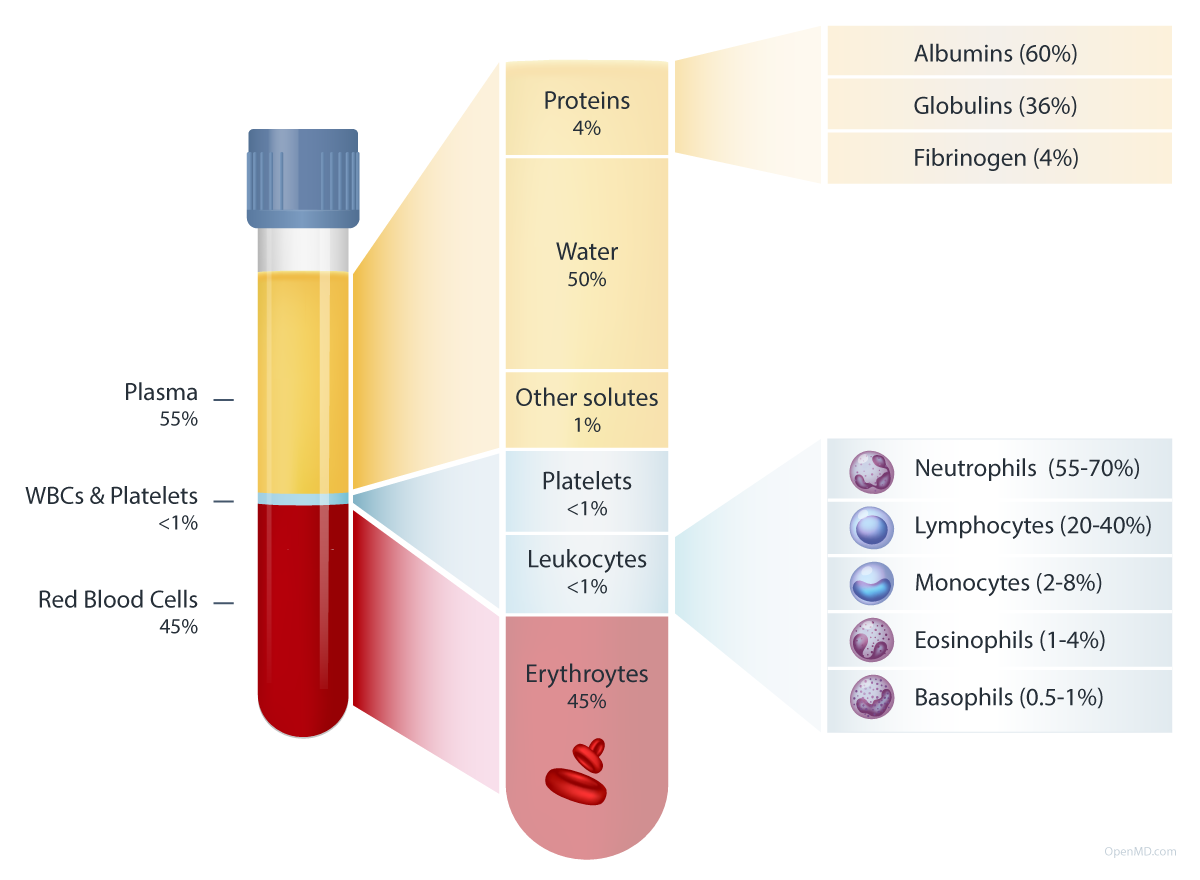
Components of Blood
There are 4 main components of Blood
One component is Red Blood Cells
They are created in Bone Marrow
Red Blood Cells do not have a Nucleus
Hemoglobin allows the Red Blood Cells to bind with Oxygen and Carbon Dioxide
Another component is White Blood Cells
Their main function is to protect the body from infections
White Blood Cells have a nucleus and can move independently from the blood flow to attack invaders
A third component is Platelets
Their main function is to assist in clotting blood
Platelets bind together to create barriers to stop blood flow
The fourth component is Plasma
Its main function is to carry nutrients and waste to and from cells
Outline: Blood
Blood Types
A
B
AB
O
Components of Blood
Red Blood Cells
Created in Bone Marrow
Lack a Nucleus
Hemoglobin binds with Oxygen and Carbon Dioxide
White Blood Cells
Protect the body from infections
Have a nucleus and can move independently
Platelets
Assist in clotting blood
Create barriers to stop blood flow
Plasma
Carries nutrients and waste to and from cells
The Heart
Why does the Heart symbol look nothing like a real Heart?
One theory believes that Aristotle’s description of the Heart in the 4th century led to the design of the Heart Symbol
Aristotle described the heart as a three-chambered organ with a rounded top, a pointed bottom, and a depression between two main chambers.
Structure of the Heart
All mammals and birds have a 4-chambered heart
The Right Atrium and Right Ventricle collect de-oxygenated blood from the body through the Vena Cava (meaning right vein) or the main veins to the Heart
From the Right Ventricle, the de-oxygenated blood is pushed to the Lungs through the Pulmonary Artery
Oxygenated blood returns to the Heart and enters the Left Atrium and Left Ventricle before being pushed toward the rest of the body through the Aorta
Reptiles and Amphibians have a 3-chambered heart (2 arteries and a ventricle)
Fish have a 2-chambered Heart
All Hearts have Valves that help control the flow of blood and help prevent backflow of blood within the Heart
Complications of the Heart often stem from the valves either not opening properly or not being able to close properly.
The Average Human Heart can push about 70 ml of blood with every heartbeat and can push anywhere from 4 to 8 litres of blood every minute
The Heart is part of the body’s Autonomic Response system, which can automatically adjust the heart rate according to the situation
Cold-blooded species often have the slowest heart rates, which can get as low as 20 BPM
Bird species often have the fastest heart rates, which can get as fast as 1200 BPM
The Brain
In Ancient Egypt, how was the Brain removed from bodies before they were mummified?
The preparers would use an iron hook to scramble and pull the Brain out through the nostrils
The Brain was not considered to be a vital organ and was usually disposed of instead of being placed in Canopic Jars
Regions of the Brain
There are 3 main regions of the Brain
The Hindbrain controls breathing and heart rate, and the Cerebellum (extra: most important part of the hindbrain) controls coordination and movement
The Midbrain controls reflexes and voluntary movements
The Forebrain is the largest and most developed region and separates humans from other species
The Cerebrum
The Cerebrum controls intellectual activities such as memory, organization, imagination, and computation
The Cerebrum is composed of two hemispheres
The Left Hemisphere controls the right side of the body, and the Right Hemisphere controls the left side of the body
The two Hemispheres are in constant communication through the Corpus Callosum which bridges the two halves
Helpful/Extra: Corpus Callosum is like the RAM in a computer
The Glands of the Brain
The Brain contains 3 main glands:
The Hypothalamus controls many metabolic functions such as body temperature, hunger, and sleep
The Pituitary Gland mainly controls the growth of the body by excreting growth hormones
The Pineal Gland mainly produces Melatonin which helps with the regulation of sleep and the body’s circadian rhythms
Brain Issues
Headaches are the most common Brain issue affecting almost everyone within their lifetime
Headaches are often caused by signals between the Brain, and surrounding blood vessels and nerves, which then creates pressure on the nerves that send pain signals to the Brain
There are two classifications of Headaches
Primary Headaches such as Migraines are not caused by another medical condition
Secondary Headaches are caused by another medical condition such as a Tumour or a Sinus Infection
Nerves and the Nervous System
Which sense has the fastest reaction time with the Brain?
Touch has the fastest reaction time at about 130-170 milliseconds
Auditory stimuli can get a reaction time of about 150-200 milliseconds
Visual reaction times are about 200-250 milliseconds
Neurons
The Neuron is a basic cell within the body’s Nervous System that helps transmit information between nerves and within the Brain
3 main components:
Cell Body: Contains the nucleus and genetic material for the neuron
Dendrites: They pick up impulses from other nerves
Axon: A long, protected section of the neuron that allows for impulses to be transmitted
Synapses
Synapses are the points of connection between neurons
2 types:
Chemical Synapses
The gap between two neurons allows for chemicals called neurotransmitters to be sent to other neurons
The majority of neuron transmissions occur through chemical synapses
Electrical Synapses
The gap between two neurons is very small and allows for electrical signals to be transmitted across the gap
Electrical synapses are mainly found where quick reflexes are needed (such as the eyes)
The Nervous system
The Nervous system allows for two-way transmission of electrical impulses between the Body and the Brain
The Body sends signals to the Brain through nerves for the Brain to process and understand, and the Brain can send signals to the Body through the nerves to respond to stimuli
The Body and the Brain will use the Spinal Cord as the main juncture point for communications
Sympathetic vs Parasympathetic Nervous Systems
The Sympathetic Nervous System is responsible for the “Fight, Flight, or Freeze” response to a stimuli
This can include increased heart rate, breathing, dilated pupils, and the release of adrenaline
The Parasympathetic (para =parrallel) Nervous System is responsible for keeping the body calm and regulated
This can include slowing the heart rate, encouraging digestion, and promoting rest
Digestive System
What are the three types of teeth in a Human mouth?
Incisors are used for biting food
Canines are used for tearing food
Molars are used for crushing food
The Mouth
The main function of the mouth in digestion is to chew food to make it soft enough to swallow
There are enzymes in your saliva that help to soften the food while you chew
Enzymes (they have -ase)
Amylase helps break down carbohydrates
Lipase helps break down fats
Animals such as birds who do not have teeth can have an area called the Crop that breaks down food using small stones
The Esophagus
The Esophagus helps connect the mouth with the stomach
The esophagus uses muscle contractions called Peristalsis to force food to travel down the esophagus
The Stomach
The main purpose of the Stomach is to further soften foods before they enter into the Small Intestines
Gastric Acid, which is mainly Hydrochloric Acid, helps break down Proteins within the Stomach
To help prevent the Stomach from being consumed by its own Gastric Acid, it has a lining of mucus protecting the Stomach
For some animals called RUminants, they will have several stomachs to assist with breaking down of foods
The Intestines
The Small Intestines is responsible for most of the digestion in the Digestive System
Enzymes in the Small Intestines help break down food to the ponit of having it enter into the bloodstream
About 95% of nutrients are absorbed through the Small Intestine
The main purpose of the Large Intestines is to absorb water and minerals from the food, and to ferment the food into waste
Digestive System Outline
Types of Teeth in the Human Mouth
Incisors
Used for biting food
Canines
Used for tearing food
Molars
Used for crushing food
The Mouth
Function: Chew food to make it soft for swallowing
Saliva Enzymes
Amylase: Breaks down carbohydrates
Lipase: Breaks down fats
Birds and the Crop: Use small stones to break down food
The Esophagus
Connects mouth to stomach
Peristalsis: Muscle contractions to move food down
The Stomach
Purpose: Further soften food before entering Small Intestine
Gastric Acid: Mainly Hydrochloric Acid to break down proteins
Mucus lining protects stomach
Ruminants: Have multiple stomachs for digestion
The Intestines
Small Intestine
Main site of digestion
Enzymes break down food for absorption into bloodstream
95% of nutrients absorbed here
Large Intestine
Absorbs water and minerals, ferments food into waste
Human Intestine Length
Small: Average of 6 meters
Large: Average of 2 meters
Flashcards
Blood Types: There are 4 main Blood Types for Humans: A, B, AB, and O.
Red Blood Cells: They are created in Bone Marrow and do not have a Nucleus.
White Blood Cells: Their main function is to protect the body from infections and have a nucleus.
Platelets: Their main function is to assist in clotting blood by binding together.
Plasma: Its main function is to carry nutrients and waste to and from cells.
Heart Symbol: One theory believes that Aristotle’s description of the Heart in the 4th century led to the design of the Heart Symbol.
Right Atrium: Collects de-oxygenated blood from the body through the Vena Cava to the Heart.
Pulmonary Artery: Carries de-oxygenated blood from the Right Ventricle to the Lungs.
Left Atrium: Receives oxygenated blood returning to the Heart.
Cerebrum: Controls intellectual activities such as memory, organization, imagination, and computation.
Hypothalamus: Controls many metabolic functions such as body temperature, hunger, and sleep.
Neurons: Basic cells within the Nervous System that help transmit information between nerves and within the Brain.
Synapses: Points of connection between neurons where transmissions occur.
Sympathetic Nervous System: Responsible for the “Fight, Flight, or Freeze” response to stimuli.
Incisors: Teeth used for biting food in the Human mouth.
Amylase: Enzyme in saliva that helps break down carbohydrates in the mouth.
Esophagus: Connects the mouth with the stomach and uses Peristalsis to move food down.
Gastric Acid: Mainly Hydrochloric Acid in the Stomach that helps break down Proteins.
Small Intestines: Responsible for most of the digestion in the Digestive System and absorbs about 95% of nutrients.
Large Intestines: Absorbs water and minerals from food and ferments food into waste.