Unit 4 - Vision
The process of transforming particles of light energy into colorful sights.
Eye Anatomy
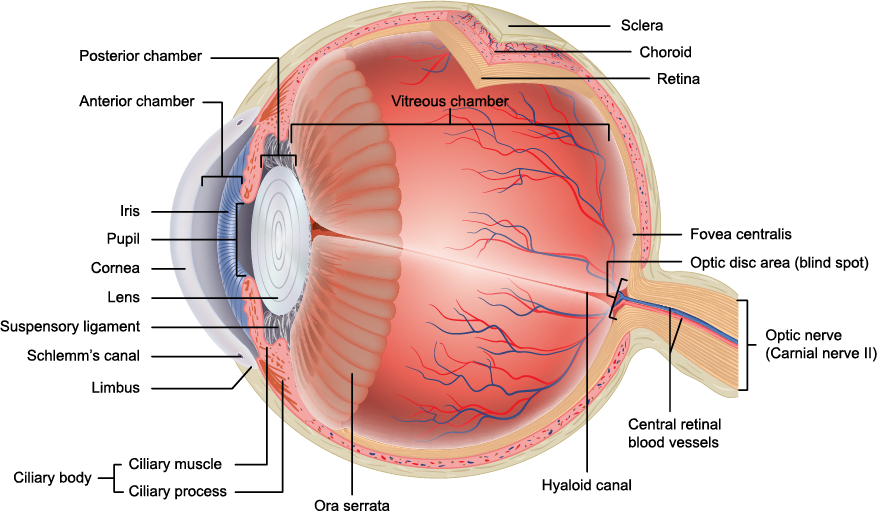
- Retina - inner surface of the eye containing rods and cones and layer of neurons that begin the processing of sending images to the brain.
- Cornea - outer covering. Protects the eye as well as bends light to provide better focus.
- Pupil - the adjustable opening through which light enters.
- Iris - a ring of muscle tissue that gives the eye its color and controls the size of the pupil opening. It dilates in response to the intensity of light.
- Lens - located behind the pupil, it changes shape () to help focus near and far objects on the retina.
- Blind Spot - where the optic nerve (ganglion axons) leave the retina creating a ____ spot because no receptor cells are located there.
- Fovea - the center of the retina, where the image we see is cast and most cones are located.
- Optic Nerve - carries neural impulses from the retina (eye) tot he brain (visual cortex) via the axons of ganglion cells and thalamus.
The Stimulus Input: Light Energy
- Transduction occurs when any stimulus energy (light waves, soundwaves, etc.) is %%transformed intro neural impulse%% our brain can interpret.
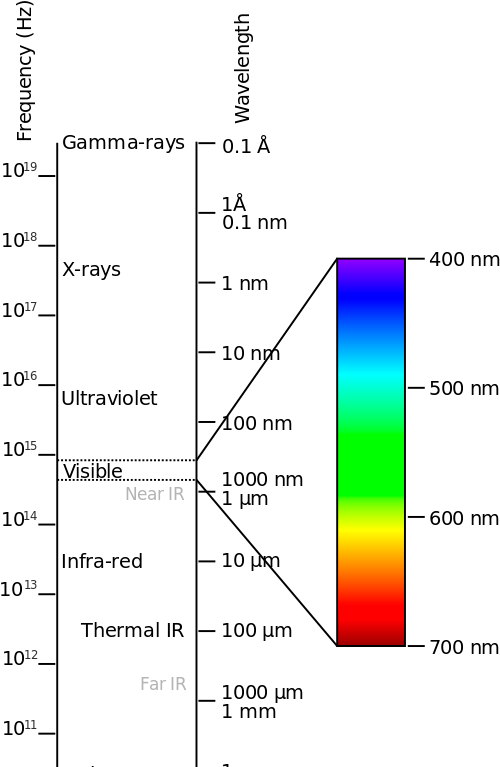
- Wavelength determines the we see.
- Amplitude (intensity) determines the of the colors we see.
We see pulses of electromagnetic energy that, through transduction, are converted into colors and images we recognize.
The Process of Vision
- Light passes through the cornea, which bends it to provide better focus.
- Light the passes through the iris, which either dilates or contracts the pupil based on its intensity.
- From the pupil, it passes through the lens.
- The lens focuses the near and far objects onto the retina through the process of accommodation.
The Retina’s Reaction to Light
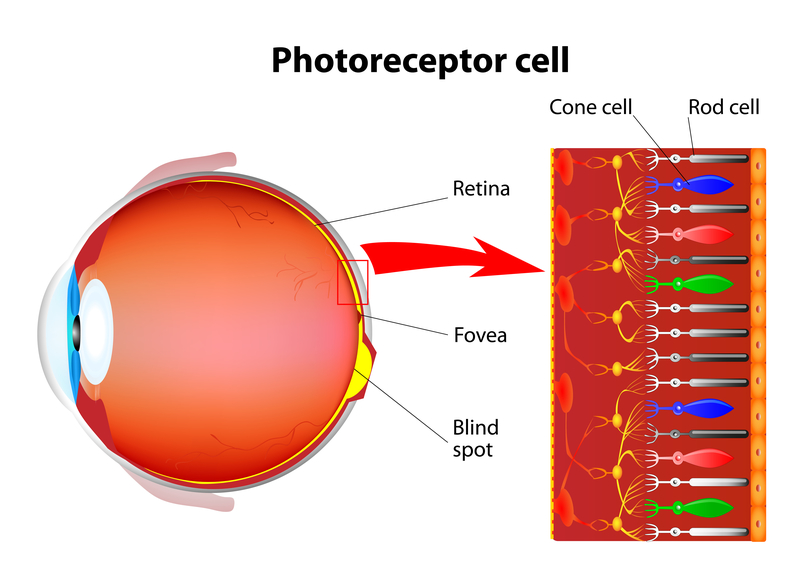
- Light entering the eye triggers photochemical reaction in rods and cones at back of retina.
- Chemical reaction in turn activates bipolar cells.
- Bipolar cells then activate ganglion cells, the axons of which converge to form the optic nerve.
- The optic nerve transmits information to the visual cortex (via the thalamus) in the brain.
REALLY(rods) COOL(cones) BALD(bipolar) GIRL(ganglion)
Rods Vs. Cones
Rods and cones transfer light energy into neural signals which are sent to the visual cortex and reassembled into images.
| CONES | RODS | |
|---|---|---|
| # | 6 million | 120 million |
| Location in retina | center | periphery |
| Sensitivity in dim light | low | high |
| Color sensitivity | high | low |
| Detail sensitivity | high | low |
Feature Detectors
- Nerve cells in the brain that respond to specific features of visual stimuli, such as
- shape
- angle
- edges
- lines
- movement
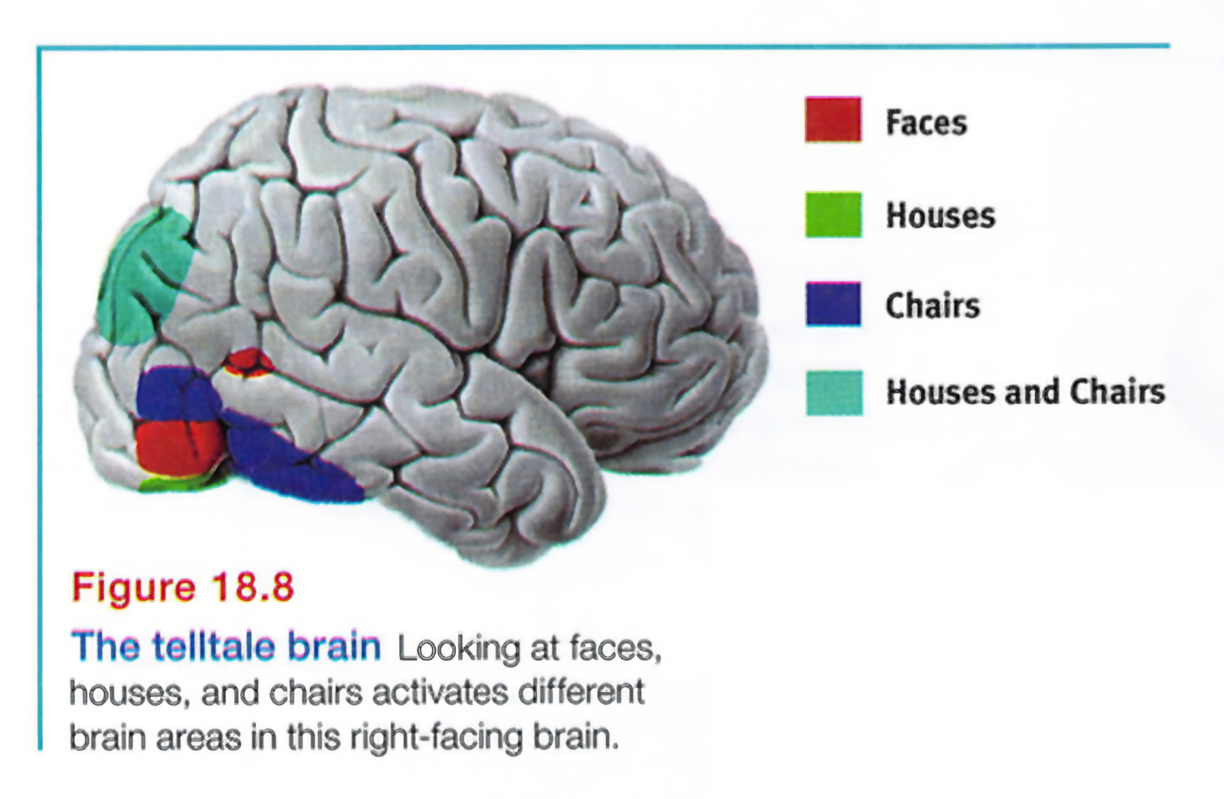
- Located in the visual cortex (occipital lobe)
- They process and the pass information onto other cortical areas where supercell clusters respond separately and simultaneously to more complex patterns. (like human faces)
Visual Information Processing - Parallel Processing
- Allows our brain to process multiple subdivisions of a stimuli at once by dividing and sending them to a supercell cluster to be analyzed and then reconstructed into the perceptions we experience!
[[The order goes:[[
- Retinal Processing
- (sensation)
- Feature Detection
- Parallel Processing
- (perception)
- Recognition