SOCL250 Midterm 2
GDAC Chapter 7
deviance - modes of action that do not conform to the norms or values held by most members of a group or society
deviant subculture - a subculture whose members hold values that differ substantially from those of the majority
sanction - a mode of reward or punishment that reinforces socially expected forms of behavior
laws - rules of behavior established by a political authority and backed by a state power
crime - the result of any action that contravenes the laws established by a political authority
Merton’s Deviance Typology
Conformists - accept generally held values and the conventional means of realizing them, regardless of whether they meet with success.
most of society.
Innovators - accept socially approved values but use illegitimate or illegal means to follow them.
mafia! want to lead respectable lives by entering into mainstream society, need to acquire wealth illegally at first.
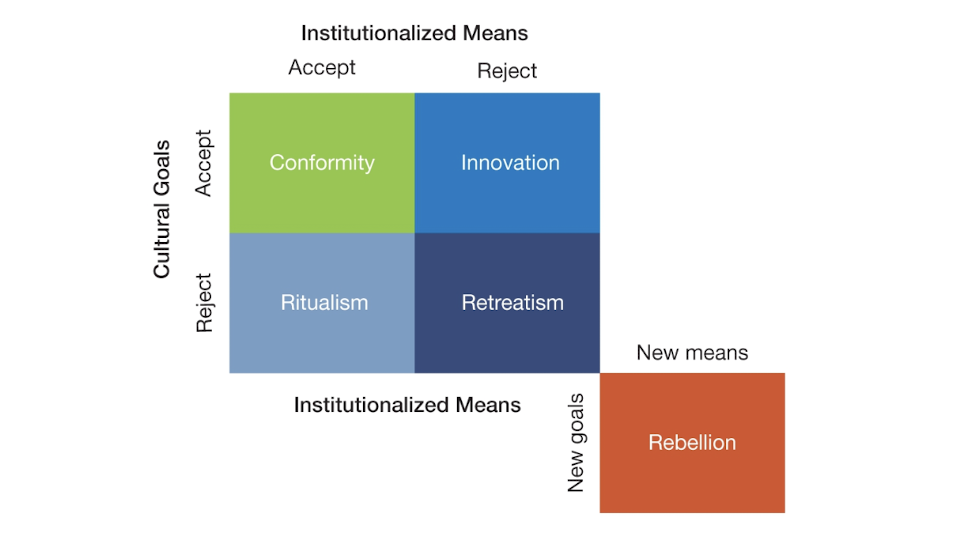
Ritualists - conform to socially accepted standards, although they have lost sight of their underlying values.
might dedicate themselves to a boring job, even though there are no career prospects, provides few rewards.
Retreatists - have abandoned the competitive outlook, rejecting both the dominant values and the approved means of achieving them.
members of a self-supporting commune
Rebels - reject both the existing values and the means of achieving them but work to substitute new ones and reconstruct the political system.
Heaven’s Gate Cult.
relative deprivation - deprivation one feels by comparing oneself with a group
differential association - an interpretation of the development of criminal behavior proposed by Edwin H. Sutherland, according to whom criminal behavior is learned through association with others who regularly engage in crime
labeling theory - an approach to the study of deviance that suggests that some people become “deviant” because certain labels are attached to their behavior by political authorities and others.
primary deviation - according to Edwin Lemert, the actions that cause others to label one as deviant
secondary deviation - according to Edwin Lemert, the actions that cause others to label one as deviant
conflict theory - the argument that deviance is deliberately chosen and often political in nature
control theory - the theory that crime is the outcome of an imbalance between impulses toward criminal activity and controls that deter it. Theorists believe that criminals are rational beings who will maximize their own reward unless they are rendered unable to do so through either social or physical controls
white-collar crime - criminal activities carried out by those in white-collar, or professional, jobs
corporate crime - offenses committed by large corporations in society.
ex. pollution, false advertising.
cybercrime - criminal activities by means of electronic networks or information technologies.
ex. electronic money laundering, personal identity theft, electronic vandalism
community policing - an approach to policing that emphasizes crime prevention rather than law enforcement to reintegrate policing within the community
shaming - a way of punishing criminal and deviant behavior based on rituals of public disapproval rather than incarceration.
maintain the ties of the offender to the community.
Theory Approach to Understanding Deviance Contemporary Application |
Functionalist Theory Deviance serves the function of creating solidarity in the larger society In 2019, when a group of affluent parents that included Lori Loughlin was caught attempting to gain admission for their children to prestigious universities through a scheme of bribery and deception, parents and children across the country shared outrage over this act of deviance. |
Interactionist Theory No act is objectively deviant - to understand the nature of deviance, we must understand the process through which some people get labeled deviant Diagnostic labels for certain psychiatric disorders - e.g. ADHD and depression - may add to the stigma associated with certain behaviors. |
Conflict Theory The poor disproportionately violet norms and laws in response to their unequal position in society Immigrants without papers feel compelled to work “off the books” |
Control Theory Crime results from a lack of social and physical controls that deter it Street sensors, cameras, and other surveillance systems have contributed to lower crime rates in many cities |
Broken Windows Theory Minor acts of deviance must be controlled to avoid a spiral of crime and social decay Proactive policing focused on graffiti or drinking in public is believed by some to have the effect of lowering violent crime. |
GDAC 385 to the middle of 405 (from the beginning of Chapter 11 up to but not including Hispanics and Latinos in the United States); bottom of 416 to 422 (from Has Real Progress Been Made Since the Civil Rights Movement of the 1960s up to but not including How Can Ethnic Conflict Be Reduced?)
minority group - a group of people in a given society who, because of their distinct physical or cultural characteristics, find themselves in situations of inequality compared with the dominant group within that society
race - a socially constructed category rooted in the belief that there are fundamental differences among humans, associated with phenotype and ancestry
ethnicity - cultural values and norms that distinguish the members of a given group from others. An ethnic group is one whose members share a distinct awareness of a common cultural identity, separating them from other groups.
racism - the attribution of characteristics of superiority of inferiority to a population sharing certain physically inherited characteristics
prejudice - the holding of preconceived ideas about an individual group, ideas that are resistant to change even in the face of new information
stereotyping - thinking in terms of fixed and inflexible categories
scapegoats - individuals or groups blamed for wrongs that were not their doing
discrimination - behavior that denies to the members of a particular group resources or rewards that can be obtained by others.
white privilege - the unacknowledged and unearned assets that benefit whites in their everyday lives
institutional racism - the idea that racism occurs through the respected and established institutions of society rather than through hateful actions of some bad people
racial microaggressions - small slights, indignities, or acts of disrespect that are hurtful to people of color even though they are often perpetrated by well-meaning whites
scientific racism - the use of scientific research or data to justify or reify beliefs about the superiority or inferiority of particular racial groups
apartheid - the system of racial segregation established in South Africa
affirmative action - policies that grant preferential treatment to groups regarded as disadvantaged or subject to discrimination
GDAC middle of 405 to bottom of 416 (Chapter 11 from Hispanics and Latinos in the United States up to but not including Has Real Progress Been Made Since the Civil Rights Movement of the 1960s?)
“model minority”
Asian “work ethic” - they are able to thrive in the face of racial and ethnic barriers
colonial model - of immigration, grants preferences to immigrants from former colonies
guest workers model - of immigration, immigrants are admitted on a temporary basis, often to fulfill demands within the labor market, but they do not receive citizenship rights, even after long periods of settlement.
illegal models - of immigration, immigrants who gain entry into a country either secretly or under a non-immigration pretense often live illegally, outside the realm of official society.
push factors - dynamics within a country of origin that force people to emigrate, such as war, famine, political oppression, and population pressures
pull factors - features of destination countries that attract immigrants, such as prosperous labor markets, better living conditions, and lower population density
macro-level factors - overarching issues such as the political situation in an area, laws and regulations controlling immigration and emigration, and changes in the international economy.
micro-level factors - involve the resources, knowledge, and understandings that the migrant populations possess
Castles and Miller (1993) - 4 tendencies that will characterize migration
1. acceleration: migration across borders is occurring in greater numbers than ever before
2. diversification: most countries now receive immigrants of many different types - in contrast with earlier times, when particular forms of immigration, such as labor immigration or refugees, were predominant
3. globalization: migration has become more global, involving a greater number of countries as both senders and recipients
4. feminization: a growing number of migrants are women, making contemporary migration much less male-dominated than previously. The increase reflects changes in the global labor market, including the greater demand for domestic workers, the expansion of sex tourism, “trafficking” in women, and the “mail-order brides” phenomenon.
Cohen (1997) - all diasporas share certain key figures
a forced or voluntary movement from a homeland to a new region of regions
a shared memory about the homeland, a commitment to its preservation, and a belief in the possibility of eventual return
a strong ethnic identity sustained over time and distance
a sense of solidarity with members of the same ethnic group also living in areas of the diaspora
a degree of tension in relation to the host societies
the potential for valuable and creative contributions to pluralistic host socieities
5 categories of diasporas
victim,
imperial
labor
trade
cultural
scientific racism - the use of scientific research or data to justify or reify beliefs about the superiority or inferiority of particular racial groups. flawed or biased!
apartheid - the system of racial segregation established in South Africa
assimilation - the acceptance of a minority group by a majority population, in which the new group takes on the values and norms of the dominant culture
melting pot - the idea that ethnic differences can be combined to create new patterns of behavior drawing on diverse cultural sources
pluralism - a model for ethnic relations in which all ethnic groups in the US retain their independent and separate identities yet share equally in the rights and powers of citizenship
multiculturalism - a condition in which ethnic groups exist separately and share equally in economic and political life
immigration - the movement of people into one country from another for the purpose of settlement
emigration - the movement of people out of one country to settle in another
diaspora - the dispersal of an ethnic population from an original homeland into foreign areas, often in a forced manner or under traumatic circumstances
GDAC Chapter 10
gender binary - the classification of sex and gender into two discrete, opposite, and nonoverlapping forms of masculine and feminine
gender nonconforming - identifying as a gender other than male or female, or not identifying with a particular gender at all
transgender - identifying as or expressing a gender identity that differs from a person’s sex at birth
intersectionality - a sociological perspective that holds that our multiple group memberships affect our lives in ways that are distinct from single group memberships
ex. the experience of a black woman may be distinct from that of a white woman or a black man
sex - the biological and anatomical differences distinguishing females and males
gender - social expectations about behavior regarded as appropriate for the members of each sex. Refers not to the physical attributes distinguishing men and women but to socially formed traits of masculinity and femininity.
intersex - describes individuals possessing both male and female genitalia. Although statistically rare, this subpopulation is of great interest to gender scholars
gender identity - how individuals see and describe their own gender
cisgender - describes individuals whose gender identity matches their biological sex.
gender expression - how a person chooses to convey gender through behavior, voice, mannerisms, and other external characteristics
sexual orientation - an individual’s enduring emotional, romantic, or sexual attraction to other people
sexual and gender minority (SGM) - the broad label applied to populations that include, but are not limited to, individuals who identify as lesbian, gay, bisexual, asexual, transgender queer, and/or intersex
gender role socialization - the learning of gender roles through social factors such as schooling, the media, and family
social construction of gender - the learning of gender roles through socialization and interaction with others
hegemonic masculinity - social norms dictating that men should be strong, self-reliant, and unemotional
biological essentialism - the view that differences between men and women are natural and inevitable consequences of the intrinsic biological natures of men and women
feminist theory - a sociological perspective that emphasizes the centrality of gender in analyzing the social world and particularly the uniqueness of the experience of women
liberal feminism - the form of feminist theory that posits that gender inequality is produced by unequal access to civil rights and certain social resources, such as education and employment, based on sex
radical feminism - the form of feminist theory that posits that gender inequality is the result of male domination in all aspects of social and economic life
patriarchy - the dominance of men over women
black feminism - a strand of feminist theory that highlights the multiple disadvantages of gender, class, and race that shape the experience of a non-White woman.
transnational feminism - a branch of feminist theory that highlights the way that global processes - including colonialism, racism, and imperialism - shape gender relations and hierarchies
postmodern feminism - the feminist perspective that challenges the idea of a unitary basis of identity and experience shared by all women
gender inequality - the inequality between men and women in terms of wealth, income, and status
gender typing - women holding occupations of lower status and pay, such as secretarial and retail positions, and men holding higher status and pay, such as managerial and professional positions
glass ceiling - a promotion barrier that prevents a woman’s upward mobility within an organization
glass cliff - refers to a situation in which women are promoted to higher positions during times of crisis or turmoil or amid an economic recession when the chance of failure is more likely
sexual harassment - unwanted sexual advances by one individual toward another, in which the first person persists even though it is clear that the other party is resistant.
sex segregation - the concentration of men and women in different occupations
human capital theory - the argument that individuals make investments in their own “human capital” to increase their productivity and earnings
rape - the forcing of nonconsensual vaginal, oral, or anal intercourse