master streams
Will be used in a volume driven fire
Types:
Fixed; permanent through 4 in pipe Deck gun, ARFF turrets
Portable; not permanent, supplied by 3in Blitz, piped waterway, aerial
Modes:
Short-
offensive, fire not structurally a problem
Fire exceeds a quick knockdown
Rapid exterior advance, spreading faster than we can lay a line
! Transitional, quick attack !
Transitional attack
Aggressive attack of interior FROM exterior ALONG with interior line placement
Battling interior fire volume
Quick attack
Master stream used to halt fast growing exterior fire
Battling speed of fire spread
Long-
Defensive
Interior operations no longer safe or practical
Usually total loss situation, roof failure, collapse
Apparatus placement
EN: put out fire TR: make sure engine is successful
TR gets the yard= less dist for carrying tools, better position when utilizing aerial
EN gets the yard= deck gun is used to slow fast moving fire
Types of structures
Multi family low rise with interior stairs
Rapid vertical fire spread spread through attic, large rescue profile
Single family = exposure adjacent DETACHED
multi family = exposure adjacent ATTACHED
Auto exposure- exterior fire spread, use master stream
when doing this, hit seat then head
Fire= where it is Smoke= where it’s going to be
TR placement for rescue w/ max scrub (amt of structure you can reach with aerial)
Rescue closest survivable to fire then work away
Vent single family for LIFE , survivability
Vent multi family for LOCALIZATION, increase fire control
Multi family, exterior stairs
multiple units under common attic w/ exterior access
EN to perform “hot lap” determine best route and location of fire
TR- hug curb away from fire
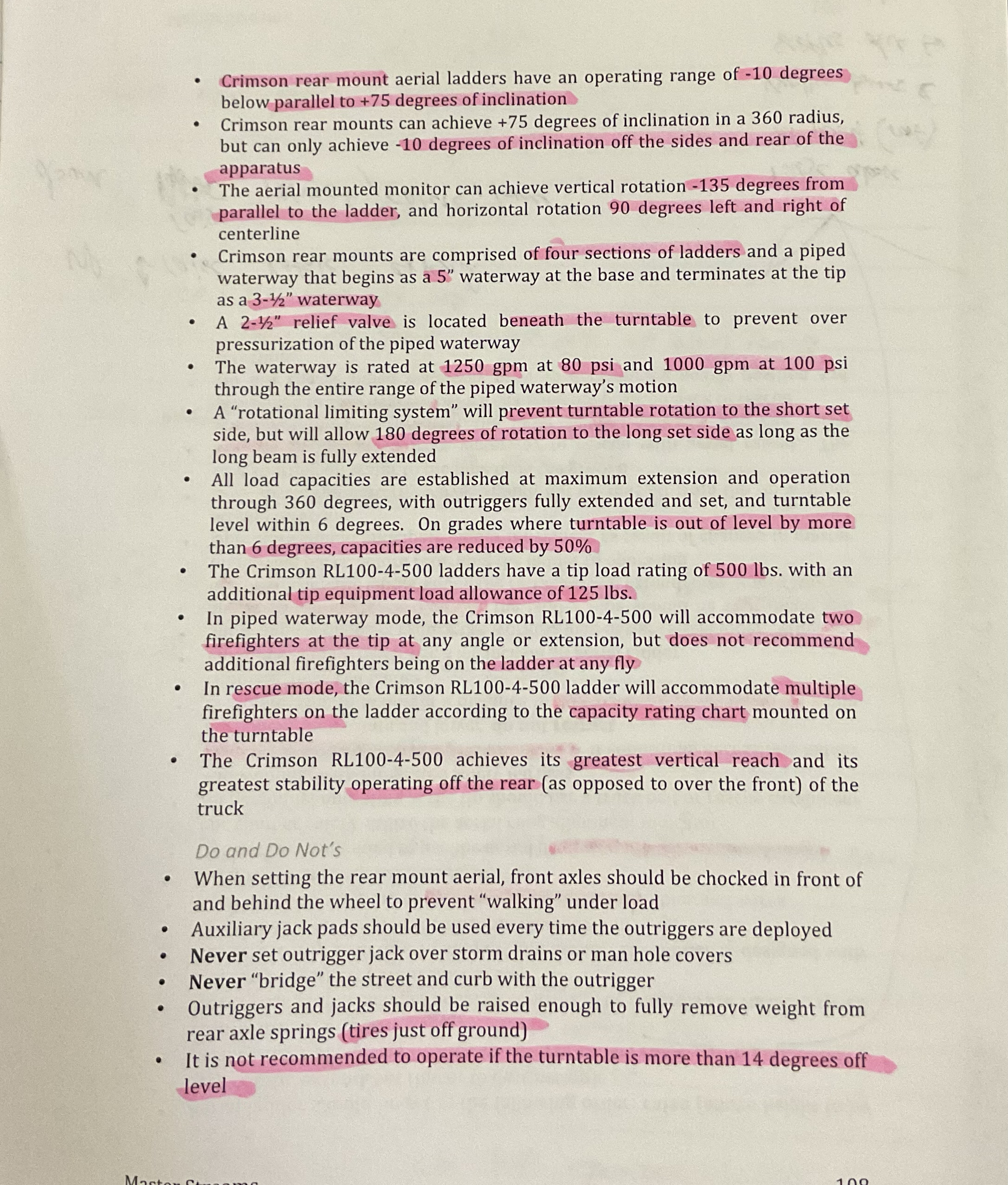
Short set ladder- outriggers not fully extended on non fire side, 9percent to short side
stop short, pull past for better scrub
Strip centers
Most common variant: flat roof w/ veneer walls, likely parapet
Constructed of UNprotected open web joist
Drop down ceiling? Cockloft
RUN PERPENDICULAR TO LONG WALL WHEN UNSUPPORTED COLUMNS
TR gains access, use TIC, see truss type, condition, and direction
place water early to freeze trusses
signs of wall failure= ~cracks in load bearing wall
~corners pulling apart
~sagging lentils
~failed parapet
~falling veneer
(first wall to fail is perpendicular to truss direction = long wall)
EN alpha side, place stream on trusses
Attack lines
If using truck for piped water alpha side, in direction to exposure near engine
Charlie side for piped water and ventilation
Below grade set? Tr= parallel to storefront and ladder swinging 45 degrees away from cab
Considerations: nozzle angles, can go ⬇135 degrees but not raise up due to ladder rungs
Parapets, place back 1 ½ X parapet height
2nd TR: one on alpha one on Charlie
Alpha= access, piped waterway
Charlie= roof ops
Roof ops nuggets:
cut off fire= trench cut= slows horizontal fire spread, length of building short wall cut
localize fire= release heat, smoke. Behind fire
Taxpayer
Store front with load bearing walls adjacent with occupancies
VOID SPACES
Check vertical extension
master stream= deep into structure as possible as close to seat as possible
Advantages: 2-3 lane road, can stack set engine and truck
Masonry load bearing walls hold floors and roof joists, designed to withstand vertical loads not horizontal failing joist and floor systems
EN pull past and position at far corner
TR stop short of building on opposite corner
Tilt slab
Not sprinkled, wide variety of materials, structure doesn’t reveal use on outside
Must inspect underside of roof due to wide variety of trusses, usually no drop down
Metal shows heat, TIC can only read heat not through things
wood trusses with gusset plates= much greater hazard
EN must attempt to find seat before placement
TR priority is gaining access, set away from seat, perpendicular to trusses
Barn door cuts to not pull fire due to rapid air introduction
2nd TR access to rear
Monolithic multi on top of tilt slab
Business and residential 1st floor is commercial 2-4 floor is residential
Usually has 10 ft ceiling w/ 2 foot void space between floors
4 story can be equivalent to 5
Rescues may only be performed in interior stairwells
! Rapid fire spread in voids!
They use prefab open wed gusset plated trusses
ANY indication of smoke or fire transmit an immediate second alarm, staging at least a block away
High rise
Engine placement dictated by FDC
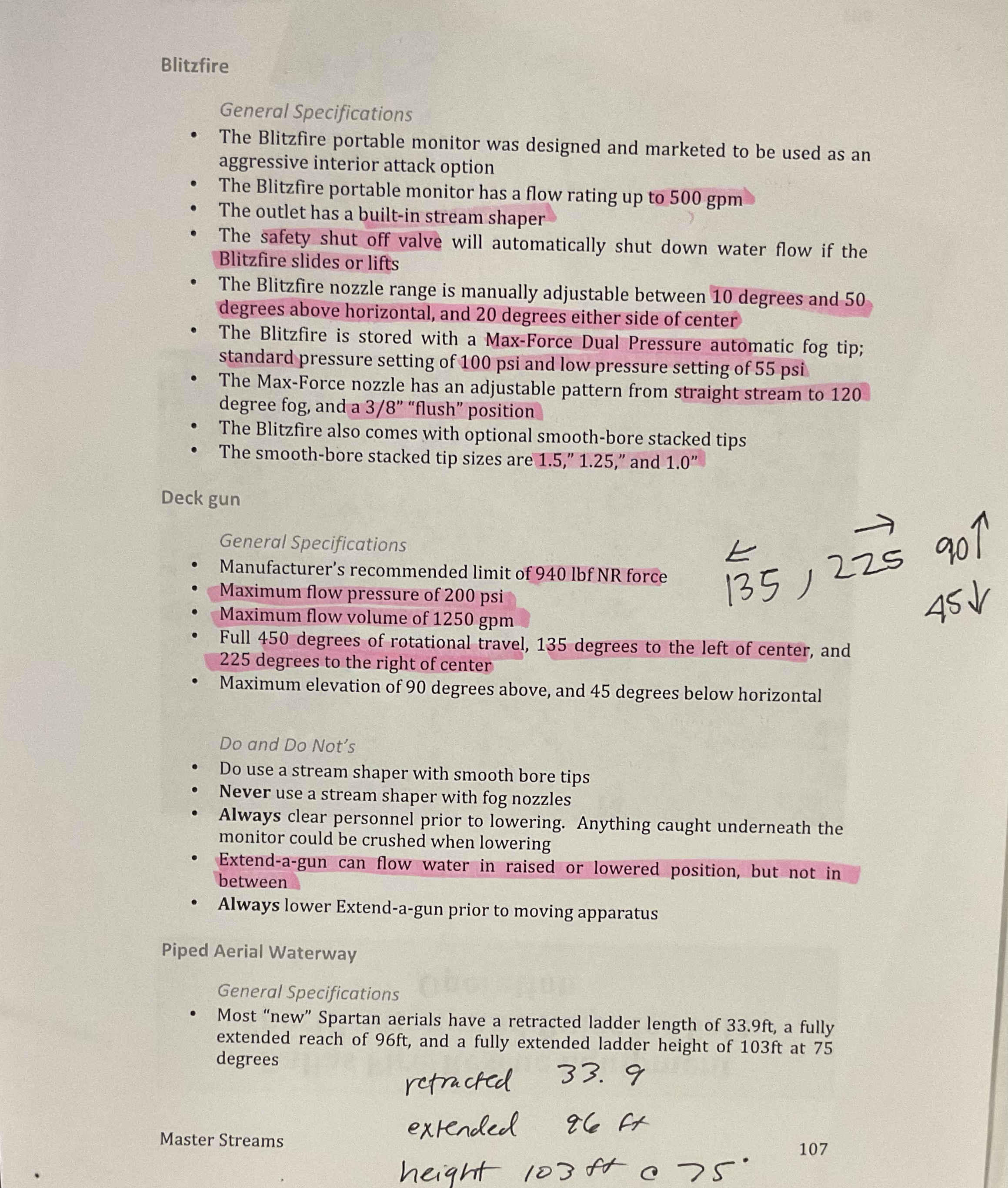
Deck gun, central master stream= Theoretical vertical reach of 140 ft at 75 degrees nozzle inclination (Max angle for aerial)
Aerial- vertical reach of 140 ft stream
Vertical reach of ladder 103 ft
Theoretical reach of 243 ft, 20 stories
More logical, practical reach is 14 stories at 75 degrees nozzle inclination
Auto exposure is most rapid form of fire spread
Rescue is always fire ground priority
Safer to evacuate through interior stairs
TR placement 34ft from structure (length of bedded ladder) for 4th floor and below ; can reach 6-7 stories
Placement higher than 4th floor, position closer
Max ladder reach is most efficient position turntable off back (greatest strength, closest to structure)
DFR SPECIFICS
NOZZLES: smooth bore; fixed gallonage
Automatic constant pressure fog nozzle
Master streams: Blitz, deck gun, ladder pipe
Smooth bore: earliest invented
Advantages
Volume at low pressure
Minimal stream production
Minimal air entrapment
Stream reach
Stream penetration
oversupplied SB creates a convergent stream; poses as fog stream due to break over
Practical pressure of 80-110 PSI
Automatic constant pressure for nozzle : Invented 1960s by chief McMillian Indiana Task Force
adjusts flow by progressive coil spring
Works like PRV on engine; pressure goes up or down so does the discharge opening
GPMs may change but will provide constant discharge pressure
Automatically adjusts to pressure changes
need more water? Just pump more pressure
Drawbacks: 1. Minimum op pressure of 100 psi, will flow lower but gpm deficient
Max flow rating; max water that can fit through
Nozzle reaction ; based on person, not equipment like the master stream devices
Range of 150-1250 GPM, constant pressure at 100-105 psi
Blitz fire
Aggressive interior knockdown
Max flow from manufacturer is 500, DFR tested up to 600 GPM
2 nozzles ; SB THREE STACK AND DUAL MAX FORCE FOG
FOG; low at 55psi, NP goes down by 50%
High pressure, 100 psi
SMOOTH BORE: TFT STACKED
1 256 GPM
1 ¼ 415 GPM 80 PSI
1 ½ 598 GPM
DECK GUN
RC3 TELESCOPING WATERWAY W HURRICANE RC MONITOR
3 in waterway
1250 GPM
200 max pressure
900 max NP
12” of travel
Nozzles
1250S FOG
100PSI 1250 GPM
SMOOTH BORE STACKED TIPS 4
1.375 500 GPM 200 max psi 80-110 generally
1.5 600 GPM 200
1.75 810 GPM 175
2 1000 GPM 150 110 psi @1250 GPM ; greatest vol and reach
Aerial piped waterway
Ladder:
Horizontal reach 96 ft
Vertical reach 103 ft
Max of 75 degrees incline at 360 rotation
-10 degrees off rear
900-1180 GPM
Monsoon RC monitor
Max 2000 GPM
Max 200 psi
Max NR 1200 lbf
Can rotate 90 degrees left and right
-135 degrees
Nozzles
1250S fog 100 psi 1250 GPM
4 stack SMOOTH BORE
2 1060 GPM
2 ¼ 1350 All at 80 psi
2 ½ 1660
2 ¾ 2010
Supplying master streams
Affecting quality and effectiveness
Water supply, hydrant
Engine capability, hydraulic pump
Flow capacity, friction loss
Min. Required flow rate, monitor and nozzle
Hydrants
Red 500 Dead end
Aluminum 1000 Intra main
Blue 1500 Intra main large
Yellow 1500+ Intra main large industrial
En only has psi intake gauge, does not read GPM
initial PSI for, hydrant is usually 90, don’t go below 20 psi
“Run away from water” pump exceeds available water; hydrant is at its limit
“Run away from pump” ran out of throttle before water
Need another plug?
Discharge capability of your engine
GPM discharge
Capability of hydrant
EN hydraulic pump
Waterous CMV 2 stage centrifugal pump
NFPA rating are established while drafting, 10 ft above, pump has to generate all the pressure, I’m volume
Only switch from pressure to volume when pump required to discharge 50-75% of total GPM rating
Why? -Most fires are hand lines 1st; pressure driven
- assumptions are made on drafting situation
Pump
Impeller takes volume at certain pressure
Uses centrifugal velocity to build on it
Pressure- sends to one impeller, volume goes down because only using one not both impeller.. first #1 adds pressure and passes to the next
Volume- both impellers = up in volume
Both build on pressure passing through independently, pump only boosted once
PRESSURE IS SERIES IS DUAL STAGE
VOLUME IS PARALLEL IS SINGLE STAGE
Volume puts out fire, pressure is tool that drives the volume
Pressure is hammer that drives the nail of volume
Pressure- once perm water established discharge can be between 180-210 psi @ idle
Can generate 600 psi as long as volume is below half rated (750 GPM)
Volume- 3000 GPM while 150-170 psi; 2 5’ lines
Less than 1500 GPM can maintain 300 psi
Typical FF ops = Volume mode
= pre connected line, deck gun, aerial, portable master streams, overhaul
Pressure mode =
high rise situations
Standpipe NO PRV, fire floor over 10th floor
Standpipe has PRV building exceeds 10 stories
Excess of 250 psi or 350 compounded
Flow capabilities
Diameter, length of hose
Elevation changes
Friction loss
FL
1 ¾ 15 per section
2 ½ 5 per section
5 per floor
Standpipe riser:
Not equipped with PRV you estimate EL up to top control (highest floor needing hose line)
Equipped with PRV you est EL to roof of building(length of riser)
Master streams FL 25 per appliance
Deck gun
Aerial
Blitz
Fire ground FL of 10 psi
Trimese
Gated wye
Manifolds
Water thief
Impacts
5 min for mod structures
10 min for large Longer ? No knockdown? Prepare for long duration operation
Master stream placed ? Wait at least 20 min for re entry