Chapter 8 Intro To Metabolism
cell respiration
cell respiration: extracts energy. stored in sugar and other fuels
metabolism
- totality of an organisms chemical reactions
- emergent property
- metabolic pathway: begins with a specific molecule and ends with a product
pathways
- catabolic pathways: release energy by breaking down complex molecules into simpler compounds
- anabolic pathways: consumes energy to build complex molecules from simpler ones
biogenetics
- biogenetics: study of how energy flows through living systems
energy
- energy: capacity to cause change
- can be converted from one form to another
- kinetic energy: energy associated with motion
- thermal energy: random movement of atoms or molecules
- heat: thermal energy in transfer between objects
- potential energy: energy matter possess based on location/structure
- chemical energy: potential energy waiting to be released in a chemical reaction
laws of energy transformation
- thermodynamics: study of energy transformations
- isolated system: liquid in a thermos, unable to exchange energy ot matter with its surroundings
- open system: energy and matter can be transferred
- organisms are open systems
==first law of thermodynamics==
- energy of the universe is constant
- cant be created or destroyed
- aka principle of conservation of energy
@@second law of thermodynamics@@
- some energy is unusable and is often lost as heat
- every energy transfer increases the entropy of the universe
- entropy: measure of molecular disorder, randomness
- spontaneous process: occur without energy input; they can happen quickly or slowly
- non spontaneous processes decrease entropy; occur only if energy is provided
biological order and disorder
- organisms create ordered structures from less organized forms of energy and matter
- organisms can also replace ordered forms of matter and energy in their surround with less ordered forms
- ex: animals consume complex molecules in their food and release smaller, lower energy molecule and heat into their surroundings
free energy
- free energy: energy that can do work when the temperature and pressure are uniform
- measure of a systems instability, tendency to change to a more stable state
- change in free energy; delta G
- spontaneous change- free energy decreases
- equilibrium: state of maximum stability
- a process is spontaneous and can perform work only when it is moving toward equilibrium
free energy and metabolism
- exergonic reaction: net release of free energy and is spontaneous
- endergonic reaction: absorbs free energy from its surroundings and is non spontaneous
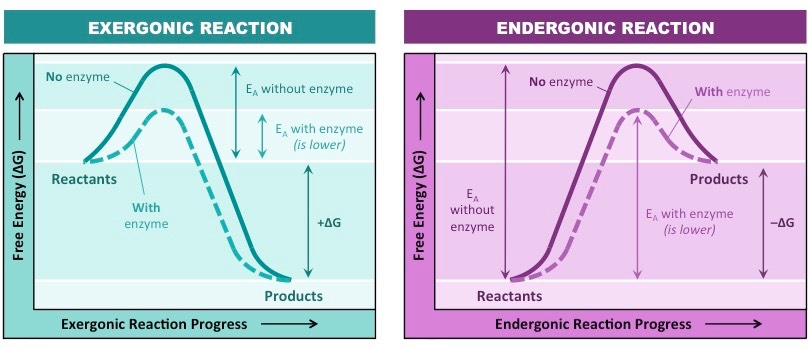 equilibrium and metabolism
- reactions in a closed system eventually reach equilibrium and then can do no work
- cells are not in equilibrium: open systems experiencing a constant flow of materials
- our metabolism is never at equilibrium
- catabolic pathway in a cell releases free energy in a series of reactions
ATP
- cell does 3 main types of work
- chemical work: pushing endergonic reactions
- transport work: pumping substances against the direction of spontaneous movement
- mechanical work: such as contraction of muscle cells
- energy coupling: use of an exogenic process to drive an endergonic one
- most energy coupling is used by atp
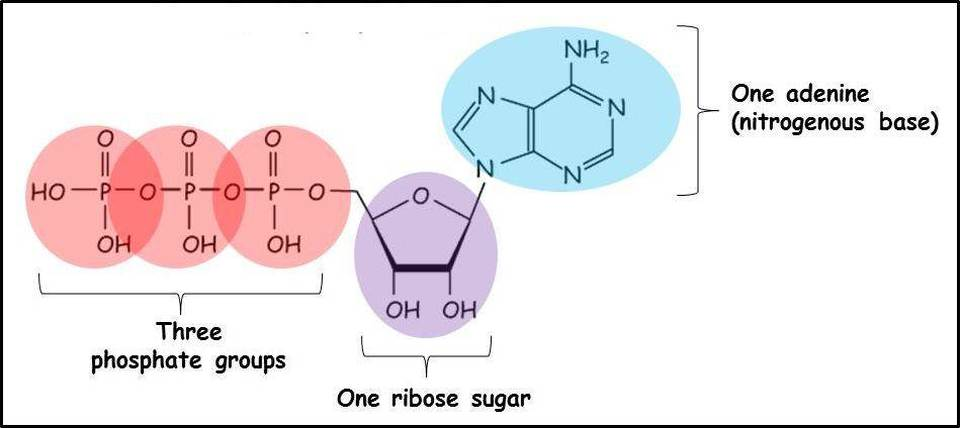
composed of
- ribose (sugar)
- adenine (a nitrogenous base)
- three phosphate groups
how does atp hydrolysis perform work?
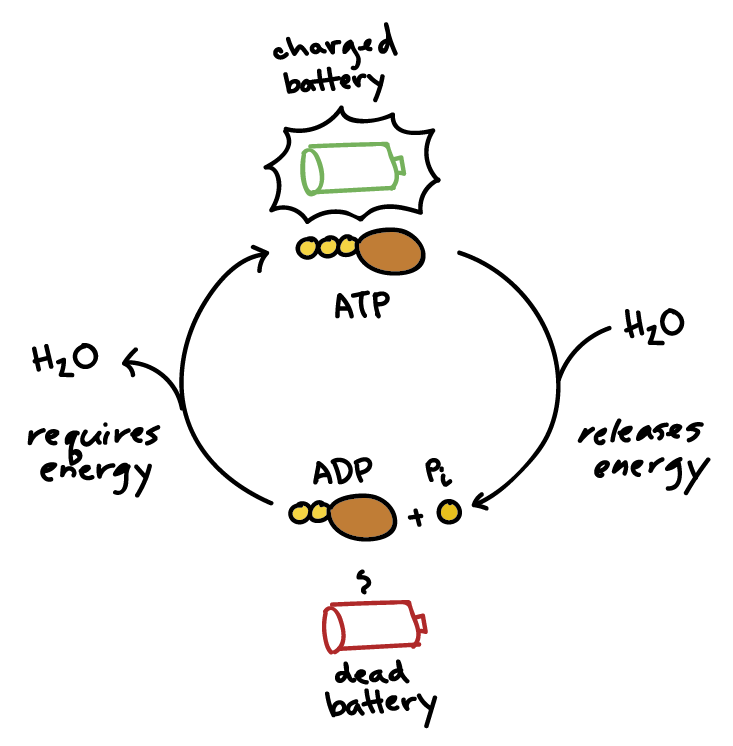
- hydrolysis of ATP makes ADP (adenosine diphosphate)
- from exergonic to endergonic reaction
- phosphorylation: transfer of a phosphate group to some other molecule, like a reactant
- phosphorylated intermediate: recipient molecule
- transport and mechanical work in the cell are powered by atp hydrolysis
- leads to a change in protein shape and binding ability
regeneration of atp
- renewable source that is regenerated by addition of a phosphate group to ADP
- energy comes from the catabolic reaction in the cell
- ATP cycle is a revolving door through which energy passes during its transfer from catabolic to anabolic
enzymes
- enzyme: catalytic protein
- ex. sucrase catalyzes the hydrolysis of sucrose (helps facilitate the split)
enzymes activity can be affected by
- general environmental factors, like pH and temperature
- chemicals that specifically influence the enzyme
- catalyst: any chemical agent that speeds up a reaction without being consumed by the reaction.
- catalysis: enzymes or other catalysts speed up specific reactions by lowering the activation energy barrier.
- optimal temperature: the temperature at which a procedure is best carried out
- optimal pH: the pH at which a procedure is best carried out
activation energy barrier
- activation energy: initial energy needed to start a chemical reaction (free energy of activation)
- often supplied in the form of thermal energy that the reactant molecules absorb from their surroundings.
substrates specificity of enzymes
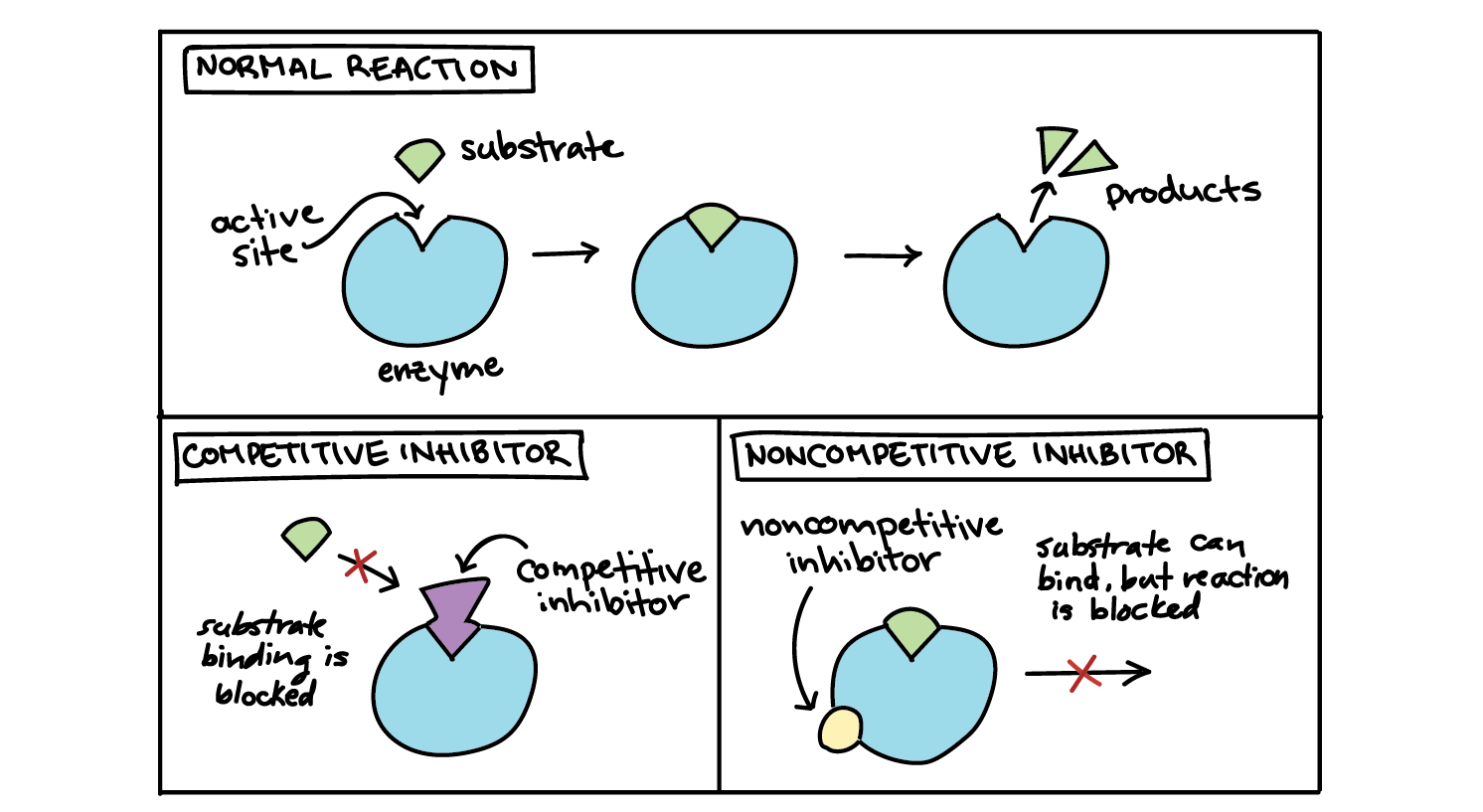
- substrate: the reactant that an enzyme acts on
- enzyme-substrate complex: the enzyme binds to its substrate
- active site: region on the enzyme where the substrate binds
- induced fit: brings chemical groups of the active site into positions that enhance their ability to catalyze the reaction
- fast acting and emerge from reactions in their original form.
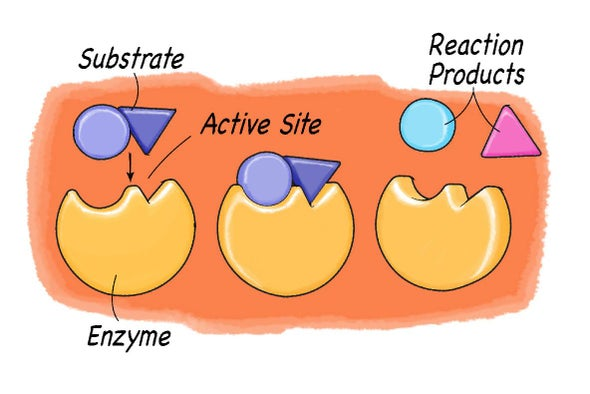 process of enzyme-substrate complex
- substrate enters active site
- substrates are held in active sire by weak interactions
- the active site lowers activation energy
- substrates are converted to products
- products are released
- active site is available for new substrates
- process starts over
catalysis
active site can lower activation energy barrier by covalently bonding to the substrate
- the rate of reaction can be sped up by increasing substrate concentration
- if enzyme is saturated, the reaction rate can only be sped up by adding more enzymes
cofactors
nonprotein enzyme helpers
- coenzymes: an organic cofactor; includes vitamines
- competitive inhibitors: binds to the active sire of an enzyme, competing with the substrate
- noncompetitive inhibitors: binds to another part of an enzyme, causing the enzyme to change shape and making the active site less effective
##  regulation of enzyme activity helps control metabolism
- if a cells metabolic pathways were not tightly regulated, chemical chaos would result
- a cell does this by switching on or off the genes…
## allosteric regulation
- inhibit/stimulate an enzymes activity
- occurs when a regulatory molecule binds to a protein at one site and affects the protein’s function at another site.
- made from polypeptide subunits
cooperativity
- form of allosteric regulation that can amplify enzyme activity
feedback inhibition
- the end product of a metabolic pathway shits down the pathway
- prevents a cell from wasting chemical resources by synthesizing more product than is needed.