COMM 1000: Module 7: Proffessional Communication
In Class: Professional Communication
Date: 3/9/2026
What is professional communication?
Engaging in successful, appropriate, and beneficial interactions across a variety of professional contexts
Effective way of communication
– Interviewing
– Relational Communication
– Written Documents
– Presentational Speaking (public speaking)
– Mediated Communication
Why study this?
Professional contexts are increasingly varied and increasingly competitive (job sector - need to stand out in the right way with good communication skills)
Being a strong communicator immediately sets you apart from other applicants and employees
Identifying weaknesses in our communication helps to lower stress, increase productivity, and improve work experiences
Nerves are normal
Communication Apprehension: An individual’s level of fear or anxiety associated with either real or anticipated communication with another person or persons (McCroskey, 1982)
→ Types: Trait (diagnosed w/anxiety or have), Context-Based (format of our communication), Audience-Based (change the communication as well - can make apprehension), Situational (if there is an emergency)
→ Causes: Novelty, formality, subordinate status, peer evaluation, dissimilarity(fight/flight response when people are not similar with you), prior history (trauma baring itself when returning to that situation)
Interviewing
Tips
Preparing
Congratulations! Put your best foot forward
Anticipating Questions; behavioral (open-ended) and traditional (why do you want to work here?)
During the interview
Maintain professionalism at all times (signaling posture, voice)
Monitor your nonverbals (nervous face - do not want this)
Stay positive and stay flexible
Don’t ramble ; do smile
After the interview
Thank the interviewer(s); then send a thank you note
Provide any requested information immediately (attentive + a good coworker)
Workplace relations
Communicating with superiors
Ingratiation: Kissing up to your boss (you are a great boss!)
Advocacy: Using messages that align with your boss’s needs (certain priorities - focus on the main stuff that boss wants ; what matters to you matters to me)
Communicating with coworkers
Meets both Task and Social needs (building bonds)
Relationships can grow intense with proximity and time
Be careful: Romance at work; Appropriateness & TMI
Have a professional ethos: polite, timely, focused, positive (tends to go well when done in interactions)
Communicating with customers
Quick responses, careful listening, customer-focused
We have a lot more to lose than the customer - be careful when lashing out
Difficult customers require patience, good decision-making
Professional Writing
Strong, coherent message structure
Know what you’re trying to say, accomplish
Clear organization (outlines can help)
Know your audience and tailor to them
About receiver and what they want to receive
What’s their investment? Level of understanding?
Interest?
Do the little things
Avoid typos, misspellings, grammatical errors
Strong layouts, clear fonts, use whitespace
When and how to use AI: Sometimes it makes up stuff that isn’t true
Presenting: A few key tips
Do you research
Do research on the topic beforehand
If flow is throwed off and they might not be able to think something on the spot
Know enough about the topic so you can talk about it confidently
Settle down
Calm down nerves - interact with people ; stop worrying so much about yourself
What happens first
Set the tone: what happens first matters ; opening matters
Primacy effect: first exposure matters
Owning the room
Own the room, use the space - moving around a little
Nonverbal reciprocity motivates speaker
Don’t forget the visuals
Visual aids have to look good
Make the slides compelling
Use media as a quick time out
What happens last
What happens at the end is also critical too
Circling around to end smoothly
“Thank you” can also end a speech - nonverbal communication
Be a storyteller
Use context!
Video Lecture: Organizational Communication
We are all part of an organization (club, business, schools)
Root itself in thinking about systems
Organization Culture
A continuum from Traditional to Innovative
The Whole of an organization’s behavior patterns
Involves multiple components
→ Individualism:individuals themselves/Collectivism: as a group
→ Power Distance: How far away from leadership does every person in the organization think they are?
→ Dominance: How people communicate - dominate and control OR fluid/open?
→ Time: How do we use/prioritize time?
→ Uncertainty Avoidance: Situations where we are not sure what's going on.. Strong effort to be clear/not worrying if not on track
Deal and Kennedy’s Culture types
Thought about how different organizations shape their cultures based on how fast/slow you get feedback about performance
Or high/low it is to hit your wagon to this organization (low or high risk situation)
→ Work hard/play hard: Fast feedback speed, but low risk endevor (sales orientated business - the employees don’t take a ton of risks but feedback = nearly immediate ; bringing in money) → individualist enviroment
→ Tough guy, macho: Feedback speed is fast ; degree of risk = high (might get fired time= money) - culture in entertainment, sports, or advertising
→ Process: feedback speed is slow, degree of risk = low ; retail companies, banks, insurance, university work setting → slow culture (takes years to see if someone has made a success or not..)
→ Bet your company: feedback speed is slow, but the degree of risk = high ; pharmacutietical sales, oil companies → lot of $ to sell a product/successful - takes a while to pull it off
All four of these cultures tend to materialize differently based on the circumstances in which people are doing the work - beahvior can be shaped by tone + environment based on culture
Communication in organizations
Command function: Tell people what to do using communication
Relational function: Connect one another and form bonds whether for professional purposes/personal purposes
Ambiguity-Managemet Function: Things in various organizations that some people need to know while others do not need to know ; open book or not.. ; key part of teaching
Organizational Communication Patterns
Upward communication: Employees and subordinates give management information for decision making - can use to make operation better
1)relieve employee frustration
2)enhance a sense of participation
3)allows gage whether it is effective
4)suggest better uses
Downward communication: Supervisors give direction to the workers - give a due date
Horizontal communication: Talk to our peers - task coordinating, solving problems, forming long term relationships w/people in shared enviroment
Communication networks
Wheel: Leader operates in the middle and everybody in the organization gets information directly from leader
Chain: Military (chain of command) - chain of formal commands: so the person at the highest point of the network shares information down, share down to report to them → linear network
All-channel: Everyone can and does interact together
Rumors
Leveling, sharpening, assimilation
Leveling: as people retell the rumor/story - they reduce details to be efficient
Sharpening: As we tell storys, we impart our own opinions to say what is important
Assimilation: Sometimes our brain distort the actual rumor itself
Two purposes: self serving: share a rumor where we benefit ourselves ; group serving: try to get other people to think
Organizational Change
Communication in organizations lead to prompt change - failure of organization communication
Senstative to changes: ripple effects
Video Lecture: Leadership
“Great Leaders Make you Feel Safe!” - Simon Sinek
An organization is very much similar to a tribe ; looked out for one another - communicate, thrive, feeling supported
Good Leader
Has the skills such as inspiration + intergrity
Leader-Member Exchange Theory
Focus on the interactions between leaders and followers that shape an organization’s culture
Leaders and members have relationships
These relationships affect how subordinates behave and perform in the organization
Communication Accomidation Theory
We adjust our communication style when interacting with other people
Convergence: changes to mirror interaction partners
Divergence: changes to highlight differences
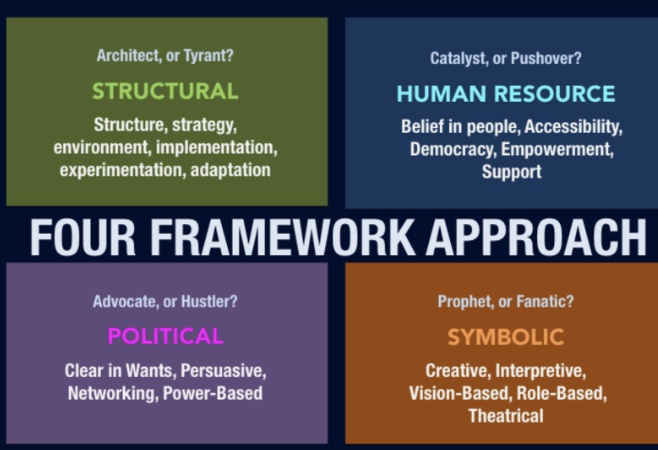
Four Framework Approach
“Successful leaders, we have found, are great askers. And they do pay attention.” Bennis & Nanus, 1985