Learning
How do we learn?
Learning - the process of acquiring new and relatively enduring information or behaviors.
Information must stick around (no cramming for test)
We expect and prepare for certain events (arrival of food) - classical conditioning
Learn to repeat actions that bring good outcomes - Operant Conditioning
Learn new behaviors by observing people and events - Cognitive Learning
But how do we learn?
Humans learn from experience
Nature’s most important gift is humans ability to adapt
Association we learn through habits. Habits form when we repeat behavior in a given context. As we repeat this behavior, the next time we encounter that context, we will evoke our habit. Behavior turns into habits after 66 days.
Seals will repeat behavior (clapping) once it learns that doing so will get it treats
Associative Learning - learning that certain events occur together. The events may be two stimuli (as in classical conditioning) or a response and its consequence (as in operant conditioning).
since we know after lightning comes the boom of thunder, we start to brace ourselves just from the lightning, not the boom.
classical conditioning
Respondent Behavior - behavior that occurs as an automatic response to some stimulus. (bracing ourselves from the lightning)
Operant Behavior - behavior that operates on the environment, producing a consequence.
Associate our action with a consequence. We then repeat the action in order to achieve good results (or avoid bad ones)
Kid learns that being polite means you are more likely to get what you want
Cognitive Learning - the acquisition of mental information, whether by observing events, by watching others, or through language.
Lets humans learn though other’s experience
Classical Conditioning
Classical Conditioning - a type of learning in which we link two or more stimuli and anticipate events.
Explored by Ivan Pavlov
Said psychology was a science and should be based in experiments
Pavlov’s Experiments
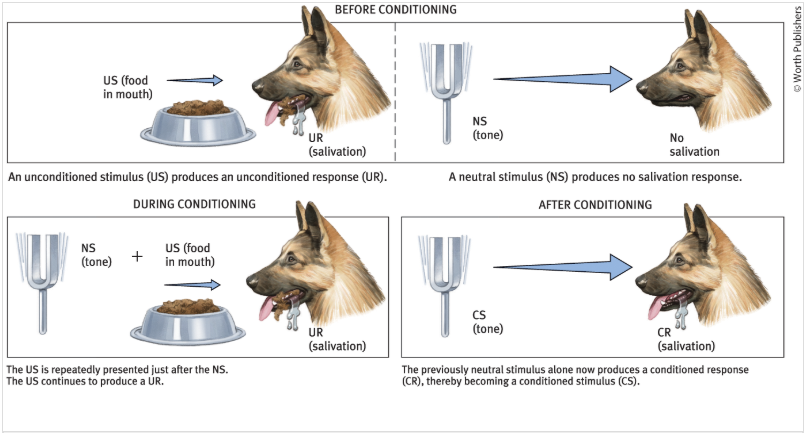
Studied Dog’s digestive system and then later on, learning
Noticed that when he put food on the dog’s tray, their mouths would begin to salivate
Not at the taste of the food, but at the sight of it
Neutral Stimulus - in classical conditioning, a stimulus that evokes no response before conditioning.
When you first see lightning, you don’t have a reaction (its neutral)
If these stimulus happened before the dog was given food, would the dog connect the stimulus and the food? Would the dog start to salivate?
Yes and yes!
A dog doesn’t learn to salivate in response to food in its mouth; food in the mouth automatically, unconditionally, triggers this response.
The dog salivating in response to a bell is a learned response
Unconditioned Response - in classical conditioning, an unlearned, naturally occurring response (such as salivation) to an unconditioned stimulus (US) (such as food in the mouth).
Natural response to a unconditioned stimulus
Unconditioned Stimulus - in classical conditioning, a stimulus that unconditionally — naturally and automatically — triggers a response (UR). The food for the dogs
When you first hear a boom of thunder, you automatically respond
Conditioned Response - in classical conditioning, a learned response to a previously neutral (but now conditioned) stimulus (CS).
The dog salivating once it heard the bell
You connect the lightning and the boom of thunder, and you prepare for the thunder
Conditioned Stimulus - In classical conditioning, an originally neutral stimulus that, after association with an unconditioned stimulus (US), comes to trigger a conditioned response (CR).
You see lightning and know thunder will happen
Tuning Fork/bell with Pavlov’s Dogs
If Pavlov’s research was so simply, why did he continue to study it for 3 decades?
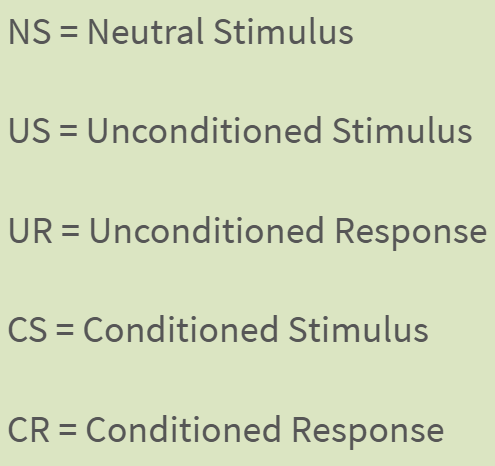
Five Stages of Conditioning Processes:
Acquisition
Extinction
Spontaneous Recovery
Generalization
Discrimination
Acquisition
Acquisition - in classical conditioning, the initial stage — when we link a neutral stimulus and an unconditioned stimulus so that the neutral stimulus begins triggering the conditioned response. (In operant conditioning, the strengthening of a reinforced response.)
The point when the dogs linked the bell and the salivating
how much time passes between the bell and the salivation (half a second)
What would happen if the food was first, then the bell?
the conditioning would not happen. The order must go stimulus then response
Present the neutral stimulus and unconditioned stimulus in order to connect them together
Strengthen the response
Extinction and Spontaneous Recovery
What would happen if the bell rang, but no food showed up?
CS occurred without no US
Extinction - in classical conditioning, the weakening of a conditioned response — when an unconditioned stimulus does not follow a conditioned stimulus. (In operant conditioning, the weakening of a response when it is no longer reinforced.)
Forgetting the connection between the two stimulus
Spontaneous Recovery - the reappearance, after a pause, of a weakened conditioned response.
The dog will learn faster the second time around
Generalization
A dog conditioned to the sound of a bell would also respond to the sound of another different bell
Called stimulus generalization
Generalization - in classical conditioning, the tendency, after conditioning, to respond similarly to stimuli that resemble the conditioned stimulus (CS). (In operant conditioning, when responses learned in one situation occur in other, similar situations.)
Can be adaptive:
Toddlers who fear cars can learn to fear trucks/motorcycles
Can Linger:
A journalist who was tortured in prison flinches whenever he sees black shoes (the first sight of his torturers in prison)
Discrimination
Dog’s learned to respond to the sound of one bell and not the sound of another
Discrimination - knowing the differences between one stimulus and another
Your iPhone knows what your face looks like from multiple different angles (generalization)
Your iPhone is able to differentiate your face from others (discrimination)
Pavlov’s Legacy
Most psychologists agree that classical conditioning is the primary form of learning
Many other responses to many other stimuli can be classically conditioned in many other creatures
Pavlov showed us how a process such as learning can be studied objectively
Used to show how psychology might progress when experimenting
Modern neuroscience has identified neural circuits that link a conditioned stimulus (warning signal) with an upcoming unconditioned stimulus (threat)
Responses to stimuli can be classically conditioned in many other species
Classical Conditioning in Everyday Life
Medical Treatments - cancer treatments can cause vomiting. Patients develop classically conditioned nausea to sights, sounds, and smells of cancer clinics
Drug Cravings - People who formerly misused drugs often feel a craving when they are again in the drug-using context, because their brain has become conditioned to associate that context with a drug’s reward. Drug counselors tell their patients to stay away of any people/places associated with drug usage
Food Cravings - Sweet foods create cravings
John B Watson said that Pavlov’s research could help us understand our emotions
Showed an infant a white rat (the kid was not afraid). The next times they showed the rat, a loud noise was made behind the infant’s head. This was repeated and eventually the infant started crying at just seeing the rat)
Super unethical
Operant Conditioning
Operant Conditioning - a type of learning in which a behavior becomes more probable if followed by a reinforcer or less probable if followed by a punisher
Behavior that operates on the environment to produce rewarding or punishing events is called operant behavior.
Skinners Experiments
B.F Skinner was behaviorism’s influential and controversial person
His work built upon the research of Edward L. Thorndike’s Law of Effect
Law of Effect - Thorndike’s principle that behaviors followed by favorable consequences become more likely, and that behaviors followed by unfavorable consequences become less likely.
Skinner wanted to experiment that would reveal behavior control
Can we teach a pigeon how to bowl?
He shaped pigeons natural walking and pecking habits
Taught pigeons how to play ping-pong, and keep a missile on track
Operant Chamber - in operant conditioning research, a chamber (also known as a Skinner box) containing a bar or key that an animal can manipulate to obtain a food or water reinforcer; attached devices record the animal’s rate of bar pressing or key pecking
Reinforcement - in operant conditioning, any event that strengthens the behavior it follows.
Depends on the animal
Shaping Behavior
Shaping - an operant conditioning procedure in which reinforcers guide behavior closer and closer toward a desired behavior.
First observe the animals behavior in their natural habitat
Give rat the food whenever it gets close to the bar
Then give rat food the closer and closer it gets to the bar
finally require the rat to touch the bar to get food
Shaping allows for researchers to understand what nonverbal organisms can perceive
If we can shape them to respond to one stimulus and not to another, then we know they can perceive the difference.
Types of Reinforcers
Positive Reinforcement - increasing behaviors by presenting a pleasurable stimulus, such as food. A positive reinforcer is anything that, when presented after a response, strengthens the response.
Negative Reinforcement - Increasing behaviors by stopping or reducing an aversive stimulus, such as an electric shock. A negative reinforcer is anything that, when removed after a response, strengthens the response.
Negative reinforcement could lead to substance abuse (drinking to avoid stress)
Is not punishment, rather it removes a punishing stimulus
Operant Conditioning Term | Description | Examples |
Positive Reinforcement | Add a desirable stimulus | Pet a dog that comes when you call it; pay someone for work done |
Negative Reinforcement | Remove an adverse stimulus | Take painkillers to end pain; fasten seat belt to end loud beeping. |
Primary and Conditioned Reinforcers
Primary Reinforcers - an event that is innately reinforcing, often by satisfying a biological need
Unlearned
Conditioned Reinforcers - an event that gains its reinforcing power through its link with a primary reinforcer.
If a rat learned that a light turned on means there is food, the rat would work to turn on the light
The light became a conditioned reinforcer that is linked with food
Immediate and Delayed Reinforcers
Immediate reinforcers helps link the behavior with the reward
Giving the rat food as soon as it touches the bar
If you delay giving the rat food, it won’t connect the behavior with the reward
Immediate feedback means immediate learning
But unlike rats, Humans have the ability to respond to delayed reinforcers
learning to control our impulses in order to achieve more valued rewards is a big step toward maturity
Sometimes, small immediate pleasures are more attractive than big but delayed rewards
Scrolling through Instagram at night vs getting a good nights sleep
Reinforcement Schedules
Reinforcement Schedule - a pattern that defines how often a desired response will be reinforced
Continuous Reinforcement - reinforcing a desired response every time it occurs.
Learning occurs rapidly
Extinction happens rapidly as soon as the reinforcement stops
Partial (intermittent) Reinforcement - reinforcing a response only part of the time; results in slower acquisition but much greater resistance to extinction than does continuous reinforcement.
Slot machines only reward players occasionally and unpredictably, but they still play them
Fixed-Ratio Schedule - a reinforcement schedule that reinforces a response only after a specified number of responses
Cafes giving us a free coffee after 10 purchases
Variable-Ratio Schedule - a reinforcement schedule that reinforces a response after an unpredictable number of responses
You never know when you will win at gambling, so you keep doing it
Fixed-Interval Schedule - a reinforcement schedule that reinforces a response only after a specified time has elapsed.
People waiting for a letter check more often as the delivery date approaches
Creates a “stop-start” pattern rather than a steady response pattern
Variable-Interval Schedules - a reinforcement schedule that reinforces a response at unpredictable time intervals
At unpredictable times, a food pellet rewarded Skinner’s pigeons for persistence in pecking a key
Produces steady response patterns
Fixed | Variable | |
Ratio | Every so many: reinforcement after every nth behavior, such as a “buy 10 coffees, get 1 free” offer, or paying workers per product units produced | After an unpredictable number: reinforcement after a random number of behaviors, as when playing slot machines or fishing |
Interval | Every so often: reinforcement for behavior after a fixed time, such as Tuesday discount prices | Unpredictably often: reinforcement for behavior after a random amount of time, as when checking for a social media update |
Response rates are higher when reinforcement is linked to the number of responses (a ratio schedule) rather than to time (an interval schedule)
responding is more consistent when reinforcement is unpredictable (a variable schedule) than when it is predictable (a fixed schedule)
Punishment
Positive Punishment - an event that decreases a behavior by administering a negative stimulus.
Negative Punishment - an event that decreases a behavior by removing a rewarding stimulus.
Type of Punisher | Description | Example |
Positive Punishment | administer an aversive stimulus | Spray water on a barking dog; give a traffic ticket for speeding |
Negative Punishment | Withdraw a rewarding stimulus | Take away a misbehaving teen’s driving privileges; Put a kid in time out |
Criminal behavior is influenced not by the threat of severe punishments but by swift punishments
Should adults punish kids physically? The answer is no:
Punished behavior is suppressed, not forgotten. This temporary state may (negatively) reinforce parents’ punishing behavior.
Physical punishment does not replace the unwanted behavior.
Punishment teaches discrimination among situations.
Punishment can teach fear.
Physical punishment may increase aggression by modeling violence as a way to cope with problems.
How should adults punish their kids → Time outs from positive reinforcement
You hit Emma? No more Dora the explorer!
Punishment tells you what not to do; reinforcement tells you what to do.
Skinners Legacy
Skinner believed that external influences (not internal thoughts and feelings) shape behavior.
Wanted people to use operant conditionings to influence other people’s behavior
Critics said that he dehumanized people by neglecting their personal freedom and controlling their actions.
Skinner’s response: External consequences already control people’s behavior. So why not steer those consequences toward human betterment?
Operant Conditioning in Everyday Life
At school:
skinner wanted “machines and textbooks” to give immediate reinforcements of correct answers
“Students must be told immediately whether what they do is right or wrong and, when right, they must be directed to the step to be taken next.”
At work and in sports:
It is better to make reinforcement immediate
Better to reward specific, achievable behaviors
Managers can praise workers for good work
In Video Games:
Game developers use reinforcement principles to create computer programs that mimic human learning.
In Parenting:
If parents give into whining and complaining, they reinforce that behavior. If the adult yells and that makes the kid comply it will lead to a strained relationship.
Notice people doing something right and affirm them for it. Give children attention and other reinforcers when they are behaving well
In Changing your own Behavior:
State a realistic goal in measurable terms and announce it.
Decide how, when, and where you will work toward your goal.
Monitor how often you engage in your desired behavior.
Reinforce the desired behavior.
Reduce the rewards gradually.
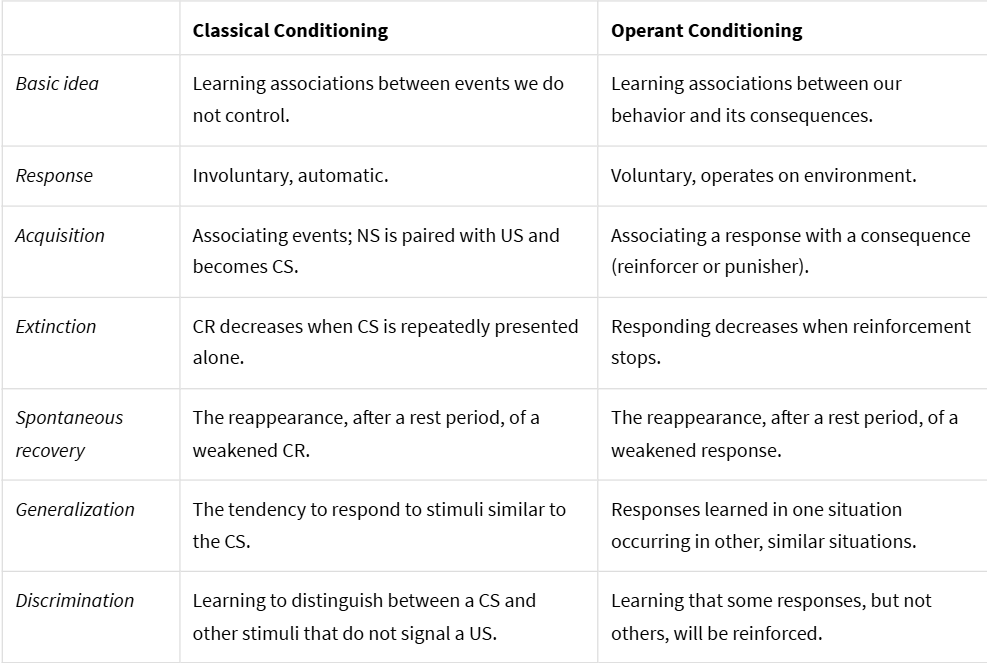
Contrasting Classical and Operant Conditioning
Biology, Cognition, and Learning
Biological Limits on Conditioning
Charles Darwin proposed Natural Selection aid in survival
There are limits on classical conditioning
Humans are biologically prepared to learn some things, rather than others
Species are predisposed to learn things needed in its survival
Biological Limits on Classical Conditioning
Rats avoid certain tastes that are linked with rat poison
not the sights or sounds that accompanied the rat poison
Taste aversion
In one study, wolves were fed sheep carcass filled with a sickening drug. The wolves would avoid sheep meat and sheep all together
Humans are biologically prepared to learn some certain things rather than others
our ancestors learned to avoid food that made us sick
Biological Limits on Operant Conditioning
It is easier to learn and retain behavior that reflects our biological and psychological predispositions
You can use food to make a hamster dig (they are used to digging for food)
You cannot use food to make a hamster wash its face (food is not connected to this type of behavior
Cognitive Influences on Conditioning
Cognition and Classical Conditioning
Behaviorism - the view that psychology (1) should be an objective science that (2) studies behavior without reference to mental processes. Most psychologists today agree with (1) but not with (2).
John B Watson said “Its theoretical goal is the prediction and control of behavior.”"
Underestimated two influences:
is the way that biological predispositions limit our learning
is the effect of our cognitive processes — our thoughts, perceptions, and expectations — on learning.
Early Behavioralists thought that dogs and rats’ learned behavior were mindless mechanisms
no need to learn cognition
Animals can learn predictability
If a shock is always preceded by a tone, a rat will learn to react with fear to the tone, because the tone reliably predicts the shock. What would happen if a tone always comes before the shock, but a light sometimes accompanies the tone? A rat will react with fear to the tone, but not to the light.
Tone is a better predictor
People being treated for alcoholism are given alcoholic drinks with a vomit-inducing drug. But if they know that it is the drug making them sick, not the alcohol, it weakens the association with drinking and getting sick
Cognition and Operant Conditioning
Skinner resisted the idea that cognition was needed in psychology
he died 8 days later
Cognitive Map - a mental image of the layout of one’s environment.
Rats running around a maze are able to memorize it
Latent Learning - learning that is not apparent until there is an incentive to demonstrate it.
kids who have their parents dive them to school are able to walk to school later
Excessive rewards can destroy intrinsic motivation
People who focus on their work’s meaning and significance do better work and earn extrinsic rewards
Classical Conditioning | Operant Conditioning | |
Biological Influences | Biological tendencies limit the types of stimuli and responses that can easily be associated. Involuntary, automatic. | Animals most easily learn behaviors similar to their natural behaviors; associations that are not naturally adaptive are not easily learned. |
Cognitive Influences | Thoughts, perceptions, and expectations can weaken or strengthen the association between the CS and the US. | Animals may develop an expectation that a response will be reinforced or punished; latent learning may occur without reinforcement. |
Learning By Observation
Observational Learning - learning by observing others.
You cannot learn how to be a good basketball player simply by watching LeBron James
Modeling - the process of observing and imitating a specific behavior.
the physical practice of basketball
Kids who watch adults beat up a blow up clown are then more likely to beat up a blow up clown
By observing models, we vicariously (in our imagination) experience what they are experiencing.
Mirrors and Imitations in the Brain
A monkey had electrodes on its head that would allow researchers to see activity in the frontal lobe (planning and acting out movements)
when the monkey put peanuts in its mouth, the machine would buzz because there would be activity
One day the monkey saw a scientist eating an ice cream cone, and the machine buzzed
as if the monkey itself was making that motion
Mirror Neurons - neurons that some scientists believe fire when we perform certain actions and when we observe others performing those actions; a neural basis for imitation and observational learning.
Humans mirror catchphrases, ceremonies, food, traditions, morals, fads, by copying one another
Emotions are contagious. We unconsciously mimic people’s posture, faces, voices, writing styles and we understand what the person is feeling
When a loved one is in pain, our brains light up the same way as theirs
Observational Learning in Everyday Life
People look, they listen, they mentally imitate, and they learn
Pro-Social Effects
Prosocial Behavior - positive, constructive, helpful behavior. The opposite of antisocial behavior.
After observing someone helping people, we become more helpful subconsciously
Kids observe and replicate their parent’s behavior
If parents have moral behavior, their kids are more likely to be moral
Kids are more likely to be religious if their parents practice with them
Anti-Social Effects
Anti-social Behavior - negative, destructive, harmful behavior. The opposite of prosocial behavior
Can explain why abusive parents have abusive kids
Aggressiveness can have a genetic link, and it can be environmental
If people are constantly hearing hate speech, they are desensitized to hateful language
TV shows can promote violent behavior, making people desensitized