(1) PSYCH. TESTING AND ASSESSMENT
TESTING ASSESSMENT
Alfred Binet Test -
- Developed by Alfred Binet and Theodore Simon (1905)
- Called as “Binet - Simon Scale”
- Was the first practical intelligence test used to know students who need special education.
- Introduced the concept of Mental Age
William Stern (WS) -
- developed a refied method of scoring Binet’s test — the Intelligent Quotient (IQ)
- He wrote that IQ Test should not degrade individuals.
(1) PSYCHOLOGICAL TESTEING AND ASSESSMENT “DEFINED”
The OSS model is used by the highly trained professionals — later inspired by known as Assessment Center — an approached to personnel evaluation.
Test is only used by professional assessors (ex. tool “Interview”) that value of the test is linked with the knowledge, skill, and experience of the assessor.
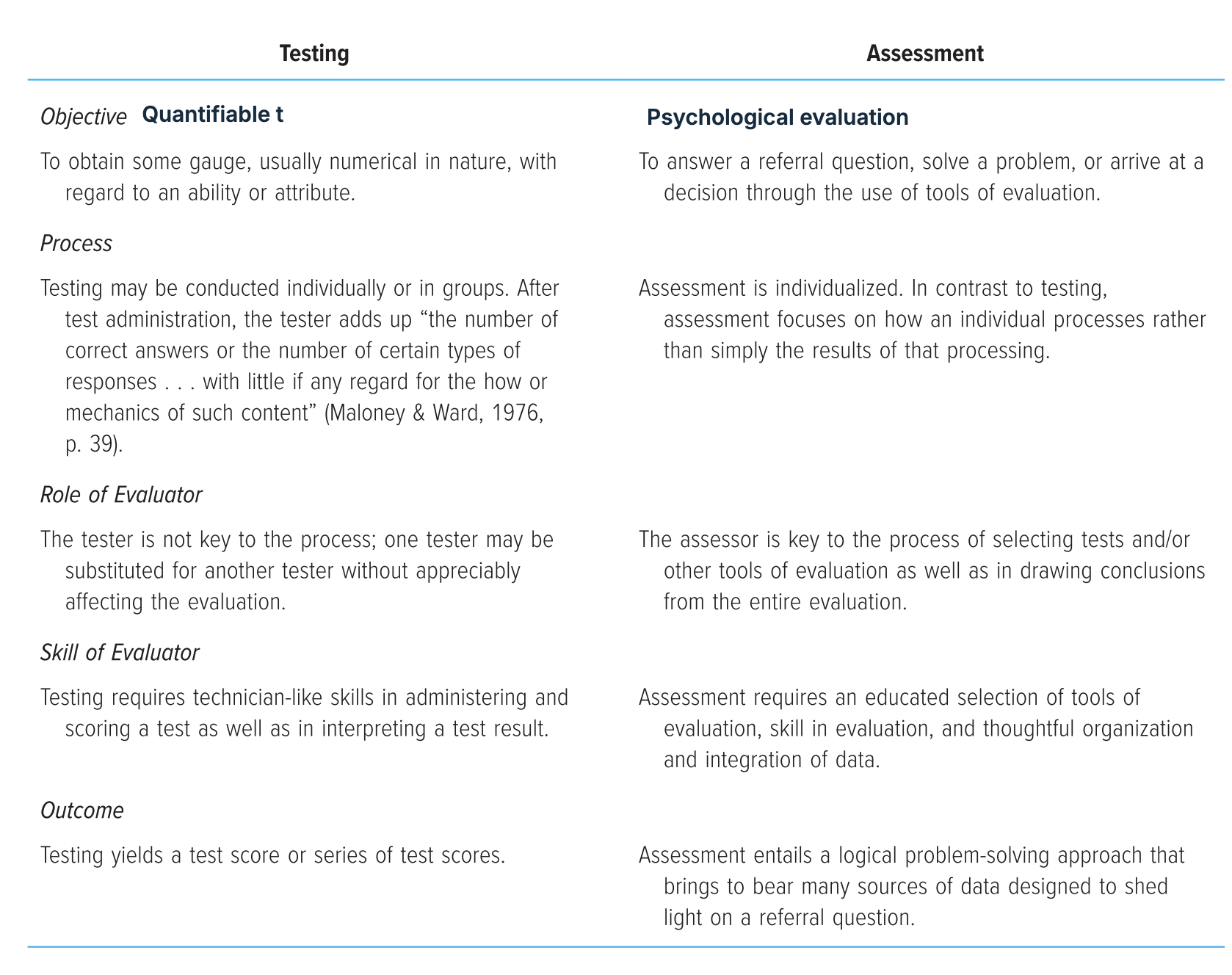
DIFFERENCE BETWEEN “TEST” AND “ASSESSMENT”
TESTING —
- To obtain gauge or measurement (Quantifiable and Numerically)
- The result of process through numbers
- Group or Individual
PROCESS: Result process through numbers
ROLE: Tester is not the key to the process (submitted to one another testes) pasa2
OUTCOME: testing yields at series of test scores.
ASSESSMENT —
- To answer Referral Question, To solve problems, Arrive at decision by using evaluation.
- How does the Individual Process
- Individualized
- PROCESS: Individualized process
- ROLE: Assessor is the key to the process of selecting test or other tools for evaluation and drawing conclusions to the entire evaluation.
- OUTCOME: Logical problem solving bears many sources of data.
Testing - (AI)
- It refers everything that is in the administration of the test (or “The testing in progress) to the Interpretation of the score (“The testing indicates…”)
Integration - unified the part into a whole.
Psychological Assessment -
- Is to Gather and Integrate some Psychology Relate Data to acquire Psychological Evaluation (Goal) through the use of “Tools” such as:
Tests
Interviews
Case Studies
Behavioral Observation
Designed Apparatuses
Measurement procedures.
Psychological Testing -
- Used to “measure” psychological relate variables by the means or used of devices or procedures to obtain a sample of behavior.
- Uses IQ tests (standardized instruments)
- Measure specific traits and abilities that are quantifiable.
(2) VARIETIES OF ASSESSMENT
Assessment can be defined in many ways, for example:
Educational Assessment -
- It used test and tools to evaluate abilities and skills that is relevant to success and failure of schools and pre-school.
Retrospective Assessment
Remote Assessment
Ecological Monetary Assessment
Retrospective Assessment -
- Using evaluative tools to draw conclusions about psychological aspects of a person as they existed at some point in time prior to assessment.
- The challenge is whether the person is alive.
(Retrospective — analyzing peoples’ past)
Remote Assessment -
- Using evaluative tools to draw conclusion the subject who is not in physical proximity to the person or people conducting the evaluation. (ex. using digital and telecommunication)
Ecological Momentary Assessment (EMA) -
- evaluate specific problems that are related to cognitive and behavioral variables at the exact time and place that it occurs.
- known as "“in the moment evaluation”
- Ex. they can analyze if that person has Post - traumatic Stress Disorder.
Collaborative Psychological Assessment (CPA) -
- The assessor and assessee work as partner to initial contact (IC) to final feedback.
- Ex. After this assessment what would you like to know that you do not know?
- Collaborative Psychological Assessment is also known as Therapeutic Psychological Assessment (TPA)Therapeutic Psychological Assessment (TPA) -
- This assessment intentions can only see on the final process.
- We can see the intention of this assessment because the examiner reveals the:
Explains the result
Summarizes conceptualization
Shares lists of recommendations to help the examinees.
- Other definitions — therapeutic self-discovery and new understanding.
THE PROCESS OF ASSESSMENT (RRF)
(Referral) t begins with referral for assessment before the “formal assessment” (ex. teacher, parent, school psychologist)
-ex. “Can this child function in a general education environment”(Report) Then, assessor writes the report of the findings
(Feedback session) Feedback session scheduled with the person they refer and the person that they wanted to evaluate.
Dynamic — Interactive Approach
Educational Settings is referred to as Dynamic Assessment — the term “Dynamic” suggests that a Psychodynamic and Psychoanalytic Approach to assessment is being applied.
Dynamic Assessment -
- refers to an Interactive Approach to psychological assessment that follows a model:
Evaluation
Intervention of some sort
Evaluation
- Dynamic assessment it provides evaluation how the assesee process or benefits from the type of Intevention.
THE TOOLS OF PSYCHOLOGICAL ASSESSMENT
Test - (with modifier)
- measuring device or procedures.
- If that test is introduced with modifier so now it refers to the device or procedure to measure a variable that is related to that modifier.
- Modifier (the thing they wanted to measure) IQ is measured with Valid Tests such as Wechsler Scale.
Psychological test -
- refers to a device or procedure used to measure a variable that is related to psychology.
Psychological Test may differ with the respect of the number of variables.
Content (subject matter)
Format - form, plan, structures, arrangement, and layout of test items, and time limits.
format will tell if it is Paper and Pencil or Computerized.
Administration Procedures - where it can be administered one on one basis, needs active knowledge test administrator, various kind of tasks of assessee. (ex. Computers can be used to )
Scoring & Interpretation procedures -
- Score - code or summary statement that reflects evaluation of performance of a test, task, and interview.
- Scoring - it is the assigning of that evaluative codes or summary of statement to performance obtain on test, task, and interview.
-Some score results simple summing of responses (such as summing or correct/incorrect or agree/disagree responses)
Score -
- code and statement of summaryScoring -
- assignment to code and statement of summary
Cut Score -
- or cutoff score, reference point (a fixed spot) RP, dive a set of data into two or more classifications.
-used in decision making.
Rorschach Inkblot Test -
- sold with no manual at all. It does not have a cutoff scores.
- projective tests
Psychometrics -
- defined as the “science” of psychological measurement.
-Adjective: psychological in nature
-Noun: a professional used psychological test.
Utility -
usefulness or practical value of a test.
THE INTERVIEW
Interview -
- we define interview as talking face to face.
- Taking notes
- Uses Nonverbal Communication (ex. body language)
- Definition: method of gathering information through direct communication involving reciprocal exchange (mutual give & take relationship)
Types of Interview: (PM)
Panel Interview - or board interview — more than one interviewer.
Motivational Interview - a therapeutic type of interview that requires person centered listening skills (openness & empathy) with the use of cognition altering techniques to affect motivation.
PORTFOLIO
Portfolio -
-”Retained” on paper, video, and audio.
- Compilation of anything about you.
ex. students skills can be acquired not by administration of test but to require compile of writing samples.
CASE HISTORY DATA
Case History Data (CHD) -
- Record, Transcript, Pictorial, and anything that can preserved archival information.
-can know the prior occurence of that trauma.
Groupthink.-
- history material of a collective decision making that did not always result in a best decision.
- arises as a result of the varied forces that drive decision-makers to reach a consensus (such as the motivation to reach a compromise in positions)
BEHAVIORAL OBSERVATION
Behavioral Observation -
- monitoring others action and ones action by the means of electronic and visual through recording qualitatively and quantitatively Information regarding on that actions.
Naturalistic Observation -
- records and observe in a real world settings.
-observe autistic children.
ROLE PLAY TEST
Role Play -
- Acting improvised and partially improvised part in a simulated situation.
- Useful in evaluating Skills.
People that are evaluated in a corporate, industrial, organizational, or military contextfor managerial or leadership ability may routinely be placed in role-play situations.
COMPUTERS AS TOOLS
Computers -
- can be used as administrator of test.
Scoring may be done:
Onsite (Local Processing) - process and done right there on the location.
Central Location (Central Processing) - done and returned in the central facility.
Phone lines (Teleprocessing) - mail
Scores can be lists on a (simple scoring report) to the more detailed extended scoring report.
TYPES OF REPORTS (ICI)
Interpretative Report -
- a step up in scoring reports
- distinguished and known as inclusion of numerical and narrative interpretative statement.
- some interpretative reports focused on the high and low scores that focused on and less interpretative.
Consultative Report -
- Written in a language appropriate for communication between assessment and professionals.
- Experts will give their opinion about the analysis of data.
Integrative Report -
- employ previously collected data into test report.
One of the example of the computerized assessments are:
Computer - assisted psychological assessment (CAPA) - “assessment”
- Brand used Q - Interactive
- By the used of 2 Ipads connected with each other through bluetooth.
Computer adaptive test (CAT) - “test”
- An ability of the computer to tailor the test.
- Can adjust (ex. if the students fail the math test it will tailor to switch to english test)
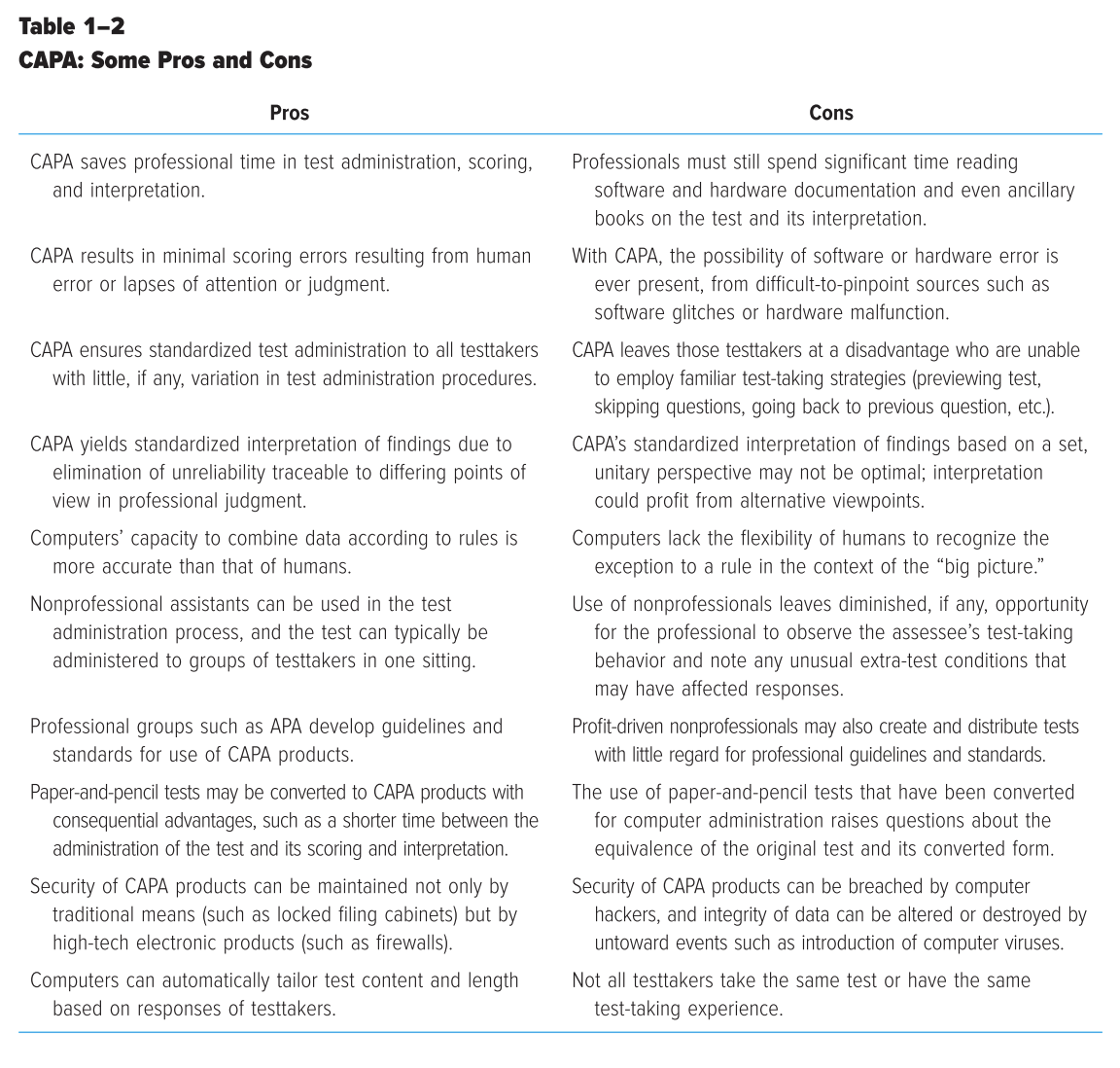
PROS OF COMPUTERIZED TESTS
(1) Have a greater access globally
(2) Scoring is more quicker
(3) Cost associated is lower
OTHER TOOLS
Virtual Reality (VR) Technology -
Biofeedback Equipment - measures of bodily reactions.
WHO ARE THE PARTIES?
THE TEST DEVELOPERS -
- the creator and publisher.
THE TEST USER -
- Who qualified for psychological tests:
- Clinicians, counselors, school psychologists, HR personnel, consumer psychologists, experimental psychologists, social psychologists (professionals).THE TEST TAKERS -
- We have all been test takers.
- But it is in a matter how we approach the test.
Psychological Autopsy -
- will be conducted on the deceased individual.
- the problem is how? when the person is already…
- we can acquire information through archives, artifacts, and previous interviews when he/she is alive.
TYPES OF SETTINGS ASSESSMENTS ARE CONDUCTED
EDUCATIONAL SETTINGS -
Achievement Test -
- which evaluates accomplishment or the degree of learning that has taken place. Some of the achievement tests you have taken in school were constructed by your teacher.
Diagnosis -
- defined as description or conclusion define on the basis of evidence and opinion.
- this conclusion reach through a process.Diagnostic Test-
- a tool for assessment used to narrow down and identify areas of deficit to be targeted for intervention.
- anything that is assess for intervention.Informal evaluation -
- measures of social interaction in class.
- ex. “Who plays well”?
- Def. nonsystematic assessment that leads to the formation of opinion and attitude.
CLINICAL SETTINGS
- Hospitals, Clinics, and Consulting Room.
Ex.
- Clients evaluation
- Clinically evaluates a child with learning difficulties.
- Psychotherapy effective in treating a particular problem.
- Psychological Problems
- To give an opinion on defendant competency trial (court - appointed psychologist)
- (prison psychologist)
Tools to be used in clinical settings:
(1) Intelligence Tests
(2) Personality Test
(3) Neuropsychological Test
COUNSELING SETTINGS -
- Schools, Prisons, Government, and other private Institution.
- Goal: to improve the assessees in terms of adjustment and productivity.
- it answers referral questions
GERIATRIC SETTINGS -
- Healthcare of older adults
Quality of life -
- perceived stress, satisfaction, personal value, quality of living conditions.Dementia -
- loss of cognitive functioning.
- cognitive declinePseudo - dementia -
- severe depression of “erderly” that mimics dementia.
BUSINESS AND MILITARY SETTINGS -
Psychologists working in the area of marketing help “diagnose” what is wrong (and right) about brands, products, and campaigns.
GOVERNMENTAL AND ORGANIZATIONAL CREDENTIALING -
- Must pass the examination
- Should have a license or certification
ACADEMIC RESEARCH SETTINGS -
- to answer a questions
OTHER SETTINGS -
Courts -
- relies on psychological test data and related expert testimony as one of the source of information to help answer an important questions.
Health Psychology -
- focuses on understanding psychological related variable such as onset, course, treatment, and prevention of illness, disease, and disabilities. (POTC)
HOW ARE ASSESSMENT CONDUCTED
Select and use test that is appropriate
Test is stored properly to ensure it is not known by the test taker in advance.
Prepared a trained person to administered the test.
Protocol -
- form, sheet, or booklet where the responses of test takers are recorded.
Rapport -
- working relationship between the examinee and the examiner.
ASSESSMENT OF THE PEOPLE WITH DISABILITIES
Alternate Assessment -
- how such assessment could be conducted.
- this assessment could be done using accomodation.
Accomodation -
- to adjust, to adapt, and to make suitable.
- ex. conducting it with hearing problems so your assessment be on a sign language. — visual problems > Audiotape
Alternate Assessment -
- is an evaluative or diagnostic procedure or process that varies from the usual, customary, or standardized way a measurement is derived, either by virtue of some special accommodation made to the assessee or by means of alternative methods designed to measure the same variable(s).
- measurement varies through special accommodation and provide alternatives measuring same variables. (Disabilities and based on situations)
Self-Assessment
Test your understanding of elements of this chapter by seeing if you can explain each of the following terms, expressions, and abbreviations:
accommodation - | groupthink - Varied forces that drive decision makers to reach a consensus . | Q-Interactive - |
achievement test - | health psychology - | quality of life - |
alternate assessment - | informal evaluation - | rapport - |
behavioral observation - | integrative report - | remote assessment - |
CAPA - | interpretive report - | retrospective assessment - |
case history - | interview - gathering information through direct communication involving reciprocal exchange. | role play - Acting an improvised simulated situation. |
case history data - | local processing - | role-play test - A tool of assessment as where the assessee where directed to act as if they were in a particular situation. |
case study - | motivational interviewing - | score - |
central processing - | naturalistic observation - | scoring - |
collaborative psychological - | panel interview - | scoring report - |
assessment - | portfolio - | simple scoring report - basic summary of test takers performance. |
consultative report - | protocol - | social facilitation - |
cut score - A reference point, usually numerical, derived by judgement and used to divide a set of data into classifications. | pseudodementia - | teleprocessing - |
dementia - | psychological assessment - | test - Measuring device or procedure. |
diagnosis - | psychological autopsy - | test catalogue - |
diagnostic test - | psychological test - | test developer - |
dynamic assessment - | psychological testing - | test manual - |
ecological momentary assessment - | psychometrician - | testtaker - |
educational assessment - Evaluate the abilities and skills that is relevant to the success and failure of the school. | psychometrics - Science of psychological measurement. | test user - |
extended scoring report - More detailed scoring and need of statical analysis. | psychometric soundness - the psychometric tools is scientifically reliable and valid. how consistent and accurate the psychological test. Or technical quality | therapeutic psychological assessment - Throughout the process the it requires therapeutic self-discovery and understanding. |
format - | psychometrist - Professionals who interprets psychological test data. | utility - the usefulness of the test. practical use |
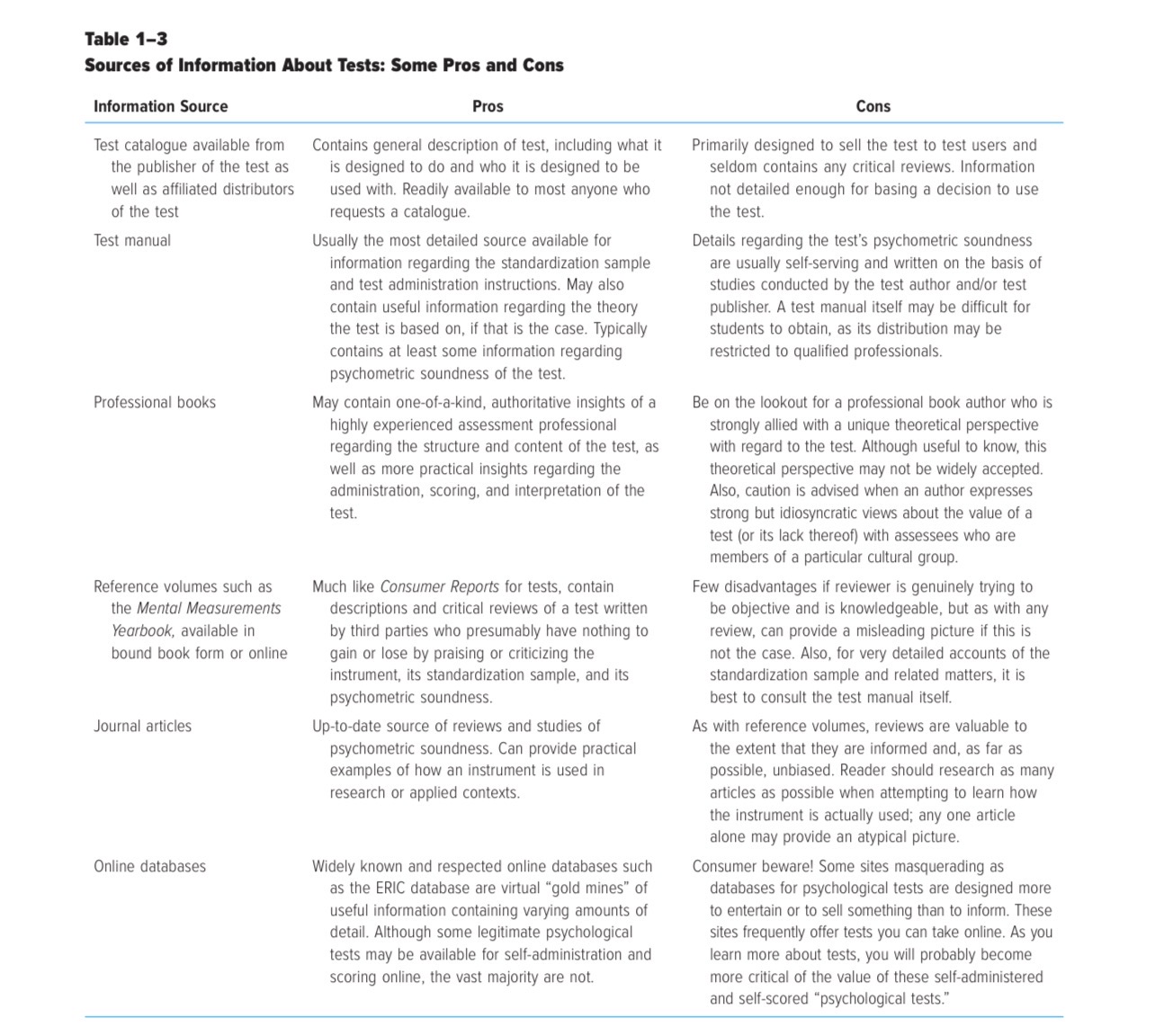
WHERE TO GET AUTHORITATIVE INFORMATION? REFERENCES SOURCES (TT PR JO)
Test Catalogue-
- What is designed to do and what is designed to be used.
- General description of the test
- Readily available to most anyone
Brochure sales
Easy to get but,
It only sells: The main goal is to make a sale, so it will never include bad reviews.
It lacks detail: It gives a brief summary but skips the heavy technical and scientific data.
Test Manuals -
-It has the useful information regarding the theory and the test.
- Instructions
instructions to a specific test
Focuses on data rather than sales
Professional Books -
Authoritative insights of a highly experience assessment professionals, regarding the structure and content of the test.
Written by experts to help to find a specific psychological tests.
Reference Book -
Written by a “third party” about the description and reviews of the test.
act as search engine for psychological and educational test.
Just like ecosia.
Journal Articles -
- Up to date source of reviews and studies of psychometric soundness. (2026)
- Can provide practical examples of how an instrument is used in research or applied contexts.
Online Data base -
Respected online data bases ERIC database are virtual “gold mines” of useful information containing varying amounts of details.