Week 1 Pre-Work
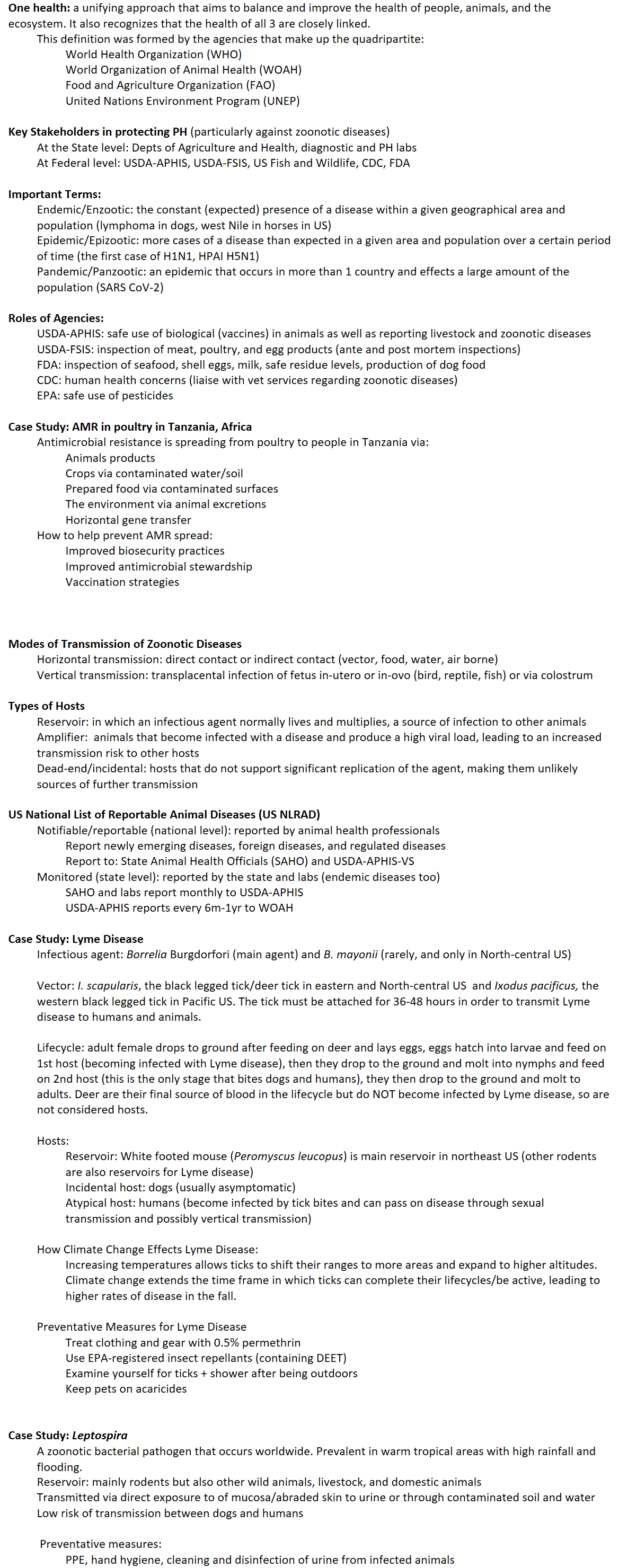
One health: a unifying approach that aims to balance and improve the health of people, animals, and the ecosystem. It also recognizes that the health of all 3 are closely linked.
This definition was formed by the agencies that make up the quadripartite:
World Health Organization (WHO)
World Organization of Animal Health (WOAH)
Food and Agriculture Organization (FAO)
United Nations Environment Program (UNEP)
Key Stakeholders in protecting PH (particularly against zoonotic diseases): At the State level: Depts of Agriculture and Health, diagnostic and PH labs. At Federal level: USDA-APHIS, USDA-FSIS, US Fish and Wildlife, CDC, FDA
Important Terms:
Endemic/Enzootic: the constant (expected) presence of a disease within a given geographical area and population (lymphoma in dogs, west Nile in horses in US)
Epidemic/Epizootic: more cases of a disease than expected in a given area and population over a certain period of time (the first case of H1N1, HPAI H5N1)
Pandemic/Panzootic: an epidemic that occurs in more than 1 country and effects a large amount of the population (SARS CoV-2)
Roles of Agencies:
USDA-APHIS definition: safe use of biological (vaccines) in animals as well as reporting livestock and zoonotic diseases. USDA-FSIS definition: inspection of meat, poultry, and egg products (ante and post mortem inspections). FDA definition: inspection of seafood, shell eggs, milk, safe residue levels, production of dog food. CDC definition: human health concerns (liaise with vet services regarding zoonotic diseases). EPA definition: safe use of pesticides
Case Study: AMR in poultry in Tanzania, Africa
Antimicrobial resistance is spreading from poultry to people in Tanzania via: Animals products, Crops via contaminated water/soil, Prepared food via contaminated surfaces, The environment via animal excretions, and Horizontal gene transfer
How to help prevent AMR spread: Improved biosecurity practices, Improved antimicrobial stewardship, Vaccination strategies
Modes of Transmission of Zoonotic Diseases: Horizontal transmission: direct contact or indirect contact (vector, food, water, air borne). Vertical transmission: transplacental infection of fetus in-utero or in-ovo (bird, reptile, fish) or via colostrum
Types of Hosts
Reservoir: in which an infectious agent normally lives and multiplies, a source of infection to other animals
Amplifier: animals that become infected with a disease and produce a high viral load, leading to an increased transmission risk to other hosts
Dead-end/incidental: hosts that do not support significant replication of the agent, making them unlikely sources of further transmission
US National List of Reportable Animal Diseases (US NLRAD)
Notifiable/reportable diseases (national level): reported by animal health professionals. must Report newly emerging diseases, foreign diseases, and regulated diseases. they Report to: State Animal Health Officials (SAHO) and USDA-APHIS-VS
Monitored diseases (state level): reported by the state and labs (endemic diseases too). SAHO and labs report monthly to USDA-APHIS. USDA-APHIS reports every 6m-1yr to WOAH
Case Study: Lyme Disease. Infectious agent: Borrelia Burgdorfori (main agent) and B. mayonii (rarely, and only in North-central US). the Vector: I. scapularis, the black legged tick/deer tick in eastern and North-central US and Ixodus pacificus, the western black legged tick in Pacific US. The tick must be attached for 36-48 hours in order to transmit Lyme disease to humans and animals. the Lifecycle: adult female drops to ground after feeding on deer and lays eggs, eggs hatch into larvae and feed on 1st host (becoming infected with Lyme disease), then they drop to the ground and molt into nymphs and feed on 2nd host (this is the only stage that bites dogs and humans), they then drop to the ground and molt to adults. Deer are their final source of blood in the lifecycle but do NOT become infected by Lyme disease, so are not considered hosts. the Hosts: Reservoir: White footed mouse (Peromyscus leucopus) is main reservoir in northeast US (other rodents are also reservoirs for Lyme disease), Incidental host: dogs (usually asymptomatic), and Atypical host: humans (become infected by tick bites and can pass on disease through sexual transmission and possibly vertical transmission). How Climate Change Effects Lyme Disease: Increasing temperatures allows ticks to shift their ranges to more areas and expand to higher altitudes, and Climate change extends the time frame in which ticks can complete their lifecycles/be active, leading to higher rates of disease in the fall. Preventative Measures for Lyme Disease: Treat clothing and gear with 0.5% permethrin, Use EPA-registered insect repellants (containing DEET), Examine yourself for ticks + shower after being outdoors, Keep pets on acaricides
Case Study: Leptospira. A zoonotic bacterial pathogen that occurs worldwide. Prevalent in warm tropical areas with high rainfall and flooding. Reservoir: mainly rodents but also other wild animals, livestock, and domestic animals. Transmitted via direct exposure to of mucosa/abraded skin to urine or through contaminated soil and water. Low risk of transmission between dogs and humans. Preventative measures: PPE, hand hygiene, cleaning and disinfection of urine from infected animals.
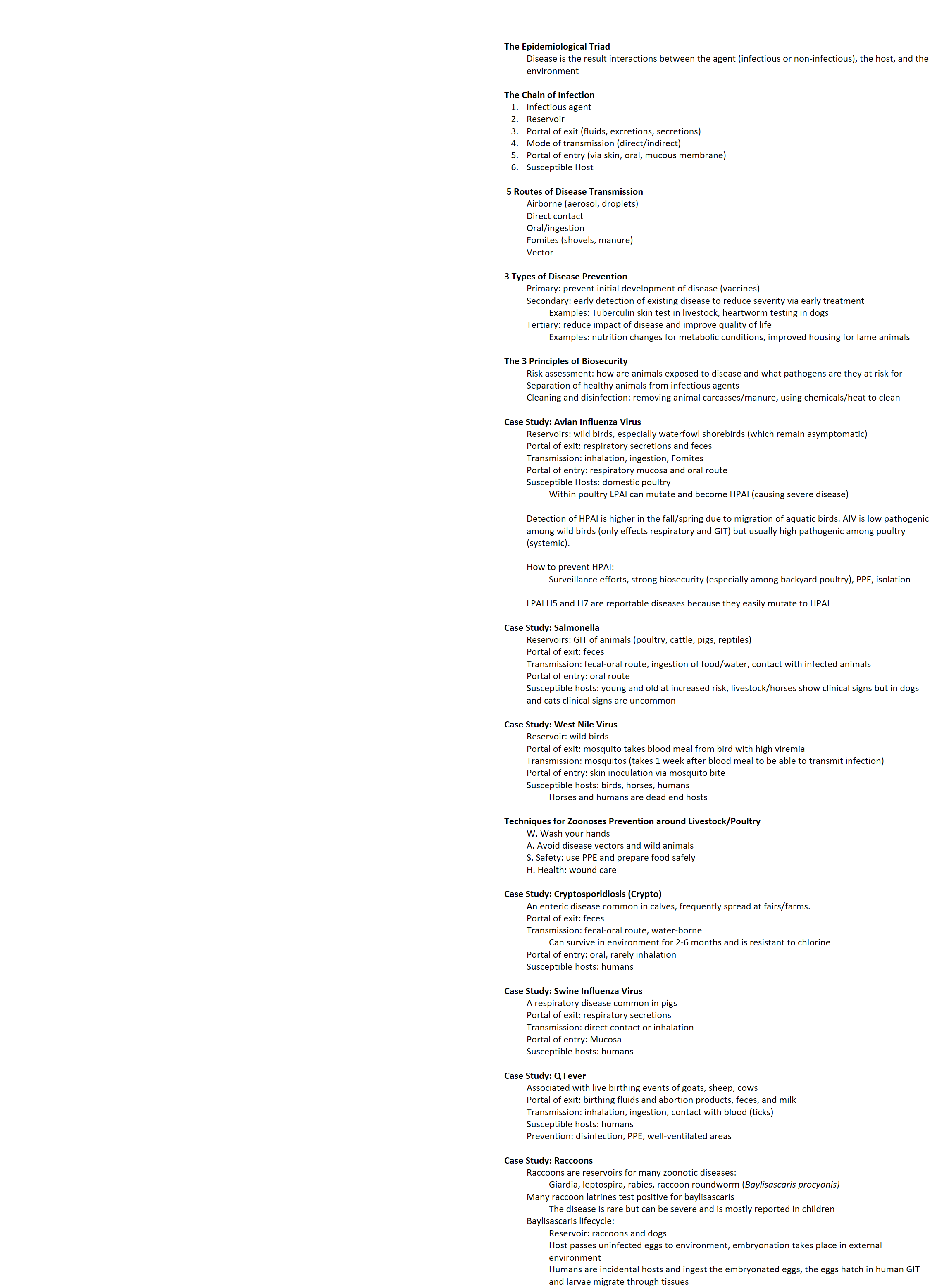
The Epidemiological Triad
Disease is the result interactions between the agent (infectious or non-infectious), the host, and the environment
The Chain of Infection: Infectious agent, Reservoir, Portal of exit (fluids, excretions, secretions), Mode of transmission (direct/indirect), Portal of entry (via skin, oral, mucous membrane), Susceptible Host
5 Routes of Disease Transmission: Airborne (aerosol, droplets), Direct contact, Oral/ingestion, Fomites (shovels, manure), Vector
3 Types of Disease Prevention: Primary: prevent initial development of disease (vaccines), Secondary: early detection of existing disease to reduce severity via early treatment (Examples: Tuberculin skin test in livestock, heartworm testing in dogs), Tertiary: reduce impact of disease and improve quality of life (Examples: nutrition changes for metabolic conditions, improved housing for lame animals)
The 3 Principles of Biosecurity: Risk assessment: how are animals exposed to disease and what pathogens are they at risk for, Separation of healthy animals from infectious agents, and Cleaning and disinfection: removing animal carcasses/manure, using chemicals/heat to clean
Case Study: Avian Influenza Virus: Reservoirs: wild birds, especially waterfowl shorebirds (which remain asymptomatic). Portal of exit: respiratory secretions and feces, Transmission: inhalation, ingestion, Fomites. Portal of entry: respiratory mucosa and oral route. Susceptible Hosts: domestic poultry. Within poultry LPAI can mutate and become HPAI (causing severe disease). Detection of HPAI is higher in the fall/spring due to migration of aquatic birds. AIV is low pathogenic among wild birds (only effects respiratory and GIT) but usually high pathogenic among poultry (systemic). How to prevent HPAI: Surveillance efforts, strong biosecurity (especially among backyard poultry), PPE, isolation. LPAI H5 and H7 are reportable diseases because they easily mutate to HPAI
Case Study: Salmonella: Reservoirs: GIT of animals (poultry, cattle, pigs, reptiles). Portal of exit: feces. Transmission: fecal-oral route, ingestion of food/water, contact with infected animals. Portal of entry: oral route. Susceptible hosts: young and old at increased risk, livestock/horses show clinical signs but in dogs and cats clinical signs are uncommon
Case Study: West Nile Virus: Reservoir: wild birds. Portal of exit: mosquito takes blood meal from bird with high viremia. Transmission: mosquitos (takes 1 week after blood meal to be able to transmit infection). Portal of entry: skin inoculation via mosquito bite. Susceptible hosts: birds, horses, humans. Horses and humans are dead end hosts
Techniques for Zoonoses Prevention around Livestock/Poultry (WASH): Wash your hands, Avoid disease vectors and wild animals, Safety: use PPE and prepare food safely, Health: wound care
Case Study: Cryptosporidiosis (Crypto): An enteric disease common in calves, frequently spread at fairs/farms. Portal of exit: feces. Transmission: fecal-oral route, water-borne. Can survive in environment for 2-6 months and is resistant to chlorine. Portal of entry: oral, rarely inhalation. Susceptible hosts: humans
Case Study: Swine Influenza Virus: A respiratory disease common in pigs. Portal of exit: respiratory secretions. Transmission: direct contact or inhalation . Portal of entry: Mucosa. Susceptible hosts: humans
Case Study: Q Fever: Associated with live birthing events of goats, sheep, cows. Portal of exit: birthing fluids and abortion products, feces, and milk. Transmission: inhalation, ingestion, contact with blood (ticks). Susceptible hosts: humans. Prevention: disinfection, PPE, well-ventilated areas
Case Study: Raccoons: Raccoons are reservoirs for many zoonotic diseases: Giardia, leptospira, rabies, raccoon roundworm (Baylisascaris procyonis). Many raccoon latrines test positive for baylisascaris. The disease is rare but can be severe and is mostly reported in children. Baylisascaris lifecycle: Reservoir: raccoons and dogs, Host passes uninfected eggs to environment, embryonation takes place in external environment, Humans are incidental hosts and ingest the embryonated eggs, the eggs hatch in human GIT and larvae migrate through tissues