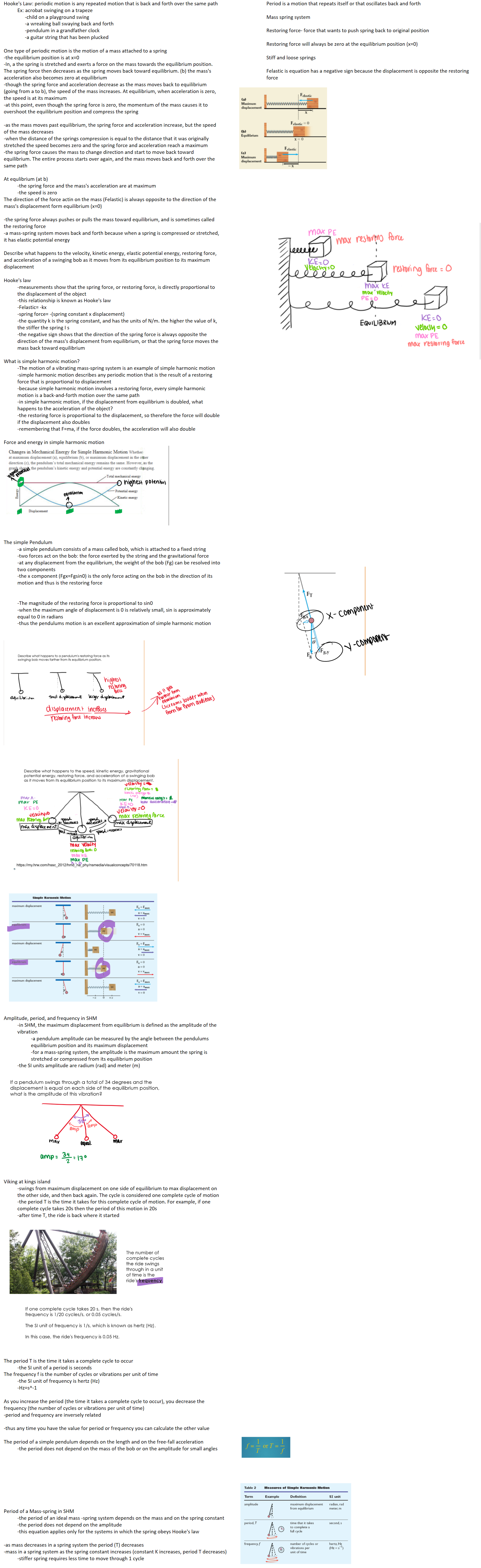
physics ch 13 notes
Hooke's Law: periodic motion is any repeated motion that is back and forth over the same path
Ex: acrobat swinging on a trapeze
-child on a playground swing
-a wreaking ball swaying back and forth
-pendulum in a grandfather clock
-a guitar string that has been plucked
One type of periodic motion is the motion of a mass attached to a spring
-the equilibrium position is at x=0
-In, a the spring is stretched and exerts a force on the mass towards the equilibrium position. The spring force then decreases as the spring moves back toward equilibrium. (b) the mass's acceleration also becomes zero at equilibrium
-though the spring force and acceleration decrease as the mass moves back to equilibrium (going from a to b), the speed of the mass increases. At equilibrium, when acceleration is zero, the speed is at its maximum
-at this point, even though the spring force is zero, the momentum of the mass causes it to overshoot the equilibrium position and compress the spring
-as the mass moves past equilibrium, the spring force and acceleration increase, but the speed of the mass decreases
-when the distance of the springs compression is equal to the distance that it was originally stretched the speed becomes zero and the spring force and acceleration reach a maximum
-the spring force causes the mass to change direction and start to move back toward equilibrium. The entire process starts over again, and the mass moves back and forth over the same path
At equlibrium (at b)
-the spring force and the mass's acceleration are at maximum
-the speed is zero
The direction of the force actin on the mass (Felastic) is always opposite to the direction of the mass's displacement form equilibrium (x=0)
-the spring force always pushes or pulls the mass toward equilibrium, and is sometimes called the restoring force
-a mass-spring system moves back and forth because when a spring is compressed or stretched, it has elastic potential energy
Describe what happens to the velocity, kinetic energy, elastic potential energy, restoring force, and acceleration of a swinging bob as it moves from its equilibrium position to its maximum displacement
Hooke's law
-measurements show that the spring force, or restoring force, is directly proportional to the displacement of the object
-this relationship is known as Hooke's law
-Felastic= -kx
-spring force= -(spring constant x displacement)
-the quantity k is the spring constant, and has the units of N/m. the higher the value of k, the stiffer the spring I s
-the negative sign shows that the direction of the spring force is always opposite the direction of the mass's displacement from equilibrium, or that the spring force moves the mass back toward equilibrium
What is simple harmonic motion?
-The motion of a vibrating mass-spring system is an example of simple harmonic motion
-simple harmonic motion describes any periodic motion that is the result of a restoring force that is proportional to displacement
-because simple harmonic motion involves a restoring force, every simple harmonic motion is a back-and-forth motion over the same path
-in simple harmonic motion, if the displacement from equilibrium is doubled, what happens to the acceleration of the object?
-the restoring force is proportional to the displacement, so therefore the force will double if the displacement also doubles
-remembering that F=ma, if the force doubles, the acceleration will also double
Force and energy in simple harmonic motion
The simple Pendulum
-a simple pendulum consists of a mass called bob, which is attached to a fixed string
-two forces act on the bob: the force exerted by the string and the gravitational force
-at any displacement from the equilibrium, the weight of the bob (Fg) can be resolved into two components
-the x component (Fgx=Fgsin0) is the only force acting on the bob in the direction of its motion and thus is the restoring force
-The magnitude of the restoring force is proportional to sin0
-when the maximum angle of displacement is 0 is relatively small, sin is approximately equal to 0 in radians
-thus the pendulums motion is an excellent approximation of simple harmonic motion
Amplitude, period, and frequency in SHM
-in SHM, the maximum displacement from equilibrium is defined as the amplitude of the vibration
-a pendulum amplitude can be measured by the angle between the pendulums equilibrium position and its maximum displacement
-for a mass-spring system, the amplitude is the maximum amount the spring is stretched or compressed from its equilibrium position
-the SI units amplitude are radium (rad) and meter (m)
Viking at kings island
-swings from maximum displacement on one side of equilibrium to max displacement on the other side, and then back again. The cycle is considered one complete cycle of motion
-the period T is the time it takes for this complete cycle of motion. For example, if one complete cycle takes 20s then the period of this motion in 20s
-after time T, the ride is back where it started
The period T is the time it takes a complete cycle to occur
-the SI unit of a period is seconds
The frequency f is the number of cycles or vibrations per unit of time
-the SI unit of frequency is hertz (Hz)
-Hz=s^-1
As you increase the period (the time it takes a complete cycle to occur), you decrease the frequency (the number of cycles or vibrations per unit of time)
-period and frequency are inversely related
-thus any time you have the value for period or frequency you can calculate the other value
The period of a simple pendulum depends on the length and on the free-fall acceleration
-the period does not depend on the mass of the bob or on the amplitude for small angles
Period is a motion that repeats itself or that oscillates back and forth
Mass spring system
Restoring force- force that wants to push spring back to original position
Restoring force will always be zero at the equilibrium position (x=0)
Stiff and loose springs
Felastic is equation has a negative sign because the displacement is opposite the restoring force
Period of a Mass-spring in SHM
-the period of an ideal mass -spring system depends on the mass and on the spring constant
-the period does not depend on the amplitude
-this equation applies only for the systems in which the spring obeys Hooke's law
-as mass decreases in a spring system the period (T) decreases
-mass in a spring system as the spring constant increases (constant K increases, period T decreases)
-stiffer spring requires less time to move through 1 cycle