AP Psychology Unit 3 Notes
Topic 3.1 - Themes & Methods In Developmental Psychology
Enduring Theme:
Definition: Aspects of an individual that consistently appear throughout their life.
Stability & Change
Key Focus: What stays the same and what changes over time.
Example: The temperament of an individual or an individual's interests.
Nature & Nurture
Key Focus: The roles of genetics and environment in shaping behavior.
Example: Genetic predispositions and cultural influences on a person's personality.
Continuous/Discontinuous Stages
Key Focus: Whether growth is gradual or occurs in distinct phases.
Example: Gradual skills acquired over time and cognitive milestones that happen as an individual gets older.
Continuous Development: Gradual and ongoing changes that happen little by little over time.
Discontinuous Development: Changes that occur in specific stages of life.
Cross-Sectional Research Methods: Studying different groups of people at different ages all at the same time.
Example: A researcher conducts a study to examine stress levels of students in college. The study takes students from each class and compares their stress levels.
Longitudinal Research Methods: Research that studies the same group of people over a long period of time.
Example: A researcher wants to understand how academic motivation changes as a student goes through high school. The study follows 100 9th graders over the course of the next four years, checking their motivation levels every semester.
Topic 3.2 - Physical Development Across the Lifespan
Teratogens
Definition/Impact: Harmful substances that can disrupt fetal development.
Example: Alcohol, drugs, cigarettes, or other toxins.
Maternal Illness
Definition/Impact: Any health condition that can impact a woman's health and well-being during pregnancy.
Example: Severe cases of influenza or hypertension.
Genetic Mutations
Definition/Impact: Abnormalities in a fetus's genes that can lead to developmental disorders or disabilities.
Example: Down Syndrome, Turner Syndrome, or Sickle Cell Anemia.
Hormonal Factors
Definition/Impact: Imbalances in hormones can lead to atypical brain development, possibly impacting behavior and cognitive abilities.
Example: Maternal stress can cause an overproduction of the hormone cortisol, which can impact fetal development.
Environmental Factors
Definition/Impact: External factors that impact prenatal development such as maternal stress, malnutrition, or exposure to harmful environmental factors.
Example: Pollutants, chemicals, teratogens, or physical trauma/injury.
Fetal Alcohol Syndrome: A condition caused by a pregnant individual consuming alcohol during their pregnancy, leading to physical, behavioral, and cognitive impairments in the fetus.
Infant Reflexes: Involuntary movements that help with survival, present in newborns.
Palmar Grasp:
Description: When an object is placed in a baby's hand, the baby will instinctively close their fingers around it.
Babinski Reflex:
Description: When the sole of the baby's foot is stroked, their toes fan out and then curl inward.
Rooting Reflex:
Description: When a baby's cheek is touched, they turn their head toward the stimulus and open their mouth.
Observations About Infant/Children Development:
Physical development generally occurs in the same order.
The timing of development can vary.
Gross Motor Skills: Involve larger movements, such as crawling and walking.
Fine Motor Skills: Involve smaller movements, such as holding a spoon.
Visual Cliff Experiment: The experiment uses a visual cliff apparatus which consists of a large table with a glass surface extending across the entire tabletop. The goal is to determine whether depth perception is present in infants.
Critical Period: A window of time during which an individual must be exposed to certain stimuli or experiences for normal development to occur.
Sensitive Period: A time when an individual is more receptive to learning certain skills; however, the individual can still learn the skill later in life.
Imprinting: When a newborn forms an attachment to the first moving object they see, this is seen in animals such as some birds.
Transition from Childhood to Adolescence: Puberty.
Changes During Adolescence:
An individual's thinking becomes self-focused.
Individuals gain the ability to think abstractly.
Individuals become more impulsive and emotional, due to the limbic system and prefrontal cortex.
Primary Sex Characteristics: Characteristics that are directly related to the reproductive system (Example: Development of ovaries or testes).
Menarche: The first time a woman menstruates.
Spermarche: The first time a man ejaculates.
Secondary Sex Characteristics: Characteristics that are indirectly related to reproduction (Example: Growth of body hair or changing of a person's voice).
Early Adulthood: Individuals in their early adulthood are often in their peak physical health.
Middle Adulthood: As individuals continue to age into their middle adulthood years they start to see a decline in various physical and mental functions.
Physical Changes in Middle or Late Adulthood:
Reduction in muscle mass.
A decline in an individual's hearing/vision.
Reduction in reaction time.
Menopause: This is the end of a woman's menstrual cycle and ability to conceive, this typically occurs in middle adulthood.
Topic 3.3 - Gender & Sexual Orientation
Sex: The biological differences between men and women.
Gender: Refers to the social, physical, and behavioral traits that are considered normal for men and women.
Gender Schema Theory: This is the ability for children to create mental categories for masculinity and femininity.
Four Main Socialization Factors: Family, school, peer groups, media.
Examples of How Socialization Factors Can Impact Gender Roles:
Parents may encourage their sons to play with trucks and their daughters to play with dolls.
Teachers may be more strict with men in class and more lenient towards women.
Movies often portray men as strong providers and women as caretakers.
Homosexual: A person is attracted to the same sex.
Heterosexual: A person is attracted to the opposite sex.
Bisexual: A person is attracted to both sexes.
Topic 3.4 - Cognitive Development Across the Lifespan
Assimilation: When new information is put into an existing schema.
Accommodation: When an individual changes or modifies a schema to incorporate new information.
Sensorimotor Stage
Description: Child gains access to their hands and begins to move. The child learns to make things happen and starts to develop object permanence
Timeframe: Birth-2 years old
Preoperational Stage
Description: Child learns to use language but will struggle with concepts such as conservation. Here a child starts off as egocentric but will develop the theory of the mind
Timeframe: 2-6 or 7 years old
Concrete operational Stage
Description: Children start to think logically. Children can start to understand conservation and more complex topics, such as mathematics and reversibility
Timeframe: Starts around 7 years
Formal operational Stage
Description: Here an individual can think about hypothetical situations or questions, and apply logic to different situations. Individuals here also have moral reasoning
Timeframe: Starts around 12 years old
Object Permanence: This is the ability for an individual to understand that an object continues to exist even when the object is out of sight.
Egocentric: An individual can only see their OWN perspective and will assume that other people see the world as they do.
Theory Of The Mind: An individual understands that other people have their own thoughts, feelings, and perspectives that are different from their own.
Animism: The belief that inanimate objects have feelings, thoughts, or other human characteristics.
Classification: This is the ability to organize objects based on multiple attributes, such as sorting objects by color and shape simultaneously.
Seriation: This is the ability to arrange items in a quantitative order, such as organizing sticks from shortest to longest.
Conservation: The idea that properties such as volume and mass remain the same, even if they are transferred into different containers.
Reversibility: A mental operation where an individual can reverse a sequence of events.
Sociocultural Theory: This theory highlights the role of social interaction, culture, and language in cognitive development. The idea is that learning is a social process that can be enhanced when interacting with others.
Vygotsky's Zone of Proximal Development: The zone of proximal development is what a child can learn with the assistance of another individual. If a concept is outside of the zone of proximal development it will be too difficult for the child to learn, even with assistance.
Scaffolding: Scaffolding is when an individual provides support and guides a child to an understanding of unfamiliar concepts. This is often used in a teaching environment, with the goal being to help expand an individual's knowledge or skills.
Crystallized Intelligence: The accumulation of knowledge, facts, and skills acquired through experience and education.
Fluid Intelligence: The individual's ability to reason quickly, think abstractly, and adapt to new situations.
Changes to Intelligence with Age: As an individual ages their fluid intelligence decreases or slows down, but their crystallized intelligence grows.
Dementia: This is a broad term for cognitive disorders that significantly impair memory, reasoning, and other mental abilities.
Topic 3.5 - Communication and Language Development
Language: A system of communication that uses symbols, such as words, sounds, or gestures.
Phonemes:
Description: Distinct units of sound in a language, often the first sounds an infant will make
Example: The mmm in mom, or the shhh in shut
Morphemes:
Description: The smallest unit of meaning, containing a minimum of 2 phonemes
Example: Root words or prefixes
Semantics:
Description: The meaning of words and sentences (involves understanding how words and phrases relate to each other)
Example: Bank can mean a financial institution or the side of a river (Context matters)
Grammar:
Description: A set of rules that the language follows
Example: This is what enables people to communicate and understand the meaning of different sentences
Syntax:
Description: The rules that are used to order words in a sentence
Example: In English adjectives are put before nouns
Surface Structure Semantics: The literal meaning of words.
Deep Structure Semantics: The underlying meaning of a sentence.
Generative Language: Language allows for the creation of an infinite number of sentences and ideas.
Pre-Language Communication: By using gestures like pointing, waiving, or showing objects.
Cooing Stage:
Description: During this stage, infants begin to make simple vowel sounds.
Sounds/Words: OOOO or AAAHHH.
Babbling Stage:
Description: Infants start their speech development. Start making consonant vowel sounds.
Sounds/Words: Ma ma, Da Da.
One-Word Stage:
Description: Child is able to say one word but the word has a larger meaning.
Sounds/Words: Child says food, which is the child saying I want to eat.
Telegraphic Speech Stage:
Description: Child starts to use two-word phrases.
Sounds/Words: Toy feel, milk spill.
Holophrase: This is a single word that conveys a larger meaning.
Overgeneralization: This is when an individual applies general rules that they are learning too broadly, resulting in them applying the rule in an incorrect manner.
Crucial and Sensitive Periods for Language: A crucial period is a time in which an individual must learn specific information, if they do not learn it by that window, plasticity is severely limited. Sensitive periods are times where the brain is best able to do something. For example the sooner a child is exposed to a particular language the easier it is for them to master the language.
Topic 3.6 - Social-Emotional Development Across the Lifespan
Ecological Systems Theory
Microsystem:
Description: Immediate environment.
Example: Interactions with parents, teachers, and friends.
Mesosystem:
Description: Connection between the groups within the microsystem.
Example: How an individual's parents interact with the individual's teacher.
Exosystem:
Description: Indirect factors that impact an individual's life.
Example: Parent working late at the office results in the child not having as much parental involvement.
Macrosystem:
Description: Social and cultural values.
Example: Cultural values, social norms, and government policies influence an individual
Chronosystem:
Description: Time, including the individual's current stage of life and the historical context in which they live.
Example: Teenagers today experience development differently than teenagers 50 years ago.
Ecological Systems Theory Summary: An individual's development is influenced by both their immediate relationships and the broader social and cultural forces. Highlighting that development is not solely genetics, but is also the results of environmental factors.
Parenting Styles
Authoritarian:
Description: Parents set strict rules and expect their children to follow every rule without explaining their reasoning. Children can't ask questions.
Permissive:
Description: Parents are loose with the rules and do not demand much from their children. Little to no limits are set for children.
Negligent:
Description: Parents are completely uninvolved in their children's lives (Do not play an active role in the child's life).
Authoritative:
Description: Parents set expectations for children and do enforce rules, but encourage discussion and dialogue (Will explain the reason for rules).
Attachment Styles
Secure Attachment:
Description: The child feels safe and supported by their caregiver. The child will feel confident to explore their environment and will seek comfort from their caregiver if they become distressed
Long term impacts: Oftentimes this leads an individual to develop stronger social skills an have better emotional regulation
Avoidant Attachment:
Description: The child tends to avoid or ignore their caregiver, showing little emotion when the caregiver leaves them or returns to them
Long term impacts: May struggle to form close relationships
Anxious Attachment:
Description: Also known as ambivalent or resistant attachment. Here the child is overly dependent on their caregiver and shows extreme distress when separated
Long term impacts: May lead to a fear of abandonment
Disorganized Attachment:
Description: The child show confusing or contradictory behaviors, often due to the child being exposed to inconsistent or possibly even frightening care
Long term impacts: May lead to emotional and behavioral problems
Temperament: An individual's natural biologically based patterns of emotional reactivity.
Culture's Influence on Attachment Styles: Different cultures will emphasize different behaviors for children. With each culture considering certain behaviors to be normal and abnormal, this leads to different perspectives as to what is a secure or insecure attachment.
Separation Anxiety: It is a normal developmental stage that typically occurs when the child is 6 to 8 months old. This is when a child experiences heightened distress, fear, or anxiety when they are separated from the caregivers.
Monkey Studies and Attachment: It highlighted the importance of comfort. Showing that living beings need more than just food and water to thrive.
Parallel Play: When a child plays alongside another child without interaction directly with the other child.
Pretend Play: When a child uses their imagination to act out scenarios with toys, objects, and other children.
Adolescent Concepts
Ecocentrism:
Description: The inability to see a situation or understand the world from another person's perspective
Impact on a Teenager: Teenagers often become focused on themselves as they try to explore their identity
Imaginary Audience:
Description: The belief that an individual is constantly being watched and judged by others
Impact on a Teenager: Teenagers often feel self conscious, believing that everyone is watching them
Personal Fable:
Description: The belief that an individual is unique and that no one else can fully understand what they're going through
Impact on a Teenager: Teenagers often feel invincible or isolated, since they are unique and others cant relate
Start of Adulthood: Life events such as getting married, having children, or starting a career.
Social Clock: This is the idea that adulthood begins when major life events occur, these are societal expectations about when major life events should happen.
Emerging Adulthood: This is a transitional stage that a person in their mid-twenties goes through; this is when they start to explore different career paths, relationships, and better refine their identity.
Attachment Style Influence on Adult Relationships: The attachment style of an individual often shapes an individual's ability to trust, communicate, and emotionally connect with their partner, friends, coworkers, and family members.
Adverse Childhood Experience (ACE): This is a traumatic or challenging event that occurred during a person's childhood, such as abuse or neglect.
Erikson's Stages of Development
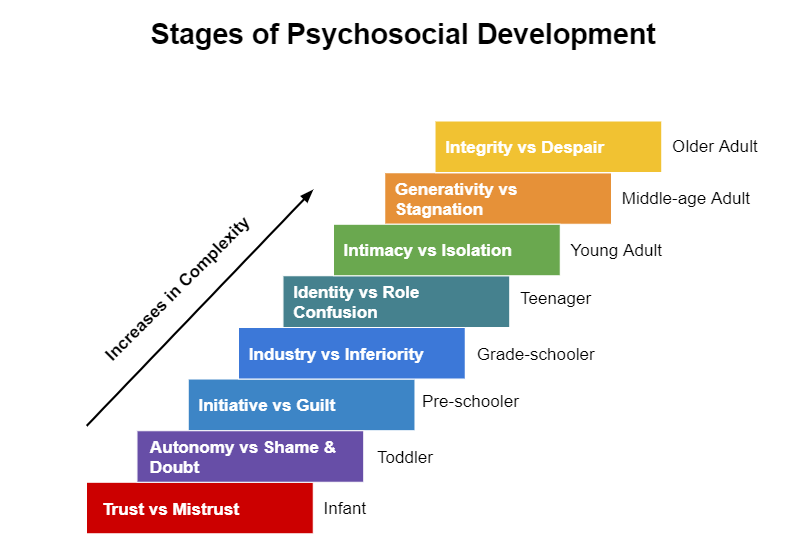
Trust vs. Mistrust:
Description/Important Events: Feeding, affection, and security are the important life events. If the child has all of those things they will form secure attachments, if they do not they may develop insecure attachments
Timeframe/Stage of Life: Infancy
Autonomy vs. Shame/Doubt:
Description/Important Events: Child starts to separate items in the environment, understands what is theirs and what is someone else's. Important life events include potty training. Positive reinforcement is key, this allows the child to develop confidence and autonomy
Timeframe/Stage of Life: Early childhood
Initiative vs. Guilt:
Description/Important Events: Child becomes social and will ask lots of questions. Children need to have some control over different aspects of their life, independent activities are key. If a child is not allowed independence it could cause the child to question their ability
Timeframe/Stage of Life: Preschool years
Industry vs. Inferiority:
Description/Important Events: School becomes one of the most important events in the child's life. Children start to make their own decisions, and grapple with the concept of good and bad. Children also start identify with different social factors such as wealth
Timeframe/Stage of Life: School years
Identity vs. Role Confusion:
Description/Important Events: Peer groups become extremely important, individuals seek friendships and will conform to those friendships. Individuals start to solidify their role in society and seek to understand their own identity. If an individual cannot understand their place in the world it can cause an individual to feel lost
Timeframe/Stage of Life: High school years-Early college
Intimacy vs. Isolation:
Description/Important Events: Individuals look for a career and a partner to be intimate with. Significant life events may include advancing in a career, starting a business, getting married, or starting a family (Focus here is on love and commitment)
Timeframe/Stage of Life: College years and a person's twenties
Generativity vs. Stagnation:
Description/Important Events: Individuals seek to guide the next generation, parenting becomes an important event in this stage of life. Individuals will focus on giving back to their family and community, or pursuing work/ hobbies that contribute to the greater good
Timeframe/Stage of Life: 40-65 years old
Integrity vs. Despair:
Description/Important Events: Individuals will reflect on their life and think about their accomplishments. If an individual has little to no regrets they are more likely to accept death, if they have regrets they may feel like they have not done enough and struggle accepting death
Timeframe/Stage of Life: 65 years on
James Marcia's Identity Model
Foreclosure: An individual has a high degree of commitment to a particular identity but has not looked at other options.
Identity Diffusion: An individual is not committed to a set identity and has not looked at or explored other possibilities.
Moratorium: An individual has a low commitment to their identity and are actively exploring other identities.
Identity Achievement: An individual has a set identity and has explored a variety of different options, allowing them to come to their own conclusion.
James Marcia Identity Model Statements
Moratorium: "I do not have a set identity or idea but I am thinking about what I should do and exploring different options."
Identity Diffusion: "I do not have a set identity and have little interest to find one“
Identity Achievement: "After looking at a variety of different ideas and identity I am now confident in who I am“
Foreclosure: "I have a set identity but I have not looked at any other ideas or options"
Order Through James Marcia's Stages: There is no set order in which people progress through the stages of identity.
Topic 3.7 - Classical Conditioning
Classical Conditioning: A type of learning involving an individual learning to associate two stimuli together, resulting in a change in behavior.
Association: This is when an individual connects items or experiences together because of the order in which they were experienced.
Classical Conditioning Terms
**Neutral Stimulus (NS)
Definition: A stimulus that elicits no response from an individual
Example: A generic photo of an apple
**Unconditioned Stimulus (UCS)
Definition: A stimulus that naturally triggers a response, there is no teaching that occurs
Example: Someone screams behind you and you jump
**Conditioned Stimulus (CS)
Definition: A previously neutral stimulus that, after being repeatedly paired with an unconditioned stimulus, triggers a learned response
Example: Pairing the sound of a bell to food
**Unconditioned Response (UCR)
Definition: A response that does not need to be learned and occurs naturally
Example: When eating you salivate
**Conditioned Response (CR)
Definition: A previously neutral response that occurs due to a conditioned stimulus
Example: A dog salivates every time it hears the sound of a bell. This is due to the bell being paired with food
Pavlov's Experiment - UCS and UCR:
UCS: The food
UCR: The dog drooling
Acquisition: The process of associating a NS with a UCS. Pavlov associated a bell (NS) with dog food (UCS).
Extinction: This happens when the conditioned stimulus is repeatedly presented without being paired with the unconditioned stimulus, causing the association between the two to weaken (Gradually diminishing the conditioned response).
Spontaneous Recovery: This is when there is a reappearance of a conditioned response after a pause of an extinguished conditioned response.
Stimulus Discrimination: When a subject has been conditioned and is able to recognize when other stimuli are different from the conditioned stimulus.
Stimulus Generalization: When a subject has been conditioned and responds to other stimuli that are similar to the original conditioned stimulus.
Higher-Order Conditioning: This is when a neutral stimulus becomes the new conditioned stimulus, without the unconditioned stimulus being present.
Example: You could take Pavlov's original conditioned stimulus and conditioned response and associate the conditioned stimulus with a new neutral stimulus. For example you could turn a light on before ringing the bell, this would get the dog to start salivating once the light was turned on.
Counterconditioning: This is a therapeutic approach that seeks to replace an unwanted emotional response, such as fear, with a more positive or neutral response. Counterconditioning slowly exposes an individual to their fear while at the same time making sure the individual is in a positive and enjoyable environment. The goal is to associate the object or situation with positive memories and feelings.
Taste Aversion: This is when an individual has negative associations with food that they ate because it resulted in sickness or pain in the past, causing them to avoid that food in the future.
One-Trial Conditioning and Taste Aversion: This type of conditioning can establish a response after just one experience; the individual does not need multiple pairs of the stimuli. When it comes to food, we can see that individuals are predisposed to associate food with illness more quickly than other stimuli; this helps with survival.
Biological Preparedness: The concept that organisms are evolutionarily predisposed to learn certain associations more easily than others because those associations are help with survival.
Habituation: When an organism gradually stops responding as strongly to a repeated stimulus.
Sensory Adaptation: When you get used to an unchanging stimulus.
Topic 3.8 - Operant Conditioning
Operant Conditioning: Learning that happens through reinforcement and punishment.
Law of Effect: Behaviors that result in positive outcomes become strengthened, while behaviors followed by negative outcomes become weakened.
Examples of Consequences:
Positive: You work hard at work and get a raise.
Negative: You show up late for work and get fired.
Operant Conditioning vs. Classical Conditioning: Operant conditioning involves making an active decision, while classical conditioning involves a response to a stimulus.
Operant Conditioning-types
Positive Reinforcement:
Description: When a desirable stimulus is added, which has the result of promoting/increasing a behavior.
Example: You get an A in your class and your parents give you 50 dollars, which motivates you to keep studying.
Negative Reinforcement:
Description: When an undesirable stimulus is removed, which has the result of promoting/increasing a behavior.
Example: You get an A in your class and your parents take away your chores, which motivates you to keep working hard.
Positive Punishment:
Description: When an unpleasant stimulus is added, and the result is a decrease in an undesirable behavior.
Example: You get a bad grade and you have to pay your parents money, which motivates you to try harder in school.
Negative Punishment:
Description: When a positive stimulus is removed, and the result is a decrease of an undesirable behavior.
Example: You get a bad grade in school and get your phone taken away, motivating you to work harder in school.
Primary Reinforcers: Naturally rewarding because they satisfy basic needs like food, water, or warmth.
Secondary Reinforcers: Learned rewards often associated with primary reinforcers, such as money, which can be used to purchase items such as food.
Reinforcement Discrimination: Occurs when an individual learns to respond only to specific cues or signals.
Reinforcement Generalization: Happens when a response that has been reinforced in the presence of one stimulus also occurs in the presence of similar stimuli.
Shaping: This is when reinforcement is used to gradually teach a complex behavior by rewarding small steps that lead toward the final desired behavior.
Skinner Box Experiment and Shaping: Skinner put a rat in a box that had a food dispenser, speaker, light, and a lever. He started by giving the rat a food pellet when the rat moved towards the lever. Eventually he only gave the rat a pellet once the rat pushed the lever.
Instinctive Drift: This is the tendency for an organism to revert back to their instinctual behaviors after being conditioned to perform a learned behavior.
Superstitious Behaviors: These behaviors happen when an individual believes that certain actions, even if unrelated to the outcome, influence events due to coincidental reinforcement.
Learned Helplessness: Individuals that repeatedly experience negative outcomes may result in the individual feeling like they have no control.
Continuous Reinforcement: When reinforcement is provided every time a correct behavior is performed.
Partial Reinforcement: When reinforcement does not occur with every correct behavior, making it more resistant to extinction.
Extrinsic Motivation: When an individual is motivated to perform a behavior because of an external reward or to avoid an external punishment.
Intrinsic Motivation: When an individual has a desire to do something for their own sake; there is no external punishment or reward.
Schedules of Reinforcement
**Fixed-Ratio Schedule
Description: Reinforcement is given after a set amount of responses
Impact: Great at getting a high number of responses in a short amount of time
Example: Punch card at a restaurant gives you a free meal after 5 visits
**Fixed-Interval Schedule
Description: Reinforcement is given after a set amount of time
Impact: Will often see more responses occur right before the payout
Example: Employee of the month award is given the last week of each month
**Variable-Ratio Schedule
Description: Reinforcement is given at what appears to be a random amount of responses
Impact: Will see a high amount of responses from an individual
Example: Slot machines at a casino
**Variable-Interval Schedule
Description: Reinforcement is given after a random amount of time
Impact: Responses are consistent over a period of time
Example: Secret shoppers at a store
Overjustification Effect: This is when extrinsic rewards replace intrinsic motivation. If the extrinsic rewards stop, the behavior will most likely stop. This is because the individual focuses on extrinsic rewards not intrinsic.
Topic 3.9 - Social, Cognitive, and Neurological Factors in Learning
Social Learning Theory: This theory emphasizes that people can learn new behaviors by observing others, without direct experiences or reinforcement.
Observational Learning: This is part of social learning theory. Observational learning involves an individual acquiring new behaviors or information by watching others perform actions.
Vicarious Reinforcement and Vicarious Punishment: This is when observers are influenced by seeing others' rewards or punishments for a behavior.
Insight Learning: When someone suddenly understands how to solve a problem without relying on trial-and-error, punishment, rewards, or observing others.
Latent Learning: When learning happens but it is not noticeable until there is a reason to demonstrate what was learned.
Cognitive Map: A mental representation of an environment.