CH 5 Homeostasis, Adaptation and Stress
Summary of Learning Objectives
Homeostasis and Stressor Categories
Homeostasis: A relatively stable state of physiologic equilibrium where the body adjusts to internal and external changes to maintain constancy.
Stressor Categories: Physiologic (e.g., injury, aging), Psychological (e.g., fear, insecurity), Social (e.g., discrimination, poverty), and Spiritual (e.g., guilt, value conflicts).
Holism: Body and Mind Beliefs
Both aspects directly influence one another; the relationship between the mind and body can sustain health or cause illness. A person is seen as a whole entity where physiologic, psychological, social, and spiritual areas are interconnected.
Adaptation: Purpose and Outcomes
Purpose: To regulate homeostasis and protect the organism from disequilibrium using self-protective properties.
Unsuccessful Adaptation: Leads to the exhaustion stage of GAS, increasing the risk for severe infections, cancer, physical/mental deterioration, or death.
Structures and Pathways of Adaptive Responses
Responses occur through the Central Nervous System (Cortex and Subcortex), Autonomic Nervous System (SNS and PNS), and the Endocrine System (primarily the HPA axis involving the Hypothalamus, Pituitary, and Adrenal glands).
Sympathetic vs. Parasympathetic Responses
Sympathetic (SNS): Prepares for "Fight-or-Flight" by accelerating heart rate, dilating pupils/airways, and releasing norepinephrine/epinephrine.
Parasympathetic (PNS): Promotes "Rest and Digest" by restoring equilibrium and inhibiting the stimulation caused by the SNS.
Stress and Influencing Factors
Stress: Physiologic and behavioral responses to disequilibrium which overwhelm homeostatic adaptation.
Factors: Intensity, number, and duration of stressors; physical health status; life experiences; social support; and personal beliefs/values.
General Adaptation Syndrome (GAS) Stages
Alarm Stage: Immediate hormonal cascade (norepinephrine, cortisol) and sympathetic activation.
Resistance Stage: Attempted restoration of homeostasis via neuroendocrine compensation.
Exhaustion Stage: Failure of adaptive mechanisms leading to physical and mental breakdown.
Psychological Adaptation and Outcomes
Involves Coping Mechanisms (unconscious tactics to defend the psyche) and Coping Strategies (conscious efforts). Therapeutic strategies lead to emotional maturity and confidence, while nontherapeutic ones lead to long-term maladaptation.
Three Levels of Prevention
Primary: Eliminating stressors or shielding the client before illness occurs.
Secondary: Screening and early identification for prompt intervention.
Tertiary: Rehabilitation and management after a disorder occurs to restore function.
Nursing Activities and Management
Identify and reduce stressors, provide understandable explanations, remain calm during crises, promote physiological adaptive responses, and teach management such as reframing or sensory manipulation.
Words to Know
Homeostasis: A chronic state of internal stability.
Stressor: Internal or external change that disrupts equilibrium.
Holism: The concept that humans are a whole of mind, body, and spirit.
Adaptation: The process of responding to stress to restore balance.
Neurotransmitters: Chemical messengers like Serotonin and Dopamine.
Neuropeptides: Neuromodulators such as Endorphins and Substance P.
HPA Axis: The Hypothalamus-Pituitary-Adrenal communication pathway.
General Adaptation Syndrome (GAS): The body's three-stage physical response to stress.
Cortisol: A stress hormone released by the adrenal cortex.
Coping Mechanisms: Unconscious tactics used to defend the psyche.
Coping Strategies: Conscious, selected activities to manage stress.
Reticular Activating System (RAS): The mind-body communication link.
Overview of Health and Stress
Health is a tenuous state. To sustain it, the body continuously adapts to stressors, which are changes with the potential to disturb equilibrium. While minor stressors result in negligible and unnoticed responses, intense or numerous stressors require significant efforts to restore balance, often causing uncomfortable signs and symptoms. Prolonged stress can lead to stress-related disorders or death.
Gerontologic Considerations
Social Support: Networks of social support tend to dwindle or disintegrate with advanced age, which diminishes the ability of older adults to cope.
Coping Strategies: Older adults are more likely to focus on accepting limitations, adjusting expectations, and maintaining quality of life.
Nursing Intervention: Strengthen social support resources and teach caregivers specific stress reduction techniques.
Homeostasis and Holism
Homeostasis: A relatively stable state of physiologic equilibrium. It requires constant physiologic activity to adjust to internal and external environmental changes.
Holism: The belief that both the mind and the body directly influence humans. Entities in physiologic, psychological, social, and spiritual areas contribute to the whole person.
Categories of Stressors (Table 5-1)
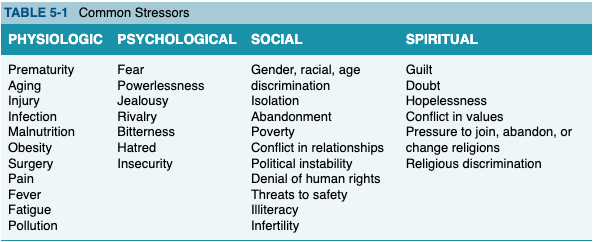
Physiologic: Prematurity, aging, injury, infection, malnutrition, obesity, surgery, pain, fever, fatigue, pollution.
Psychological: Fear, powerlessness, jealousy, rivalry, bitterness, hatred, insecurity.
Social: Discrimination, isolation, abandonment, poverty, relationship conflict.
Spiritual: Guilt, doubt, hopelessness, value conflicts.
Adaptation and Communication Pathways
Adaptation: The response of an organism to change to maintain homeostasis using self-protective mechanisms.
Neurotransmitters:
Serotonin: Stabilizes mood, induces sleep.
Epinephrine & Norepinephrine: Heighten arousal and increase energy.
GABA: Inhibitory; suppresses excitatory neurotransmitters.
Neuropeptides:
Substance P: Transmits pain sensation.
Endorphins: Interrupt Substance P to promote well-being.
The Nervous Systems
Central Nervous System (CNS):
Cortex: Enables abstract thinking and decision-making.
Subcortex: Responsible for survival activities: breathing, heart contraction, BP, and appetite.
RAS: The link between mind and body.
Autonomic Nervous System (ANS):
Sympathetic (SNS): "Fight-or-Flight."
Parasympathetic (PNS): "Rest and Digest."
Physiologic Stress Response: General Adaptation Syndrome (GAS)
Alarm Stage: Sympathetic neurons release norepinephrine \rightarrow Adrenal glands release epinephrine \rightarrow Hypothalamus secretes CRF \rightarrow Pituitary secretes ACTH \rightarrow Adrenal cortex releases Cortisol.
Actions of Cortisol: Increases blood glucose via gluconeogenesis, increases protein breakdown, and suppresses inflammatory/immune responses.
Stage of Resistance: Neuroendocrine hormones endeavor to compensate for the alarm stage and restore homeostasis.
Stage of Exhaustion: Adaptive mechanisms fail. Prolonged high cortisol levels result in lowered immune response (IgA), risking infection and death.
Psychological Adaptation
Coping Mechanisms: Unconscious, automatic psychological processes that protect the individual against anxiety and from awareness of internal or external stressors.
Repression: Unconsciously pushing unpleasant thoughts or memories out of awareness (e.g., forgetting a traumatic car accident).
Denial: Refusing to acknowledge the existence of a real situation or the feelings associated with it (e.g., a person with a terminal illness making long-term vacation plans).
Displacement: Transferring feelings from one target to another that is considered less threatening (e.g., a student who is angry at a professor kicks their dog).
Projection: Attributing feelings or impulses unacceptable to oneself to another person (e.g., a person who is unfaithful accusing their partner of cheating).
Regression: Retreating to an earlier level of development and the comfort measures associated with that level (e.g., a toilet-trained child starts wetting the bed when a new sibling is born).
Rationalization: Attempting to make excuses or formulate logical reasons to justify unacceptable feelings or behaviors (e.g., "I didn't get the job because I didn't have the right connections").
Coping Strategies: Conscious, deliberate efforts to solve personal and interpersonal problems and seek to master, minimize, or tolerate stress or conflict.
Therapeutic: Positive, health-promoting actions. Includes seeking social support, engaging in regular physical exercise, using relaxation techniques, and problem-solving through the stressor. These result in increased resilience and emotional health.
Nontherapeutic: Maladaptive or harmful responses. Includes substance abuse (drugs/alcohol), social withdrawal, aggressive outbursts, or avoidance. These behaviors fail to resolve the stressor and can lead to physical or mental health decline.
Assessment: utilizes the Social Readjustment Rating Scale (LCU > 300 is high risk) and Hospital Stress Rating Scale.
Levels of Prevention:
Primary: Eliminating potential for illness (e.g., nutrition education).
Secondary: Screening and early diagnosis (e.g., BP screening).
Tertiary: Minimizing consequences and restoring function (e.g., rehab).
Sequential Order of Stress Response
Sympathetic neurons release norepinephrine.
Adrenal glands release norepinephrine and epinephrine.
The body prepares for fight or flight.
Hypothalamus secretes CRF.
Pituitary gland secretes ACTH.
Adrenal cortex releases cortisol.
Blood glucose level rises.
Immune system becomes suppressed.
Next-Generation NCLEX-Style Review Questions
When the nurse assesses a client, which make up a cluster of signs and symptoms suggesting the client is experiencing a stress response? Select all that apply.
a. Rapid heart rate
b. Nervousness
c. Excessive thirst
d. Impaired concentration
e. Elevated BP
Answer: a, b, d, e.
Strategy: Recall that stimulatory hormones (SNS activation) cause tachycardia, hypertension, and cognitive disruption. Excessive thirst is not a primary acute stress response indicator.
Which nursing intervention is initially most appropriate when providing information to a stress-prone client?
a. Advise obtaining monthly BP assessments.
b. Provide information about antihypertensive medications.
c. Explore various stress management techniques.
d. Teach the client the health hazards of hypertension.
Answer: c.
Strategy: Identify the key word "initial." Prevention and management techniques have priority over treating or merely explaining hazards.
When the nurse cares for an older adult, which recent event likely represents the greatest stressor?
a. Death of a spouse
b. Change in living conditions
c. Planned retirement
d. Change in financial state
Answer: a.
Strategy: Use the process of elimination. Situational events like the loss of a life partner represent the highest impact on equilibrium (LCU).
When the nurse interacts with a client, which coping mechanism is being demonstrated when the client refuses treatment because they believe their breast biopsy indicating cancer is incorrect?
a. Somatization
b. Regression
c. Displacement
d. Denial
Answer: d.
Strategy: The client's belief contradicts factual evidence, which defines denial.
Which nursing activity would have the most benefit toward promoting health and wellness?
a. Encouraging teenagers to never smoke cigarettes
b. Offering suggestions for smoking cessation
c. Explaining how to apply nicotine patches to the skin
d. Advising smokers with a chronic cough to consult a physician
Answer: a.
Strategy: "Most benefit" usually refers to primary prevention which prevents the onset of a condition entirely.
A client who has developed an ulcer during a period of intense work stress is likely experiencing which stage of the General Adaptation Syndrome (GAS)?
a. Alarm
b. Resistance
c. Exhaustion
d. Homeostasis
Answer: c.
Strategy: Physical breakdown and organ vulnerability (stress-related disorders) occur during the exhaustion stage when adaptive mechanisms fail.
A nurse is teaching a client about primary prevention. Which of the following is an example?
a. Teaching a patient how to use a walker after a fall
b. Administering a yearly flu vaccine to a healthy adult
c. Performing a mammogram screening
d. Monitoring glucose in a diabetic patient
Answer: b.
Strategy: Primary prevention occurs before illness happens to eliminate stressors or protect the healthy host.
Which hormone released during the stress response cascade is responsible for suppressing the immune system and increasing blood glucose?
a. Epinephrine
b. Norepinephrine
c. ACTH
d. Cortisol
Answer: d.
Strategy: Cortisol, released by the adrenal cortex, stimulates gluconeogenesis and exerts anti-inflammatory/immunosuppressive effects.