Comparative and International Politics
Dimensions of Power
1st Dimension: Power is the ability to compel someone to act against their will.
2nd Dimension: Power includes the ability to prevent actions, such as law enforcement.
3rd Dimension: Power shapes political demands by influencing how people perceive issues, often against their interests.
Example: Tariffs are imposed at ports, affecting economic decisions.
Summary of Theories
Normative Theory:
Based on personal values and experiences.
Addresses questions of how things should be (e.g., gun control, abortion).
Empirical (Positive) Theory:
Based on facts and observable phenomena.
Evaluated through data, statistics, and factual analysis.
Key Concepts
Resource Curse: Wealth from a specific resource can hinder development.
Democratic Peace Theory: Democracies are less likely to engage in wars with each other.
Rational Choice Theory: Individuals act in their self-interest.
Cultural Theories: Decisions influenced by culture and ideology.
Structural Theory: Decisions constrained by social status.
Institutional Theories: Decisions shaped by established rules and norms.
Key Concepts: States and Nations
States:
Sovereign organizations with compulsory membership.
Claim monopoly on legitimate violence within a territory.
Changes infrequently; borders are significant.
Single source of authority.
Nations:
Groups sharing identity, culture, and often seeking territory/government.
Common culture includes language and shared identity.
State Characteristics:
Defined territory with borders.
Bureaucracy for governance.
Sovereignty:
External: Recognition by other states.
Internal: Control over territory and decision-making.
Regimes:
Set of institutions governing political activity.
Types:
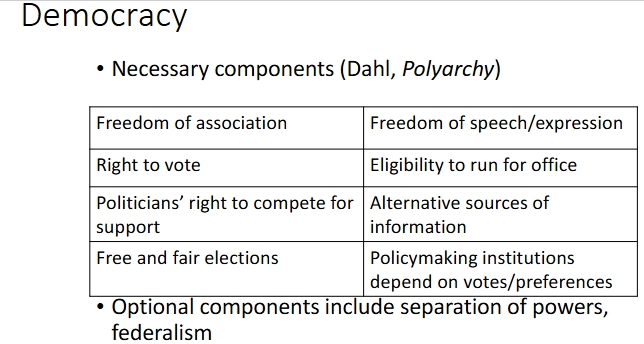
Democracy: Periodic elections.
Authoritarianism: Power held by a single entity (e.g., king, military).
Governments:
Individuals occupying state apparatus; can change frequently.
Origins of the State System
Feudalism: Lords collect tribute; decentralized power.
Absolutism: Lords consolidate control over defined territories; expansionist.
Bureaucracy: Resource extraction necessitates reliable staff; leads to tax agencies and conscription.
Westphalian State System: Established post-Thirty Years' War (1618-1648); recognized state sovereignty and borders.
Modern State System: Emerged during colonialism; focused on resource extraction, limited bureaucracy.
Post colonial State System: Independence movements (1700-1800); emergence of new states, ethnic diversity, and arbitrary borders.
Key Points on the German Empire (1871)
Unification: Prussia unified various German states into the German Empire.
Government Structure: Established as a constitutional monarchy with a Kaiser and an elected legislature.
Federal System: Kingdoms transformed into states within the federation.
Bureaucracy: Existing bureaucratic structures managed taxation and conscription.
Military Control: Prussian leaders maintained military authority.
Takeaway
The German Empire's bureaucratic capabilities were developed through its state-building efforts.
Key Points on the German Empire (1871)
Unification: Prussia unified various German states into the German Empire.
Government Structure: Constitutional monarchy with a Kaiser and an elected legislature.
Federal System: Kingdoms became states within the federation.
Bureaucracy: Managed taxation and conscription.
Military Control: Prussian leaders retained military authority.
Building Brazil (Starting 1500)
Colonial Administration: Established as a Portuguese colony for commercial purposes (lumber, sugar, coffee, rubber, gold).
Land Grants: Allocated to Portuguese nobles.
Labor Source: Primarily provided by African slaves.
Geography: Coastal cities served as administrative centers; minimal border conflicts.
Portuguese Royal Family in Brazil (1808-1822)
1808: The Portuguese royal family fled to Brazil due to the Napoleonic Wars.
1821: The royal family returned to Portugal, leaving Dom Pedro in charge.
1822: Dom Pedro declared Brazil's independence from Portugal, establishing the Empire of Brazil.
Brazilian Empire Revenue
Taxation: No individual taxes; wealthy landowners held significant power.
State Bureaucracy: Weak, limiting effective tax collection.
Economy: Relied on British bank loans and export duties to sustain itself.
Conceptions of Society
Normative Theory: Focuses on how society should be based on values and ethics. It addresses questions of morality and ideal societal structures.
Empirical Theory: Examines how society actually functions, relying on data, facts, and observable phenomena.
Cultural Theories: Emphasize the influence of culture and ideology on societal behavior and norms.
Structural Theory: Highlights how social structures and hierarchies constrain individual decisions and actions.
Institutional Theories: Focus on the impact of established rules, norms, and procedures on societal behavior and decision-making.
Identities
Personal Identities: Individual beliefs and characteristics that define a person.
Group Identities: Collective identities formed through shared experiences and the concept of an "imagined community."
Political Identities: Group identities that hold political significance, often based on shared interests and grievances.
Key Concepts in Political Identity
Primordialism:
Focuses on inherent, longstanding differences that shape political identities.
Religion
Culture
Etc.
Instrumentalism:
Suggests that political elites manipulate identities for their own gain.
Constructivism:
Emphasizes the collaborative process between individuals and elites in forming political identities.
Brazil and the U.S
Race and Politics
African American and Afro-Brazilian Identity
Demographics
African Americans
12.6% of U.S. population
13.1% of U.S. House of Representatives
Asian Americans
4.8% of U.S. population
4.4% of U.S. House of Representatives
Hispanics
16.3% of U.S. population
10.8% of U.S. House of Representatives
Afro-Brazilians
51% of Brazilian population
8.5% of Brazilian Chamber of Deputies
Political Salience
African American Identity
Politically salient due to historical context, civil rights movements, and ongoing issues of racial inequality.
Afro-Brazilian Identity
Less politically salient; often overshadowed by broader racial categories and lack of political representation.
Historical Context
Legal Status of Slaves
U.S. abolished slave trade early (1808).
Brazil abolished slave trade late (1888).
Racial Classification
U.S.
"One drop rule": any African ancestry classifies as Black.
Jim Crow laws: 1/8th Black = classified as Black.
Brazil
No legal definition of race; more fluid racial categories.
Intermediate classifications exist without strict legal definitions.
Theoretical Perspectives
Telles' Explanation
Grievances alone are insufficient; a strong group identity is necessary for political mobilization.
U.S. physical segregation fosters distinct group and political identity.
Cultural Differences
Language
Differences in language usage and dialects between African Americans and Afro-Brazilians.
Religion
Distinct religious practices and beliefs within African American and Afro-Brazilian communities.
Economic Aspects
Black-Owned Businesses
Presence of black-owned businesses in both communities, but varying levels of support and success.
Black Institutions
Development of black institutions (churches, schools) in the U.S. as a response to segregation and discrimination.
Summary
African American identity is politically salient due to historical struggles and systemic inequalities, while Afro-Brazilian identity lacks similar political recognition despite significant demographic
Instrumentalism and Political Identity Manipulation
Definition of Instrumentalism
Instrumentalism: A theory suggesting that political elites manipulate group identities for their own political gain.
Elites use identities as tools to mobilize support, create divisions, or consolidate power.
Adolf Hitler and the Nazis
Rise to Power: Hitler and the Nazi Party utilized manipulation of racial and ethnic identities to gain political control in Germany.
Racial Identity: The concept of Aryan racial superiority was not a significant aspect of German political identity before the Nazis.
Many Germans, including Hitler, did not fit the Aryan ideal (e.g., Hitler had dark hair, dark skin, and dark eyes).
Manipulation of Identities
Political Tool: Elites, like Hitler, politicized group identities to:
Foster a sense of belonging among supporters.
Create an "us vs. them" mentality, targeting Jews and other minorities as scapegoats.
Justify discriminatory policies and actions.
Implications of Instrumentalism
Identity as a Weapon: Political identities can be weaponized to:
Mobilize masses for political agendas.
Distract from economic or social issues.
Solidify power through fear and division.
Conclusion
Instrumentalism highlights the strategic use of identities by political elites.
The case of Hitler and the Nazis exemplifies how manipulation of racial and ethnic identities can lead to significant political and social consequences.
Constructivism in Politicizing Group Identities
Elites shape identities: Influential figures can mold political identities.
Limits of elite influence: Elites cannot fully control or dictate identities.
Interpersonal interactions: Political identities are formed through social interactions.
Islamist political identity: A transnational identity transcending ethnic and national boundaries.
Global movement: Individuals unite across diverse backgrounds under a shared ideological framework.
Identity fluidity: Political identities can evolve based on context and experiences.
Collective narratives: Shared stories and histories reinforce group identities.
Primordialist Interpretation: islam and Christianity have a historical conflict. Instrumentalist Interpretation: Leaders like Osama bin Laden promote Islamic identity for power and recruitment. Constructivist Interpretation: Conflict involves more than manipulation; it includes the lived experiences of Muslims. Impact of US occupation on Muslims in Iraq and Afghanistan is significant.
Ethnic Groups and Nationhood
Definition of a Nation
Nation: An ethnic group seeking to control a state.
Formula: Ethnicity + Seeking Government/Territory = Nation.
Cultural Characteristics
Shared cultural traits include:
Languages
Religion
Customs (music, food, holidays, etc.)
Identity Types
National Identity:
A political group identity.
Ethnic Identity:
A group identity with varying political significance.
Example: Irish American Identity
Cultural Aspects: Celebrations like Saint Patrick's Day, wearing green.
Historical Context:
Once faced heavy discrimination.
Strong political identity in the past, linked to machine politics in the U.S.
Aimed to represent interests of marginalized ethnic groups.
Importance of Politicization
Ethnic identities can become politically salient based on historical grievances and social contexts.
Example: Asian American Identity
A broad category encompassing diverse groups (Japanese, Chinese, Korean, Vietnamese, Filipino, etc.).
Each group has distinct languages, customs, and histories.
Historical conflicts and varying immigrant experiences contribute to complexity.
Conclusion
Ethnic identities can evolve from cultural to political significance, influenced by historical contexts and social dynamics. Understanding these identities is crucial for grasping the complexities of nationhood and political representation.
Notes on National Identity and Racial Categories
Key Concepts
National Identity vs. Racial Categories: Racial categories do not inherently equate to political identity.
African American Identity:
Can be claimed by anyone with partial descent from sub-Saharan Africans.
Primarily associated with descendants of enslaved individuals, but includes others (e.g., Barack Obama).
Unites diverse ethnic groups with different languages, religions, and historical conflicts.
Characteristics of African American Identity
Physical Traits: Shared characteristics like skin color.
Political Salience: Skin color alone does not create a politicized identity in sub-Saharan Africa.
Grievances: Political identity in the U.S. is shaped by historical grievances, such as discrimination.
Comparative Examples
Brazil:
Emphasizes cultural nationalism.
Political identity is influenced by state formation before nation-building.
France vs. Germany:
France: Civic nationalism; a nation exists before the establishment of a state.
Germany: Cultural nationalism; a state is built around an existing national identity.
Historical Context
France:
Modern borders established in medieval Europe.
The Hundred Years' War (1337-1453) between rival monarchies shaped national identity.
Conclusion
Racial identity can become politicized through shared experiences and grievances, but it is not a universal basis for political identity. The formation of national identity can vary significantly based on historical and cultural contexts.
Capitalism and Trade
Capitalism is an economic system characterized by private ownership of the means of production and their operation for profit. Key features include:
Market Economy: Prices and production are determined by supply and demand.
Private Property: Individuals and businesses can own and control assets.
Competition: Multiple businesses compete for consumers, driving innovation and efficiency.
Capital Accumulation: Individuals can invest and reinvest profits to grow wealth. Bought and sold- items and services
Capitalism contrasts with systems like socialism, where the state often controls production and distribution.
three schools of political economy
Mercantilism
Definition: An economic theory focused on strengthening and enriching the mother country.
Key Principles:
Wealth > Power: Economic wealth is essential for national power.
Trade > Wealth: Emphasis on positive balance of trade.
Manufacturing > Agriculture: Prioritization of manufacturing over agricultural production.
State Role: The government plays a crucial role in regulating the economy.
liberalism
purpose of economic activity: enrich individuals> enhance the sets power
trade surpluses do not help the state’s power countries would benefit with a trade deficit
manufacturing goods are not better than primary commodities
the state should make little effort to influence balance of trade
Absolute Advantage - Adam Smith
Definition: A country has an absolute advantage in producing a product when it can produce it more efficiently than any other country.
Specialization: Countries should specialize in goods where they have an absolute advantage.
Trade: They can then trade these goods for products produced by other countries, enhancing overall economic efficiency.
(In final exam)
Comparative is about having lower opportunity cost
David Ricardo's theory of comparative advantage posits that countries should specialize in producing goods they can produce most efficiently and trade for those they produce less efficiently. This specialization enhances overall economic efficiency and benefits all trading partners.
Opportunity Cost
The loss of potential gain from the best alternative
is the value of the next best alternative that is forgone when a decision is made to pursue a certain action. It represents the benefits you could have received by taking an alternative route instead of the one chosen.
Adam Smith and Absolute Advantage
A country has an absolute advantage when it can produce a good more efficiently than others.
Countries should specialize in goods where they have this advantage and trade for others.
Marxism
Focuses on the conflict between capitalists and the proletariat.
Capital tends to concentrate in the hands of a few, leading to:
Lower returns on capital.
Increased exploitation and inequality.
The state acts as an agent for the capitalist class.
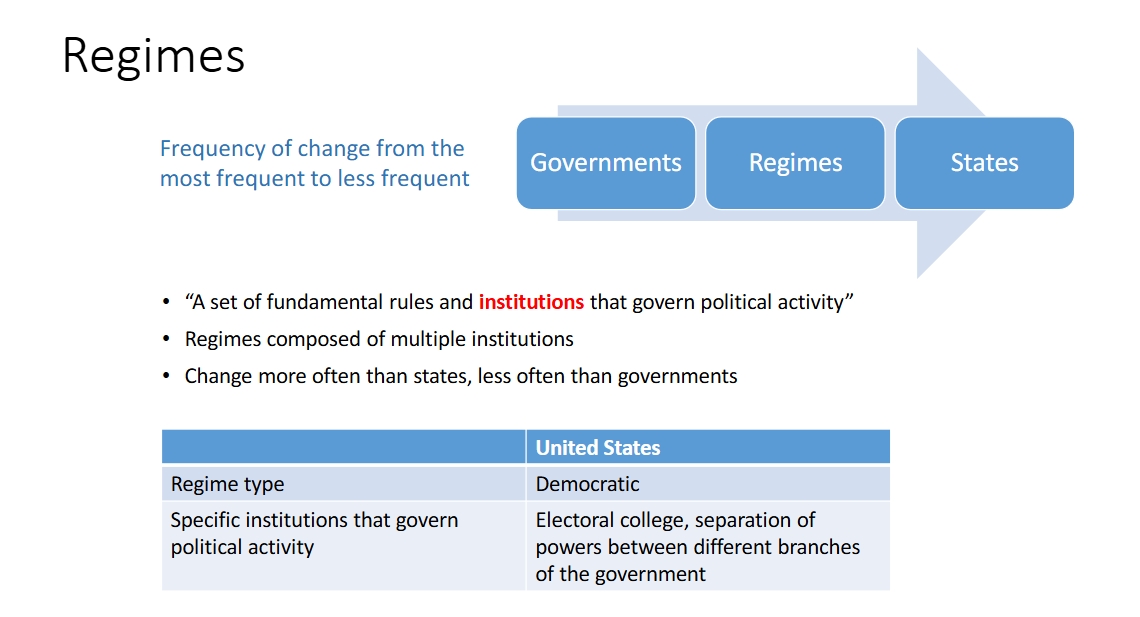
Regimes
A set of fundamental institutions that govern political activity.
Composed of multiple institutions.
Change more often than states but less often than governments.
Institutions
Institutions are the formal and informal rules and norms that organize social, political, and economic relations (North, 1990).
Types of Institutions
Formal Institutions: Established laws, regulations, and organizations that govern behavior. Examples include constitutions, legal systems, and government bodies.
Informal Institutions: Unwritten rules, conventions, and cultural norms that influence behavior. Examples include traditions, social norms, and community practices.
Regimes: Additional Features
Relationship between a State and Citizens: The nature of the interaction and expectations between a governing body and its citizens is shaped by the regime.
monarch extract taxes and granting citizens protection
Ideological Basis: Regimes are often built upon specific ideologies that define the foundation of the state’s legitimacy, influencing how power is exercised and justified.
Rights Emphasis: Different regimes may prioritize various types of rights (civil, political, economic) to varying degrees, reflecting their ideological stances and governance goals.
Rights: Origins and Typology
Citizens (but not subjects) have rights
Types of Rights (from T. H. Marshall):
Civil Rights: Freedom from state overstepping its bounds.
Political Rights: Right to participate in self-governance.
Social Rights: Right to social welfare.
Different types of regimes
Liberal Democracy:
Combines liberalism and democracy.
Liberalism:
in the us liberal means left wing policy
in political science it means
Emphasis on the freedom of individuals.
Critical of state efforts to restrict freedom.
Social contract theory: legitimate governments are formed by free individuals jointly consenting to be governed by representatives.
Uk is a unitary system
Liberal Democracy: Legitimacy and Rights
Legitimacy: Derives from the consent of the governed.
Rights: Emphasis on civil and political rights over social rights.
Communism
first major regime type to …
Communism: Karl Marx
Historical Materialism: Marx's theory that economics drive historical development.
Capitalism's Contradiction: Highlights the inequality between the bourgeoisie (owners of production) and the proletariat (working class).
Revolution: This inequality ultimately leads to class struggle and revolution, leading to the establishment of a dictatorship of the proletariat.
Abolition of Private Property: Marx advocates for the abolishment of private property as a means to achieve a classless society.
State Ownership: Under communism, the state owns the means of production and administers them to benefit the workers, ensuring equitable distribution of resources.
Communism: Vladimir Lenin
Historical Materialism: Lenin believed that the proletariat could catalyze revolution without waiting for capitalism to fully develop, challenging Marx's timeline.
Role of the Party: Emphasizes that in less developed countries, a vanguard party, rather than the workers themselves, should lead the revolution.
Rule by Party Elite: This approach often results in a ruling class of party elites who govern in the name of the
Communism: Legitimacy and Rights
Legitimacy: The state governs in the interest of the working class, aiming to represent their needs and eliminate class disparities.
Rights: Emphasizes social rights over civil and political rights, focusing on ensuring equitable welfare and social justice for the disadvantaged.
Fascism
major examples- Germany in 1980s
Anticommunist ideology and regime type.
Emphasis on national unity over individual rights or social classes.
Advocates for a top-down organization of society, where the state assumes a central role in controlling various aspects of life.
Supports corporatism rather than pluralism, promoting the collaboration of government and private
Fascism: Legitimacy and Rights
Legitimacy: The state is seen as acting on behalf of the national interest.
Rights: Rights are restricted, with a greater emphasis placed on the duties of individuals to the state.
Modernizing Authoritarianism
National Interest: The primary focus is on economic development, which is considered more important than class interests or individual rights.
Assumptions:
Development requires technocratic leadership: Leaders are expected to be experts in their fields who can implement effective policies.
An authoritarian regime can successfully produce development by maintaining control and directing resources effectively.
National unity is essential for successful development, promoting stability and cohesion.
Subtypes:
One-party: A single political party dominates, controlling the state and limiting political competition.
Military: Military leaders hold power and often govern through coercion and de facto authority.
Personalist: Power is concentrated in an individual leader who often acts independently of institutional constraints.
Modernizing Authoritarianism: Legitimacy and Rights
Legitimacy: The state is considered legitimate because it promises to deliver economic development to its citizens.
Rights: While individual rights are restricted, the level of restriction is less severe than in fascist regimes.
Semi-Authoritarianism
Hybrid Regime: Contains elements of both democracy and authoritarianism.
Elections: Conducted, but often lack fairness.
Opposition Parties: Exist nominally, but face significant restrictions.
Civil and Political Liberties: Some freedoms are permitted, but heavily controlled or limited.
System Rigging: The political system is designed to ensure that the ruling party always wins, undermining true democratic processes.
Semi-Authoritarianism
Legitimacy:
Legitimacy is derived from a combination of formal democratic institutions and the focus on national interest and development.
Rights:
Citizens experience more civil and political rights compared to authoritarian regimes but fewer rights than in full democracies.
Theocracy
ruled by religious authorities, by will of God
May have democratic elements such as elections, but religious leaders in charge
Examples: Masoud Pezeshkian President of Iran- Ali Khamenei supreme leader of irán.
Theocracy: Legitimacy and Rights
Legitimacy: state embodies will of God
Rights: most are restricted
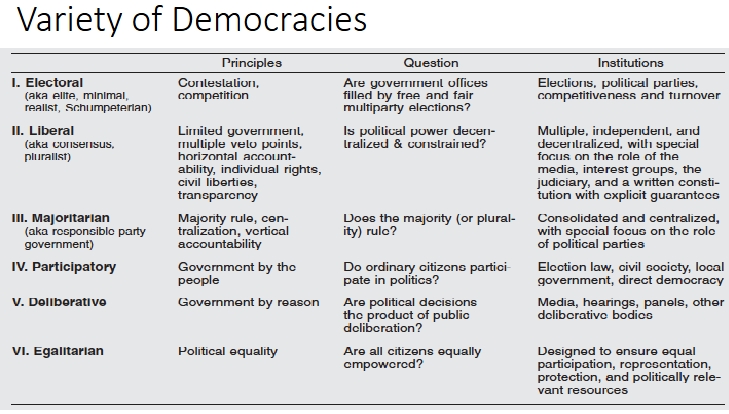
Varieties and Alternatives of Democracy
Alternatives to democracy
communism
Fascism
Modernizing Authoritarianism
Semi- Authoritarianism
Theocracy
why Democracy?
Can other regime types also work?
Key arguments made by Bell
The tyranny of the
majorityThe tyranny of the
minorityThe tyranny of the
voting communityThe tyranny of
competitive individuals
human rights
a set of rights afforded to individuals on the basis of being human, i.e. irrespective of national citizenship,gneder,ethnicity, or other traits