DNA - Deoxyribonucleic acid
Deoxyribonucleic Acid
Nucleic Acid - made up of nucleotides
Three parts of a nucleotide: 1) 5 carbon sugar (deoxyribose), 2) phosphate, 3) nitrogenous base
Nitrogenous bases can be classified into two categories: purines (adenine and guanine) and pyrimidines (cytosine, thymine).
Each nitrogenous base pairs with a specific partner in the DNA double helix: adenine pairs with thymine, while guanine pairs with cytosine. (Apples in Tree) (Car in Garage)
Purine = 2 rings (Adenine and Guanine)
Pyrimidine = 1 ring (Cytosine and Thymine)
Adenine and Thymine = 2 Hydrogen bonds
Guanine and Cytosine = 3 Hydrogen bonds
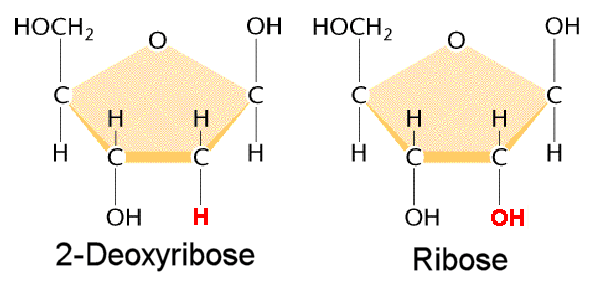
Deoxyribose vs Ribose sugar
Deoxyribose, found in DNA, lacks one oxygen atom compared to ribose, which is present in RNA, making it (DNA) more stable and less reactive (than RNA). This stability is crucial for the long-term storage of genetic information, as it reduces the likelihood of spontaneous mutations.
3- end and 5 end- carbons of the sugar backbone refer to the carbon atoms in the deoxyribose sugar, which are numbered from 1' to 5'. The 3'-end has a hydroxyl group (-OH) attached to the 3rd carbon, while the 5'-end has a phosphate group attached to the 5th carbon, creating the directionality essential for DNA replication and transcription.


DNA Replication
The semiconservative nature of DNA involves separating the two parent strands of the double helix: the template strand and the coding strand, and the building of a complementary strand.
The Process:
Step 1 - Strand Separation: Replication origins (specific sequences of DNA) act as starting points (many replication origins in a eukaryotes DNA strand). The enzyme helicase binds to these origins to unwind the two parent strands by breaking the hydrogen bonds between the complementary pairs. As the two parent strands separate they form a y-shape known as the replication fork.
Topoisomerases relieves tension in the DNA strands by cutting one or two strands near the replication fork allowing them to untangle and then rejoins the strands
Single-strand binding protein (SSB) prevents annealing (H bonds from reattaching) by attaching to the DNA strand
Step 2 - Building Complementary Strands (in prokaryotes): RNA primase places/makes RNA primers on the template strands so that DNA polymerase III knows where to add nucleotides to build the DNA strand (Primers act as a starting point for DNA polymerase III).
Two new strands begin to assemble by DNA polymerase III in opposite directions:
Leading Strand - DNA is copied in direction towards replication fork (continuous)
Lagging Strand - DNA is copied in direction away from replication fork (discontinuous)
The Lagging Strand “lags” because it creates Okazaki fragments (short discontinuous fragments of DNA)- Okazaki fragments happen when RNA primase attaches another primer to the lagging strand allowing DNA polymerase III a new starting point.
DNA polymerase I removes the RNA nucleotides placed by DNA polymerase III and replaces them with DNA nucleotides
DNA ligase catalyzes the reaction that forms the phosphodiester bonds that fill in Okazaki fragments (only in lagging strand)
Step 3 - Dealing with Errors during DNA Replication: Step 2 should result in an original strand and a new strand. Sometimes rare mismatching errors are made.
DNA polymerase II is an enzyme that repairs damage after DNA replication and to DNA in general
Insert Replication fork picture
DNA Replication and Aging: Telomeres
Telomeres protect chromosomes from losing essential coding DNA during replication
Once a chromosome’s telomeres are gone, DNA coding us lost with every replication and the cells begins a period of decline
Cancer cells do NOT lose their telomeres
Longer telomeres = can divide more before entering senescence
Four IMPORTANT functions of telomeres:
They help prevent chromosome ends for fusing to other chromosomes
They prevent DNA degradation from enzymes called nucleases
They assist DNA repair mechanisms
They may play a role in determining number of times a cell can divide
The cell senescence - period in a cells lifespan when it loses the ability to divide and grow (aging)
Hayflick Limit - the limit of cell division or the total number of times that a cell can divide. (Human cells can divide roughly 50x times before telomeres are too short)
Germ Cells (reproduce infinitely)
In germ cells an enzyme called telomerase adds more DNA to shortening telomeres to restore their length to avoid damage
Cancer Cells
Cancer cells have an abundance of telomerase (keeps telomeres from shortening)
Cancer cells never begin senescence (die) and grow indefinitely
Protein Synthesis
One Gene One Polypeptide - each gene is unique and codes for the synthesis of a single polypeptide (chain of amino acids)
The Central Dogma - the principal which states that genetic information flows from DNA to RNA to Proteins
Process:
Step 1 - Transcription: the enzyme RNA polymerase creates an RNA molecule (mRNA strand) with a base sequence complementary to the template strand. RNA molecule (mRNA strand) created in nucleus can now leave for cytosol where ribosomes are found.
Step 2 - Transition: mRNA strand attaches with ribosome, the amino acids coded for that mRNA are delivered to it by tRNA through the ribosome (creates a polypeptide).
Transcription: Explained Further
Involves the formation of the mRNA molecule/strand
DNA template strand read from 3- end to 5- end direction, mRNA molecule is formed in the complementary 5- end to 3- end direction.
Template strand is the strand that is transcribed by mRNA molecule
Occurs in nucleus of a eukaryote and cytoplasm of a prokaryote
Four Steps:
1) Initiation (in prokaryotes and eukaryotes) - begins when RNA polymerase binds to the promoter and unwinds the strands near the beginning of the gene- the promoter: a special sequence on one strand of DNA located somewhere at the start of the gene
2) Elongation - the polymerase starts building the single-stranded RNA molecule (does not need primers) - RNA molecule formed in a 5-end to 3- end direction following its complementary 3- end to 5- end strand (template strand) - the strand opposite to the template strand that is not being used is known as the coding strand.
3) Termination - RNA polymerase recognizes the terminator sequence and detaches from template strand.
4) Post-transcriptional Modifications -
Translation: Explained Further
Occurs in cytoplasm/cytosol
Reads the encoded message on the mRNA strand using a ribosome and tRNA molecules assemble one amino acid at a time forming a polypeptide (aka protein)
tRNA molecule: contains anti-codon (complementary to mRNA sequence) and region of amino acids that correspond to anti-codon
Anti-codon: ensures that the proper amino acid is inserted into the polypeptide
the process of adding an amino acid to a tRNA is called aminoacylation
Ribosome: three binding sites:
E Site - holds and exits the tRNA molecules
P Site - holds the tRNA with growing polypeptide - first tRNA enters the P site
A Site - holds the aminoacylation tRNA - second tRNA enters the A site
Process:
1) Initiation - begins when the large and small subunits of the ribosome associate with the mRNA molecule - the initiator forms a complex that binds to mRNA at the 5’ cap and moves along the mRNA until it reaches the first AUG codon (start codon - the large subunit then binds to complete the ribosome
2) Elongation - begins when an initiator tRNA is bound to the P site - the next codon aligned with the A site is read and binds to tRNA - once the polypeptide bond begins to form methionine is released from its tRNA and the tRNA leaves the P site - now both amino acids are attached to the tRNA molecule in the A site window - the ribosome then shifts down one codon
3) Termination - beings when A site arrives at a stop codon - release factor binds at this site instead of aminoacyl (amino acid) - polypeptide is released and goes to Golgi to become protein - ribosome is detached and disassembled
Mutations
a permanent change in genetic material
can have harmful, positive or negative effects
mostly caused by agents of environment (gamma rays, radiation and chemicals)
Two main categories of mutations - point mutations (substitution) and frame shift mutations (insertion)
Small Scale Mutations (Point Mutations): only one codon effected
1) Missense Mutations - change in a base pair or a group of base pair (codons) results in change of a different amino acid - different sequence may function differently
2) Nonsense Mutations - change in a single base pair or group of base pair results in stop codon - polypeptide cut short may not function
3) Silent Mutations - change in one or more base pairs does not affect the functioning gene
4) Frameshift Mutations (large scale mutations) - one or more nucleotides are inserted into or deleted from a DNA sequence - “shifts” the reading frame one by one and every amino acid coded for this is affected
Restriction Enzymes
Recombinant DNA - a DNA strand that is created using DNA pieces from two or more sources
Restriction Enzyme (restriction endonuclease) - an enzyme that cuts DNA at a specific sequence (molecular scissors)
Restriction Fragment - the piece of DNA fragment the restriction endonuclease cuts out
Process:
1) Isolate/ cut out DNA fragment that contains desired gene
2) Two possible outcomes when a restriction enzyme cuts out DNA fragment:
Blunt Ends - cut straight across
Sticky Ends - cut in a zigzag
ligase joins blunt and sticky ends together
Plasmids and Recombinant Plasmids
Plasmids - small circular pieces of DNA found in bacteria (prokaryotes)
Usually genes found in plasmids produce immunity to an antibiotic (amp - gives the plasmid immunity to ampicillin) (tet - gives the plasmid immunity to tetracycline
Plasmid Mapping - scientists use a restriction map to determine which restriction enzyme they will use to cut the plasmid
Recombinant Plasmid - a bacterial plasmid + a DNA fragment that has been cut out with the same restriction enzyme so that is creates sticky ends (joined together by ligase)
Gel Electrophoresis
used to separate molecules of different size and determine length of DNA fragments
two gels: agarose and polyacrylamide
DNA (negatively charged) moves towards the positively charged side
smaller fragments migrate further because they experience less resistance navigating through the gel while larger fragments have a harder time passing through the smaller pores of the gel.
PCR - The Polymerase Chain Reaction
the process that can greatly increase copies of DNA from one biological example
Process: (runs about 30 to 40 times)
1) Denaturation - a doubled stranded DNA molecule is broken into two strands
2) Annealing - the annealing of single stranded DNA primers to each of the separated strands
3) Elongation - two new DNA strands are made using the original two strands that were separated as templates
DNA Sequencing
Whole-genome shotgun method - many copies of DNA are randomly cut into tiny fragments by passing the DN through a pressurized syringe and the using a computer to reassemble fragments
Nanopore Sequencing - drawing strands of DNA through tiny microscopic holes and reading one bp at a time
Tandem
PCR