Springs in series and parallel
Series
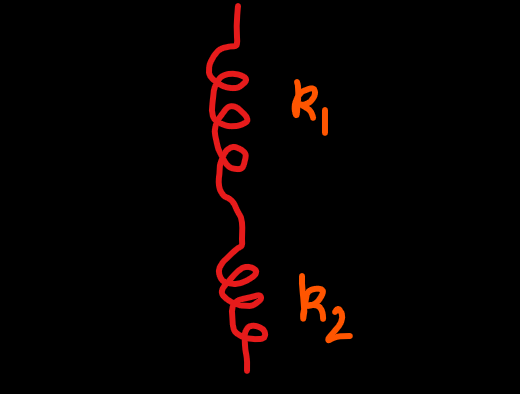
Equation to find the total spring constant: 1/KT = 1/K1 + 1/K2 (It requires less force to produce an extension of 1m)
Spring resulting from the combination of the two springs will act like a single spring, with spring constant equal to 1/KT = 1/K1 + 1/K2
Parallel
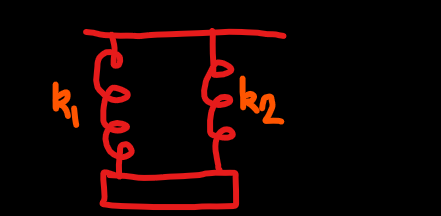
The total spring constant is equal to: KT = K1 + K2 (It requires more force to produce an extension of 1m)
Combination of the two springs can be modelled as a single spring, with spring constant equal to KT = K1 + K2
Other useful information
Take care as to whether the stated extension refers to the extension of each spring or the overall extension of the whole system.
It might be helpful to redraw the diagram, like for resistors in series and parallel, with a single spring.
When a spring is cut in half, the spring constant doubles. Don’t think about it too hard, just memorise it. It’s probably because twice the force is required to produce the same extension, but I’m not too sure if that’s true?
Remember that the the spring constant is just the force required to produce an extension of one metre.