China
Overview
China is the world’s most populous country
Over 1.3 billion people
94% are of the Han ethnic group
Characteristics of traditional Chinese Music [Han people]
Much traditional art music is written for a single instrument
.Composers and performers emphasize melody
.Balance and harmonious proportions are significant
.Ornamentation fundamental – highly developed, used for expression
.Often have variations on a main basic melody using ornamentation – variation through ornamentation
.Timbre is also an important part of composition
Music for bowed fiddle-type (erhu) and flute-type instruments tends to be monophonic
.Music for plucked and hammered chordophone types (guzheng, yangqin) will often have some harmony and be more homophonic
.Music for ensembles (small groups) tends to be heterophonic, with each player sticking to the original melody but ornamenting it in their own way
.Songs often start with a free rhythm, then move to a more rhythmic pulse and a faster-moving section
Chinese Instruments – 8 categories based on materials
Know the one with asterisks*
*Silk – chordophones (silk strings)
*Bamboo – flute aerophone
*Gourd – reed aerophone
*Metal – gongs (idiophones)
Wood – idiophone
Stone – idiophone/aerophone
Clay – aerophone
Skin – membranophone
Silk Class Instruments
Chordophones – strings were initially made out of silk
May be bowed, plucked, or hammered
The Erhu
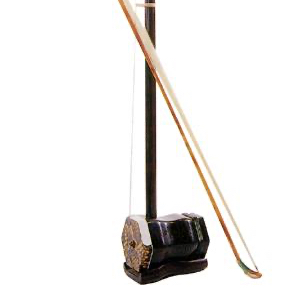
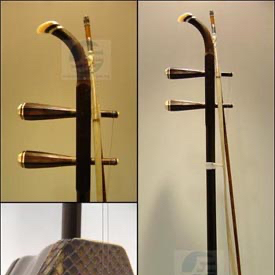
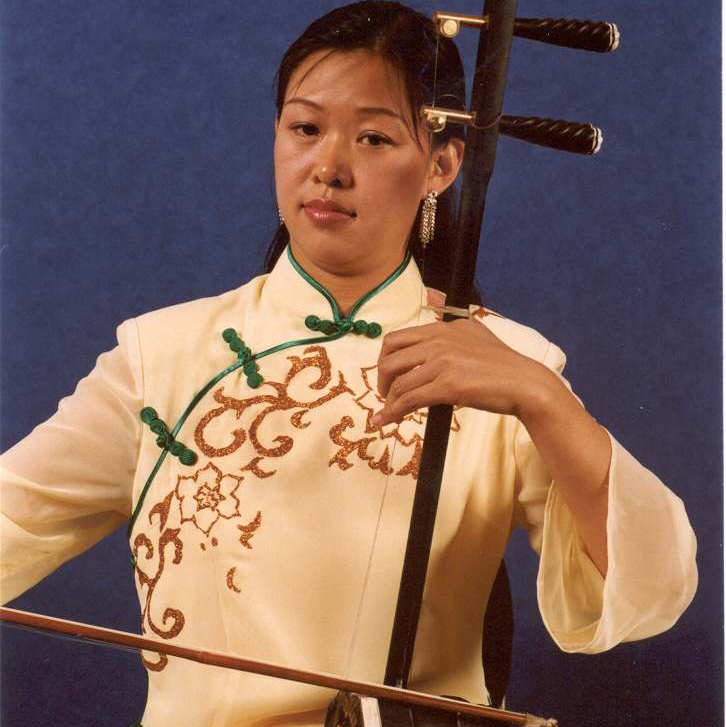
Chordophone/silk class
Lute type, bowed, no frets
.
Er in Chinese = 2
The instrument has two strings [usually a fifth apart]
The bow is threaded between the strings – as the player draws the bow across the string, they will push down on one string and press up on the other
.The body of the instrument is covered in snake skin,
The bow is made from the hair of a horse’s tail
.Strings made of silk (which comes from a secretion from worms for their cocoons)
Primarily used as a solo instrument
.Notice the same song is also being played in the following video, but the ornamentation the player uses is different, so the performances are a bit different from each other
Questions
How old is its history?
It’s over 1000 years old.
What does its sound represent?
It represents China
[What is your personal impression of the sound? Describe the sound in your own words (1-2 sentences)]
Soft, resonant, and evoking a sense of tranquility. But it also has a sense of sadness.
According to the lectures and videos, the sounds of the erhu may imitate/symbolize which of the following sound.
Horse neighing
The human voice
wind rushing through the leaves
birds
Playing techniques for the erhu –
Slides/Sliding (sliding the finger along the fingerboard rapidly through several pitches)
Vibrato (rocking the left hand back and forth to create an oscillation of the pitch – makes a richer sound)
See Video – Introduction to the Erhu – at 3:45 for examples of left-hand techniques of slides and vibrato
.Dynamic variation – increase or decrease of volume created through the pressure of the bow on the strings
Tremolo – rapid repetition on one note/pitch (see at 1:23 in Video – The Erhu – it also shows dynamic variation)
Pizzicato – plucking strings (see:54 in The Racing Horse)
The Yangqin
Hammered zither type
Strings struck with two bamboo beaters
.8-12 courses of strings (usually have pairs of 2 strings tuned to the same pitch)
Delicate sound
Usually has harmonies
Assignment
What is the basic technique of Yangqin?\
Use the moon rubber shape end
Use the bamboo side
You can strum it as if it were a pencil
You can wiggle the bamboo(rolling)
Hold the strings on the side to change the sound.
What is unique about beaters made of bamboo and the technique of the beaters?
The bamboo beaters can be wiggled (rolled) and strum the Yanqin really fast.
Pipa and Guzheng
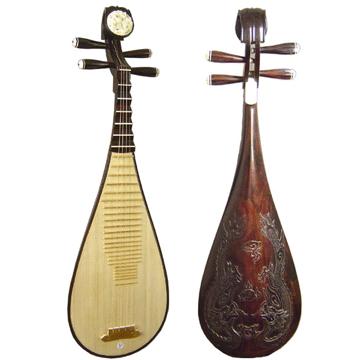
Pear-shaped, lute-type chordophone
4 strings (sometimes 5)
Many frets - 23-25 frets – originally only had 4-5 frets
Plucked – player has finger picks on the right-hand fingers
.Can play melody and harmony
Note - Ancient traditional folk music for pipa tends to have a delicate sound, a sing-song like melody, often starts with a free rhythm or flexible pulse, and then becomes more animated later in the song
.
Questions - Pipa
What two instruments did the pipa develop from, and when do they date from?
China had a pear-shaped, hollow-bodied instrument called the ‘ruan xian’ dating from 200 BC, and the instrument that came from Cental Asian around 300 BC called the curved-neck pipa.
What kind of piece is she playing?
Traditional folk music
More questions
From where does this instrument get its name? Give specific details.
It’s from the ancient way of saying “forward and backward plucking”
What are three types of playing techniques shown in the video?
Stumming, Tremolo, back and forward plucking.
What specific sound effect on the pipa does the video mention?
gentle and beautiful but it also has a more masculine side were the strumming is harder.
Classical Tradition of Northern players –
Tend to like descriptive solo pieces
Traditionally used for storytelling and banquet music
Music often represents historical or mythological scenes
Style – extroverted and dynamic and virtuosic (high technical difficulty)
Martial style from the traditional classical repertory
Represents history – Liu Bang beats Xiang Yu
Also known as The Ambush From Ten Sides (classical tradition): With its highly virtuoso programmatic effects and tremendous power, this piece is regarded as the most representative of the "martial repertoire" of classical pipa solo. It describes the glorious victory of Liu Bang over Xiang Yu in 202 BC, the same theme as "The King doffs his Armour", however, from a totally different view point.
Style very extroverted and dynamic
Virtuosic technique – different strumming techniques – very difficult
The Guzheng –
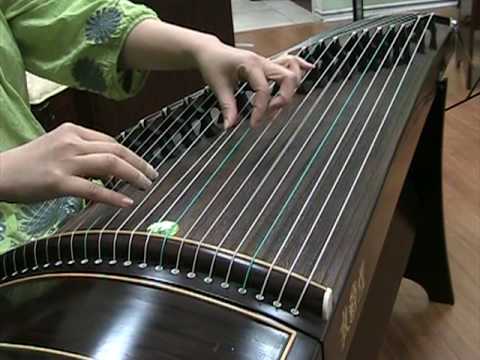
Zither type of silk instrument (chordophone)
A type of table harp
Plucked
Has different string for each pitch with 21-25 strings
Can bend pitches by pressing on the strings behind the bridge
Assinment - The Guzheng
How many years back does its history date?
2500 years ago
What type of music is it historically associated with in ancient times?
It was used in a palace
More assignments
What two techniques does the player do with the strings on the left side of the bridge?
[String bending and vibrato]
Bamboo class – flutes- Dizi and Xiao
Dizi –
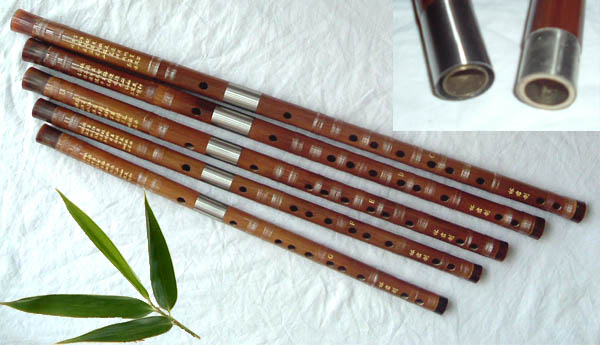
Horizontal bamboo flute with 6 fingerholes
Shorter than xiao
Higher in pitch than xiao
Slightly strident sound (bird-like) – with a little buzz
One hole has a membrane covering to give it a buzz sound
Popular as a solo instrument for folk ballads, and as group instrument in ensembles and operas
Assignment Questions –
How long is its history – how far back does it date?
It dates back 8000 years
What other material besides bamboo can flutes be made from? List 3 other materials.z
bird bones, jade, and stone
What makes it different from Western flutes?
The holes have a membrane covering
What is its membrane covering made from?
It is made from river reeds
What song is she playing?
New Sheperds Song
More Questions -
What modern musical elements are there?
Xiao -
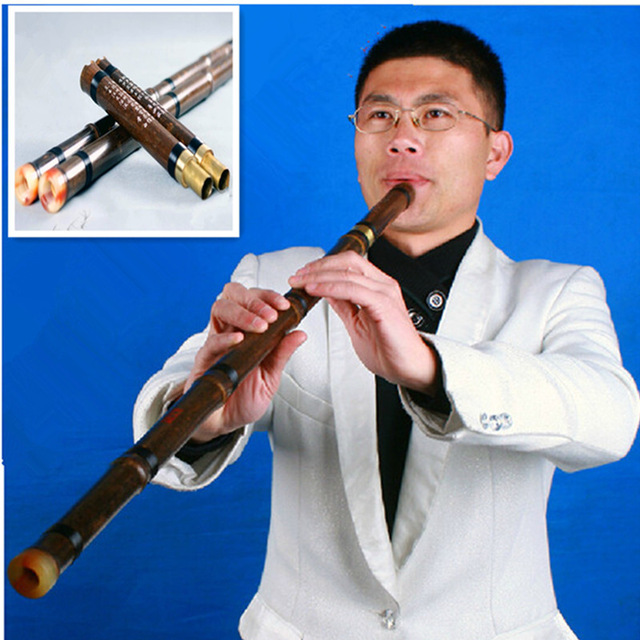
Vertical bamboo flute – player blows through hole on top
5 finger holes in front, one in back
Long (a little less than 3 feet) – longer and lower pitched than dizi
Historically used for civil ceremonies
Soft, sweet, gentle sound
Gourd class –
Sheng –
A type of mouth organ (aerophone)
Originally bamboo pipes were placed in a gourd bowl
Players blows through a mouthpiece in the gourd bowl – controls airflow to different pipes with fingers
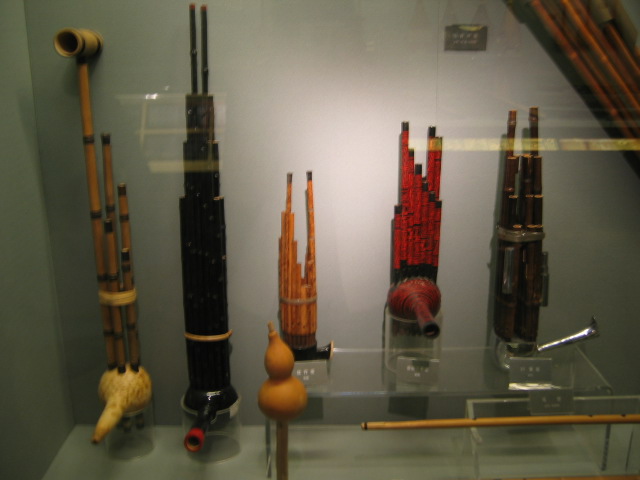
Can have occasional notes of harmony
Nowadays – more complex
Silk and Bamboo Ensemble from Shanghai –
Mainly string (silk) and flute (bamboo) instruments
Might add a sheng (gourd class)
Might have a few small percussion instrument (small drum or woodblock)
Each instrument plays same melody – but in own way, ornament in own style for the instrument – heterophonic texture
Here are the Silk & Bamboo Ensemble (Jiangnan sizhu) instruments with their instrument types added:
Silk (string) instruments
Erhu — bowed lute (bowed chordophone)
Pipa — plucked lute (plucked chordophone)
Ruan — plucked lute (plucked chordophone)
Yangqin — hammered dulcimer (struck chordophone)
Sanxian — plucked lute (plucked chordophone)
Bamboo (wind) instruments
Dizi — transverse bamboo flute (aerophone)
Xiao — vertical bamboo flute (aerophone)
Sheng — mouth organ (free-reed aerophone)
Light percussion
Clappers — idiophone
Small drum — membranophone
Woodblock — idiophone
Beijing/Peking Opera
Western opera – tells a s story with music, drama, and spectacle, and everything is sung
Beijing opera tells a story using singing, dialogue, dancing, mime, and martial arts
Write your impressions on the first time hearing
Was this what you were expecting?
How is this different or similar to what you were expecting?
What are the main instruments you hear?
Differences from Western European Opera
Western European opera has more regular tone; round full sound, vibrato
Majority of orchestra is bowed string/chordophone instruments with some aerophone/woodwind (flutes and reed), brass (trumpet types), and percussion
There is a more continuous flow of pitches in Western European opera
Mixture of different sounds—not homogeneous sound
Flow of drama is different
Musical Characteristics of Beijing Opera –
Vocal style—twang, high pitched, nasal, very shrill, strident, loud [Western European opera has more regular tone; round full sound, vibrato]
Women not allowed onstage until early 1900s
Female impersonators used falsetto voice
Instruments—combination of lots of percussion instruments and some melodic instruments
Conductor – uses wood clapper and drum
Lots of gongs
Melodic – civil and military sections of instruments
Civil – jinghu (like erhu) bowed lute type, plucked lute type [ yueqin – moon shaped lute], flute
Military – oboe type [ suona – double reed]
Chinese opera percussion is very important (strings important in Western European)
How the instruments are used –
Gongs and percussion – especially used for stage pacing, movement of actors, entrances, exits, action.
Notice in our video example how the actors entrances and movements coincide with the gong sound
Chordophones & flutes – accompany singing
Acting and gestures are highly stylized and symbolic according to 1) role type; 2) melodic mode; 3) metrical/rhythmic pattern; 4) linguistic tone
Character types –
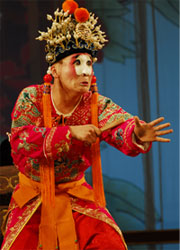
Stock characters—4 main categories and sub-categories according to gender, social status, age, character – Sheng, Dan, Jing, Chou, [also had Mo—minor old-man role—but merged with Sheng]
Each character type defined by costumes, makeup, and timbral quality of speech/singing
All characters sing but have distinct vocal technique and singing style
Sheng—Male role
Xiaosheng—young male role without a beard; usually romantic, may be dandyish scholar (wen xiao sheng), must have good singing voice—delicate falsetto and chest voices
Wu xiao sheng – handsome young warrior
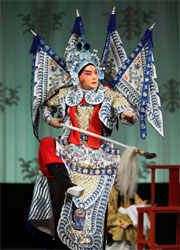
Laosheng—middle aged man with a beard [major middle to old male role]; decency, usually serious, loyal; must have good singing and acting skills
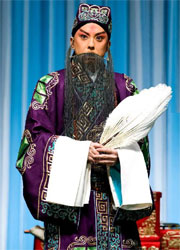
Wu sheng—male warrior, acrobat; high acrobatic ability; skilled with sword and spear; sing with throaty voice
Dan—female role
Qingyi (Gui Men Dan/Zhengdan)—most important role in opera; major female role, strong-minded middle-aged woman [mature woman], behaves elegantly, exemplifies virtuous womanhood; sing exclusively in falsetto in steady delicate manner; must be very good singer and actor.
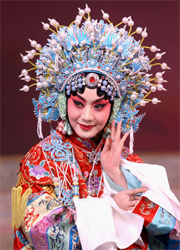
Huadan—little girls (bottom of society); young female role; usually frivolous, flirtatious young lady; sings in falsetto full of nuance and innuendos; must have good singing and acting skills
Lao Dan—the older woman, powerful characters. Slightly less shrill tone than the younger Dan
Wu Dan – female who is good at fighting
Jing—painted-face role
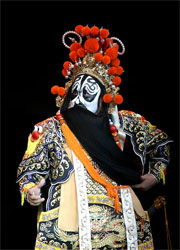
face painted with intricate colored patterns indicating character and psychological makeup
unique appearance or personality
high social position
powerful character
sing with throaty voice and forceful manner; heroic character
Chou—clowns; male comic role; often has a small patch of white chalk around the nose; also could be villainous character, or righteous person. Quick wit, verbal skills, mimic; not sing often but exaggerated & ironic when does
Stagecraft - Symbolic staging is common
a blue flag will indicate sea,
or a seat surrounded by flags with coloured tassels shows travelling by carriage
Color symbolism for old-school Beijing opera
Please note - this color symbolism differs somewhat from modern-day color symbolism.
Red represents bravery
yellow ambition
blue fierceness
gold and silver for gods and demons
black for honesty
white for sinister
green – violent, impulsive, lacks restraint
purple – substitute for red, justice, sophistication
pink – romantic
Beijing Opera – Things to know –
How is this opera different from our Western European Opera?
Emphasis on visual storytelling: Beijing Opera combines music, vocal performance, mime, and acrobatics to convey narratives, whereas Western opera often emphasizes vocal prowess and orchestral accompaniment.
Use of stylized movements: The performers in Beijing Opera employ exaggerated gestures and movements that are not typically seen in Western European opera, highlighting cultural differences in performance art.
What is the vocal style/timbre?
Beijing Opera's vocal style uses a unique, often falsetto and "sun-like" timbre, differing from Western opera's robust sound. It conveys emotion and character.
What are the main instruments used in Beijing Opera?
The primary instruments include the Jinghu (a two-stringed fiddle), the Yueqin (a moon-shaped lute), and various percussion instruments, such as gongs and clappers, all of which contribute to the distinctive sound and atmosphere of the performance.
How are the gongs and percussion used in Beijing Opera?
They are employed to punctuate dramatic moments, enhance emotional expression, and create a rhythmic backdrop that supports the vocalists and storyline.
What are the male roles called in Beijing Opera?
Male roles are referred to as "Sheng" and can be further categorized into various types, such as "Laosheng" (older gentleman), "Xiaosheng" (young man), and "Wusheng" (warrior role), each with distinct characteristics and vocal styles that highlight their respective portrayals.
What are the female roles called in Beijing Opera?
Female roles are known as "Dan," which can also be divided into several subcategories, including "Qingyi" (noblewoman), "Huadan" (young, lively woman), and "Laodan" (older female roles), each of which showcases unique traits and vocal techniques that reflect the complex personas they embody.
What are the Jing and the Chou?
Jing: Known as the painted face roles, these characters are easily recognizable by their elaborate facial makeup, which signifies their personality traits, strengths, and weaknesses. Common types include warriors and heroic figures, often depicted with bold, dynamic movements.
Chou: Also known as the clown roles, these characters provide comic relief and are characterized by distinctive white facial paint. They are known for their wit, agility, and humorous performance style, often engaging in antics that contrast with the opera's serious themes.
Color symbolism – What do the following colors symbolize?
Red
Symbolizes loyalty, bravery, and love; often associated with positive traits and heroic characters in Chinese culture.
Blue
Symbolizes immortality, tranquility, and healing, frequently linked to nature and the sky, reflecting a sense of peace in Chinese tradition.
Pink
Symbolizes romance, femininity, and joy, often representing love and affection, making it a popular choice for celebrations and festivals in Chinese culture.
Black
Symbolizes power, elegance, and mystery, traditionally associated with strength and authority, but also carries connotations of death and mourning, making it a complex color in the Chinese cultural context.
White
Symbolizing purity, innocence, and grief, it is commonly worn at funerals and during periods of mourning and reflects its dual role in both celebration and loss within Chinese traditions.
Yellow
Symbolizing imperial power and prosperity, it has historically been favored by emperors and represents the earth in Chinese culture, embodying the balance of nature.
Green
Symbolizing harmony, growth, and fertility, green is often associated with health and tranquility in Chinese culture, representing the color of spring and renewal.
Purple
Symbolizing nobility and elegance, purple is often associated with wealth and power, historically worn by emperors and officials in China and imbued with deep spiritual significance.