Adverbs and Adjectives
Adjectives
Adjectives are words used to describe nouns:
Examples:
The roof was blue.
Comparative vs. Superlative
Comparative adjective forms show the comparison of 2 nouns. It is usually constructed by adding “-er” to the end of the adjective (some adjectives require the addition or change of letters before adding “-er”):
Her dog was bigg**__er__** than mine.
Tyler ran fast, but Scott ran fast**__er__**.
Superlative adjective forms discuss the extremes of any group of 3 or more nouns. It is usually constructed by adding “-est” to the end of the adjective:
Maria was the fast**__est__** runner on the track team.
Tom’s grade on the English midterm was the high**__est__** in his class.
Adverbs
Adverbs, on the other hand, are words used to describe adjectives, verbs, and other adverbs. Many adverbs end in “ -ly.”
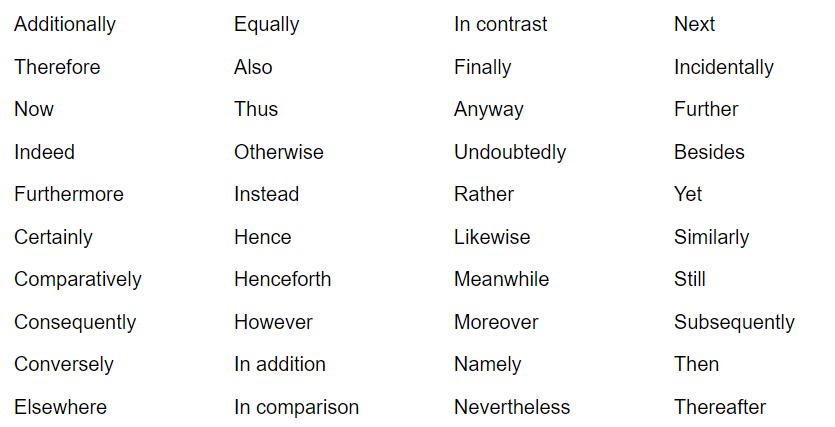
Conjunctive Adverbs are used to transition between or introduce new clauses and sentences. Note that these adverbs do not always end in “-ly.”
Some Conjunctive Adverbs
Example Questions:
1. “You did that work very beautiful,” (1) said my mother about how I had arranged the bouquets for the dinner party.
- NO CHANGE
- well beautiful
- very beautifully
- very, beautiful
Solution: The correct answer is C. since a verb (“did”) must be modified by an adverb (“beautifully”).
2. The campers glimpsed the arresting beautiful (2) sunset from the top of the hill.
- NO CHANGE
- arrestingly beautiful
- arresting beautifully
- arrestingly beautifully
Solution: The correct answer is B. The adjective “beautiful” is being modified; therefore you must use an adverb. Add “-ly” to create the adverb “arrestingly.”
3. The judges will choose the best singer (3) from among the fifty contestants.
- NO CHANGE
- a better singer
- the better singer
- the bestest singer
Solution: The correct answer is A. The sentence is correct as it is written. Use the superlative “best” to describe one member of a group with three or more members.
Theme: Conventions of Standard English