Lesson 20: Central Chemoreceptors and Their Functions
Lesson 20: Central Chemoreceptors
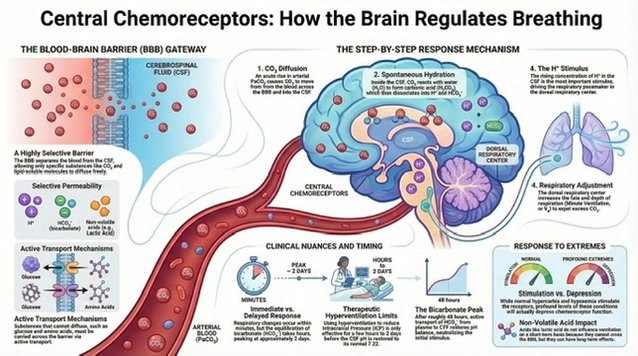
Respond indirectly to PaCO2.
Located in medulla; stimulate dorsal respiratory center.
Blood-brain barrier (BBB): selective barrier separating blood from CSF.
CO2 diffuses freely; H+ and HCO3- do not.
CO2 in CSF dissociates into H+ and HCO3-.
Rising H+ in CSF increases rate and depth of respiration until steady state is achieved (minutes).
Impact of Non-Volatile Acids
Non-volatile acids (e.g., lactic acid) do not pass through BBB, influencing ventilation (Ve) only long-term.
Hyperventilation and Its Effects
Therapeutic hyperventilation can reduce intracranial pressure (ICP), effective for hours to ~2 days.
After that, pH normalizes at pH 7.32 due to bicarbonate transport.
Central chemoreceptor responds to hypercarbia and hypoxemia but is depressed by excessive levels of both.