Definitions
Mechanics
Terminal velocity is the maximum, constant velocity achieved by an object, and it occurs when the object has a zero resultant force , that is, no further acceleration
Moment is the product of force and perpendicular distance
Centre of gravity is the point at which the entire weight of an object appears to act.
Inelastic: total KE is not conserved
Elastic: total KE is conserved
Electricity
Drift velocity is the slow, gradual shift to the positive terminal.
A semiconductor is a material that has small delocalised electrons
Superconductivity is the critical temperature at which a material has zero resistance.
Resistivity is the resistance of a material of length 1m with a current of 1A flowing through it. The material has a cross sectional area of 1m2
Kirchhoff's 1st Law: This is the law of conservation of charge. The current entering the component will be the same as the current leaving the component.
Kirchoff's 2nd Law: The emf of the circuit is equal to the sum of the p.d's in a series circuit.
Electric Fields
Permittivity is the ability of a region of space to hold an electric field
Electric field is a region of space where a charged will feel a force.
Electric field strength is the force per unit charge experienced by a positive charge placed at that point.
Electric potential is the work done to bring a unit positive charge from infinity to any point in an electric field.
The electric potential energy of a capacitor is equal to the work done in moving the extra charge onto the plates against the pd across the plates.
EXPLANATION QUESTIONS: ALWAYS TALK ABOUT DECREASING OR INCREASING EXPONENTIALLY
Time constant is the time taken for the current / charge / potential difference of a discharging capacitor to fall to 37% of its original maximum value
Thermionic emission is the release of electrons from the surface of a heated metal (1 mark). The thermal energy gives electrons enough energy to overcome the work function of the metal (1 mark), allowing them to escape into the vacuum or surrounding space (1 mark).
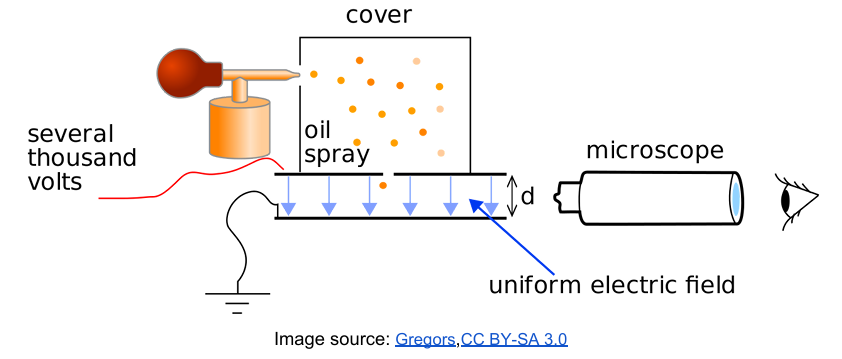
Millikan’s oil drop experiment
Performed to calculate the charge of an electron.
Magnetic Fields
Magnetic field is a region of space where a magnetically susceptible material experiences a force.
Magnetic flux is the number of lines in a region of space within a magnetic field.
Faraday’s law: A change of flux linkage of 1Wb per second will induce an emf of 1V in a loop of wire.
Lenz’s law: The emf that is induced will be in such a direction as to oppose the charge producing it.